FAITH IN INDONESIA

FAITH IN INDONESIA
The shape of the world a generation from now will be influenced far more by how we communicate the values of our society to others than by military or diplomatic superiority. William Fulbright, 1964

Tuesday, April 19, 2016

SHARING DISASTER MITIGATION STORIES

A supermall of disasters      


There’s a simple way to slash the death and injury toll from the natural disasters that brutalise Indonesia’s most vulnerable:  Stop people farming in danger zones, like banks of rivers prone to flood, and the slopes of grumbling volcanoes.

However policing such bans would be almost impossible in modern democratic Indonesia, according to Medi Herlianto (right), director of preparedness in Badan Nasional Penanggulangan Bencana BNPB – the national office for disaster management.

“Floodplains and the lower levels of volcanoes are fertile areas where people grow crops and raise stock essential to their livelihood,” he said. “They’ve been there for generations.  It’s their right.

“What we can do is encourage citizens to be aware of the risks, understand what’s going on and have the ability to escape. We don’t want everyone to rely on central government.”

Herlianto was speaking in Wellington on the sidelines of a New Zealand government aid program study tour run by the research institute GNS Science.  It’s been designed to help Indonesians prepare for the next big horror show that a fickle universe can throw up.

The BNPB was formed in 2008, four years after the devastating Indian Ocean tsunami.  The policy is to develop district agencies known as BPBD (Badan Penanggulangan Bencana Daerah (district) so communities can handle smaller emergencies themselves

That includes ensuring villagers take responsibility for early warning systems.  This year 22 tsunami sensor buoys installed off the West Sumatra coast failed because they’d been plundered for parts or stolen for scrap.

A new system is being developed. “We will change the technology,” Herlianto said. “We’re still working to help people realise the importance of these devices.”

In the past natural disasters came ‘out of the blue’ as the idiom suggests, or as insurance companies still say, ‘an Act of God’.

In the scientific and rational age it is clear many catastrophes are predictable, like heavy mountain rains ripping out treeless hillsides causing landslips and flooded fields below. 

Some precautions are common sense; tertiary training isn’t necessary to know that forest trash set alight during a drought is certain to cause down-wind smoke. In other situations technology can help with automated weather-change stations.

Not every disaster sends alerts.  The 2004 tsunami that killed around 250,000 (the majority Indonesians in Aceh), was triggered by an undersea megathrust earthquake which hit without warning.

One thing could have saved lives – an understanding of natural events.  Before the waters hit coastal communities the ocean inhaled leaving exposed beaches.

Unaware this extreme low tide was the prelude to the tsunami, thousands ran onto the suddenly bare sands to collect stranded fish and marvel at the rare phenomenon.  They were the frontline victims when the tide reversed like a cavalry charge.

Disaster mitigation and management is a growing business dominated by engineers like Herlianto who studied in France.  But the industry needs multi-task experts willing to cooperate with other professionals.

When Teuku Faisal Fathani (left) enrolled at the prestigious Universitas Gadjah Mada he was asked to number the Yogyakarta campus faculties. “Eighteen,” replied the sharp young undergraduate who’d done his homework.

“Wrong,” said the lecturer.  “There are only two:  Engineering and non engineering.”

Faisal, as he’s best known, tells the story to illustrate the arrogance of closed-mind academics contemptuous of the trendy ‘soft’ courses luring students from the traditional ‘hard’ sciences.

Times change. In one of life’s many curious twists and turns, the student from Aceh is now an associate professor of geotechnical engineering at UGM.  This suggests his habitat is a factory load-testing concrete girders.

Instead he’s directing a disaster preparedness project that embraces many of the courses despised by his superior decades ago – like sociology, psychology, political science and anthropology.

“It’s fascinating and I’ve learned so much,” he said. “Engineering is measurable.  It has a beginning and end.  It deals with known materials with limits.  That can lead to thinking in terms of black and white.  That’s not how things work with tsunamis, earthquakes and other calamities.”

In the NZ capital Faisal, along with 28 public servants and academics from four Indonesian provinces, visited seaside suburbs most likely to drown should a tsunami hit.

Knowing that in the chaos and confusion of a major natural disaster people often panic, blue signs and lines have been painted on roads leading to safe zones.  It’s an example of a low cost initiative that’s been copied by Indonesia and other countries.

After the 2010 eruption of Central Java’s Mount Merapi, Faisal co-authored a self-evacuation program including maps of danger spots. Leaders were chosen and groups assigned to take care of the old and vulnerable while fleeing in orderly fashion.

“The village of Glagaharjo was wiped out, but all residents survived because they’d rehearsed an exit plan,” he said. “They knew what to do and where to go.”

Wellington mayor Celia Wade-Brown told the Indonesians that her city had been built on a major earthquake fault so it was important for citizens to be regularly reminded of the dangers that could suddenly strike. 

Pavement plaques remind that the central business district is now several hundred meters from the ocean.  Before a 19th century earthquake which tilted the harbor, shops and offices were on the waterfront.

“Disaster awareness must be part of the school curriculum – continuously educating generations of the dangers even when nothing has happened for years,” said Yunelimeta Asman Djannas (right) , who also studied in France.

She’s the second in charge of a 78-strong BPBD, opened in 2010 in Agam. The West Sumatra regency was an early acceptor of the need to establish local agencies.  It’s also the site of floods and landslips.

“Unfortunately not everyone is easily convinced that disasters will strike, or that if they do anything can be done,” she said. “There’s a lot of conservative thinking and resistance to new ideas. We need time to change mindsets.  It’s a slow process.

“In my religion (Islam) it’s taught that we have a duty to take care of ourselves, our families and neighbors.   That’s a priority.”

In his stay alert-be aware campaign Faisal and his colleagues have designed posters and teaching materials, including some that only use pictures.  “In isolated mountain settlements we’ve found people over 50 who can’t read Indonesian,” he said.

“Getting over fatalism is our biggest hurdle.  That’s why we need experts from other disciplines who understand the best ways to convince people that they can save their lives in an emergency.”

In another curious twist Faisal was in Japan studying for a doctorate when the tsunami struck Aceh.  Member of his family, including his parents, were seriously hurt though none perished.

Back in Indonesia he saw the psychological damage to victims of the catastrophe. “Survivors can often suffer long-term emotional problems,” he said. “They are alive, but no longer the same people.”

 Faisal has now built a tsunami-resistant home for his relatives who remain in the North Sumatra province.


By the numbers

Indonesia has 127 active volcanoes.
Thirty per cent of the population lives within 30 kilometers of a volcano.
Of all volcanic eruptions worldwide last century, Indonesia ranked among the top ten in deaths, injuries and home destruction.
The 2010 Mount Merapi eruption killed 302 and impacted more than 100,000.
In 2015 there were 1,685 disasters.
Most were caused by floods, fires, droughts and landslips.
Disasters cause knock-on economic damage to the nation through closed transport hubs, school shut-downs and business disruptions – seven times the cost of the original event.
BNPB says the capacity to respond effectively to disasters is still limited. It wants to reduce risks by 30 per cent within three years

 (First published in The Jakarta Post 10 April 2016) 


Monday, April 18, 2016

RIDWAN 'EMIL' KAMIL: BANDUNG BOY MAKES GOOD

 Pedalling mayor peddles change    


Indonesia has long been ranked CCC by international investors and visitors for Corruption, Crowds and Chaos – particularly in civic administration.

Till recently Bandung rightly deserved the triple C rating plus a minus mark.  Once known as Parijs von Java’s because it represented the archipelagic version of the French capital, the place had lost its charm.

Tourists and escapees from sweaty and sultry Jakarta still made the 180 kilometer pilgrimage to the mountainside retreat, but progressively found their journey less than refreshing.

Textiles might be cheaper, the Sundanese cuisine more diverse, the art déco heritage quaint and the climate cooler at 770 meters elevation, but the downsides were becoming more off-putting.

Flooding from the Cikapundung River and its tributaries, and waste disposal from factories and residents were serious spoilers.  Traffic got throttled in choke points and road discipline was an alien notion.

That wasn’t all. Mayor Dada Rosada, who’d held the top job for a decade, had been exposed as a crook. Likewise secretary Edi Siswadi. Both men are now in jail after convictions for bribing judges to acquit officials charged with stealing social aid funds. 

To the astonishment of no-one, national audits ranked the West Java capital a basket case for performance and service delivery. The place had become an Urban Planning 101 classic example of how not to run a city.

Time for a cleanskin.  Enter Ridwan ‘Emil’ Kamil, at first glance hardly the ideal candidate. At the time he was 42, a California- educated local lad with academic parents. He had no background in bureaucracy or local government.

His wife and two children weren’t keen on Dad entering government but Kamil claims they’ve adjusted though he works 11 hours a day.

Instead of being appointed from the military (a favoured labour pool during Soeharto’s New Order presidency) he was elected for a five-year term despite having a history in the soft science of building design, not bare-knuckle politics.

He’d formed a ginger group called Creative City Forum after returning to Bandung in 2004 arguing that the nation’s major problems concern mismanagement and the failure to liberate and nurture imaginations, not a lack of creativity.

In Indonesian public life image frequently trumps merit.  Kamil wasn’t known as a pompous person, and like former Jakarta governor turned President Joko ‘Jokowi’ Widodo, made a virtue of being approachable. It’s an approach he says he’s maintained in office.

“I seldom use police motorcycle outriders to get me to meetings unless they are really urgent and I’ve run out of time,” he said during a visit to Wellington.  The compact capital of New Zealand has just one fifth the population of Bandung.


“Otherwise I cycle or walk. I get to talk to people and hear their concerns.  It also gives me time to think about ways to improve.”

There’s a space shortage  in Indonesia’s third largest city (behind Jakarta and Surabaya), with 2.5 million citizens and a population density of more than 15,000 per square kilometer – a third higher than in the squashed Big Durian. 

However there’s no dearth of ideas fermenting from the former lecturer and businessman, and the creative people his 2013 election attracted to move inland. He wants Bandung to become a ‘technopolis’ – Indonesia’s Silicon Valley, drawing investors who demand a safe environment and well-run government.

Unsurprisingly voter confidence in local administration was in the pits when Kamil took over.  So was morale among the 20,000 bureaucrats.  The mayor gave a speech:

‘Look guys, let’s forgive the past.  Now you’ve got to go with a new leader. You’ll be like water – having to follow the shape of the container you get poured into. I’m demanding transparency – you must be open and accountable.

‘I can’t be fooled.  I know my way around. My credibility depends on my ability to introduce reform and that needs your support. Everything can be learned.  But this first year is going to be tough.’

And it was.  Mindsets needed to shift gear and for many that was discomforting; few public servants thought like their boss or understood his outlook.

Not all wanted to be swept along by the new broom and in his second year the EXIT doors opened. More will pass through when he returns from NZ where he’s been a guest of Prime Minister John Key’s ASEAN Fellowship program.

In previous lives he’d taught at the prestigious Bandung Institute of Technology.  In 2006 he was named as the British Council’s Young Creative Entrepreneur.

He’d also been a businessman and architect working on international commissions through his award-winning company Urbane Indonesia.  These jobs led him to visit scores of overseas centers (he claims 155) – which helped frame views of an ideal place to live.

“I like Prague for its picture-postcard look and Kyoto because it has found the right balance between identity and modernity,” he said.  “But for liveability I prefer Melbourne.

“Safety for citizens must come first.  Last year we started employing 1,500 neighborhood watchers who do things like helping control traffic and handle beggars.

“We defied an attempt this year by the Islamic Defenders’ Front to close down a theatre performance on the life of Tan Malaka. (The communist leader and nationalist was killed in 1949).

“Public transport is critical so people can move around easily.  We are buying a fleet of electric busses and renting bikes to poor families to help children get to school.  Only 20 per cent use public transport – that has to increase.

“My vision is for light rail linking with other systems, like the high speed train connection with Jakarta.  I don’t see the capital as a competitor, but the other end of an economic corridor

“To get more money for these and other initiatives we’ve formed partnerships with commerce and community.  The town square has been developed with a business; a church paid for street work, a mosque helped clean buildings.

“When the public gets involved they own the place where they live. Volunteer trash pick-ups have been successful. The river is now much cleaner. Gotong royong (community self help) has long been part of village culture.  We need to get that spirit back into the city.”

Problems remain.  A cable car project announced four years ago has still to be completed.  Rapid transit links with Jakarta remain problematic.   The gulfs between idea and implementation remain unbridged.  Old regulations remain as roadblocks.  “There are some things a mayor can’t do,” said Kamil.

This implies the man favours authoritarianism, a suggestion he’s quick to refute:  “A mayor needs to lead by example. But at the same time he or she should be in the middle, to know what’s happening.

“I’ve set out to make Bandung a place of happiness, where people enjoy their community.” British behavioural scientist Paul Doolan’s book Happiness by Design: Change what you do not how you think has been an influence.

Kamil’s pre-election ideas are on a You Tube video Creativity and Design for Social Change in Cities. In the TEDx Jakarta speech he cites the famous Mahatma Gandhi quote: ‘Be the change that you want to see in the world’.

“Change is difficult. People can be apathetic and avoid doing something not because they are bad but because there are no alternatives,” he said.  “We can’t always rely on rules.”

The mayor is a prolific tweeter with around 400,000 followers.  Although a slight figure he’s easy to spot in Bandung with trademark geeky glasses and pork-pie hats, though he favours a blue Sundanese ikat (headscarf) for cultural events. 

He’s also a terabyte user of social media to sow and glean ideas.  GAMPIL (Gadget Mobile Application for Licence) is an app used to accelerate business registration by small traders who can get access to microcredit programs.

Kamil loves lists, marshalling ideas and adding acronyms. Samples:

“You know of Pancasila (the nation’s five philosophical principles)?  We have Panca trottoir (sidewalk): Places to sit, good lighting, protective walls, flower pots and signage.”

Then there are the aphorisms: “Negative space equals negative experiences.” “We want a liveable and loveable Bandung.”  “Restore joy to city living.”

One liners are easily dismissed as trite solutions to complex problems. Even the most creative and enthusiastic changemakers can fail without the skills to wade through the cesspit of factional politics.

Along with Jakarta governor Basuki ‘Ahok’ Tjahaja Purnama and Surabaya mayor Tri Rismaharini, Kamil is being billed by the media as one of Indonesia’s new can-do regional leaders elected through their competence, not connections.

The proof of reform comes with real facilities being used by contented electors over the long term, not as a platform for an individual’s higher ambitions.  In the 2013 campaign he stood as an independent.  Since then he’s been courted by the major parties.

Though he briefly toyed with the idea of higher office Kamil now says he’s not interested in a pitch for the Jakarta governorship.  Or beyond. Well, not yet.

(First published in Strategic Review 18 April 2016 - see: http://www.sr-indonesia.com/web-exclusives/view/pedaling-bandung-mayor-peddles-change


##


Monday, April 11, 2016

JUST A PASSING GLANCE

More protein – less rice                                                 


Australian activist Pat Walsh has had what he calls a ‘hot and cold’ relationship with Indonesia.  He co-founded Inside Indonesia 25 years ago, originally a print magazine, now on-line and a must-read for anyone seriously interested in the Archipelago.
During the Suharto years the former Catholic priest was blacklisted. More recently he’s been involved in Timor Leste where he was an official observer of the 1999 referendum and later with the Commission for Reception. Truth and Reconciliation in Timor Leste, known by its acronym of CAVR
In the past two years he’s been surgically sub-editing an English translation of the CAVR report Chega! for the publisher Gramedia.
Chega! [Portuguese for ‘enough’] examines events between April 1974 when the Indonesian Army invaded the former Portuguese colony, and October 1999 when the people voted four to one for independence.
Walsh spent 28 weeks on and off slicing and dicing the text in Jakarta, making critical decisions on what terms to use. Was it an ‘invasion’ or a ‘presence’?  Were the pro-Indonesia Timorese ‘militias’ or ‘partisans’?
‘Words were turned on their head and recycled to a passive Indonesian public by a submissive media,’ he writes in Stormy with a chance of fried rice.
‘[Not] a harmless exercise in semantics, the reality is that these words were actually bullets that killed.’ He quotes Voltaire:  ‘Those who can make you believe absurdities can make you commit atrocities.’
‘As I worked through the litanies of violence recorded in Chega! I found it extremely difficult to remain emotionally and professionally detached,’ Walsh writes. ‘I found myself not just reading what happened, but re-living it.’
His new book with its silly title comes across as catharsis, an attempt to purge his mind of the horrors by focussing on more cheering experiences in the Big Durian.
Walsh separates the actions of the vindictive and brutal Indonesian military from the behavior of ordinary Indonesians.  He says they were duped by propaganda that turned Timorese independence supporters into Gerombolan Pengacau Keamanan [Gang of Security Disturbers]
Nobel laureate and former East Timor President Jose Ramos-Horta called Chega! ‘an encyclopaedia of our history, rich in both teachings and sufferings. We must utilise its great teachings to … help prevent future crises.’
Despite such endorsements and wide distribution Chega! has yet to have a major impact in Indonesia. The new government of Timor Leste has also shown limited enthusiasm, perhaps because the report claims the Resistance was responsible for almost 30 per cent of the killings and disappearances during the Indonesian occupation.  ‘I felt a proxy anger on behalf of victims at the lack of impact the report has had …’ Walsh writes.
He agrees with Ramos-Horta’s assessment, which shows clearly in the chapter titled Two sharp eyes, the longest and most important section in the book.  Here we get glimpses of the clawing anxieties of a man long wracked by concerns for human rights and which has won him widespread respect and an Order of Australia medal.
The jump from victims’ testimonies and international crises to chit-chat about the people he met and the experiences he enjoyed when talking a break in Jakarta sounds like a worthwhile  idea.  Unfortunately it’s not original.
Westerners exposed to Indonesia tend to be dazzled by the differences. Some find them repulsive, others exhilarating and want to tell the world about cascading green paddy, sparkling-eyed maidens and everything cheap in a land with nannies that’s not a nanny state.
Walsh is no raw newbie but still finds the quirks entertaining, often charming and frequently disturbing.  Foreigners can rant about the Indonesian government’s failure to protect its most vulnerable citizens, but daily encounters with a hungry beggar on a footbridge gnaw at the conscience and chew theory into shreds.
Like others who enjoy this challenging and complex country, Walsh wants to  shape a new view of Australia’s giant and mysterious northern neighbor, to ‘expose … glimpses of Indonesia’s everyday hidden beauty, too often obscured by sorrows of one or another kind.’
A worthy ambition – but sadly it fails.  His observations are too slight, his words too brief.  One chapter is only a page long, others just two or three.  This is more Facebook than book.
The short story form is one of the most difficult literary exercises mastered by few. Britain’s wartime leader Winston Churchill - though some believe Mark Twain - once said he wrote a long letter to a friend because he had no time for a short one.
So we get snippets about jamu [herbal drink] ladies and cheerful maids, visiting a mosque and renewing a visa – all worthy topics. He often uses these tales as click-bait, a subterfuge to illustrate an aspect of Indonesia’s history and culture hoping readers drawn by a simple domestic event might learn a little of the Revolution.
Then the effect is spoilt by reference to transient figures of no interest beyond Australia – like Joe Hockey, a former treasurer.  And do we really want to know the décor of Gramedia’s office and the ‘playful gurgle of the water fountain’?  Students of Indonesian current affairs would rather read an analysis of the President’s human rights record from someone who understands the complexities.
If Walsh had applied the substantial skills he used in Chega! to his stories, drawn more on his intimate knowledge of Indonesia, let his emotions loose and deleted the perpendicular pronoun we’d have the book we need from this good man.
Stormy with a chance of fried rice                                                                                                         by Pat Walsh                                                                                                                             Kepustakaan Populer Gramedia 2015     
(First published in The Jakarta Post 11 April 2016)                                                                               


Sunday, April 10, 2016

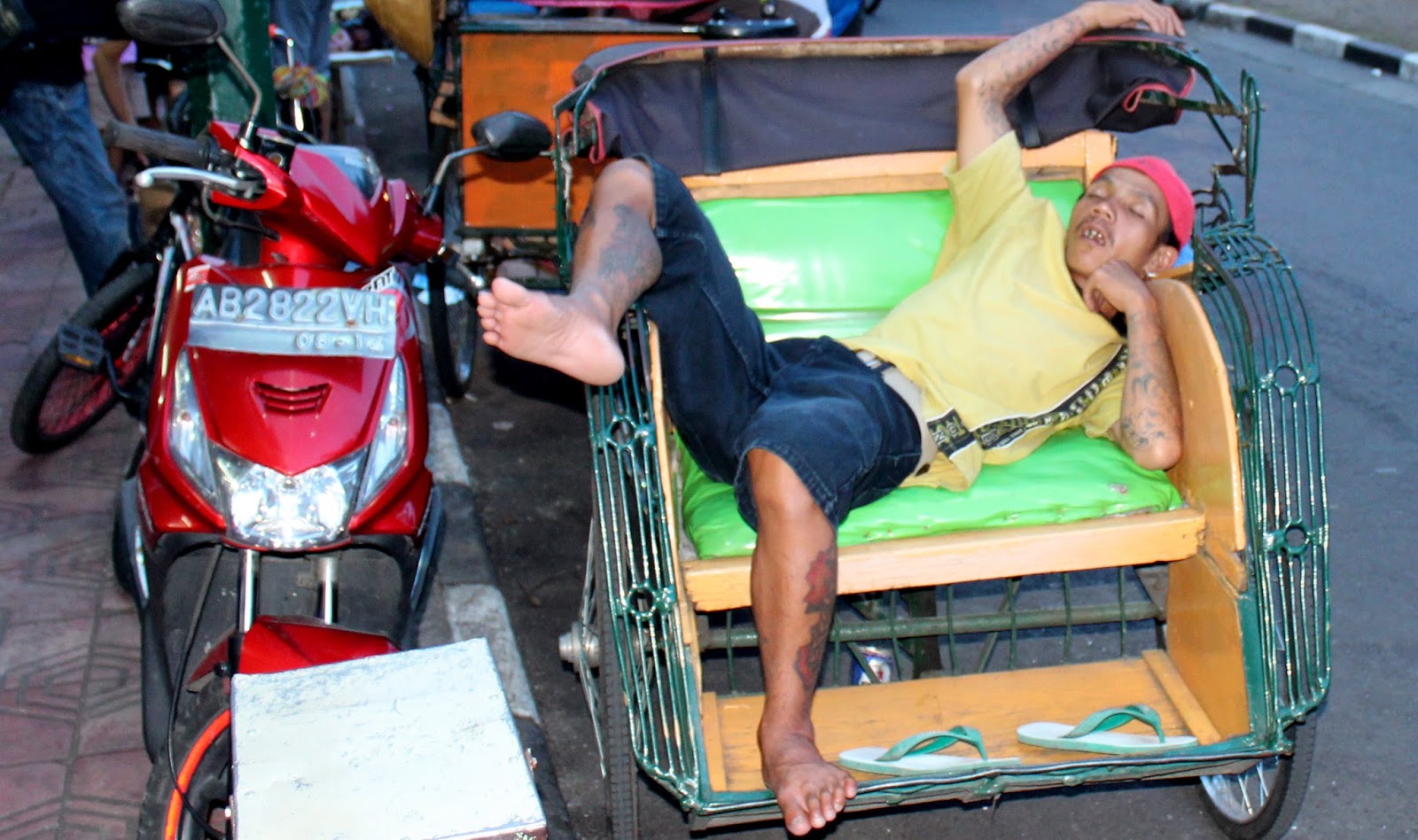
ROMANCE ON A BECAK

Take a tadpole ride on the wild side    


Here are three things you won’t find in Indonesia:
A Javan tiger; an unsweetened coffee – even when you’ve stressed pahit and the waitperson has nodded vigorously - and a fat becak (pedicab) cyclist.  But this slimming suggestion won’t be featured in women’s magazines.
“That’s right, you never get overweight,” said Tukiran who at 78 claims to be the oldest becak driver in Malang. “It’s a job that really keeps you fit.  I’ve never been sick.”  As proof he showed his calf muscles, worth admiring despite being of more interest to a vascular surgeon.
In the principles of honest journalism, but to the grief of the Quit lobby, it has to be disclosed that Tukiran’s recipe for longevity includes nurturing asphalt-coated lungs.  He smokes the coarse hand rolled kretek clove cigarettes.  These are so lethal that - unlike handguns – they’re banned in the US.
These are not the refined and processed products promoted on TV by heedless hipsters skydiving off razor-tipped cliffs and skindiving among sabre-toothed tiger sharks.
If the smoke ad models wanted to confront real danger they’d clamber out of their gull-winged Mercedes and fly through the traffic in a Malang becak.
 Unlike rickshaws, invented about 150 years ago with the rider alongside, the pedicabs in the East Java city have the passenger in front. Designers call this the ‘tadpole’ model.  It’s more efficient than the sidecar version and can squeeze through narrow lanes.
Training as a health and safety officer is not needed to know that in any collision the passenger will be the human bumper, or if rammed from behind, an instant projectile.  If your dream is to be a space explorer, this is your moment of glory before gore. 
However if you plan to study the orifices of truck exhaust systems for a mechanical engineering degree then this is the place for research.
There are positives; becak are pollution free and next to noiseless apart from the grunts of the driver. 


For those too poor to have a home, a becak can serves as an abode.
Passengers get to spot potholes before the driver and brace for the shock, though there’s nothing to hold onto unless you are riding with your beloved.
The bench seats are designed for two slim-hipped pre-teens, not wide-bottomed bule (foreigner); enjoy knees in mouth like airline economy class and hunchback headroom.
If love is in the air travel at night in the rain - wheels hissing through puddles - with a plastic curtain windshield.  To suggest the material is waterproof would be a misprint, but the joy is that passengers can see out, well just, and others can’t see in.
As this is a family magazine we’ll go no further along this road, just leave the direction to your imagination.

Despite the obvious hazards Tukiran (right) claims he’s never had an accident.  He calls the becak which he owns Sabar meaning ‘be patient, tolerant and calm’.
A splendid motto for preservation when the steel four-wheelers jostling for the same road space drive to discredit these ancient Javanese qualities.
If readers get the impression Tukiran is arrogant then this story needs a rewrite.  His title of Becak Opa (Grandpop Pedicab) was bestowed by his mates on the corner of the alun-alun (town square) and he only laughingly acknowledged the rank.
Perhaps he blushed, but we’ll never know.  Almost eight decades of exposure to sun and smog, rain and dust have turned his skin near to buffalo brown.
If lucky he’ll earn Rp 50,000 (US$ 3.70) a day starting at 7 am and finishing around 4 pm.  He’s competing with around 2,000 others and a boom in privately-owned motorcycles so fares are getting rare.  A becak driver plays the waiting game.
His younger mates have handphones with subscribers on speed-dial to regularly ferry kids to school or maids to market.  The elderly and disabled reckon they’re handy because this public transport is easy to access.
Loads too big for motorbikes and too small for pick-ups are also part of the business.

The other threat is the bentor (motorised pedicab) cobbled from old motorbikes and becak cut in half and crudely welded together.
“The problem is that there’s no front brake,” said Suwoho, 38, one of the younger bentor drivers.  “The police say they’re illegal if unregistered and can only be used outside the city.  We have to play a cat-and-mouse game.’
If so the feline must be well fed. While talking to a group of drivers and assorted hangers on, including cigarette hawkers and ladies of the night on the day shift, police cars cruised past.
No-one jumped into drains. Today the cops were displaying their perfected blindness to minor malfeasance by those too poor for a shakedown.
Suwoho doesn’t own his motorised second-hand three-wheeler – he’s paying off the Rp 800,000 (US$ 60) loan at Rp 100,000 a month – if he gets enough customers.
“It’s no good if people are stingy,” he said, resigned to reality. “What I earn depends on the blessings of God.”
 Becak and bentor don’t have meters so the cost has to be negotiated.  That’s a skill mastered by the drivers though not easily learned by outsiders, particularly tourists.
They tend to convert rupiah into their own currency and measure the cost against a cab fare in their homeland.  “What, only Rp 100,000 to the Post Office?  It would cost five times that in Chicago – what a deal!”
It would cost five time less if they’d asked locals for the right rate.


The becak men know they’re heading down a no-through road. Tukiran started pedalling when he was 12 and hasn’t stopped since.  His Pop was also in the trade, but his two sons have found other jobs.
The story of Jakarta authorities briefly cleaning up the capital by dumping thousands of becak in the ocean is well known.  Less understood is that Yogyakarta has spruced up its becak to make them tourist attractions.
“This work is only for those who don’t have another job and who left school early,” said Suwoho.
But when shown pictures of a new design being explored in the US for Asia (see breakout) he urged that the idea be introduced to the city mayor.

Reinventing the wheel

·     Catapult Design, based in Denver, Colorado, has won a US$340,000 (Rp 4.5 billion) one-year contract from the Asian Development Bank (ADB) to ‘redesign the existing rickshaw into a modern pedicab’. 
      Project team leader Bradley Schroeder calls himself a ‘bicycologist’.  He’s written a book about cycling and studied pedicabs in 11 countries.
     “I’ve worked quite a bit in Indonesia,” he told J-Plus. “The project would be applicable in many cities.  I believe the status of the car is declining among the younger generation.
    “Take Bandung for example.  The mayor (architect Ridwan Kamil) is very focussed on creating a liveable city and managing traffic.  Jakarta is a really tough place because of the street sizes and the national and local politics. Medan has a long way to go.
      “Catapult will also make 60 prototype vehicles and test them in Kathmandu and Lumbini (the birth place of Buddha) in Nepal with a further ADB grant of US $150,000 (Rp 2 billion).
      “It’s important to note that the prototype cost will be significantly higher than production costs. So a simple division does not represent the true cost of the manufactured vehicle once in production.”
·      Half the pedicabs will be pedal powered costing around US $750 (Rp 10 million), the rest assisted by an electric motor. 
      The pedicabs, made of aluminium with an enclosed drive train, will be lighter; the GPS touchscreen could also be used for advertising.
     “The design will be open source,” said Schroeder.  “This means that any manufacturer can use the ideas without violating copyright.”
(First published in J-Plus - The Jakarta Post 10 April 2016)

TITANIC RESPONSE TO TWEETING TINSELTOWNER

BTW

Acting on best advice

Hi and welcome to the Wonderful Indonesia 2016 Visitor Promotion Awards.  It’s been a tight contest in a big field with many worthy performances, particularly in the popular long-running LGBT series Outrageous Statements.

Who could forget its memorable theme song?  Amazing nation, what a destination. It’s the only place to stay; come out, be gay.

The judges found it tough, but in the end were unanimous.   Step up the Immigration Department.  Give them a hearty hand, folks!

You guys have done the industry proud.  You’ve put the nation on the map, drawn attention to its spellbinding diversity, natural wonder and quirky attitudes.  You’ve attracted publicity beyond the reach of bribes.  Now every woman’s magazine reader knows Indonesia is heartthrob haven.

As you’ll remember last year’s winner was Maritime Affairs and Fisheries under Minister Susi ‘Torpedo’ Pudjiastuti.  She took out the Best Costume Award with her arresting naval fatigues and matching helmet modelled on a former East German warship. 

By sinking 23 foreign poachers this month Smokin’ Susi reasserted our position as an international power, jealous of its reputation.

No one, apart from Chinese sailors with faster boats and bigger guns, nets one red and white fish and gets to sail away unhooked. Many expected she’d reprise her pistol-packin’ role with the explosive sequel Sovereign Borders 2, getting great billing here and overseas. 

Not to be; Susi has been overtaken.  Not by an infuriated foreign fisher but another department.  Which shows the strength of competition in an open society.

This year’s Best Performance Award goes to the Directorate General for Immigration at the Law and Human Rights Ministry.

Spokesman Heru ‘Hero’ Santoso impressed with his firm patriotic declaration: Anyone disobeying his agency’s rules faces being blacklisted forever from the blackened stumps of once pristine forests. 

The career public servant’s strident statement moved the judges to overlook ridicule and see the positives.  Put your hands together for this year’s Best Emerging Talent.

(Applause).

Thank you, everybody, it’s a great honor.  Let me seize the opportunity and say this: Those who don’t respect the way we mistreat our land and its resources can go back to their own ravaged landscapes and toxic rivers.  Leave ours alone, I say. We do our own despoiling.

Thespians may be Tinseltown titanics in LA, but once they step off the track in Gunung Leuser National Park their reputations mean nothing among the orang-utans and our vigilant officials.

In my latest performance, which your kindness has voted most memorable. I called out US actor Leonardo DiCaprio.

As you and all celebrity watchers now know from my speech, the man had the effrontery to enter our Republic as a tourist.  If I hadn’t been so outspoken few would have known of his presence.

His visa allowed him the right to a massage in Sanur and a counterfeit watch in Kuta. However rules expressly prohibit foreigners from opening their mouths without a permit, unless to drink beer and eat hamburgers.

There’s nothing unusual here; try rubbishing the royals in Thailand or the party in China and see what happens. 

Unfortunately the Wolf of Wall Street abused our generosity by prowling around Sumatra.  Had he tweeted his admiration for our monoculture and blamed himself for selecting a hazy day he’d have stayed within the law.

Instead the self-styled campaigner against global warming made a provocative statement, inciting my anger and discrediting the democratically- elected government. This is what he tweeted:

‘The expansion of palm oil plantations is fragmenting the forest and cutting off key elephant migration corridors … a world-class biodiversity hotspot, but palm oil expansion is destroying this unique place’.

I refused to let such defamatory comments pass unnoticed.  Before the Mental Revolution we might have looked the other way. But those days have departed.

The Oscar winner’s minders should have reminded him that while he might play a 19th century frontiersman wrestling grizzly bears in Montana, in 21st century Indonesia he has to confront the ferocious fellows of Immigration.  We are not so easily overcome.

If DiCaprio hadn’t fled while we were busy at prayer he’d have been deported.  I can assure you he’ll not be allowed back.  We won’t entertain a revenant. Duncan Graham

(First published in The Jakarta Post 10 April 2016)


Wednesday, April 06, 2016

FORTRESS AUSTRALIA: WHAT MESSAGE IS BEING SENT?

Brittle bonds, wary views, slow trade: Rethink required               

Just before Easter Australian Foreign Minister Julie Bishop opened her country’s latest and grandest Embassy.
The AUD 415 million complex covering four hectares of Central Jakarta is being billed as a marvel of modern technology married to sensitive architecture.  There’s even an embrace of greenery and Javanese beliefs with four transplanted banyan trees.
Building colors represent minerals of the Great South Land. The walls are blast resistant; in 2004 a Jemaah Islamiah car bomber killed nine outside the former Embassy.
Bishop banged a gong and pronounced: ‘This is our largest overseas diplomatic post and will be a symbol of the breadth and the depth and the importance of this relationship between Australia and Indonesia’.
These are familiar lyrics which read well but never seem to catch on. ‘Underlying strengths’ and ‘bilateral ballast’ are other timeworn diplomatic standards, but not Golden Oldies. As Ross Taylor, President of Perth’s Indonesia Institute points out, ballast doesn’t help a ship go anywhere.
Inside the Forbidden City are tennis courts, a medical center, club and 34 four-bedroom apartments. A boon for some of the 500 staff who won’t have to dodge the Big Durian’s waspish   motorcycle swarms, wade flooded streets and share the travel dramas of millions of commuters.
Following a tough day at the keyboard first, second and third secretaries can do lazy laps in the chlorinated pool not far from Ciliwung and its black tributaries which the poor use as laundries and lavatories. 
Sometimes they might get a whiff of kretek (clove cigarettes) blown over the battlements from the mysterious kampongs beyond. Or hear azan, the ancient calls to prayer from mosques nearby.
Is Fortress Australia the right model for overseas engagement in the Internet Age, particularly with the people next door? Big isn’t necessarily better.
The days of translators gluing press clippings have gone the way of the fax and cassette tapes, along with chanceries spiked with aerials. Video conferences miss the subtle messages passed through handshakes, but they’re far cheaper and time efficient.
Professionals in Australasia are no longer tethered to static desks. Mobile offices are a smartphone and laptop hooked into the staffer’s HQ mainframe from wherever a decent coffee is brewed. 
Counsellors and envoys scattered across Jakarta’s sprawl deny terrorists the big targets; the foreigners can mix with the locals, squabble about soccer instead of cricket, and see the view from the street, not the satellite.
Posted for three years, attaches analyse data, massage files and interpret reports.  Their views and advice help craft policy in Canberra. This principally concerns the STD that infects Indonesian-Australian relationships – Security, Trade and Defence. 
As an aside they mention aid, less so since the budget was slashed by 40 per cent, and the amorphous people-to-people relationships.
Last year Malcolm Turnbull popped into Jakarta on his way to Europe and showed how to relate, more by accident than design.  It was his first visit as Prime Minister, seven months after Ambassador Paul Grigson was withdrawn when reformed drug traffickers Andrew Chan and Myuran Sukumara were executed.
A high point of the stopover was accompanying President Joko ‘Jokowi’ Widodo on one of his signature blusukan through a crowded and chaotic market.  The walkabout delighted Indonesians surprised that a tie-free foreigner was meeting and greeting the wong cilik (ordinary folk).
Cynical Australians assumed the PM was being mistaken for George Clooney; who’d clap a politician they’d never elect?  Sweaty Turnbull yanked off his jacket, grinned a lot and snapped selfies. Security looked hot and bothered.
The trip was a gate-opener for Trade Minister Andrew Robb and 360 business folk clutching order books.  Major deals have yet to be trumpeted.  As the Australians flew home a 1000-strong Japanese delegation jetted in with big construction projects in mind.  They got to meet Jokowi – a favor denied Robb’s Mob.
Before Krismon the 1998 Asian economic storm that toppled President Soeharto’s 32 years of military-backed power, 400 Australian companies operated across the archipelago.  Now there are 250.
Robb wants 750, but the journey will be all uphill.  Australian directors are wary about risking funds in a country where the rule of law is exercised by might and mates. Corruption has deep roots drawing from the nation’s aquifer of graft.  Positions on foreign investments are acrobatic and Jokowi’s mindset hard to fathom.  Indonesians have the same problem.
Opportunities abound.  Two-way trade is worth AUD 16 billion a year, less than tiny Malaysia with only 12 per cent of its neighbor’s population.  
Indonesia is hungry for Australian wheat and beef, administrative expertise and smart technologies. But problems are also abundant – the business arena is seldom fair and flat.  White line boundaries are smudged. Spectators and players interchange and the goal posts can be erected anywhere. Or nowhere.
Indonesia ranks 109th on the World Bank’s ease-of-doing-business list.   Singapore is tops and Australia number 13.
There’s hope a fresh recruit might give the whole show a shake.  Harvard-educated Thomas Lembong is the new Trade Minister recruited last year in a Cabinet shake up that favored technocrats over politicians.  He’s been in Australia claiming the tide of protectionism which has washed deep into the national psyche is now retreating.
If he’s right then foreign funds may start to flow.  They are needed – the growth rate is around 4.7 per cent (Australia’s is three per cent).  The Indonesian figure sounds phenomenal till measured against the World Bank estimate of eight per cent needed to meet domestic demands from 250 million consumers.
Lembong, a former investment banker, has been polishing the idea of a Free Trade Agreement with talks scheduled for later this year.  If fruitful this Indonesian initiative will be some accomplishment.  A similar attempt four years ago collapsed under the weight of misunderstandings, misjudgements and some gross gaffes.
Here’s one story: In 2010 Jokowi’s predecessor Susilo Bambang Yudhoyono gave a speech to the National Parliament in Canberra.  Local media called it ‘forthright’, ‘touching’ and ‘transformative’.  
"Australia and Indonesia have a great future together,” he said. “We are not just neighbours, we are not just friends. We are strategic partners. We are equal stake-holders in a common future, with much to gain if we get this relationship right, and much to lose if we get it wrong.”
The wrong rapidly followed when SBY discovered that his phone and that of his wife Ani had been tapped by Australian spies.  The leader of the world’s third largest democracy was outraged and so were the citizens.  To his credit SBY maintained his Javanese cool and is now a visiting professor at the University of Western Australia.
More blunders followed, like the abrupt halt of cattle exports following reports of cruelty, leaving consumers short. The most recent clanger was authored by former PM Tony Abbott.  Recalling support for the victims of the 2004 Indian Ocean tsunami he linked this generosity to an unsuccessful plea to stay the firing squad taking aim at Chan and Sukumaran.
Sore from smarting under Dutch rule for 350 years, Indonesians are on 24/7 alert for real or imagined remnants of colonialism, well aware their neighbor once ran a White Australia policy. They started collecting coins to pay back the aid.
The Embassy can’t be blamed for every offence, but some errors have been so stupid and damaging it seems either diplomats aren’t heard or are serving bad advice from flawed sources.
Saying Australia needs Indonesia more than the reverse is a cliché with limited truth. Although politicians on either side of the Arafura Sea tend to focus on parochial and separate interests, the far-sighted recognise that common concerns should prevail. 
China’s military expansion worries both nations. There’s already been one high-sea clash with the Chinese allegedly using force to recover a fishing boat seized by Indonesia. Threats are unlikely to come through the Southern Ocean. Indonesia needs solid friends in the region, as does Australia. 
The ten-member ASEAN (‘One Vision, One Identity, One Community’) should be a backer but has become what Indonesians call a NATO – No Action, Talk Only encounter. It’s neither an Asian version of the original acronym nor the common market and regional powerhouse once imagined.
Apart from foods, fuels, raw materials, tourists and services, what do Indonesians seek from Down Under? According to Allan Behm, former senior public servant turned security analyst and commentator, Indonesians want ‘respect, understanding, support, quiet engagement and constructive advocacy of their growing role as a regional and global player’.
Instead they get a citadel of ballast paraded as ‘a symbol of the breadth and the depth and the importance of the relationship’. 
Three years ago Australian National University Professor of Strategic Studies Hugh White wrote: ‘Australia not only needs a new kind of relationship with Indonesia, but a new way of thinking about foreign policy’.  The needs remain.

(First published in Strategic Review 4 April 2016,  See: http://sr-indonesia.com/web-exclusives/view/what-next-for-indonesia-and-australia )

##


Monday, April 04, 2016

JACK! INSPIRING OTHERS TO CROSS CULTURES

A symphony of Indonesian love 

Not all festschrifts travel well.  Sometimes the contributors veer away from the subject, driving in another direction in search of their own interests.

Though not with this beautiful book where even the format and design pays tribute to a remarkable musician, photographer, entrepreneur, teacher, song-catcher and above all lover of Indonesia, its people and music.

Jack! celebrates the life of the New Zealand composer Jack Body, ‘his endless musical curiosity’ and ‘love of life’s complexities’.

He died earlier this year shortly after the book was completed and he’d been named a NZ Arts Icon, the nation’s highest arts award and the first composer to be recognized.   

Although the writers knew Body was ill and that the cancer he thought he’d defeated was galloping back, Jack! is seldom maudlin or clogged by irrelevant minutia.

Its one hundred contributors record a life well lived and where the subject was still thinking of compositions to come ‘about what the earth taught me, what the plants said, what the birds said.’  

In it Body talks in interviews about ‘discovering a new sensuality’ in Indonesia where he taught at the Akademi Musik Indonesia. He also found the love of his life, Yono Soekarno.  They lived together till Body died.

‘We met in the Yogyakarta Post Office on Boxing Day in 1976 …[Body had been recording street musicians in the city].  He is beautiful even though he is no longer the dazzling youth I first met.  Oh my God, was I the envy of all, male and female to have such a beautiful and desirable companion!

‘And the miracle of it all is that he loved unlovable me!  I like to point out to the young that love is something that is learned, something that grows with time.  Yono taught me how to love.’

One of the many photos shows Body and Soekarno together shortly after they became a unit, two handsome young men smiling and joyful, as are almost all the pictures. For Body had an orchestra of friends drawn by his cheerful humility and unqualified commitment to music – and the gamelan in particular.

Among his friends were the three women who edited this book – Gillian Whitehead, Scilla Askew and Jennifer Shennan who writes about Body’s ‘inclusive personality and joie de vivre …a low tolerance for boredom, cliché and comfort zones’.

John Stanley [Jack] Body was born in 1944 in Te Aroha, a dairy town in NZ’s North Island.  His father had a small farm and also worked as an earthmoving contractor. 

Though his Dad ‘never really understood my interest in music … [he] certainly didn’t stand in my way’. Body’s parents must have been farsighted because in those days rural NZ was a masculine place where boys played rugby in the mud, swilled beer and prided themselves on their toughness. 

Despite this young Jack was taught the piano and sent to board at the prestigious King’s College in Auckland where his artistic talents were nurtured.

In his final year he garnered a group of friends for a performance of Haydn’s [or maybe Leopold Mozart’s] Toy Symphony. This work with its disputed authorship includes birdsong and a cornucopia of sounds from toy trumpets, whistles and other instruments. 

It was a sign of things to come; apart from his organisational skills and ability to attract support for projects he developed an ear for the natural and human-made noises of the world, particularly in Indonesia, and incorporated them in his compositions.

At Auckland University he graduated in music and then completed a master’s degree studying composition and teaching.

He went to Europe on a NZ grant to study at Cologne and Utrecht.  On his slow way home overland he diverted through Indonesia and his life’s direction was set.

‘The experience of living in Indonesia and of being in a different culture, having to learn the language, hearing the sounds around me, not only the musics but the environment … that gave me a very rich resource.

‘Indonesia was a total environment; it was the weather, the food, the friendships.  I would say also the sensuality.’

In the NZ capital of Wellington where Body eventually became a professor at the School of Music on the campus of Victoria University, there was a gamelan. 

It had been donated in 1973 through the President’s wife Tien Soeharto after formal relationships were established between the two nations.  Instead of gathering dust in a storeroom, where such government gifts are often abandoned, under Body’s leadership the gongs, drums and metallophones have become a key component of Wellington’s music, training hundreds of students and exciting many to study in Indonesia.

It remains one of the better-known ensembles in the city, regularly playing in locations as diverse at Parliament House, churches and concert halls. In a music environment dominated by European traditions, the gamelan offers a splendid alternative and a prelude to exploring the nation’s nearest Asian neighbor.

The NZ players will tour Java next year. Since 1996 Embassy employee and local resident Budi Putra has been the gamelan’s musical director bonding the orchestra with its roots.

The gamelan is not the only enduring legacy of Body’s involvement with Asia.  He also became enchanted by the music of Cambodia and China where he collaborated with the Forbidden City Chamber Orchestra,

When funds could not be found to bring composers and musicians from Indonesia and other Asian countries to NZ, Brady used his own funds, as he did with the Asia Pacific Festivals.

There are several Indonesian contributors to Jack! thankful that their horizons have been expanded through one man’s credo:  Music is the universal language that moves through political, geographical and ethnic obstacles as though these barriers don’t exist.

This book is a primer on how individuals can make a difference in cross-cultural relationships.

Jack! edited by Jennifer Shennan, Gillian Whitehead and Scilla Askew
Published by Steele Roberts, 2015    256 pages

(First published in The Jakarta Post 4 April 2016)