FAITH IN INDONESIA

FAITH IN INDONESIA
The shape of the world a generation from now will be influenced far more by how we communicate the values of our society to others than by military or diplomatic superiority. William Fulbright, 1964
Showing posts with label Unisma. Show all posts

Wednesday, September 19, 2018

MALANG'S NO-NONSENSE RECTOR


Harmony v Hate: The main event       


Masykuri Bakri doesn’t fit the popular image of a moderate Muslim leader.

The Rector of the Islamic University in Malang (Unisma) is no wisecracking celebrity TV preacher
 adding unity as an afterthought. 

For stern Bakri interfaith tolerance is serious stuff.
 He reads the Koran as a book of peace and inclusiveness, not an order to blast infidels.

When zealots hung banners on his East Java campus promoting the triumph of militant Islam
 he ordered them ripped down and fundamentalist texts to be thrown out.

“There’s no room for radicals at Unisma,” he said.  “This is a place of harmony.”

It’s a noun he loves, but harmoni seems at odds with an unsmiling administrator 
running a tight academic institution.  

Bakri, 51, only starts to relax after a clumsily worded question wrongly implies he’s polygamous. 

His background, upbringing and career to date could have constructed a determined 
advocate of Indonesia as a Sharia state, or at least follow Egypt and make minorities 
so fearful they either convert or flee.

Instead he wants to “break down walls” between faiths. Critics get the flick: 
“I just keep going.  That’s my job.  I’m not interested in politics, just peace, understanding and respect.”

Bakri is more than words.  Earlier this year his university hosted the Deklarasi Malang Berdoa 
 (the Declaration of a prayer for Malang)

This was kampong musyawarah (community deliberation and consensus building) on an urban scale.

 “We want Unisma to be an example that others can follow,” said Bakri who gave a strident
 extempore speech evoking shared national values and a vision of togetherness
 that brought frequent outbursts of applause from the 600-strong crowd, showing most were already converted.

The timing was important.  Fears that some regional election candidates might play 
the religious card shaped the event to head off hate. 

It didn’t succeed beyond Malang. 
Days later suicide bombers in Surabaya attacked churches, killing 28 and wounding 50. 
 In Central Sumatra police arrested alleged terrorists linked to Riau University.

Bakri remained undaunted: “We’re a multifaith nation; that has to be our way now and in the future.”

The Malang prayer was staged by an inter-faith committee backed by the Jawa Pos newspaper.  
Prominent in the audience were Catholic nuns, and ethnic Chinese,
the standard target when the economy sours.

Curiously few Unisma students were present.  Bakri said many were busy on other activities.

Unisma is a private university with 13,000 students.  
It’s associated with the mass Islamic movement Nahdlatul Ulama (NU) 
once led by the late president Abdurrahman Wahid (Gus Dur)

During his brief tenure (1999-2001) Wahid scrapped bans on Chinese language, names and faith.
Confucianism became a State-approved religion along with Islam, Catholicism, Protestantism, Hinduism and Buddhism.

All were represented on the Unisma stage plus kebatinan, the traditional Javanese belief system. 
The government dubs this a cultural practice, refusing requests for higher recognition.
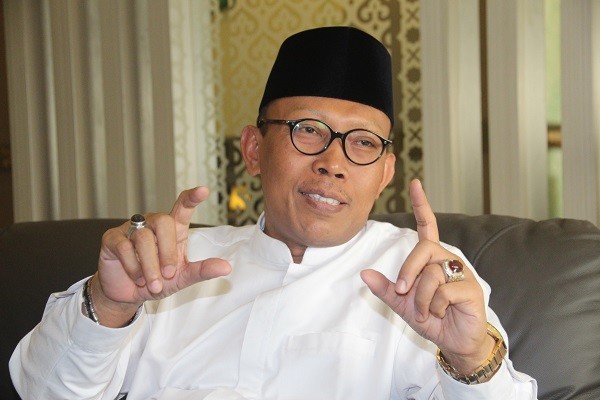

Bakri grew up in a hamlet outside Tuban on the north Java coast.  
The city is famous for the 16th century grave of Sunan Bonang, one of the nine Walisongo mystics
 who brought Islam to the archipelago.

“My parents couldn’t read or speak Indonesian,” Bakri said.  
“We had no electricity.  My farmer father was not religious though this was the heartland of Islam.  
However I loved going to the mosque. It was the centre of the community.  
Sometimes we kids slept there after sport and prayer.

“My mother was a strong advocate for education and insisted I study.  
I got so enthusiastic as a child I wrote my name as Professor Doctor Masykuri.”

His learning has been confined to Islamic institutions in Java.  
At a pesantren (boarding school) astronomer and cleric Hahfudz Anwar taught him that 
science and faith can co-exist.

Bakri’s limited formal education perversely adds to his local credibility; 
he’s shielded from the slur hurled at moderates who’ve studied overseas – 
that they’ve lost touch with their roots and become corrupted by Western values.

He doesn’t have a PhD, doesn’t speak English and resides far from the intellectual hothouses 
where competing ideas bloom and challenge. 

His benign philosophy is traditional Javanese Islam rooted in backblock villages 
where survival depends on mutual aid and tolerance. 
He says his thinking is followed by most of NU’s 40 million members, 
though often overlooked in the focus on a few extremists.

Bakri has written 18 books.  Some are titled Quo Vadis? followed by ‘education’, 
‘multiculturalism’ and other issues. The Latin means ‘Where are you going?’
 but Christians use it to define the story of Peter’s supposed turning-point on meeting the resurrected Jesus.

Despite his literary output and claim to be a wide reader, the only Western author
 Bakri recalled was Karl Marx.  
He hasn’t opened the Bible and was scheduled for his first church visit in mid June. 

Why not before? “I’ve never been invited till now.”

He supports the Islam Nusantara (Islam of the Archipelago) movement, which aims to develop 
‘Indonesian as well as Islamic society.’ Its other goals are ‘improving the welfare of 
lower classes of society, building democracy and fundamental justice, and expanding peace and non-violence throughout the world.’ 

Ive always believed spirituality and intellect must be combined to produce positive energy and the right environment,” Bakri said. 
Unisma students pray at the start and end of each lecture. “Prayer is like pedaling a bicycle – it helps you reach your goal. Spirituality can be interpreted as a source of motivation, respect for God and each other.  We all need this whatever we believe, not confrontation.” 
The Rector (Vice Chancellor in Commonwealth countries, President in US Universities) 
 has been to Mecca several times.  He’s also made short visits abroad to build tertiary institution
 links in South Korea, Taiwan, Malaysia, Singapore and Australia.

Most interest has come from the Islamic Sultanate of Brunei.

“My dream is to become world class, an international and multicultural university,” he said.
  Fine ambition, tough task. The nearby Ma Chung University opened in 2007; with 2,000
 mostly ethnic Chinese students it’s already ahead of Unisma – born 1981 - on the Unirank website. 

The heart of Bakri’s campus is not the library but the mosque.
 Framed Koranic texts and wall inscriptions in Arabic dominate. 
The study of Islam tops the list of ten faculties.

Orthodox Bakri hasn’t escaped his humble origins but given them provincial status. 
Going further and drawing from disparate sources could threaten his base. 
Yet despite the limitations and setbacks his focus remains.

“I’m very optimistic harmony can and will prevail,” he said firmly.  “No doubts.”


First published in Inside Indonesia, 18 September 2018.  See:  http://www.insideindonesia.org/essay-harmony-versus-hate

Thursday, May 17, 2018

TERRORIST BOMBINGS IN EAST JAVA


PRAYING IS FINE – ACTION BETTER       

The man on the far left represents Kebatinan.  Then Confucianism, Buddhism, Hinuism, Protestants, Catholics and Islam.
                        

Five guards and an inmate died in a Jakarta prison riot last week, allegedly launched by Islamic State.  More than 150 terrorists are held at the overcrowded jail where turmoil erupted six months ago.
Then early on Sunday church bombings in Surabaya, Indonesia’s second largest city, killed nine at the start of the Muslim fasting month.
In March police said they’d smashed an Internet jihad group known as the Muslim Cyber Army.  It was accused of spreading fake news to stir the gullible and destabilize upcoming elections.
Where do the radicals recruit? At universities, according to Indonesia's Intelligence Chief Budi Gunawan.
He claimed almost 40 per cent of students have been exposed to zealots ‘trying to mobilise new terrorists.’
There are close to 3,000 tertiary education institutions in the Republic.  Most are private and run by religions.  Some are resisting the fundamentalists.
It was a most worthy event.  Whether it can add value is another matter.

Days before the Jakarta riot and Surabaya bombings around 600 citizens of Malang gathered on a sweaty Saturday to support the Deklarasi Malang Berdoa (the Declaration of a prayer for Malang) hoping the initiative will spread from the East Java city throughout Indonesia.

The timing was important.  Campaigning for regional elections is well underway; fears that some candidates will invoke hate against non-Muslims have already come to pass so the occasion was intended to head off further agents provocateurs.

Sponsors of the Malang bash organised by a local inter-faith committee included churches, the Jawa Pos newspaper and the Islamic University of Malang (Unisma) where the gathering was held. 

The need for harmonis was hammered with force by rector Masykuri Bakri delivering the most stimulating speech of the two-hour show, evoking shared national values and a vision of togetherness that brought frequent outbursts of applause.


Curiously few of the happy clappers were from his private university associated with the mass Islamic movement Nahdlatul Ulama (NU).  On this campus, with more than 7,000 students, women must wear jilbab (headscarves).

However most in the auditorium covering their hair were white-clad Catholic nuns; they overwhelmingly outnumbered the Muslims. When one religion is the majority by nine to one, reconciliation usually gets initiated by the anxious minority, quietly fearful that racist violence will erupt again as it has so many times.

The last big bloody outrage was two decades ago when Soeharto’s Orde Baru (New Order) 32-year dictatorship crashed.  The fury was worst in Jakarta where ethnic Chinese were raped and killed, and their businesses burned.  (For more on the 1998 riots see: http://indonesiaatmelbourne.unimelb.edu.au/could-violence-against-the-ethnic-chinese-in-indonesia-happen-again/)

Well-prepared families bolted to Australia – mainly Perth - where they’d secured permanent residence, sent their kids to local schools and bought homes.

Since then the huge December 2016 rallies against former Jakarta Governor Basuki Tjahaja Purnama (Ahok) led to the ethnic-Chinese Christian’s two-year jailing for blasphemy.  Estimates of more than half a million fist-thrusting protestors have reminded all that tolerance in Indonesia is fragile and easily shattered by demagogues.

To assure the nervous that this won’t happen during the regional election campaigns now underway, and next year’s national vote for the President, was an army lieutenant colonel, and the head of the local police.

Splendid with swagger sticks and shirts sagging with medals and ribbons, the duo attempted to cool concerns with tedious addresses about their impartiality.  This century the late president Abdurrahman Wahid (Gus Dur) separated the army and the police forces, which are slowly becoming more professional.

They need to be.  A recent paper by Melbourne University Professor Tim Lindsey claims ‘the growing influence of Islamist hardliners, repressed by the Soeharto regime is ‘fracturing the national consensus on pluralism’.   

‘Australia needs to ‘rethink dated Soeharto-era attitudes to Indonesia.’ he added.  ‘Commitment to electoral democracy remains strong but support for liberal democracy is less certain and concern for international opinion much diminished.

‘In fact, expectations of Indonesia’s rise are already fueling experiments with populism, xenophobia and regional assertiveness (triggered to a great extent by virulent Sinophobia).’

Adult members of the audience didn’t need a foreign academic to tell them what’s embedded in their DNA.  Indonesians find it difficult to be frank with outsiders, but when they do Muslims reveal deep resentment towards the ethnic Chinese (below two percent of the population of 260 million) for their wealth and business success, often alleging corruption.

The scapegoats respond by saying their achievements are due to discipline, hard work and pursuit of quality education.

While some in the minority try to prove they are committed to the nation by converting to Islam and funding mosques, others aggravate by showing off in public and fuelling resentment.

Helping offset negative perceptions was a contingent at the Declaration from Ma Chung University, including athletic martial arts performers as a curtain-raiser.  The campus opened in 2017 and has less than 2,000 students; yet it’s already ahead of Unisma – born 1981 - on the Unirank website.

Before this century discrimination was legal.  Ethnic Chinese born in the country and eligible for Indonesian passports, and whose families have called the archipelago home for generations, were barred from using Chinese names, calligraphy and language.

They were also shut out of the armed forces and government.  Many turned to banking and now dominate the profession.

During his brief tenure (1999-2001) President Gus Dur scrapped the bans. He also recognized Confucianism as an approved religion along with Islam, Catholicism, Protestantism, Hinduism and Buddhism.

All were represented on the Malang stage plus a surprising addition - an adherent of kebatinan, the traditional Javanese faith. The government calls this a cultural practice, refusing requests for a higher status for fear of diluting Islam.

The intent was good but unbalanced. All speakers were men, middle-aged to elderly. The only women to get before the public were dancers and musicians in the warm-up. 

Few opinions would have been changed by the Declaration as attendance indicated acceptance of a multi-faith society.

The next task is to broadcast the message to the kampong, villages and pesantren  (Islamic boarding schools) where the millions don’t always hear the moderates.  Here the primacy of the pribumi (indigenous) is often strongest, intolerance greatest and ‘virulent Sinophobia’ most likely.


The Jakarta prison riot was not well covered in Australia - more details here: http://www.atimes.com/article/prison-riot-shows-isis-lethal-reach-in-indonesia/


First published in Pearls and Imitations, 17 May 2018