FAITH IN INDONESIA

FAITH IN INDONESIA
The shape of the world a generation from now will be influenced far more by how we communicate the values of our society to others than by military or diplomatic superiority. William Fulbright, 1964
Showing posts with label colonialism. Show all posts

Monday, April 15, 2019

17TH CENTURY JAVA; ADVENTURES ABUNDANT, PERILS APLENTY AND ROMANCE FOR THE FORTUNATE


Glory and riches – or death and dishonor        
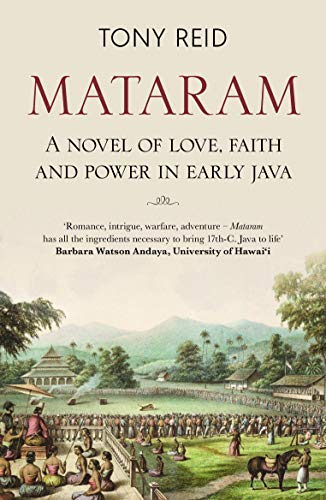
 Image result for image of mataram book cover           

Here’s a chance for foreigners bedazzled by this archipelago of astonishments to better their knowledge of its history and cultures.

Not through texts hammered by pedestrian academics clumsy at tale-telling, but through fiction.

Mataram was once a powerful Sultanate based on the lands dominated by Central Java’s Mount Merapi, and the cities of Yogyakarta and Surakarta before the Dutch took control.

Mataram is also a novel from a near octogenarian scholar who’s let his creativity roam free after a lifetime of formal study trampled by footnotes.  That leaves the way clear to introduce Tony Reid’s creation, a ginger-bearded seaman from Hampshire with a sinking marriage.  His adventures help us better understand Java four centuries ago.

Thomas Hodges had little to warrant his inclusion as master’s mate in an imagined 1608 English trading venture to the East Indies – but for one skill.  He was a natural linguist fluent in Portuguese, then the outsider’s lingua franca of commerce; he learned the language while shipping wine to Britain.

The Red Dragon makes landfall at Bantam (now Banten) in West Java after a long voyage, becalmed for a month and stricken by disease causing five deaths. Hodges is sent ashore into a ‘town with no friends and little law’ to negotiate the bulk purchase of pepper, much wanted in Europe. 

While the crew quench thirst and lust, ‘Hod’ as he was soon labeled, set about learning Malay and the culture to better deal with sellers.  He also needed to rapidly understand the complex cartels which controlled trade with the competing Dutch, Portuguese, Arabs, Indians, and British. His venture was ‘glory and riches – or death and dishonor’. 

Chinese intermediaries helped him build contacts – a role they still play today. The impatient Englishman was also given lessons in Java-style dealings with a trader called Bintara:

‘You feringgi (foreigners) will get nowhere unless you learn patience in doing business. For us, trading is part of the art of civilized living. If Tuan Hod wants Bintara’s favour, he will sit down, talk about agreeable matters that interest Bintara, and wait until he is ready to learn what you want. Then he will decide whether he wishes to help you.’

Good advice for non-Asians investors hoping to get into the Indonesian economy in the 21st century.

Bintara has a daughter and it’s not long before Hodges has forgotten his wife Margaret back in Britain.  Along the way Sri teaches him the ‘wisdom of the Javanese’; he gets to work out how to sit cross-legged on a hard floor and not collapse from cramp, give gifts, eat with his right hand and chew betel nut.  Apart from this last habit, which has largely been blown away by nicotine, the courtesies and traditions remain. 

There are also diversions into debates about theology and philosophy which give the author the chance to exercise some favorite personal theories. 

These annoy as they seem artificial in the context of a young couple wrestling with each other emotionally and practically over problems of background and culture. Philosophical meanderings can be fun, but like sex there’s a time and place.

What the reader wants to know is this: Will the gauche Brit adapt fast enough to survive and get the cargo before keris are unsheathed and the keel holed? 

After a mysterious spiritual session with an old soothsayer our hero and Sri are set upon by street thugs resentful that an Inggris is stepping out with the local prize. 

She’s rescued by other women and vanishes.  He beats off the bandits with his sword, cops a flesh wound, then wonders if he’ll ever see the Javanese beauty again.  By now we know the answer so there goes the suspense, though we doubt they’ll live happily ever after.

The Red Dragon fills its hold with spices and sails away leaving Hodges as a sort of honorary consul.  The royalist stays to tell locals the Brits aren’t as bad as the ‘grasping Dutch and swaggering Portuguese.’

This is fiction from the word-processor of a writer better known in lecture halls under the more authoritative name Professor Dr Anthony Reid; he’s a renowned New Zealand historian who has spent his life on campuses in Australia, Southeast Asia and the US.

He’s also translated many works in and out of Indonesian, a language he started learning as a child in Jakarta. That was during the early 1950s when Dad John was the UN’s Resident Rep. 

Apparently Reid’s best known book (down a narrow corridor of specialists) is the soporifically-titled Southeast Asia in the Age of Commerce, 1450-1680.  Mataram is his first novel using his research of the era, though few accurate written records remain.

Reid admits to literary license:  ‘As far as we know, neither Jesuits nor English East India Company servants found their way to Mataram in the early 1600s, though both came close and did visit other great Asian kingdoms.’

The characters have lots to say, but rarely breathe. It seems they people the pages to promote Reid’s eclectic interests.  These include mixed marriages, the shift of cultures, power struggles and faith.  He introduces a learned European Jesuit (and there’s still a few around today) who after much preaching gets sick and dies, setting the scene for a chat about funeral practices.

Hodges is incomplete.  Sometimes he’s an ignorant abroad, at others Captain Cool, then a seeker of meaning.  Only at the end do we learn more about him from wife Sri.

Last month, Reid told The Jakarta Post that he struggled with the dialogue of fiction; unfortunately he didn’t win. 

Nonetheless Mataram is well worth buying or borrowing because it explains so many practices and beliefs still relevant today, and does so in an easy read.  Free of the gluten of academic jargon, so no worries for those allergic to theses.

Mataram, by Tony Reid                                                                                                                                                  
Monsoon Press, Leicester, 2018                                                                                         336 pages.

(First published in The Jakarta Post 15 April 2019)


Saturday, October 11, 2008

CHARLES PILLIET

The curious yarn of a Kiwi in Java © Duncan Graham 2008

Hanging on the wall of a cramped kampong house in Singosari, East Java is a set of grainy soft-focus photos of the family’s ancestors. Sunshine, termites, damp and age haven’t treated them well, and the pictures started with a disadvantage.

In the early days of photography the rules were rigid; you had to dress formal and look severe. Today it’s difficult to sense the soul behind the monochrome stare, humanity in the flat featureless features.

And so it is here with the portraits of a gaunt, long faced foreigner in a bow tie flanked by Javanese teenagers, or with his housekeeper, equally stern. They seem to say; ‘We don’t trust this newfangled technology’.

The man wearing the ‘butterfly’, as they say in Singosari, was Charles Mainwaring Pilliet, a New Zealander who fled a disciplinarian father in his homeland to become an adventurer in South East Asia. He eventually died in 1959 in East Java aged 90, nursed by Mutmainah one of his adopted nieces.

Now 68 she recalled the day of his passing vividly: “As we took the body out of the house a powerful wind sprang up,” she said. “Windows banged open or slammed shut. The trees shook and bent their branches. We knew he was a paranormal.

“He was fanatical about the number seven. We had seven windows in the house and seven trees in the garden. He gave me seven bracelets.”

Who was this strange septenary Kiwi who apparently supported the Indonesian revolution and loathed the Dutch? What was he doing squatting in an Indonesian village and dying poor after being cheated of his wealth by the Madurese wife of a Scottish banker who got Pilliet to sign over his estate to her husband?

At the end of his life the old Kiwi was reduced to boiling buffalo bones to extract fat for sale as a rheumatism cure and getting the kids to hawk this door-to-door.

Now his great, great nephew Michael Pringle is trying to put together the missing threads in the tapestry of his colourful relative’s life. Pringle came to Indonesia 11 years ago to research the story and will return in January to see if he can sew a more complete narrative.

Unfortunately the old man’s books seem to have vanished. Mutmainah said he kept thousands in cupboards and wardrobes, but only the furniture remains.

Pilliet was born in 1869 in NZ’s South Island into a family with legal, journalistic and political connections, and ancestors from France. His mother died when he was three. It seems he didn’t get on with his stepmother and was raised by his grandfather.

Pilliet worked as a merchant seaman, then a miner before leaving for what was then the Dutch East Indies.

“His experiences on the west coast of Sumatra were extraordinary,” said Michael Pringle who is writing a biography of Charles’ father Walter. “Charles hunted tigers and elephants up remote rivers and undertook extremely dangerous exploratory forays into regions which had never previously seen a white man.

“ He suffered numerous bouts of malarial sickness and was probably lucky to have survived. In 1899 he was exploring the northern coast of the Celebes (now Sulawesi) sleeping in the open to avoid leprosy and other diseases that were rife in the villages.”

In Sulawesi Pilliet apparently fathered a daughter with a local woman, though the child later died. He set up house in Kupang, owned a lugger and traded in pearls in Western Australia and Singapore, amassing considerable wealth. He became the British consul in Dili where he worked as a spy monitoring German activities in the area.

He seems to have been fascinated by Eastern religions and philosophies. He read widely and in 1923 moved to Lawang, about 15 kilometers north of Malang where he built a house and had coffee plantations.

“He had a Javanese housekeeper who moved her two young nieces in with her for company,” said Pringle. “Charles became very fond of these children and almost adopted them as his own, picking them up from school and treating them with great affection. He was well regarded by the people of Lawang and taught the local children English in his house.”

Stories vary about his time during the Japanese occupation of Indonesia. One version has him being transported to the Changi prisoner-of-war camp in Singapore, though Mutmainah is adamant that didn’t happen.

She said he was arrested by the Japanese and released later when they discovered he wasn’t Dutch. This seems unlikely because New Zealand, along with Australia, was fighting with the Allies and Pilliet would have been considered an enemy alien.

However Mutmainah said that after the war he did stay for a year or more in Singapore where he had a Jewish friend. This may have been during the four-year war for Indonesian independence.

When Pilliet returned to Java he was a poor man though he got some support from his family in NZ.

Why didn’t he go back to his homeland? Mutmainah said this was because of his antagonism towards his father, but Walter had died in 1885 aged 45 from typhoid when young Charles was still a teenager. If this was the reason the hostility must have run deep.

What attracted Pilliet to East Java? Mutmainah said he spoke Indonesian, but not Javanese. He doesn’t seem to have gone native and continued to read newspapers from Singapore, drink whisky, make his own wine and dress as a European.

Pringle is particularly keen to trace his great, great uncle’s books. These were probably in English because the old man refused to use the Dutch language. They may well have been sold to libraries and were probably about philosophy.

If you have any clues or anecdotes, please contact Michael Pringle at tixall@xtra.co.nz
#
(First published in The Jakarta Post Saturday 11 October)
##