FAITH IN INDONESIA

FAITH IN INDONESIA
The shape of the world a generation from now will be influenced far more by how we communicate the values of our society to others than by military or diplomatic superiority. William Fulbright, 1964
Showing posts with label Indonesian president. Show all posts

Monday, May 15, 2023

BTW - MIGHT BE SMART TO KEEP NEIGHBOURS IN THE LOOP


                                           SNUBBING THE NEIGHBOURS 


Seen from Indonesia, Australia’s increasing closeness to the Anglosphere corrodes the view ‘that Asia is where our future substantially lies’. 


The Great Wall of Indonesia twixt us and the fantastic threats         
   Credit India-Australia-Indonesia Maritime Partnership


Credit:  Inside Indonesia


When the AUKUS nuclear-powered subs deal was made public in September 2021 by then PM Scott Morrison, Indonesia was mightily upset. 


Jakarta officially stressed it was ‘deeply concerned over the continuing arms race and power projection in the region’. Local academics added the decision has ‘left Indonesia jammed between two major powers [which] could increase tension in the region.’


Indonesian President Joko ‘Jokowi’ Widodo  (left)‘repeatedly and forcefully’ raised concerns about the new AUKUS military pact with Morrison, the ABC reported at the time. Foreign Minister Marise Payne dashed off on a placatory visit to Indonesia and other regional centres. 


All this should have been a lesson to stay onside with the neighbours. A wisdom deeply embedded in Canberra is that Indonesia is not to be ignored. Yet that’s what’s happening again with its latest defence statement. It is either sloppy policy or contrived indifference.


The Defence Strategic Review (DSR) announced by PM Anthony Albanese in April ‘sets the agenda for ambitious, but necessary, reform to Defence's posture and structure’. 


Ahead of the release, many wondered if the bogeyman would be a hint or a nation. It’s China, with nine references. Mentioned honourably 38 times is our United States protector. 


Security analysts and defence academics concentrating on what’s in the DSR haven’t noticed what can be seen clearly across 112-pages: There’s no mention of the world’s fourth most populous nation - inadvertently bang in the middle should the Titans clash. 


Check the map 


Australian defence planners may be snubbing Indonesia because they’re waiting to see who’ll be the next president. If disgraced former special forces commander Prabowo Subianto scores with his third jab at the top job next February, it’ll be back to the war room. 


Prabowo is a migraine for the West. He’s prone to make wild assertions, deny election results, turn out violent mobs and confuse a sci-fi novel for facts - Indonesia’s Donald Trump minus the bone spurs. 


His dark past includes allegations he was directly linked to killings in East Timor in the 70s and 80s. In 2000 he was denied a US visa to attend his fashion designer son’s graduation. He told Reuters in 2012 he still couldn’t get a US visa, due to accusations that he was behind riots that killed hundreds after the fall of former dictator Soeharto in 1998. 


That didn’t seem to bother Beijing. In December 2019 Prabowo visited China as Defence Minister scouting for arms. Within a year the US visa ban mysteriously disappeared and Prabowo was in Washington with a formal invitation in his pocket from then-Defense Secretary Mark Esper. 


A Pentagon statement said the two men met ’to discuss regional security, bilateral defence priorities, and defence acquisitions … Both leaders shared their desire to enhance bilateral military-to-military activities and work together on maritime security.’ 


Size matters 


Indonesia is the world’s largest and most important archipelagic state according to Singapore-based ocean-law academics, Dita Liliansa and Robert Beckman. 


They explain that the sprawling mass of 18,000 islands, with 6,000 occupied, ‘sits as the fulcrum between the Pacific Ocean and the Indian Ocean … Passage through and over the Indonesian archipelago is critically important to naval powers and maritime commerce.’ On one estimate, this trade is worth US$5 trillion a year. 


Whatever factual or fictional enemy plans to power its landing craft onto deserted Australian beaches would need to navigate a couple of geographical hazards. 


The Sunda Strait between Java and Sumatra is so narrow that there’s occasional talk of it being bridged. It’s the site of a fierce night battle in 1942 where the Allies failed to halt an advancing Japanese fleet.  


On the sea floor rest the cruisers HMAS Perth and USS Houston, six other ships and the bones of more than 1,000 sailors. 


To the northeast is the Makassar Strait - the locale of another 1942 sea fight also won by the Japanese. It’s between Sulawesi and Borneo, the island dominated by the five Indonesian provinces of Kalimantan. This ocean portal leads down to the Lombok Strait between that island and Bali. 


It’s not just rude but a serious policy error to take Indonesia for granted. In 1978 and again a decade later, Jakarta closed both straits, reportedly to ‘assert its sovereignty over two of the world’s most important maritime choke points’. 


The shutdowns breached international law, but precedents had been set. 


Buy now, manage later 


The Albanese government has reacted to the Defence Review by allocating AU$19 billion to buy longer-range ‘precision-strike missiles’ so we can knock out the invaders before they arrive. 


It’s being sold as ‘forward defence’, ‘impactful projection’ and ’strategy-of-denial’, a dramatic glee-to-gloom turnaround from the previous Labor government’s Australia in the Asian Century White Paper.  


In 2011 Australian PM Julia Gillard (right) agreed to the US Force Posture Initiatives allowing the greater opening of Australian bases and ports to US military use.
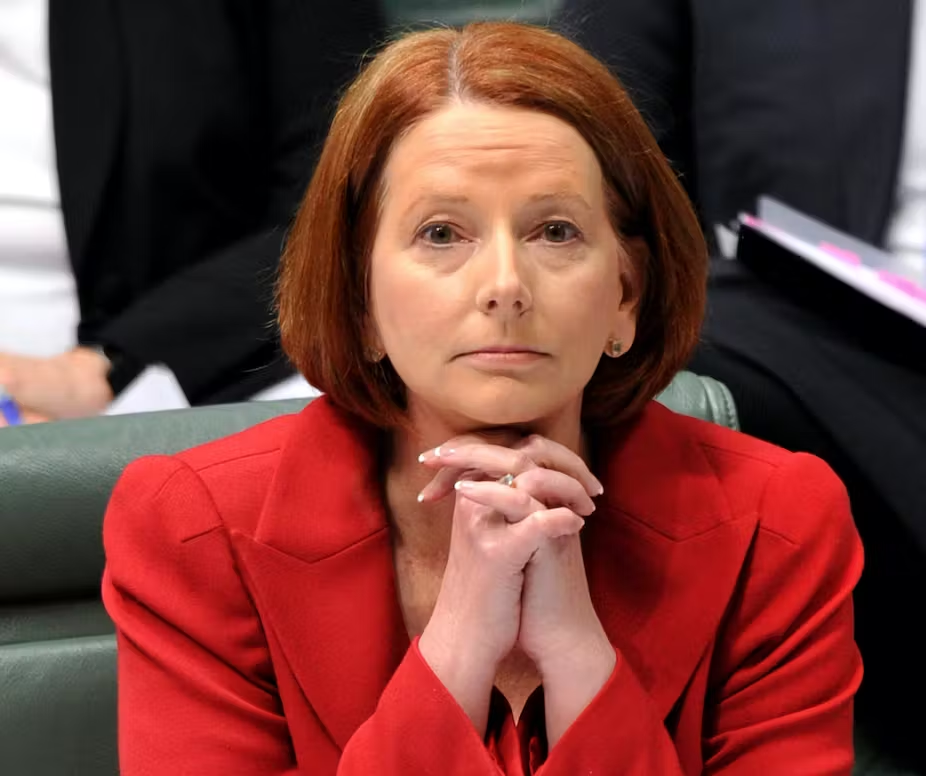


At the 2012 White Paper launch, Gillard spruiked trade and education, ’nurturing deeper and broader relationships’. Her speech made no mention of ‘threats’ and ‘defence’, though these terms are in the White Paper. 


She pushed ‘an ambitious plan to ensure Australia will emerge stronger over the decades ahead, by taking advantage of the opportunities offered by the Asian century.’ It was an advance on the earlier Keating doctrine ‘that Asia is where our future substantially lies.’ 


The 2023 Defence Strategic Review means sinking ships and killing people way outside Australian territory. It would be impossible to quarantine nearby states from any conflict, so the region has to be involved. 


Australian Defence Minister Richard Marles acknowledged this in his Defence Review statement, though more as an afterthought than the prime goal: 


‘Australia will also strengthen engagement with Indo-Pacific partners…to maintain peace, security and prosperity in our region. This includes working with key regional institutions, including the Pacific Islands Forum and ASEAN.’ 


The document asserts that these two agencies ‘remain critical to Australian engagement in the region. Australia’s refocus will continue to rely on such forums as reliable avenues to jointly engage partners at a regional level.’ 


The problem here is that the ten-member Association of Southeast Asian Nations is not ‘a reliable avenue’ but a potholed dead-end lane, a Cold War anti-Communist relic now incorporating Vietnam and Laos, plus authoritarians like Brunei and Cambodia. Indonesia is the current chair. 


In September 2021 FM Payne saw ASEAN as a way for Australia to be more Asian than Anglo because of its ‘centrality, openness, transparency, inclusivity (as) a rules-based region’. 


Her flawed ill-timed statement was delivered seven months after the Myanmar coup in February 2021. It has been made nonsense by the consensus-bound ASEAN states' inability to halt the Tatmadaw’s destruction of democracy and the genocidal civil war. 


Boosting the range 


Australia’s Defence Department says the missiles on its shopping list will be the US High Mobility Artillery Rocket (HIMARS) systems which ‘currently have a range of up to 300 kilometres which is expected to increase with technological advances.’ 


There are already rockets on the market, like the Tomahawk with ranges beyond 1,000 km. The distance from Cape York (Queensland) to Merauke in Indonesian West Papua is only 340 km, but for bigger centres like Darwin to Kupang, it’s 830 km. 


Weapons that can be installed on the Virginia-class subs (aka SSN- 774) on order through the AUKUS deal are related to long-range intercontinental missiles. 


In an earlier attempt at forward defence planning, the perceived menace was Indonesia with left-wing President Soekarno threatening the federation of Malaysia. In 1963 the Menzies government ordered 24 US F111s because they could reach Jakarta, open their bomb bays and get back to Oz.


Like the AUKUS deal, they weren’t delivered for a decade and by then the new pro-Western kleptocrat Soeharto was in power. However, the FIIIs came close to action following the 1999 East Timor referendum which gave the province independence from Indonesia.


Jakarta was furious and allegedly threatened the post-poll INTERFET peace-keeping force led by Australia.


A Sydney Morning Herald report revealed the FIIIs ‘were ‘bombed up’ to knock out Indonesian communications as far back as Jakarta’ should Indonesian forces interfere in the operation. That didn’t happen and in 2010 the F111s were replaced by Boeing FA 18 Super Hornets.


Now the supposed threat is not from, but through, Indonesia. 


The problem for defence planners is getting Indonesia to partner. That’s not best done by ignoring a nation acutely sensitive to any reminders of Dutch colonial arrogance and conscious of its importance as the world’s third-largest democracy. 


The Republic’s passionately held mendayung antara dua karang (rowing between two reefs) policy first revealed in 1948 means it won’t side with world powers. 


We should be grateful. If Chinese H-20 stealth bombers (range 8,500 km) were stationed in the archipelago they could hit Canberra and return. 


The potential to lob high explosives across Indonesian territory from Northern Australia land bases, or AUKUS subs confronting aggressive foreign navies, is already being considered. That’s reason enough to bring into the fall-out shelter those under flight paths or subject to collateral damage. 


If reluctantly forced to back one antagonist through an international crisis, Indonesians would probably choose the US, an assessment based on 2021 research by the Lowy Institute think-tank though neither nation would win any talent quest among the locals: 


 ‘They are increasingly sceptical about China, and particularly of Chinese investment, but neither are they overly enthusiastic about the United States.’ 


Base issues 


Even before the Defence Strategic Review, the Washington marriage had been well consummated. An American defence policy website claims the ‘US military already has at least seven installations in Australia.’ 


That number gets expanded to 34 according to the Australian Anti-Bases Campaign Coalition. The government says these are ‘facilities’. 


Then there are the US Marines on rotation in the Northern Territory, a deal struck by Labor in 2011. The latest known figure is 2,500 soldiers, with talk of expansion., to 5,000, and beyond.


Last year the US said it would deploy six nuclear-capable B52 bombers through Australia, though this has not been directly confirmed by PM Albanese. 


So far the Defence Review has been barely noticed publicly in Indonesia because it was launched at the end of the Islamic fasting month and the start of the week-long Idul Fitri celebrations. Businesses and offices closed as millions quit Jakarta for their hometowns. 


Even when back at work this month, the worries will be less about international hypotheticals and more concerned with domestic certainties - the upcoming elections.  


There’ll be massive and widespread shake-ups following the Constitutionally compulsory end in 2024 of Widodo’s largely benign rule of two five-year terms. 


A re-write of the Defence Review, for the new incumbent in the Presidential Palace in Jakarta might be an intelligent way to improve relations with the neighbours - if that’s what Australia wants.   


First published in Declassified Australia, 15 May 2023:  https://declassifiedaus.org/2023/05/15/snubbing-the-neighbours/

##


Wednesday, March 03, 2021

CRITICS TAKE CARE - JUST SEND COMPLIMENTS

        Messengers beware

The first who told of Lucullus ' coming so angered Tigranes that he had the messenger’s head, effectively ensuring no-one brought bad news. Deprived of fresh intelligence Tigranes watched while war raged, listening only to flatterers.

[more]

Even if Indonesian activists haven’t read Plutarch's Life of Lucullus they’d recognise their predicaments when facing President Joko Widodo, stand-in for the first century BC King of Armenia. 

Widodo comes across as humble, serious about improving the sprawling archipelago’s infrastructure.   His determination to build roads, rails and ports deserves applause, which he enjoys.

Unfortunately he hasn’t done well at social engineering and pandemic control, so no clapping.  He’s had a Chinese Covid-19 jab, but that’s ineffective against the virus of hubris.  So when he asked for public feedback, few have been brave.

The infection originated from media tycoon and Nasdem (National Democrat) Party founder Surya Paloh, 69, whose role is kingmaker, not candidate.  He’s from the north Sumatra province of Aceh; the convention has only Javanese in Jakarta’s White House.

Shortly after Widodo won the top job standing for the Partai Demokrasi Indonesia Perjuangan (Indonesian Democratic Party of Struggle), Paloh suggested the Constitution be changed, letting the President serve more than two five-year terms.

Widodo said ‘no’, knowing he’d never get backing from his party’s matriarch Megawati Soekarnoputri, 74.  She wants her dull daughter Puan Maharani, 47, currently Speaker of the Dewan Perwakilan Rakyat (DPR House of Representatives) to contest the presidency in the 2024 election.

Paloh’s obsequiousness must have gone to Widodo’s head because he’s losing his sheen as a man of the people.  This image once put clear air between himself and his arrogant rival, former General Prabowo Subianto, beating the oligarch 55 to 45 per cent in the direct vote.

In 2015 during his first term Widodo hosted Malcolm Turnbull, showing off his commoner’s credentials by taking the PM on a signature blusukan. This was a supposedly unstaged public market meet-the-wee-folk walkabout.  Those stunts are long gone as Widodo becomes more aloof.

The blusukan delighted a tie-less Turnbull who snapped selfies with cheerful traders.  However it horrified the security detail trying to handle the unconstrained crowds.  The crew cuts who wear sunnies at night and think this makes them invisible, started urging more discipline.

They weren’t alone.  Jakarta palace functionaries had been urging their boss to be esteemed by all, and not just the riff-raff.  A preferred portrayal would be more like Kim Jong-un surrounded by fawning geriatric generals scribbling down the Dear Leader’s inspiring instructions as he tours another missile site.

No journos in those staged shots from Pyongyang. In Jakarta the unkempt media youngsters thrusting smartphones don’t show enough respect for the guy who runs the world’s third largest democracy.

In 2018 a law was passed making it illegal to ‘disrespect Parliament or its members’. Unnecessary - just tickle an old one – the 2008 Informasi dan Transaksi Elektronik (ITE) Law.  It’s supposed to regulate on-line deals, but includes a defamation and insults clause with up to four-years jail for offenders.

After autocrat Soeharto quit in 1998, new media legislation gave some protection to journos and publishers facing malicious litigants. The independent National Press Council was tasked with settling disputes outside the courts.  However the ITE law takes precedence.

Rights’ activists reckon this threatens free speech. Andre Arditya , political editor of The Conversation’s Indonesian edition, wrote: ‘The ITE Law is one of the largest barriers to freedom of expression in Indonesia. The article of defamation and the article of hate speech in the ITE Law are most widely used as the basis for criminal reporting.


‘ ... (Widodo has) completely ignored criticism from the public against him. If there is a response, it usually takes the form of threats, intimidation and arrest of critics.’

In 2018 a teenager in Sumatra was reportedly sentenced to 18 months jail for insulting Widodo on Facebook. Last year South Kalimantan on-line local media editor Diananta Putra Sumedi was sentenced to 14 weeks jail for his reporting of a land dispute, even though the Press Council had apparently resolved the issue.

Last year Amnesty International claimed to have found 29 cases of harassment and intimidation against academics and journos across two months:

‘The right to freedom of expression has already been on a decline in Indonesia in recent years, which is exemplified by the increasing number of people convicted of defamation, blasphemy and makar (treason) simply for expressing their opinions online or organizing peaceful protests between 2014 and 2019.’

Widodo has neutered parliamentary criticism by making Subianto Defence Minister, and handing goodies to small parties.  Veteran Australian academic and writer Max Lane, who lives in Indonesia, has listed the President’s surviving antagonists: ‘The social justice wing of civil society – human rights and environmental NGOs, student activists and the smaller more activist trade unions – and some media, such as the Tempo group.’ .

As in Australia, defamation is an arena to play word games.  In Indonesia it’s been used against journos who expose government corruption, big business wrongdoings and remind potential investors that hazards abound in the Republic’s rugged corporate and legal jungle.

Reporters Sans Frontiéres’ World Press Freedom Index puts Indonesia 119 among 180 countries. (Australia is 28th.)  The Economist Intelligence Unit has Indonesia recording the lowest democracy score for 14 years.  Transparency International’s Corruption Perception Index ranks Indonesia 102 out of 180 countries.

Widodo may be getting concerned about overseas perceptions of his democracy lest they impact on his bid for more foreign investors, already spooked by his mishandling of the pandemic, putting health of the economy above the wellbeing of citizens.   

Human Rights Watch says the response has been ‘weak, with low testing and tracing rates, and little transparency.’  Johns Hopkins University’s Coronavirus Resource Centre reports 1.3 million cases and close to 35,000 deaths, the highest levels in Southeast Asia.

In a speech earlier this month Widodo pondered the possibility of asking the DPR to revise the ITE law ‘if it is proven that the legislation has not provided a sense of justice.’

So far little has happened apart from delegating a police chief to write guidelines, possibly not the ideal person to advise on free speech and media rights.

Widodo’s comments are, as usual, too vague to decode with certainty.  Does the President want the ITE Law to be refined to appease critics – or further strengthened to shut them down?  The man is Javanese, and his words fit a culture which is famously opaque.  Tigranes was too direct.

First published in Pearls & Irritations, 3 March 2021: https://johnmenadue.com/thin-skinned-widodo-messengers-beware/


Sunday, October 19, 2014

New dawn - or democracy’s sunset?                                               


On 20 October Joko Widodo (Jokowi), 53, a commoner from the wrong side of the river, will be installed as Indonesia’s seventh president.

One month ago most commentators were hailing the people’s choice as a bright dawning in the nation’s democratic development, and sunset for the sclerotic graft-ridden oligarchs that have long ruled our closest Asian neighbour.

No longer.

Despite backing by battalions of Generation Net volunteers demanding political and economic reform, and winning by a margin of eight million votes, Jokowi faces a ruthless political guerrilla campaign engineered by his bitter rival Prabowo Subianto.  He’s a former special forces general blacklisted by the US government for alleged human rights abuses.

Prabowo’s contempt for democracy became clear during the dirty campaign which included claims Jokowi was Chinese, communist – even a secret Christian with a conversion agenda, a serious slander in the world’s most populous Islamic nation.

For more than three months Prabowo refused to concede defeat in the 9 July election.  His Gerindra party dashed to the Constitutional Court alleging “massive fraud.”  The court’s nine judges unanimously threw out the claims.

He then mustered a coalition of six opposing parties that hold sway in the Dewan Perwakilan Rakyat, DPR (People's Representative Council).

The Red and White Coalition, named after the colours of Indonesia’s flag, includes right-wing Muslim parties.  It’s also backed by the Islamic Defenders’ Front, a gang of street thugs specialising in mob violence.

In a 2 am vote taken on September 26 the MPs scrapped direct elections for regional politicians, arguing this would save money. At the time President Susilo Bambang Yudhoyono (SBY), constitutionally bound to stand down after two five-year terms, was in the US.

The New York Times reported the move as a ‘setback for the country’s democratic transition and a naked power grab by its wounded political elite’.  Prabowo returned fire, saying this showed foreigners interfering to make Indonesia a servile state.

Now it’s being alleged that Prabowo plans to use his 353-seat muscle in the 560 member DPR to knock out direct elections for the presidency.  It’s also claimed there are plans to eliminate the Komisi Pemberantasan Korupsi (KPK) the Anti-Corruption Commission that has been investigating high-profile politicians and businesspeople, scoring several hits. 


If this happens expect Hong Kong style street protests as the young idealists who put Jokowi into the Presidential palace rise against the establishment’s move to drive him out.

Direct elections, the Constitutional Court and the KPK were introduced following the 1998 ousting of General Soeharto, Indonesia’s iron-fisted second president and Prabowo’s former father-in-law, by pro-democracy activists.

Popular voting propelled Jokowi into local government in his Central Java hometown of Solo, then into the position of governor of Jakarta, Indonesia’s sprawling and polluted capital of ten million souls.

Jokowi’s success seemed to show that anyone in Indonesia could reach the top without connections in the military and Jakarta’s sleazy Soeharto-era mafia.

Raised in a rented riverside shack he helped his father gather timber to pay for his education at the prestigious Gadjah Mada University where he graduated with a science degree in forestry.

After working for a government agency in Aceh he returned to Solo and started his own furniture business. Later he became mayor.  In 2012 he was elected Governor of Jakarta where he became popular for his blusukan (walkabout) administration, meeting ordinary folk and listening to their concerns.

This dirt-under-fingernails style, so different from his haughty predecessors, made him a media sweetheart and presidential candidate.

This slum to head of state background, appealing as it seems, has given little protection against a determined cabal of TV tycoons and cashed-up politicians better known, as one Jakarta newspaper reported, for their ‘fractiousness, proclivity for colossal corruption, political dysfunction and unfettered absenteeism than actually getting anything done’.

Indonesia ranks 114 on Transparency International corruption perception index.  NZ tops the list as the world’s least corrupt.

If external hostility wasn’t enough, Jokowi also faces domestic difficulties.  Megawati Soekarnoputri, the petulant daughter of first president Soekarno who was overthrown by Soeharto in a 1965 coup, heads the Partai Demokrasi Indonesia Perjuangan (PDIP – the Indonesian Democratic Party of Struggle) that endorsed Jokowi’s candidature.

Her behaviour since the election has reinforced a widely held view that Jokowi is her puppet relying on her matronage.  She has already snubbed outgoing President SBY’s attempts to discuss Prabowo’s democracy destabilisation, reportedly because she detests the man who defeated her 2004 bid for the presidency.

With unstable backing, a hostile parliament, a vengeful old guard that controls several media outlets, and huge economic problems across an archipelago of 240 million people, Jokowi is going to need extraordinary political skills just to survive, let alone introduce the fairer society he promised.


##

Monday, November 13, 2006

INHERITING THE KINGDOM OF SUHARTO

FORGET THE FACTS – JUST MANUFACTURE THE MYTHS
© Duncan Graham 2006

A couple of years ago I had a verbal tussle with an Australian academic. She’d been employed by a publisher to scan the typescript of a book I’d written on Indonesia, and was critical of a passage about former president Suharto.

I claimed that while the educated city elite anguishing over human rights and the rule of law might despise him, he was still much admired in the countryside.

The checker said I’d got it wrong. As an expert on Indonesia she knew the man who’d ruled for 32 years was on the nose almost everywhere for his cronyism, corruption, exploitation and neglect of the nation’s infrastructure.

Like Suharto I stuck to my guns, though eventually made concessions. Now, after a weeklong spin through the backblocks of East Java interviewing farmers I know my observations are right. Maybe not then, but after President Susilo Bambang Yudhoyono’s first two years in office they’re spot-on.

It’s no surprise that the one-time dictator will never be brought to court. SBY has heard the unwavering voices of his country’s rural folk, and knows these are more politically potent than the mutterings of metro mopheads.

Yet the reasons for loving Suharto are perverse. Farmers certainly felt the butt- end of his policies. Many were forced by bureaucrats backed by the military to plant new high-yielding varieties of rice.

The government’s Green Revolution policy boosted yields, but at the expense of time-tested farming practices and cultural ceremonies. The result was fractured communities and poisoned paddy.

Growers who refused the imported hybrids, fertilisers and chemical pesticides could have their crops trampled or burned by soldiers. Those who persisted were labelled ‘Communists’ and threatened with jail. Or they’d just disappear.

So why would anyone who’d been subject to this awful treatment still look back on the past with misty-eyed nostalgia?

The reasoning runs like this: Suharto was the father figure, a great man with good ideas. But these were badly implemented by his underlings. The New Order government was a generally peaceful period. Few demonstrated. (They didn’t dare.) The country fed its own people. Rice, fuel and other basics were affordable. If you didn’t get involved in politics you’d be left alone.

Now rice is being imported. There are high prices, demonstrations and disasters, like the Aceh tsunami, the Yogya quake and the Lapindo mud eruption. None of these things would have happened had the old man stayed in office.

For a Westerner such reasoning seems bizarre. The need to import rice has more to do with a rising population, bad planning last century and shrinking farmland than SBY’s policies. Whatever his faults, he can hardly be blamed for the slippage of sub-sea tectonic plates and bad drilling.

But it’s not like that in the minds of traditional Javanese farmers. They have little interest in the doings of democracy and researched facts, but much time for the idea that Suharto was Ratu Adil, the Just King as predicted by the 12th century seer Joyoboyo.

The present president is often criticised for his good-news photo opportunities, the apparent triumph of style over substance. The administration wants to be seen as modern and efficient. That might work with the chattering classes, but it leaves rural rustics cold.

If SBY really wants to displace Suharto in the heartlands of Indonesia he should get his minders to become mythmakers. (Maybe they already are - but let’s not commit lese-majesty, which is apparently still an offence.)

The spin-doctors could push stories of the president meditating in caves, squatting on summits (the mountain variety), having inexplicable experiences involving kris (wavy-blade daggers) and communing with the supernatural world.

Forget he’s an urbane politician with a PhD and fluent in English; just spread the word that he’s really a raw rural lad from a humble home with a mud floor – though born at the right moment in the cosmic cycle.

A trawl through flaking Javanese texts scratched on lontar leaves should surely reveal a prediction that a man with a name like an airport code is destined to be chosen by the people.

It might give the president the mystical legitimacy he seems to lack in the backward looking hamlets of the Republic. Or should that be his kingdom?

(First published in The Sunday Post 12 November 06)

##


">Link