FAITH IN INDONESIA

FAITH IN INDONESIA
The shape of the world a generation from now will be influenced far more by how we communicate the values of our society to others than by military or diplomatic superiority. William Fulbright, 1964
Showing posts with label Indonesian election. Show all posts

Thursday, February 15, 2024

REGRESSION

 INDONESIA CHOOSES - BACK TO THE PAST    


First, the good news from Jakarta on the day after the national election.

The asphalt will not turn red. Canberra and Washington warning their citizens to stay inside and beware of riots were misplaced - no evidence-free allegations that the vote had been rigged, no overturned fire-bombed cop cars, no killings.

Instead, hundreds of thousands cheered and danced to celebrate the apparent win of their heroes - disgraced former general Prabowo Subianto, 72,  and his vice-president sidekick Gibran Rakabuming Raka, 36.  

He’s the eldest son of the present president Joko ‘Jokowi’ Widodo and mayor of small-town Solo. He was supposedly recruited to attract the youth vote, but also to keep Dad’s infrastructure policies going - particularly the new capital and palace in East Kalimantan.

Although final figures are still unavailable, a quick count yesterday night put the pair capturing 58 per cent of the vote, far ahead of the second place (25 per cent)  held by Dr Anies Baswedan, a one-time academic and governor of Jakarta,


The third candidate, Ganjar Pranowo, the former governor of Central Java, was almost out of sight with 17 per cent.

So Prabowo is set to take over in October.  He'll be the nation's eighth leader since the 1945 Revolution when first president Soekarno declared the archipelago a Republic free from the three-century grip of the Dutch.  A four-year guerrilla war followed before The Hague realised its colonial era was past.

In 1965 Soekarno was overthrown by the military led by General Soeharto who instigated the genocide of maybe 500,000 real or imagined Communists.  More than 32 years of authoritarian rule known as Orde Baru (New Order) followed. In 1998 Soeharto resigned in the face of widespread demands for democracy.

In the late 1700s, the French Revolution guillotined the ruling royalty to ensure they'd never return. The Indonesian activists who brought down Soeharto at the turn of this century didn't want bloodshed;  they naively assumed the King of the Kleptocrats and his cronies would disappear into quiet retirement tending their grand gardens, all wreathed in shame.

Wrong call: The Soeharto-era just shook its shoulders and garnered the funds to mount a full-on assault on the Palace using the new democracy.

Yesterday's voters knew little of the past and seemed to care less. It didn't matter to them that Prabowo, a professional soldier, had been dishonourably discharged for disobeying orders and then fled to exile in Jordan.

Three US presidents banned him from their country for violating human rights in both Indonesia and East Timor. He was also banned from Australia till 2019 when he entered as  Defence Minister.

With the help of his businessman dollar billionaire younger brother Hashim Djojohadikusumo, Prabowo started the right-wing Gerakan Indonesia Raya (Gerindra - the Great Indonesia Movement) party as a vehicle for his political career after established parties rejected his approaches.

The cashiered former general lost three times, once as a vice president candidate and twice as president against Jokowi, but has now triumphed.


What sort of leader of 280 million people will he be?  Australian Pat Walsh, an advisor to East Timor's CAVR (Comissão de Acolhimento, Verdade e Reconciliação), has no doubt.

In a scarifying review, the co-founder of the prestigious Australian magazine Inside Indonesia concluded that Prabowo was not a fit and proper person to be president.

"(He) …shared responsibility for the fate of hundreds of civilians who endured crimes …that offends the very essence of civilised humanity included starvation, forced displacement (including of children), rape, torture, killings, imprisonment and forced displacement."

This was not the image seen by voters.  Instead, they were presented with a baby-faced gemoy (cute) grandpa, though the divorcee’s only son is childless and lives in Europe as a fashion designer.  A triumph of jolly cartoons over serious policy and the future of the world's fourth-largest nation.

The VP role now held by Gibran is dubbed ban serep (spare tyre) in Indonesian slang, a powerless ceremonial job.  More than half the voters are millennials or belong to Gen Z, so whether Gibran will lie back and enjoy the role or want to be involved and challenge his arrogant boss is one to watch.

Contrary to the imagery, the hot-tempered authoritarian  Prabowo is not cute, says Professor Tim Lindsey of Melbourne University:

“He has repeatedly said Indonesia’s democratic system is not working and the country should return to its original 1945 Constitution. This would mean unraveling most of the reforms introduced since Soeharto fell …

“Among other things, Indonesia’s charter of human rights would go, as would the Constitutional Court. The courts would no longer be independent, direct presidential elections would end, the two-term presidential limit would go and the president could again control the legislature.”

Little is known in Indonesia of Prabowo's past, where a sanitised version of history is taught in schools.  This shows the gallant military fighting for freedom in the 1940s, then defeating godless Communism in the 60s and recovering the former Portuguese colony of  East Timor, now Timor L'Este, in the 70s.

Prabowo had been involved in four tours of duty on the island.  According to Amnesty International, the invasion and occupation cost the lives of  250,000 civilians from violence or starvation during Indonesia’s 24-year control.

"A truth-telling process in Indonesia is needed," wrote Walsh.  "The deeply regrettable downside of this overdue process in Indonesia is that a person with demonstrated disregard for the rule of law, of both the domestic and international kind and regarded by many as a war criminal, may be elected Indonesia's next president."

But he has been elected by the people in a process that may be the last. Commented Lindsey:  “Indonesia’s fragile democratic system may be the next thing he reinvents – or, more likely, dismantles.”

Canberra will have to accept Prabowo and afford him status - that’s international diplomacy.  It also needs Indonesia to help relationships with China that has been doing big business in Indonesia, particularly with loans and labour for nickel smelters, toll roads and fast rail.

That doesn’t mean the Australian human rights lobby and historians will not rally against the new President. If he does visit Canberra, watch out for the protests now not happening in Jakarta.

## 

First published in Michael West Media, 15 February 2024: https://michaelwest.com.au/indonesia-elects-a-new-president-prabowosubianto/

Tuesday, November 14, 2023

HOW TO VOTE? THE PHANTOMS ADVISE

THE GHOSTS IN THE VOTE MACHINE        


Indonesian politics are about personalities, not policy. Some among the 20,000 candidates for national and regional office at  the globe’s biggest one-day ballot next year  must be driven by altruism.  But  how to vote?  Who do the dead recommend?


Election info next door comes from TV, social media and outdoor advertising, Thousands of placards, giant posters and banners are trashing calming views of paddy and jungle across the archipelago, an assault on the senses.


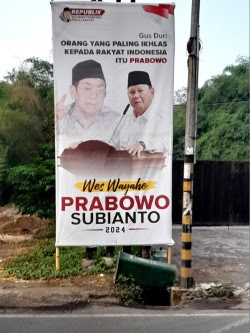
Space on the flapping vinyl is limited to meaningless one-liners, the hopeful’s photo - and a shade exhumed from the netherworld of ad agencies.


They’re added to push voters pondering their choice for next year’s Valentine's Day election, porting the message: ’I’ve come from the beyond to tell you this guy’s good.’


Indonesians are addicted to the paranormal whatever their religion.  Spirits roost in the dense aerial roots of the centuries-old banyan figs; they lurk in the crumbling ruins of Dutch colonial villas, even cornices in modern homes.


Not all are sinister. The most used spectre on the ads is the smiling wraith of Soekarno, hovering behind daughter Megawati, peering down on her choice. 


This is former Central Java Governor Ganjar Pranowo, 55, representing the  mildly left nationalist Partai Demokrasi Indonesia Perjuangan (struggle) which Mega runs ruthlessly.


Be not fooled by the D-word. The secular party and its queen are as democratic as North Korea and Kim Jong Un. Ganjar was not elected by the membership but picked from the throne.


If first president Soekarno was alive today he’d be 122, but his images aren’t Halloween. He looks young and handsome, better known for bedding nine wives than stuffing up the economy and playing footsies with the Reds.


He died in 1970, deposed after a failed coup and a military power grab.  More than half the 200 million registered voters are under 40 so their acquaintance is only  as the Proklamator who announced the end of Dutch colonialism on 17 August 1945.


Yet the party gurus believe his pictorial presence will swing votes - which is like channeling Robert Menzies to boost Peter Dutton’s profile.


Ganjar’s main rival is Prabowo Subianto, 72, a hard-right Mussolini figure. His ads use the apparition of Abdurrahman ‘Gus Dur’ Wahid who died in 2009.


The Republic’s fourth president was an enlightened liberal - the antithesis of the man he’s supposed to be endorsing from the grave. The misrepresentation is gross, running parallel with a plot to whitewash the candidate once banned from the US. 


Melbourne University Professor Tim Lindsey describes Prabowo as ‘a cashiered general and former son-in-law of the authoritarian Soeharto, who ruled Indonesia for more than three decades.


‘Prabowo has been accused of human rights abuses, including in Timor and Papua, and alleged involvement in the abduction and murders of activists around the time of the collapse of Soeharto’s New Order regime in 1998.’


When dishonourably discharged for disobeying orders he fled to exile in Jordan. Now he’s back with his own Gerakan Indonesia Raya (Gerindra) Great Indonesia Movement Party for a third crack at the top job.  He’s backed by Jakarta’s business elite - and (not a misprint), his former rival President Joko ‘Jokowi’ Widodo. 


This next bit requires some suspension of Western reason by believers in the them-and-us Westminster system where leaders are only seen together at state funerals.


Last week Jokowi hosted an intimate lunch for the three men fighting to be his successor. Did they share visions, hopes, challenges? No, they discussed the quality of the chicken soup. Indonesians find chatting about food more palatable than the confrontation debates favoured Down Under.


According to the South China Morning Post, ‘all three candidates share some common policy platforms, such as a commitment to modernising Indonesia’s armed forces and maintaining a free and active foreign policy. 


‘But they differ, analysts say, on their economic strategies, campaign rhetoric – and desire to either preserve or abandon the outgoing president’s legacy.’ This is a reference to the US$35 + billion new capital project in Kalimantan, already struggling for investors.


 Absent from this glib report is any mention of resolving the ongoing guerrilla war in West Papua.


While partisans doctor their hero’s past, a supposedly independent Australian-initiated website The Conversation has relabelled Prabowo as a ‘retired general’. The website’s charter  says its journalism is responsible, ethical and supported by evidence.


Chief Editor Ika Krismantari told this writer she knows Prabowo ‘carried a lot of baggage’ but ‘in many websites he still carries the title purnawirawan (retired), even for some military officers he is still considered as mantan jenderal (former general.’  This is the Trump tactic - tell a lie long enough and it morphs into  fact.


The third contestant, and probably the best for Australia though least likely to win, is the US-educated academic and former Jakarta Governor Dr Anies Baswedan, 54. He has Arab ancestors but so far his advisors have been unable to exhume any corpse keen to endorse.


He’s on the Nasional Demokrat ticket. Like Mega’s outfit it has nothing to do with the ancient Greek philosophy as its goal reveals: ‘To build a democracy based on strong people who are called on to bring about a bright future.’ 


NasDem is the fiefdom of Indonesia’s Rupert Murdoch, media baron Surya Paloh, 72, who titles himself ‘the father of Indonesian restoration’. He can’t get into the palace  because he’s from Sumatra, so plays as a dahlang - puppet master.


Political wisdom has only Javanese Muslim blokes stand a chance. Java is the administrative, religious and cultural heart of the archipelago and the most populous island with 56 per cent of enrolled voters. 


The polls currently show no clear winner, meaning there could be a shoot-out between the top two. In this scenario, most of Anies’ votes would likely go to Ganjar.  If Prabowo fails again expect engineered street riots, as with the 2019 election.


The candidates’ images are masterpieces of electronic editing, erasing the decades of revealing reality. The aged pray that Gen Z idealists won’t notice last century's recycled self-seekers,  only see Dorian Grays.   Spooky.


##

  First published in Pearls & Irritations, 14 November 2023: https://johnmenadue.com/the-ghosts-in-the-vote-machine/

Tuesday, October 24, 2023

MR CLEAN GETS DIRTY


 The making of a dynasty and unmaking of democracy                    


Indonesian politics are played hard. Corruption is a given, but a devious ploy to keep the present president wielding power has backfired with wholesale anger against a gross display of law-bending and nepotism. 


In one sly move, President Joko ‘Jokowi’ Widodo, 62, has lost the backing of the moderate mainstream led by the Republic’s leading public intellectual, Goenawan Mohamad.(below, left)


The writer, poet and campaigner against despots was not a friend, but an open supporter and organiser for Jokowi in the 2014 and 2019 elections.


Past endorsements by Goenawan, 82, have helped sustain the President’s Mr Clean image at home and overseas in a country rotten with graft.  When first elected he was seen as an ‘avatar of reform’.


Jokowi had no links to the military, political Islam, big business or regal families yet got to the top as a darling because he was a competent, humble, small-town man of the people. He’s been dazzlingly popular with big business and the wee folk.


Then to widespread dismay came a push to extend his Constitutionally-limited two terms in power. When this failed he turned to family to remain as a dahlang - puppet master.


The tactic involved approving the nomination of his eldest son Gibran Rakabuming Raka, 36, as a vice president candidate. Not for his father’s party but his opponent’s.


This was altogether too much for Goenawan.


‘Jokowi should have retired in dignity,’ the veteran press freedom activist and founder-editor of Tempo magazine told Michael West Media.  ‘He did much that was good; we have free health care, better infrastructure and much more. The country is safe and the economy is growing. 


 ‘He once had my respect. No longer. I do not support politics being practised without values.’


Gibran is on the ticket of disgraced former general Prabowo Subianto, a former bitter rival to Jokowi in previous elections and head of the right-wing Gerindra (Great Indonesia Movement) party.  


Posters promoting Prabowo featuring Jokowi and Gibran are already on the streets, some confusingly captioned ‘Jokowi Party’. This is like having Albanese validate  Dutton as next PM.


To get in the running Gibran had to persuade the Constitutional Court to make an exception to the rule limiting the VP role to the over-40s.


This month the court ruled five to four in his favour. One of the assenting judges is the applicant’s uncle. The Australian-educated Gibran was formerly mayor of a small Central Java town, a position previously held by his father.


In an open letter to the President and published this month Goenawan wrote: ‘The sense of justice is violated, the agreed rules are betrayed … because the person we trusted turns out to be deceitful.


‘In 2022 I said Jokowi was the best president in Indonesian history until now.


‘But in 2023, I am reminded of the classic wisdom, that a leader who is admired and praised is a man who is tempted. Power and praise are evil for the person on the throne, and addictive.


 Prabowo expected that recruiting Gibran would rocket him to the front. But Goenawan’s surprise attack on Jokowi and public dismay at the fall of their idol and what appears to be judicial activism could well shoot down Prabowo’s chances.


In Indonesian affairs, there’s rarely a separation of faith and politics. Candidates’ personalities, families and quirks carry more clout than policy. 


The three main contestants are all male, Muslim and from Java.  They want  to rule a nation of close to 278 million (of course half are women) from 1,300 ethnic groups spread across the world’s largest archipelagic state of 6,000 inhabited islands.


The number of Christians in Indonesia almost equals the total population of Australia.


The campaign is revving hard and the people next door are being chased  down with promises of El Dorado and sometimes hard cash for their 14 February vote. The world’s largest single-day election for 20,000 national and local parliament seats is held once every five years. 


Voting isn’t compulsory but in 2019 the turnout of 83 per cent from 191 million registered voters suggests Indonesians like democracy (or a mid-week holiday), though the toll was awful; 456 election officers, 91 supervisory agents and 22 police officers died, mainly from stress and exhaustion. Seven million worked on the poll.


The election outcome will be critical for Australian trade and regional security, maybe even tourism if a fundamentalist candidate wins and diplomatic relations are threatened by xenophobic politicians.


Indonesian politics don’t follow the Westminster model of government and opposition.

Switches are rarely made on matters of principle. Minor parties get seduced into coalition with promises of access to ministries and the chance to reward donors, so opposition withers.


Although Indonesia became a republic in 1945, Javanese oligarchs flaunt their connections to the Sultanates of colonial days. Prabowo adds aristocracy to his credentials for office.


Deleted from the CV are these facts: He was kicked out of the military in 1998 for disobeying orders and fled to exile in Jordan. For several years his human rights record had him banned entry to the US where he’d studied the arts of killing at Fort Benning.


He was also booted from his 15-year marriage to Soeharto’s daughter  Siti Hediati Hariyadi. Their only son Didit Hediprasetyo is a fashion designer in Germany and is widely whispered to be gay.


So what? Only that last year his homeland legislators made adult consensual same-sex conduct illegal, bucking the international trend.


Now 72 Prabowo seems nothing like a general, apart from the strut and arrogance. He’s plump and short and it shows when standing close to his slim, young recruit.


Hung with the albatrosses of disgrace, divorce, and deviancy’ should have made Prabowo politically impotent.  The shame of losing by ten percentage points to Jokowi  in the 2019 contest, was then followed by Trump-like tantrums with accusations, appeals and riots. Eight people died and more than 600 were injured.


Then Jokowi made him Minister for Defence, following the Lyndon  Johnson fugly wisdom that it’s ‘better to have your enemies inside the tent pissing out, than outside the tent pissing in. 

That gave him a platform and an equal chance, say pollsters. He’s a US dollar multi-billionaire backed by a tame media, keen to protect the nation from multiple imagined threats.


These include the claim that Australia plans to Balkanise the ‘Unity State’ to plunder its mineral riches, and treating a US sci-fi fantasy about a 2030 apocalypse as a fact.


Like the referendum debate, the slur-throwers care only that some lies will stick to the blanket of indifference and confusion.


Prabowo changes his colours like the Pacific tree frog. One commentator put it succinctly: ‘He appeared as a patriotic soldier in his 2004 bid for the vice presidency (representing yet another party) … then as a rabble-rousing nationalist in the 2014 presidential race, before polarising the public as an aggrieved Islamist in 2019.’


Ganjar Pranowo with author


 Now he’s hunting the youth vote through social media and having Jokowi’s son as a subaltern. His main opponent is Ganjar Pranowo, 54.


Logically (by Western standards) the former Central Java Provincial Governor should succeed Jokowi as both are in the mildly left populist Indonesian Democratic Party of Struggle (PDI_P) which has a majority (128 of 575) seats in the Legislative Assembly.


Their party boss is Megawati, daughter of founding president Soekarno.


Earlier this year she ordered Ganjar to reject Israel’s national team in the Under-20 World Cup football (soccer) tournament. Hosting rights were then lost to Argentina. Millions were angered by their sport being kicked by politicians. Seventeen to 39-year-olds make up half the voters.


Logically this cohort should back former Jakarta Governor Dr Anies Baswedan who appears to be the most acceptable candidate for Australia. He often visits so knows our views and values. 


He’s running behind largely because he hasn’t been blessed by Jokowi. The two men fell out when the reformist and ambitious Anies was Minister for Education and seen as a threat.


The US-educated former rector of a liberal university has Arab ancestry so pulls the Islamic vote.  Indonesia is a secular state but has the world’s largest population of Muslims. 


Ganjar is deft at handling controversy. In a 2019 podcast, he admitted to watching porn, risky in an uptight nation that bans sites like Tumblr and Vimeo.


He told an interviewer: ‘If I watch porn, what is wrong with that? I like it. I am an adult. I have a wife,’ Ganjar played the story for laughs suggesting it was a publicity stunt to tickle the lads.


The real porn stars are the power-crazed contenders raping democracy.


From now to Valentine’s Day there’ll be much hate and little love on the hustings. 


##


First published in Michael West Media, 24 October 2023: https://michaelwest.com.au/indonesian-elections-the-making-of-a-dynasty-and-unmaking-of-democracy/