FAITH IN INDONESIA

FAITH IN INDONESIA
The shape of the world a generation from now will be influenced far more by how we communicate the values of our society to others than by military or diplomatic superiority. William Fulbright, 1964
Showing posts with label Veronica Koman. Show all posts

Saturday, March 02, 2024

HAVE WE GOT GOODIES FOR YOU

WE’RE HERE TO HELP -  TRUST US


Photo:  DeTik.com

Defence Minister Richard Marles telling Indonesians of “shared collective security” is irony rich. In February neither nation saw basic fishing craft sail 800 km here, drop passengers and head home.

Indonesians worry about their confrontational neighbour Down Under.  It points missiles in our direction and invites foreign nuclear-capable bombers to use nearby airfields.  The Aussies are also shopping for warships and submarines to sail in seas that lap our  shores. Alarming?

Relax folks.  These weapons are meant to smash someone else far away;  they'll just fly overhead and sail past.  She’ll be apples.

This was the comforting message carried last week by Marles in his two-day dash to Jakarta to meet counterpart Prabowo Subianto and offer congrats.  He’d just had a major but delayed promotion to President of the Republic.

The official results of the 14 February election won’t be available for another three weeks.  The two losing candidates’ teams have combined, alleging “fraud, meddling and favouritism" and demanding an inquiry.  

These  issues didn’t bother Marles or another in-and-out visitor to Jakarta, Defence Force Chief General Angus Campbell, also scrambling to shake Prabowo's hand.
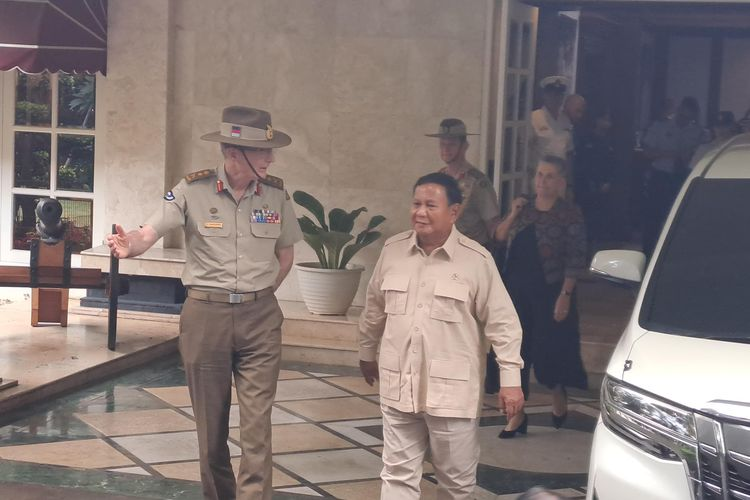


This led  to a flurry of mainstream media stories on a detail-free but adjective-heavy "very significant defence cooperation agreement within the next few months.”

Most Indonesians paid little attention; as in Oz, domestic issues top their concerns. The price of rice has risen 20 per cent in the past few months.  

Biggest fleet coming

Marles reportedly told Prabowo his government plans to build the largest naval fleet since World War II for "mutual security … the single deepest and most significant defence cooperation agreement in the history of the two countries.

"Australia and Indonesia have a shared destiny and a shared collective security and that is the basis on which we are moving forward with our own defence planning."

The bureaucratic hype sounds bracing but the words are bullshit. The “collective security” was exposed when an Indonesian fishing boat or boats carrying 39 mainly Pakistani asylum seekers crossed an open sea, beached their human cargo, and then zipped  away undetected

Either the fishers are extraordinary skilled seafarers, or shared surveillance is a nonsense. As a footnote to his talks Marles added the ministers are “discussing the issues of people smuggling and people trafficking.”

Then there’s the issue of acceptance. Prabowo won’t take over till October when he’ll have to fill a Cabinet of disparate Ministers.  Not all will like their neighbour or its prezzies.

Thanks, but no thanks

 As ANU Professor Hugh White has pointed out, Indonesian “economic growth is driving it towards a position of political and economic influence that it seems both uninterested in and incapable of exploiting.”

In other words, Jakarta hasn't been keen on being courted by the US (via postmen from Canberra) or China, but falls back on old cliches about treating all equally, staying midstream and not joining pacts.

Australian defence funding for this financial year is AUD $50 million (US$33 billion). Indonesia, eleven times larger than Australia in population, wants to spend US$25 billion.  

Despite the archipelago’s intense religious-based hostility to the godless Communists, the government has no desire to confront Beijing.  The PRC is buying megatonnes of Indonesian resources - particularly coal and nickel - and lending billions for infrastructure projects like high-speed rail.

Indonesia has already been caught  in a ‘debt trap’ say some economists, owing more than US$27 billion according to reported Bank Indonesia data.

China has 55 people to every Australian and an economy that could devour Oz and its neighbours without belching.  It already has a nuclear-armed inter-continental ballistic missile that could reach and vaporise Canberra.

Curiously the idea that buying lots of ordnance from Western countries and signing pacts might help Australia in a stoush with a monster has merit for some, like Marles and Campbell.

Though they argue they're concerned with defence and not aggression, it's hard not to see otherwise.

The arms trade is far more important than the educators, civil engineers, climate scientists, inventors of better ways to provide peace, medical workers who want to find cures for nasty diseases - and just about everyone else who’d like to be close to Indonesia and help the people.

In a statement ahead of his trip Marles said  the two countries have a long history of close cooperation on maritime security and would "share an ambition to further broaden and deepen our defence relationship.

 “This is a shared challenge for both of our countries and we need to be working cooperatively. 

Villainy nearby

To placate edgy nationalists he signaled to journalists that “there’s no support for any independence movements … we support the territorial sovereignty of Indonesia and that includes those provinces being part of Indonesia, no ifs, no buts, and I want to be clear about that.”

If "we" means himself and a few senior conscience-cauterised Cabinet members he may be right. Otherwise, he's wrong. Politicians, NGOs and churches distressed at reports of brutality, evictions and killings are backing the Free Papua movement, well-embedded in Australia.  

Indonesian human rights activist and lawyer Veronica Koman lives in Oz though she's wanted in her homeland for alleged incitement and spreading of fake news online about West Papua.

Jakarta took over West Papua from the Dutch after a staged referendum in 1969 when the hand-picked local ‘leaders’ voted unanimously to accept Indonesian control.

Since then the issue of independence has bubbled along more like a hot spring than the cool pool of Marles’ rhetoric, at times erupting into heated confrontations. In 2006 then PM John Howard turned up the heat by giving 43 asylum seekers from West Papua refugee status.

Seven years later the Australian Signals Directorate clumsily bugged the private phones of Australophile President Susilo Bambang Yudhoyono and his late wife Ani. The couple and their country were furious.

In 2017, Indonesia parked military cooperation following an alleged mocking of  the national ideology of Pancasila by an Australian language teacher.

Last year a US-dominated multi-nation defence exercise dubbed Super Garuda Shield was held, prompting this comment from China:

“The US needs to earnestly respect regional countries’ effort to uphold peace and stability … stop meddling in South China Sea issues, stop sowing discords and creating trouble.”

The real challenge is bringing the people on both sides of the Arafura Sea closer and less distrustful.  Not so easy when the tip of a Tomahawk missile looms just over the horizon.

## 

First published in Michael West Media 2 March 2024: https://michaelwest.com.au/richard-marles-indonesia-australia-relations/

Tuesday, February 15, 2022

SQUASH DISTRUST BEFORE IT SWARMS

                  Lost in mistranslation 


 Dubes Australia Penny Williams, Siap Eratkan Hubungan Kedua Nagara

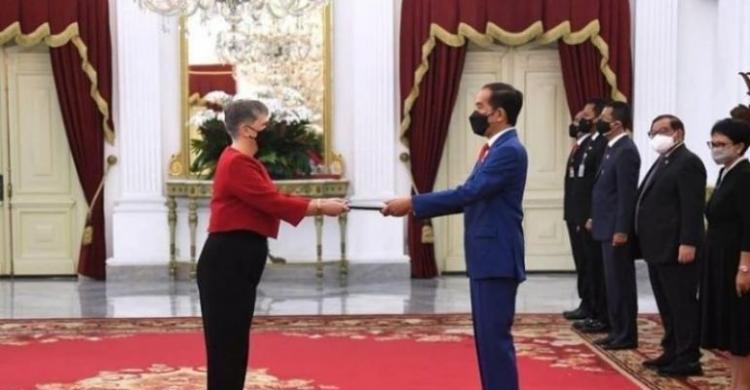
 President Joko Widodo & Ambassador Penny Williams.  Source: Rakyat Merdeka


While Australia yawns at mentions of matters relating to Indonesia, it’s much the same t’other side of the Arafura Sea.   Last century youngsters were hungry to learn English and overseas cultures.  Their appetite was met by enthusiastic teachers following a policy of raising a generation equipped to handle the world. 

Instead, the energy has bogged down in ideologies and bureaucracy notwithstanding the intentions of forward-thinkers like Harvard-educated Education Minister Nadiem Anwar Makarim. He’s a 37-year old entrepreneur drafted by President Joko Widodo to shake up the education sector, only to collide with the power of reactionaries seeing secularism behind reform.

Distrust of Western values and Australian intentions is pervasive so all the more reason to try harder.  That doesn’t seem to be on new Ambassador Penny Williams’ agenda.  Despite knowing the language and past involvement in progressive causes (she’s a former Ambassador for Women and Girls) the lady’s yet to make a splash. In the last three months, she’s put out only ten press statements, mostly on trivial matters. 

Apart from a tweet from Makassar, it appears she didn’t recognise Australia Day through any speeches or mainstream media.  (Her office hasn’t responded to a request for details.) Here was an opportunity to explain how Australian unions helped the revolutionaries liberate Indonesia from the colonial Dutch.  It’s a forgotten story for this century’s generation so needs continuous retelling.

If that’s currently considered too political for Canberra, Williams could clarify that her nation’s not a British franchise as many think because the Union Jack’s on our flag and the Queen’s image on our currency.

Nor are we the US ‘deputy sheriff’ in the region as former PM John Howard reportedly said in 1999.  The offensive tag remains fresh because Australia supported the East Timor referendum, also in 1999.  We can be proud of our initiatives and peacekeeping, our billion-dollar aid when the 2004 tsunami ripped Aceh, but that doesn’t mean we’re loved.

For Indonesians, the Unitary State is sacrosanct so the loss of the Portuguese territory it invaded in 1976 has left a deep and weeping wound.  That’s not the only irritant.

Some argue the AUKUS alliance and build-up of foreign troops and weaponry in Northern Australia are ‘too close for comfort’ and could trigger an arms race. These alarms have been addressed, though only lightly.

Instead of explanation and education, we use trade to find ‘not just a respected partner but a valued one as well’. That’s according to Agriculture Minister David Littleproud.

His message is monetary: ‘Indonesia is Australia’s fourth-largest market for bulk primary produce … valued at $2.9 billion (last financial) year.’  We want to feed you, not know you.  Curiously WA, which pioneered business and cultural ties with East Java across 30 years, has now downgraded the deal.

Despite the ravages of Covid killing 144,000 and infecting 4.3 million (Reuters’ figures from official sources and widely considered too low) the Indonesian economy is going gangbusters.

The World Bank's Global Economic Prospects forecasts growth this year will hit 5.2 per cent, but there’ll be minimal trickle-down. Oxfam research shows the four richest men in Indonesia own as much wealth as the country’s poorest 100 million citizens.

 Australian 2021 budget papers projected 3.75 per cent this fiscal year, so some catch-ups are needed.  We’re no longer masters of economic management haughtily telling ‘developing nations’ how to add and subtract.

Just as Australians can be racists, Indonesians aren’t always the pliant friendly folk of tourist brochures. In 1965 a bloody coup in Jakarta was followed by the slaughter of an estimated 500,000 real or imagined fellow travellers by civilian militias weaponised by the army.

We know of the Holocaust in Europe though not the genocide close by.

There have been other outbursts of violence, often focussing on minorities.  Ethnic Chinese are usually the targets along with so-called deviant Islamic sects.

Another eruption of hate could send a wave of asylum seekers heading our way as they did after the 1998 riots when President Soeharto quit, though they’d most likely come by plane, have full wallets and follow faiths other than Islam.

To ensure a benign view of the people next door, this distressing history is blacked out in Australia by the ‘moderate Muslim’ label, though scholars question the term’s meaning.  Likewise, the termites of corruption gnaw away in almost every departmental nook and immune to pest controllers. 

A decade ago Transparency International’s Corruption Perception Index ranked Indonesia 96 among 179 nations.  Its position now is 102.  This frightens the Western investors Widodo says he wants to attract, but won’t get serious.

Ongoing anti-graft government campaigns use billboards, pledges and stern statements – all ineffective because the political will is absent, as with the Australian government's plan to establish an anti-corruption commission.

The first stage in fixing problems is to accept their presence and examine the reasons.  Neither Indonesia nor Australia is currently inclined to confront ignorance, misunderstanding and distrust which threaten the connections.  

They’ll be a wake up when there’s an explosion of fury for some seemingly mild political stumble, like Scott Morrison’s 2019 proposal to move our embassy from Tel Aviv to Jerusalem.  Mobs protested in Indonesia, forcing the closure of two consulates.

Friction points include a low-level insurgency between West Papuan separatists and the Indonesian military, hidden from world view by Jakarta censorship equal to the Chinese cover-up of its alleged anti-Uyghur campaign.

Lawyer Veronica Koman, a prominent advocate for the dissidents, has taken refuge in Australia.  She’s wanted by the Indonesian police for ‘provocation’ and ‘spreading hoaxes’.  If Jakarta demands extradition there’ll be anger aplenty.

The late Australian Professor Jamie Mackie wrote:The first and most dangerous of the problems ahead — and possibly the most likely — are issues relating to separatist movements in Papua
and the support they garner within Australia.

‘This tends to arouse suspicions in Indonesia that Australians have a hidden agenda to bring
about the dismemberment of Indonesia as a unitary state. Because of the complex, emotionally charged political dynamics within each country associated with this, it could easily get out of hand and prove difficult for both governments to resolve through calm negotiations.

Better to spruce up the relationship now than wait till what remains collapses into misunderstandings and ill will.  The next Presidential direct election will be on 14 February 2024 and there’s a chance Prabowo Subianto, who’ll then be 72, will have his third crack at the top job.

In 1998 the former general was discharged after his troops kidnapped and tortured student protestors. He then fled to Jordan and was banned from entering the US.

Prabowo is Indonesia’s Trump lite who’d ignite the wrath of human rights activists worldwide if elected. After his 2019 loss supporters rioted in Jakarta. Eight died and more than 700 were injured. Few think the violence was spontaneous.

Prabowo is now Minister of Defence, drawn into the inner circle by  Widodo who followed US President Lyndon Johnson’s advice on handling FBI Director J Edgar Hoover: ‘It’s probably better to have him inside the tent pissing out, than outside the tent pissing in’.

Offering a Cabinet post to a defeated opponent after a vicious campaign is a fine ‘forgive thine enemies’ gesture, but it wouldn’t rock in the West, even in countries that claim to follow Christian principles.

All the more reason to get to know the neighbours.  Mackie offered scores of suggestions in his 155-page Lowy essay, but don’t ask any wannabe politicians to show the way in this year’s campaign. 

First published in Pearls & Irritations, 14 February 2022:https://johnmenadue.com/lost-in-mistranslation-australian-soft-power-goes-missing-in-indonesia/


##


Wednesday, May 05, 2021

HR v PR


          Stoking the fires in West Papua


We know this order will lead to more killing, more torture, more suffering of my people. The Speaker of the Indonesian House [of Representatives], Bambang Soesatyo, has urged the Government to ‘destroy them first. We will discuss human rights matters later’.


Indonesian government censors are slipping up. Maybe they’re too hungry and tired during the fasting month of Ramadan to choke every tweet which criticises Jakarta’s West Papua crush-dissidents policies or promotes independence for the far eastern province. (Confusingly there are two provinces – Papua and West Papua, but the latter term is widely used for both.]


Indonesians seeking information that hasn’t been well washed by the Army normally have to use VPNs to bypass the blue pencils. But the statement above by Benny Wenda, Interim President of the United Liberation Movement for West Papua, got through.


It follows the ambush of a motorcycle squad led by Special Forces Brigadier General Gusti Putu Danny Nugraha Karya, 50. He was reportedly shot on 25 April while heading to see school buildings allegedly torched by separatists. If correct it suggests the guerrillas have better intelligence than their opponents.


Two years ago nationalists killed 19 workers on the serpentine Trans-Papua Highway. The 4,600-kilometre road will open up land to outside settlers against the wishes of local tribes. 


Outsiders are barred so regular allegations of abuses by the military are rarely independently tested. Half the population of more than 1.2 million are Melanesians. The rest are mainly migrants from other parts of the archipelago leading to fears the nominally Christian indigenes will soon become a minority.


Last month’s killing of such a senior officer aroused the wrath of the government and army which launched Operasi Nemangkawi to find the attackers. They are believed to be from the poorly armed West Papua National Liberation Army, the military wing of the Free Papua Organization.


President Joko Widodo declared the WPNLA a terrorist organisation and ordered the police and military “to chase and arrest" all rebels involved: "I want to emphasise again that there is no place for armed groups in Papua." 


Widodo’s words were followed by Soesatyo who brought a tanker-load of fuel to the conflict with his comments about ignoring human rights, drawing this response from Wenda: 


“Amnesty Indonesia has already condemned the Speaker. In the last 24 hours, we have reports that people are fleeing the villages in anticipation of the crackdown. Helicopters are being deployed over the villages, reminding me of what happened in 1977 when I was a child.”


 As in so many fights for independence, irony is ever-present along with the bombs and bullets. Widodo’s and Soesatyo’s statements could have been delivered by Dutch generals between 1945 and 49. The Netherlands was fighting Indonesian nationalists who said they were in a War of Revolution. The Hollanders’ term was ‘Police Actions’.


Whatever the title it left an estimated 100,000 Indonesians and 6,000 Dutch dead before the conflict was settled following intense pressure on The Hague by Washington. However, the west end of the island of New Guinea stayed with the Dutch till it was incorporated into Indonesia in 1969 through an UN-sponsored ballot.


The authenticity of the poll has long been challenged by Wenda and his predecessors. It was called the Act of Free Choice with 1,025 voters selected from an estimated 700,000 Papuans. 

Western media observers labelled the exercise an Act Free of Choice.  The result was unanimous support for Indonesian control.


Cynics claim the low-intensity struggle waged since then with little independent scrutiny is more about money than sovereignty. 


Explainers tag the province ‘resource-rich. That’s an understatement. The Grasberg mine, once owned by the US company Freeport, but now majority held by the Indonesian government, is the seventh-largest gold mine and the second-largest copper mine in the world. Both minerals are fetching top prices.


This is one reason why Indonesians have little sympathy for the ‘terrorists’ who are usually imagined to be puppets controlled by nameless outsiders. These sinister forces apparently want to plunder the goodies and impoverish the nation, repeating the policies of the Dutch colonialists.


The loss of another province after the East Timorese voted for independence in 1999 would further destroy the ‘Unitary State’. This concept is held as strongly as Australian politicians invoke the ‘Anzac Spirit’ to demonstrate their nationalism.


Reinforcing the international conspiracy theory is that Wenda, 46, isn’t in his homeland. He lives in Oxford after escaping from a jail in West Papua in 2003 and fleeing into Papua New Guinea. He’d been charged for leading an independence rally and faced 25 years behind bars.


With the help of European NGOs, he got political asylum in Britain where he leads a global campaign for independence.


Another activist working from overseas is Indonesian Veronica Koman, 32, who remains in Australia where she came to study postgraduate law. In 2019 she won the Sir Ronald Wilson Human Rights Awards for exposing human rights abuses in West Papua. 


Indonesian authorities want her back to face accusations of sedition. An account with her name tweeted that declaring independence fighters as terrorists meant "Indonesia has just burnt the bridge towards a peaceful resolution".


Australia always denies backing Papuan separatists, though supporting NGOs – often faith-based - are operating from the continent. So far this hasn’t become a hot issue in relations between Jakarta and Canberra, probably because Covid-19 is getting a higher priority and the two nations are cooperating on disease control. 


 However, it remains a slow burner ready to flare if the death of the one-star general is followed by fierce and unchecked retaliation drawing overseas outrage. Some media are already carrying reports – sourced to the ‘Nemangkawi Public Relations Task Force’ - that nine members of an ‘armed criminal group’ were killed in a shootout three days after the Brigadier General died.


Footnote:  I first applied for a journalist’s visa to enter West Papua four years ago. It was endorsed by an Indonesian Ambassador. Despite assurances there are no problems and it’s being processed, I’m still waiting.


First published in Pearls & Irritations, 5 May 2021: https://johnmenadue.com/human-rights-abuses-on-our-doorstep-but-we-say-nothing/


Tuesday, December 29, 2020

TOO BIG TO IGNORE - TOO COMPLEX TO TRY

                        The nation that’s an afterthought

If a relationship just concentrates on STDs it’ll never mature.  That goes for countries as well as couples.

Indonesians are nuts about acronyms, so let’s indulge. We’re not referring to HIV, chlamydia and gonorrhoea, but Security, Trade and Defence.  These are the areas Australian politicians brag about when talking about the health of our relationship with the people next door.

It’s an essential trinity, but goes nowhere towards bringing the people of Australia and Indonesia closer.  When terrorists are snared few know ASIO intelligence may have helped.   Naturally the local cops take credit.

With the new free trade agreement in place producers just want to empty silos while consumers are unaware the grains used in their instant noodles come from WA’s wheatbelt.

The carcase hanging in the red meat market was raised on the Barkly Tablelands but finished in a feedlot where it lost its NT identity.  In brief we don’t push Made in Australia and show little interest in who buys what at the retail level.

Defence is problematic because the Big Durian’s conservatives don’t trust Canberra.  The 1999 US ‘deputy sheriff’ quote attributed to former PM John Howard has been long buried Down Under, though regularly exhumed by the Indonesian media.

At one time the Islamic national daily Republika screamed:  Australia ready to invade Asia.  The notion that 25 million could threaten half a billion across Southeast Asia is beyond ridiculous – but it made sense to sceptics knowing the Big Country has a Big Daddy in Washington.

We excel at aggravating suspicion.  In 2006 the Australia-Indonesia Agreement on the Framework for Security Cooperation, aka the Lombok Treaty, committed both nations to cooperation and consultation in defence and law enforcement, combating international crime and terrorism, and sharing intelligence.

The signatories also agreed they’d not ‘in any manner support or participate in activities by any person or entity which constitutes a threat to the stability, sovereignty or territorial integrity of the other Party’.

In late 2011 we learned up to 2,500 US Marines would be stationed in Darwin, the largest port in Australia closest to Indonesia. The English language Jakarta Post chose an unfortunate metaphor when it labelled the news a ‘bombshell’, claiming Indonesia hadn’t been told in advance.

How did this fit with ‘consultation’ and not threatening ‘stability, sovereignty or territorial integrity’?  The FM at the time, Dr Marty Natalegawa, reportedly said it could create ‘a vicious circle of tension and mistrust’.

In 2013 Australian spooks were exposed as phone tappers bugging then president Susilo Bambang Yudhoyono and his wife Kristiani Herawati.

Last year another surprise – plans to develop the deep-water Lombrum naval facility on Manus Island in the Admiralty Archipelago, part of Papua New Guinea.  It’s best known as a pen for asylum seekers caught sailing south from Indonesia.

Now labelled the Lombrum Joint Initiative, the scheme – reported to cost AUD 175 million - is to make the port a joint US-Australian military forward-defence post, allegedly to counter Chinese expansion.   Manus is less than 700 km from Jayapura, the capital of Indonesia’s Papua province.


For Australians with knowledge of the Japanese bombings of Darwin and Broome in WWII from airstrips in Indonesia, it makes sense to have a joint facility in northern Australia.  But our defence can be another’s offence as China and the US play musical chairs around the archipelago hoping for a safe seat.

That’s unlikely to happen without a seismic policy shift in Jakarta. The Republic has long held its ‘free and active’ foreign policy stressing non-alignment with any outside power.

When studying at the ANU Natalegawa ran a paper round in Lyneham and O’Connor. His three kids went to local schools.  He’s been a regular visitor since so knows Australia well. 

Four years ago the urbane envoy spoke at ANU  ‘of  trust deficits within nations - democratic and authoritarian alike, – a condition only too readily seized and exploited by the demagogy of those bent on whipping up public fervour for the sake of popularism ...

‘Diplomacy is a process and not an event. It is one that requires the earnest of efforts, building and, indeed, rebuilding trust and confidence.’

That effort isn’t being made earnestly by either side leaving space for the malicious purveyors of BS.  In 2013 new PM Tony Abbott announced ‘more Jakarta and less Geneva’ but didn’t maintain the pledge.  His successors have behaved similarly.

It’s as though early recognition of the world’s fourth most populous nation (270 million) with 88 per cent Muslims is a boring obligation for fresh PMs to be followed by a rapid forgetting.

President Joko Widodo prefers to concentrate on domestic issues, making foreign affairs a fertile ground for Natalegawa’s feared demagogy.

Apart from the arms build-up in Northern Australia and PNG, another threat to mateship is coming from Australian NGOs and churches supporting Papua independence activists.  This riles the partisans who reckon the Australian government is aiding and abetting a master plan to fracture the Republic.

Canberra’s shrill denials and reminders that in Western democracies peace promoters have rights to agitate have little impact.

Indonesian human rights lawyer Veronica Koman is allegedly hiding in Australia.  Jakarta wants her back to face charges of inciting race riots through social media statements.  So far these demands have been low key but if inflated could ramp tensions.

In Strangers Next Door?  Melbourne academics Tim Lindsey and David McRae put the problem plainly: ‘There are no two neighbouring countries anywhere in the world that are more different than Indonesia and Australia. They differ hugely in religion, language, culture, history, geography, race, economics, worldview and population.

‘In fact, Indonesia and Australia have almost nothing in common other than the accident of geographic proximity. This makes their relationship turbulent, volatile and often unpredictable.’ 

The Bill Gates-George Soros plot to control the world through micro-chipped vaccines is mild paranoia compared with the chauvinists’ belief the West plans to dismember Indonesia’s ‘Unitary State’ and seize its mineral wealth.   Disabusing our neighbours of this lunacy is going to need more than chants about concord.

Indonesia will only get bigger.  Like it or not, politicians and public servants need to engage or bequeath a future of hostilities.  Ambassador Gary Quinlan, 69, is in Canberra for health reasons.  He’ll retire next year and tipped to be replaced by Penny Williams, 57.

Williams was an exchange student in Indonesia during the 1980s and High Commissioner to Malaysia last decade.  It’ll be a tough gig, but the first woman to head the Jakarta post is well qualified and likely to get noticed by the media.

An Indonesian and Arabic speaker, the mother of four has been Australia’s Global Ambassador for Women and Girls.  In that role she was a strong though careful advocate focussing on the economic advantages of education to boost development rather than the human rights argument.  Diehard patriarchs don’t see women’s rights as universal but a Western threat.

In 2012 she was in Jakarta singing the required verse: ‘For Australia, there is no more important relationship than with Indonesia.’  As boss of our biggest embassy she’ll get the chance to change the STD lyrics.  How about Stratagems to Trash Disinformation?

 First published in Pearls & Irritations 16 December 2020

https://johnmenadue.com/duncan-graham-we-pay-lip-service-to-our-relationship-with-indonesia/