
How China is muscling Indonesia
Unlike Australians, Indonesians don’t fear war with China. Their concerns are more prosaic – debt, work and the virus of atheism.
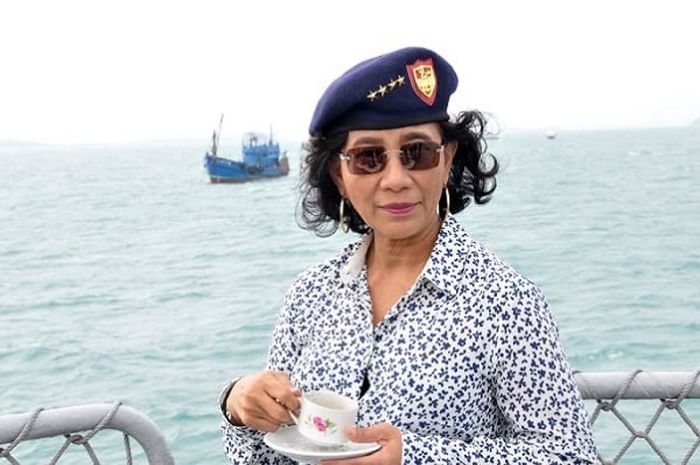 Credit: Makassar Terkini
The TV news shows were spectacular. First, a wide shot of empty fishing boats bobbing on choppy seas. Then a close-up for the thump as shattered planks flew skyward in a red flash while the hull disappeared in an eruption of bubbles.
At last – someone showing foreign poachers not to mess with the islanders of Nusantara. Hundreds of boats were sent to Davy Jones locker. The wee folk loved it – the heavies didn’t. Ships claiming to be local were found to be overseas owned.
Indonesia is the second-biggest producer of seafood and was losing trade to the first. China has a 17,000-strong fleet working the waters of other countries … ‘depleting fish stocks and threatening food security,’ said The Guardian.
Action woman was Susi Pudjiastuti (above), Maritime Affairs Minister in President Joko ‘Jokowi’ Widodo’s first term (2014–2019). She topped the poli-pops because she didn’t blah-blah - she just bang-banged.

Credit: Bangkok Post
The BBC called her a ‘tattooed high school dropout turned self-made businesswoman’ and put her on their world list of 100 inspirational and innovative women.
PR pix of her boss posing like Putin alongside a warship’s missile launcher misfired. This was a job for a woman. When appointed (in Indonesia ministers don’t have to be politicians) Widodo said he needed ‘a crazy person to make a breakthrough’.
He got both. Illegal fishing decreased by 90 per cent. Yet Widodo tossed Susi overboard from his second ministry when re-elected in 2019. Her successor got jailed for flogging lobster larvae export permits. Now the job is held by a minor politician whose tight lips don’t sink ships literally or figuratively.
Why was Susi the Scuttler cast adrift? One researcher argued her ‘harsh managerial style alienated many parties. They later coalesced into a loosely associated coalition to counter her policies and oust her from office … (that seems) to confirm the ongoing power of an oligarchic system that still heavily shapes Indonesia’s political economy.’
The lady certainly made enemies in China, the dominant power in Indonesia’s relations with the world, using what Singapore NU academic Dr Evan Laksmana calls grey zone tactics:
‘Beijing’s behaviour is less about waging a legal dispute than it is a gradual strategic push to get Jakarta to inadvertently or implicitly acknowledge China’s maritime rights. Now that China controls key strategic areas in the South China Sea, it feels more confident in pushing the envelope.’
He wrote that a year ago. Since then a Chinese survey vessel spent seven weeks mapping the seabed inside Indonesia’s Exclusive Economic Zone. The Asia Times reported the Indonesian navy didn’t protest and may have had orders not to intervene.
Laksmana theorises that the Indonesian elite are becoming dependent on the ‘private benefits and public goods China provides … (the) grey zone strategy succeeds when there is a lack of transparency.’
That’s at the top. But elsewhere across the archipelago the seven million ethnic Chinese - just over three per cent of the population – aren’t universally well integrated though many families have been present for centuries. They allegedly control 70 per cent of the nation’s wealth, though the figure needs examining.
Under former President Soeharto, sinophobia was rampant. Excluded from many jobs victims turned to banking and commerce, doing well to the resentment of the pribumi (indigenous people.) Despite initiating persecution, Soeharto used Chinese entrepreneurs as business advisors and gave them contracts.
One of the earliest known mass killings (an estimated 10,000) of ethnic Chinese in Indonesia was in 1740. There have been irregular outbreaks across the years. After the 1965 coup and genocide (500,000 plus), Communism was banned – and remains so. They weren’t all Chinese, but millions were imprisoned without trial.
The most recent murders, rapes and property destruction targeting local Chinese were during riots late last century.
The social problems and Susi’s sinking strategy haven’t disturbed inter-nation business. The People’s Republic is the second largest investor (US 4.8 billion) after Singapore.
This month eight high-speed train cars arrived for the 142-km line linking Jakarta to the West Java city of Bandung. The US $8 billion project has been built by an Indonesian-Chinese consortium using Chinese crews.
Loan agreements state at least 70 per cent of materials must come from the Middle Kingdom along with workers, an arrangement championed by Luhut Binsar Pandjaitan.
The Coordinating Minister for Maritime Affairs and Investment, no fan of Susi but a close adviser to the President, is often in Beijing doing deals with government and businesses. Dubbed ‘the prominent enabler’ he flicks aside critics worried that Indonesia is selling its sovereignty, ignoring local labour and heading into a debt trap: ‘Like it or not, happy or not happy, China is a world power that cannot be ignored.’
China is neither liked nor trusted in Indonesia, according to the US journal Foreign Policy but that slur excludes the whatever-it-takes business elite. Chinese tech firms like Huawei partner with locals, delivering the gear and training.
Huawei was excluded from Australia’s NBN and is banned or restricted in other Western nations suspecting its technology will garner state secrets.
China is also getting into Indonesia through education and its Luban vocational colleges, training students in IT and other skills. (Lu Ban was an architect and inventor in the late Zhou Dynasty.)
Close to 10,000 Southeast Asian students have reportedly been through the Luban system.
Beijing has muzzled criticism of its forced assimilation of the Uyghur Muslim minority by giving. clerics and journalists guided tours of ‘re-education camps’, claiming they’re to combat terrorism, not extinguish Islam.
Trying to make sense of these developments is bewildering when juxtaposed with history. First President Soekarno got close to Communism, much to the angst of the army which feared an internal opposition force. Religious groups also dreaded a Red wave of atheism.
Indonesians’ current concerns are not about an invasion but ideology. It’s assumed mainland Chinese are godless and want to spread their disbeliefs.
Although the party in China is officially atheist, five religions are recognised registered and monitored, according to the US NGO Council on Foreign Relations: Buddhism, Catholicism, Daoism, Islam, and Protestantism.
The ethnic Chinese in Indonesia are far from godless, mainly Christian and Buddhist and prominent funders of faiths.
First published in Pearls & Irritations, 15 September 2022: https://johnmenadue.com/how-china-is-muscling-indonesia/
##
