FAITH IN INDONESIA

FAITH IN INDONESIA
The shape of the world a generation from now will be influenced far more by how we communicate the values of our society to others than by military or diplomatic superiority. William Fulbright, 1964
Showing posts with label Penny Williams. Show all posts

Friday, June 03, 2022

TRUST NEEDED - ON BOTH SIDES

          Dear Albo: Get to know the people next door.


 IN FULL: Anthony Albanese delivers victory speech after clinching win over  Coalition | ABC News - YouTube

On ABC TV’s The Insiders, the then opposition Leader Anthony Albanese said he planned to visit Indonesia ‘as soon as possible’ – a statement rapidly drowned in the mainstream media’s trite election coverage.  In 1994 when the then PM Paul Keating said ‘no country is more important to Australia than Indonesia’, the response was intense.

Why did journos think Albanese’s comments not newsworthy?  One sad answer is that like much of the electorate they take little interest in the adjacent nation unless it’s jailing blasphemers, flogging adulterers or doing something that jars values the West thinks important.

It’s been pointed out – though as far as I can see only in the foreign media  - that Albanese’s first overseas visit as Labor leader was to Indonesia in 2019, as was his first trip as a minister in 2007.

Indonesian politics are more about personalities than policies.  President Joko Widodo first won office through his signature blusukan walkabouts.  In 2015 he drove security details nuts when he took then PM Malcolm Turnbull on a meet-the-people market tour which set a friendly and casual tone, benefitting  both nations.

That’s unlikely to be repeated when Albanese gets to the Big Durian as Widodo’s minders are now more cautious about unscripted tours.  But the Australian would find his poverty- to- power story – which is similar to Widodo’s riverbank shack-to-presidential-palace upbringing - could have a wide impact if well told.  It would certainly help erase the belief that Ozzies are privileged rich prone to belittle.

While Australia yawns or tut-tuts at mentions of matters in the world’s third largest democracy, it’s much the same t’other side of the Arafura Sea.   Last century youngsters were hungry to learn English and other cultures.  Their appetite was met by enthusiastic teachers following a policy of raising a generation equipped to handle the world. 

Instead, the energy has bogged down in ideologies and bureaucracy notwithstanding the intentions of forward-thinkers like Harvard-educated Education Minister Nadiem Anwar Makarim. He’s a 37-year old entrepreneur drafted by President Joko Widodo to shake up schooling, only to collide with the power of reactionaries seeing secularism behind reform.

 Monash Uni has already opened a postgrad campus in Jakarta. If the new Federal Government can back other ventures, preferably at high school and undergrad level and away from the capital, people would get to discover we’re not all Kuta hoons.

ANU-educated Indonesian Ambassador Dr Siswo Pramono (above) has been in Perth  promoting understanding and trust between the neighbours.. Photo:  Erlinawati Graham


Distrust of Western ways and Australian intentions is pervasive so all the more reason to try harder.  That doesn’t seem to be on new Ambassador Penny Williams’ agenda.  Despite knowing the language and past involvement in progressive causes (she’s a former Ambassador for Women and Girls) the lady has yet to make a splash. Since the start of this year she’s put out only ten press statements, mostly on trivial matters, and nothing on the election.

Apart from a tweet from Makassar, it appears she didn’t recognise Australia Day through any speeches or mainstream media.  (Her office hasn’t responded to a request for details.) Here was a chance to tell how Australian unions helped the revolutionaries liberate Indonesia from the colonial Dutch.  It’s a forgotten story for this century’s generation, so needs continuous retelling.


Here’s a job for Albanese if and when he reaches Jakarta and wants to remind the post 1945 Revolution generation that we were on their side.

If that’s currently considered too political for Canberra, Albanese should urge Williams to stress that her nation’s not a British franchise as many think because the Union Jack’s on our flag and the Queen’s image on our currency.

Nor are we the US ‘deputy sheriff’ in the region as former PM John Howard reportedly said.  The offensive tag remains fresh because Australia supported the East Timor referendum in 1999.  We can be proud of our initiatives and peacekeeping, and our billion-dollar aid when the 2004 tsunami ripped Aceh, but that doesn’t mean we’re loved.

For Indonesians, the Unitary State is sacrosanct so the loss of the Portuguese territory it invaded in 1976 has left a deep and weeping wound.  That’s not the only irritant.

Some argue the AUKUS alliance and build-up of foreign troops and weaponry in Northern Australia are ‘too close for comfort’ and could trigger an arms race. These alarms have been addressed, though only lightly.  Another task for Albanese.

Instead of explanation and education, we use trade to find ‘not just a respected partner but a valued one as well’. Former Agriculture Minister David Littleproud’s spiel was monetary: ‘Indonesia is Australia’s fourth-largest market for bulk primary produce … valued at $2.9 billion (last financial) year.’ 

The new PM’s message should be: We don’t just want to feed you, we want to know you.  We’ll listen, not tell.  We’ll talk with you, not at you. Albanese seems to understand this if his quotes are sincere. Before 21 May he said it was important to grow the relationship with a ‘future superpower’.

Despite Covid killing close to 157,000 and infecting six million (Reuters’ figures from official sources and widely considered too low) the Indonesian economy is going gangbusters.

The World Bank's Global Economic Prospects forecasts growth this year will hit 5.2 per cent, but there’ll be minimal trickle-down. Oxfam research shows the four richest men in Indonesia own as much wealth as the country’s poorest 100 million citizens.

Attitudes on both sides need renovating. Just as Australians can be racists, Indonesians aren’t always the pliant friendly folk of tourist brochures. In 1965 a bloody coup in Jakarta was followed by the slaughter of an estimated 500,000 real or imagined Communists and fellow travellers by civilian militias weaponised by the army.

We know of the Holocaust in Europe though not the genocide close by.

There have been other outbursts of violence, often focussing on minorities.  Ethnic Chinese are usually the targets along with so-called deviant Islamic sects.

Another eruption of hate could send a wave of asylum seekers heading our way as they did after the 1998 riots when President Soeharto quit, though they’d most likely come by plane, have full wallets and follow faiths other than Islam.

To ensure a benign view of the people next door, this distressing history is blacked out in Australia by the ‘moderate Muslim’ label. Likewise, the termites of corruption gnaw away in almost every departmental nook and immune to pest controllers. 

The first stage in fixing problems is to accept their presence and examine the reasons.  To date neither Indonesia nor Australia has been inclined to confront ignorance, misunderstanding and distrust which threaten the connections.   If Albanese really is a skilled negotiator he needs to be well briefed by experts outside the ultra-cautious DFAT club, offer friendship but be frank.

They’ll be a wake up when there’s an explosion of fury for some seemingly mild political stumble, like Scott Morrison’s 2019 proposal to move our embassy from Tel Aviv to Jerusalem.  Mobs protested in Indonesia, forcing the closure of two consulates.

Friction points include the low-level insurgency between West Papuan separatists and the Indonesian military, hidden from world view by Jakarta censorship equal to the Chinese cover-up of its alleged anti-Uyghur campaign.

The late Australian Professor Jamie Mackie wrote: ‘The first and most dangerous of the problems ahead — and possibly the most likely — are issues relating to separatist movements in Papua
and the support they garner within Australia.

‘This tends to arouse suspicions in Indonesia that Australians have a hidden agenda to bring
about the dismemberment of Indonesia as a unitary state. Because of the complex, emotionally charged political dynamics within each country associated with this, it could easily get out of hand and prove difficult for both governments to resolve through calm negotiations.

Better to use the spruce up the relationship now than wait till what remains collapses into misunderstandings and ill will.  The next Presidential direct election will be on 14 February 2024 and there’s a chance former General Prabowo Subianto, who’ll then be 72, will have his third crack at the top job.

Prabowo is Indonesia’s Trump lite who’d ignite the wrath of human rights activists worldwide if elected. After his 2019 loss supporters rioted in Jakarta. Eight died and more than 700 were injured. Few think the violence was spontaneous.

Prabowo is now Minister of Defence, drawn into the inner circle by  Widodo who followed US President Lyndon Johnson’s advice on handling FBI Director J Edgar Hoover: ‘It’s probably better to have him inside the tent pissing out, than outside the tent pissing in’.


Australian academics have been quick to offer advice.  Some has been sound like this offering from Professor Rebecca Strating of La Trobe Uni warning that ‘the new government also needs to listen to Southeast Asian perspectives. States like Indonesia don’t want to be forced to make a choice between US and China.


‘Engaging with Indonesia requires creative, nuanced and modulated diplomacy. Sensitivity around sovereignty, autonomy and regional security is key.’ 

All fine and dandy, but these are elite issues which make little impact on the poor and struggling in a nation of more than 273 million. A decade ago Transparency International’s Corruption Perception Index ranked Indonesia 96 among 179 nations.  Its position now is 102.  This frightens the Western investors Widodo says he wants to attract.

All the more reason to get to know the neighbours at all levels.  Mackie offered scores of suggestions in his 155-page Lowy essay – a useful guide for PM Albanese and FM Penny Wong,


First published in Pearls & Irritations, 3 June 2022:  https://johnmenadue.com/how-a-labor-government-could-revamp-our-relationship-with-indonesia/


Friday, April 22, 2022

SOCCER BEATS FA CHATATHONS


Giving diplomacy a kick


Australians aren’t tops for geography, often promoting Bali to nationhood. Likewise, Indonesians shifting Perth to the East Coast. But they can locate Manchester, the gritty industrial centre in northwest England. Curiously that could enliven the equatorial archipelago’s yawning (both meanings} relations with its neighbour.

 ‘Manchester’ remains in our lexicon as household linen, but in Indonesia, it’s synonymous with soccer. 

In a country where it’s badly played but furiously followed, games in distant Europe can score front-page coverage, capping inflation, natural disasters and corruption scandals.

Indonesian shops sell overseas club paraphernalia stencilled with the logos of English Premier League teams. It’s wanted wear.

Connecting with that enthusiasm through ‘sports diplomacy’ could waken the she’ll-be-right relationship.  However the Australian Embassy in Jakarta and the Department of Foreign Affairs and Trade concentrate on the STDs – Security, Trade, and Defence. All important, but have no emotional impact on ordinary folk.

In Indonesia, there’s no separation of sport, state and politics. Soccer is a conduit to the top. President Joko Widodo’s youngest son Kaesang Pangarep has bought Persis Solo with Erick Thohir, the Minister for State-Owned Enterprises. 

The US-educated Thohir, who is also into TV and print, used to hold a majority stake in Italy’s Inter Milan and shares in US outfits. Entrepreneur cum media tycoon Raffi Ahmad owns Rans Cilegon FC - E-Sports and a basketball team.

Despite this clout Indonesia is 159 in the Fédération Internationale de Football Association (FIFA) men’s world rankings - Australia is 42nd. The world game is dominated by Europeans and South Americans. 

‘Sports diplomacy’ sounds woke but it’s recognised by DFAT with a strategy of the same name - a 24-page document taking us to 2030. Indonesia gets just one mention; it seems the goal is to keep Pacific Islanders playing with Aussies and not signing up with Beijing.

While we’re looking east the Brits have invaded the Indonesian pitch. An international co-ed school has started running soccer classes with Manchester City.

The British School Jakarta has around 1300 students from 63 countries. Kids don’t get onto the sumptuous 14-hectare campus if their parents aren’t in the Croesus class.

The median salary in Indonesia is Rp 12 million (AUD 120) a month, but the stats don’t reveal a bell-shaped curve, more a near-flat line with a sharp spike at one end. The minimal monthly wage in Jakarta is almost Rp 4.5 million (AUD 416), but anecdotally many are paid less.

Oxfam Research shows the four richest men in Indonesia own as much wealth as the country’s poorest 100 million citizens.

BSJ’s term fees rise to Rp 124 million (AUD 11,500), plus Rp 5,750,000 (AUD 535) for 13 coaching sessions.  

While the golden kids are dashing across the school’s five full-sized football fields guided by coach Chris McCarthy who spent 12 years with MC, millions of barefoot hopefuls across 6,000 islands are kicking plastic balls on narrow potholed roads with thongs as goalposts.

It’s not known if BSJ is offering scholarships to the talented poor as it didn’t respond to queries, but there are other opportunities on offer. The Arsenal Foundation with the Save the Children Fund runs Coaching for Life ‘to improve the lives of children and in particular girls, in Jakarta.’

The Italians opened their Inter Academy with a permanent coach in 2018 in Bandung (West Java) – a deal involving Internazionale Milano. Other foreign clubs, including Manchester United, have run occasional schools.


Australian businessfolk trying to hit it off with their Indonesian counterparts should get a selfie with Robbie Gaspar and flash it during negotiations. Flicking through pics of Ambassador Penny Williams, Trade Minister Dan Tehan or Foreign Minister Marise Payne will excite no reaction, but Gaspar’s grin can help unclip pens from pockets.

Perth-born Gaspar was the first Australian to play professionally in Indonesia, and did so for almost eight years, including with the prestigious Persib Bandung.  He became a household name not just through his skill as a midfielder; he speaks Indonesian fluently and is at ease in a culture where personality counts for everything.

A few academics who understand the realities are starting to rethink the 17th century model of diplomacy – suave polyglots playing word games in private suites. Last month Monash University’s Herb Feith Indonesian Engagement Centre ran a forum on statecraft using the osmosis of raucous crowds at public events, with Gaspar as the drawcard and this preamble:

 ‘This immense passion for sport in Indonesia offers Australia a valuable platform to build long-lasting people-to-people links by breaking through cultural misunderstandings and leveraging our sporting interests, associated social values, and geographical location.’

Indonesian fans’ dedication hasn’t been matched by management. Disputes over who ran the game led to FIFA booting the national team out of the joint 2018 World Cup and 2019 Asian Cup qualifiers.

Gaspar reckons some club owners are frustrated footballers who see players as hobbyists undeserving of respect, proper pay, rests after long trips and good tucker. So he became an advisor to the players’ union, FIFPro Asia, further enhancing his appeal and offering a better image than the paunchy boozers in Kuta that Indonesians recognise. 

Since retiring Gaspar, 41, who has a post-grad degree in International Relations and is a director of the Indonesia Institute, lobbies for sports diplomacy to be treated seriously. He’s kicking into the wind. The last burst of enthusiasm from the Embassy was in 2008 when the Ambassador barracked at a game between WA and East Java.

At the time Bill Farmer said the right things – ‘playing sport together is a great opportunity to foster a spirit of friendship between our countries’, then returned to selling wheat and thwarting people smugglers, as though DFAT can’t juggle many balls at the same time.

Gaspar can and is tackling DFAT with ideas, including working with the Indonesian Women's National Team and the FIFA U20 World Cup. Indonesia will be hosting next year with games across Java and Bali: 

‘Here’s a great opportunity for us to work with Indonesia with coach education, sports science and e-sports. Setting up programs in leadership, health and wellbeing, stressing the importance of exercise, healthy eating and less screen time. Also, educating the parents, which I think is the most critical part.

‘Governments are fine with handshakes but little happens later. This has to change; we can make it change. Playing sport together is a great opportunity to foster a spirit of friendship between our countries.’

And here’s proof from a South China Morning Post report this January:

 ‘Australia women’s captain Sam Kerr was mobbed by excited Indonesian players despite them suffering an 18-0 demolition in their AFC Asian Cup group opener in Mumbai.’

The story included ‘a wholesome photo’ of winners and losers sharing joy of the game. Not a caption applied to ministers’ line-ups following a round of legacy diplomacy.


 First published in Pearls & Irritations, https://johnmenadue.com/giving-indonesian-diplomacy-a-kick-along/ 15 April 2022


l.


Tuesday, February 15, 2022

SQUASH DISTRUST BEFORE IT SWARMS

                  Lost in mistranslation 


 Dubes Australia Penny Williams, Siap Eratkan Hubungan Kedua Nagara

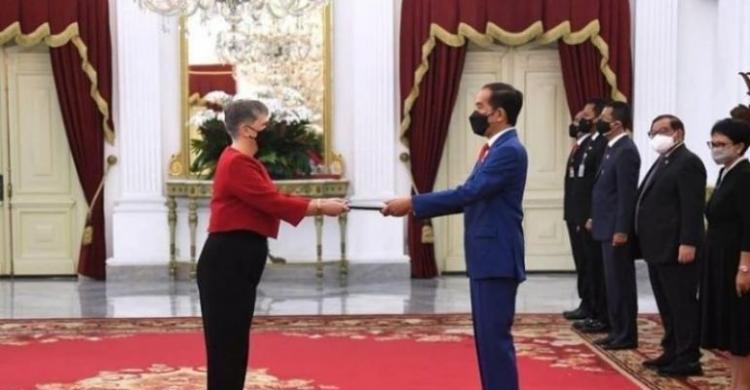
 President Joko Widodo & Ambassador Penny Williams.  Source: Rakyat Merdeka


While Australia yawns at mentions of matters relating to Indonesia, it’s much the same t’other side of the Arafura Sea.   Last century youngsters were hungry to learn English and overseas cultures.  Their appetite was met by enthusiastic teachers following a policy of raising a generation equipped to handle the world. 

Instead, the energy has bogged down in ideologies and bureaucracy notwithstanding the intentions of forward-thinkers like Harvard-educated Education Minister Nadiem Anwar Makarim. He’s a 37-year old entrepreneur drafted by President Joko Widodo to shake up the education sector, only to collide with the power of reactionaries seeing secularism behind reform.

Distrust of Western values and Australian intentions is pervasive so all the more reason to try harder.  That doesn’t seem to be on new Ambassador Penny Williams’ agenda.  Despite knowing the language and past involvement in progressive causes (she’s a former Ambassador for Women and Girls) the lady’s yet to make a splash. In the last three months, she’s put out only ten press statements, mostly on trivial matters. 

Apart from a tweet from Makassar, it appears she didn’t recognise Australia Day through any speeches or mainstream media.  (Her office hasn’t responded to a request for details.) Here was an opportunity to explain how Australian unions helped the revolutionaries liberate Indonesia from the colonial Dutch.  It’s a forgotten story for this century’s generation so needs continuous retelling.

If that’s currently considered too political for Canberra, Williams could clarify that her nation’s not a British franchise as many think because the Union Jack’s on our flag and the Queen’s image on our currency.

Nor are we the US ‘deputy sheriff’ in the region as former PM John Howard reportedly said in 1999.  The offensive tag remains fresh because Australia supported the East Timor referendum, also in 1999.  We can be proud of our initiatives and peacekeeping, our billion-dollar aid when the 2004 tsunami ripped Aceh, but that doesn’t mean we’re loved.

For Indonesians, the Unitary State is sacrosanct so the loss of the Portuguese territory it invaded in 1976 has left a deep and weeping wound.  That’s not the only irritant.

Some argue the AUKUS alliance and build-up of foreign troops and weaponry in Northern Australia are ‘too close for comfort’ and could trigger an arms race. These alarms have been addressed, though only lightly.

Instead of explanation and education, we use trade to find ‘not just a respected partner but a valued one as well’. That’s according to Agriculture Minister David Littleproud.

His message is monetary: ‘Indonesia is Australia’s fourth-largest market for bulk primary produce … valued at $2.9 billion (last financial) year.’  We want to feed you, not know you.  Curiously WA, which pioneered business and cultural ties with East Java across 30 years, has now downgraded the deal.

Despite the ravages of Covid killing 144,000 and infecting 4.3 million (Reuters’ figures from official sources and widely considered too low) the Indonesian economy is going gangbusters.

The World Bank's Global Economic Prospects forecasts growth this year will hit 5.2 per cent, but there’ll be minimal trickle-down. Oxfam research shows the four richest men in Indonesia own as much wealth as the country’s poorest 100 million citizens.

 Australian 2021 budget papers projected 3.75 per cent this fiscal year, so some catch-ups are needed.  We’re no longer masters of economic management haughtily telling ‘developing nations’ how to add and subtract.

Just as Australians can be racists, Indonesians aren’t always the pliant friendly folk of tourist brochures. In 1965 a bloody coup in Jakarta was followed by the slaughter of an estimated 500,000 real or imagined fellow travellers by civilian militias weaponised by the army.

We know of the Holocaust in Europe though not the genocide close by.

There have been other outbursts of violence, often focussing on minorities.  Ethnic Chinese are usually the targets along with so-called deviant Islamic sects.

Another eruption of hate could send a wave of asylum seekers heading our way as they did after the 1998 riots when President Soeharto quit, though they’d most likely come by plane, have full wallets and follow faiths other than Islam.

To ensure a benign view of the people next door, this distressing history is blacked out in Australia by the ‘moderate Muslim’ label, though scholars question the term’s meaning.  Likewise, the termites of corruption gnaw away in almost every departmental nook and immune to pest controllers. 

A decade ago Transparency International’s Corruption Perception Index ranked Indonesia 96 among 179 nations.  Its position now is 102.  This frightens the Western investors Widodo says he wants to attract, but won’t get serious.

Ongoing anti-graft government campaigns use billboards, pledges and stern statements – all ineffective because the political will is absent, as with the Australian government's plan to establish an anti-corruption commission.

The first stage in fixing problems is to accept their presence and examine the reasons.  Neither Indonesia nor Australia is currently inclined to confront ignorance, misunderstanding and distrust which threaten the connections.  

They’ll be a wake up when there’s an explosion of fury for some seemingly mild political stumble, like Scott Morrison’s 2019 proposal to move our embassy from Tel Aviv to Jerusalem.  Mobs protested in Indonesia, forcing the closure of two consulates.

Friction points include a low-level insurgency between West Papuan separatists and the Indonesian military, hidden from world view by Jakarta censorship equal to the Chinese cover-up of its alleged anti-Uyghur campaign.

Lawyer Veronica Koman, a prominent advocate for the dissidents, has taken refuge in Australia.  She’s wanted by the Indonesian police for ‘provocation’ and ‘spreading hoaxes’.  If Jakarta demands extradition there’ll be anger aplenty.

The late Australian Professor Jamie Mackie wrote: ‘The first and most dangerous of the problems ahead — and possibly the most likely — are issues relating to separatist movements in Papua
and the support they garner within Australia.

‘This tends to arouse suspicions in Indonesia that Australians have a hidden agenda to bring
about the dismemberment of Indonesia as a unitary state. Because of the complex, emotionally charged political dynamics within each country associated with this, it could easily get out of hand and prove difficult for both governments to resolve through calm negotiations.

Better to spruce up the relationship now than wait till what remains collapses into misunderstandings and ill will.  The next Presidential direct election will be on 14 February 2024 and there’s a chance Prabowo Subianto, who’ll then be 72, will have his third crack at the top job.

In 1998 the former general was discharged after his troops kidnapped and tortured student protestors. He then fled to Jordan and was banned from entering the US.

Prabowo is Indonesia’s Trump lite who’d ignite the wrath of human rights activists worldwide if elected. After his 2019 loss supporters rioted in Jakarta. Eight died and more than 700 were injured. Few think the violence was spontaneous.

Prabowo is now Minister of Defence, drawn into the inner circle by  Widodo who followed US President Lyndon Johnson’s advice on handling FBI Director J Edgar Hoover: ‘It’s probably better to have him inside the tent pissing out, than outside the tent pissing in’.

Offering a Cabinet post to a defeated opponent after a vicious campaign is a fine ‘forgive thine enemies’ gesture, but it wouldn’t rock in the West, even in countries that claim to follow Christian principles.

All the more reason to get to know the neighbours.  Mackie offered scores of suggestions in his 155-page Lowy essay, but don’t ask any wannabe politicians to show the way in this year’s campaign. 

First published in Pearls & Irritations, 14 February 2022:https://johnmenadue.com/lost-in-mistranslation-australian-soft-power-goes-missing-in-indonesia/


##


Tuesday, December 29, 2020

TOO BIG TO IGNORE - TOO COMPLEX TO TRY

                        The nation that’s an afterthought

If a relationship just concentrates on STDs it’ll never mature.  That goes for countries as well as couples.

Indonesians are nuts about acronyms, so let’s indulge. We’re not referring to HIV, chlamydia and gonorrhoea, but Security, Trade and Defence.  These are the areas Australian politicians brag about when talking about the health of our relationship with the people next door.

It’s an essential trinity, but goes nowhere towards bringing the people of Australia and Indonesia closer.  When terrorists are snared few know ASIO intelligence may have helped.   Naturally the local cops take credit.

With the new free trade agreement in place producers just want to empty silos while consumers are unaware the grains used in their instant noodles come from WA’s wheatbelt.

The carcase hanging in the red meat market was raised on the Barkly Tablelands but finished in a feedlot where it lost its NT identity.  In brief we don’t push Made in Australia and show little interest in who buys what at the retail level.

Defence is problematic because the Big Durian’s conservatives don’t trust Canberra.  The 1999 US ‘deputy sheriff’ quote attributed to former PM John Howard has been long buried Down Under, though regularly exhumed by the Indonesian media.

At one time the Islamic national daily Republika screamed:  Australia ready to invade Asia.  The notion that 25 million could threaten half a billion across Southeast Asia is beyond ridiculous – but it made sense to sceptics knowing the Big Country has a Big Daddy in Washington.

We excel at aggravating suspicion.  In 2006 the Australia-Indonesia Agreement on the Framework for Security Cooperation, aka the Lombok Treaty, committed both nations to cooperation and consultation in defence and law enforcement, combating international crime and terrorism, and sharing intelligence.

The signatories also agreed they’d not ‘in any manner support or participate in activities by any person or entity which constitutes a threat to the stability, sovereignty or territorial integrity of the other Party’.

In late 2011 we learned up to 2,500 US Marines would be stationed in Darwin, the largest port in Australia closest to Indonesia. The English language Jakarta Post chose an unfortunate metaphor when it labelled the news a ‘bombshell’, claiming Indonesia hadn’t been told in advance.

How did this fit with ‘consultation’ and not threatening ‘stability, sovereignty or territorial integrity’?  The FM at the time, Dr Marty Natalegawa, reportedly said it could create ‘a vicious circle of tension and mistrust’.

In 2013 Australian spooks were exposed as phone tappers bugging then president Susilo Bambang Yudhoyono and his wife Kristiani Herawati.

Last year another surprise – plans to develop the deep-water Lombrum naval facility on Manus Island in the Admiralty Archipelago, part of Papua New Guinea.  It’s best known as a pen for asylum seekers caught sailing south from Indonesia.

Now labelled the Lombrum Joint Initiative, the scheme – reported to cost AUD 175 million - is to make the port a joint US-Australian military forward-defence post, allegedly to counter Chinese expansion.   Manus is less than 700 km from Jayapura, the capital of Indonesia’s Papua province.


For Australians with knowledge of the Japanese bombings of Darwin and Broome in WWII from airstrips in Indonesia, it makes sense to have a joint facility in northern Australia.  But our defence can be another’s offence as China and the US play musical chairs around the archipelago hoping for a safe seat.

That’s unlikely to happen without a seismic policy shift in Jakarta. The Republic has long held its ‘free and active’ foreign policy stressing non-alignment with any outside power.

When studying at the ANU Natalegawa ran a paper round in Lyneham and O’Connor. His three kids went to local schools.  He’s been a regular visitor since so knows Australia well. 

Four years ago the urbane envoy spoke at ANU  ‘of  trust deficits within nations - democratic and authoritarian alike, – a condition only too readily seized and exploited by the demagogy of those bent on whipping up public fervour for the sake of popularism ...

‘Diplomacy is a process and not an event. It is one that requires the earnest of efforts, building and, indeed, rebuilding trust and confidence.’

That effort isn’t being made earnestly by either side leaving space for the malicious purveyors of BS.  In 2013 new PM Tony Abbott announced ‘more Jakarta and less Geneva’ but didn’t maintain the pledge.  His successors have behaved similarly.

It’s as though early recognition of the world’s fourth most populous nation (270 million) with 88 per cent Muslims is a boring obligation for fresh PMs to be followed by a rapid forgetting.

President Joko Widodo prefers to concentrate on domestic issues, making foreign affairs a fertile ground for Natalegawa’s feared demagogy.

Apart from the arms build-up in Northern Australia and PNG, another threat to mateship is coming from Australian NGOs and churches supporting Papua independence activists.  This riles the partisans who reckon the Australian government is aiding and abetting a master plan to fracture the Republic.

Canberra’s shrill denials and reminders that in Western democracies peace promoters have rights to agitate have little impact.

Indonesian human rights lawyer Veronica Koman is allegedly hiding in Australia.  Jakarta wants her back to face charges of inciting race riots through social media statements.  So far these demands have been low key but if inflated could ramp tensions.

In Strangers Next Door?  Melbourne academics Tim Lindsey and David McRae put the problem plainly: ‘There are no two neighbouring countries anywhere in the world that are more different than Indonesia and Australia. They differ hugely in religion, language, culture, history, geography, race, economics, worldview and population.

‘In fact, Indonesia and Australia have almost nothing in common other than the accident of geographic proximity. This makes their relationship turbulent, volatile and often unpredictable.’ 

The Bill Gates-George Soros plot to control the world through micro-chipped vaccines is mild paranoia compared with the chauvinists’ belief the West plans to dismember Indonesia’s ‘Unitary State’ and seize its mineral wealth.   Disabusing our neighbours of this lunacy is going to need more than chants about concord.

Indonesia will only get bigger.  Like it or not, politicians and public servants need to engage or bequeath a future of hostilities.  Ambassador Gary Quinlan, 69, is in Canberra for health reasons.  He’ll retire next year and tipped to be replaced by Penny Williams, 57.

Williams was an exchange student in Indonesia during the 1980s and High Commissioner to Malaysia last decade.  It’ll be a tough gig, but the first woman to head the Jakarta post is well qualified and likely to get noticed by the media.

An Indonesian and Arabic speaker, the mother of four has been Australia’s Global Ambassador for Women and Girls.  In that role she was a strong though careful advocate focussing on the economic advantages of education to boost development rather than the human rights argument.  Diehard patriarchs don’t see women’s rights as universal but a Western threat.

In 2012 she was in Jakarta singing the required verse: ‘For Australia, there is no more important relationship than with Indonesia.’  As boss of our biggest embassy she’ll get the chance to change the STD lyrics.  How about Stratagems to Trash Disinformation?

 First published in Pearls & Irritations 16 December 2020

https://johnmenadue.com/duncan-graham-we-pay-lip-service-to-our-relationship-with-indonesia/