FAITH IN INDONESIA

FAITH IN INDONESIA
The shape of the world a generation from now will be influenced far more by how we communicate the values of our society to others than by military or diplomatic superiority. William Fulbright, 1964

Thursday, September 03, 2020

WHEN WEST MET EAST


              So much potential, so much let go

PM Scott Morrison wants the right to cancel agreements (there are reported to be 130) between foreign governments and authorities outside Canberra if deemed ‘contrary to Australia’s national interests’. The prime target is said to be Victoria jogging down China’s One Belt, One Road, but beware elbowing state initiatives aside.

In August 30 BC (Before Coronavirus), Western Australia and East Java signed a Sister-State Agreement promoting mutual friendship, education, sport, trade and whatever else smart and open minds might imagine.

At the time the idea was considered commendable. Although the Constitution says only Canberra can sign binding international treaties on Australia’s behalf, other tiers of government can contract with foreign governments and their entities, according to Monash Uni’s Professor Luke Beck.

The Sister-State idea was formalised during the Labor Premiership of Carmen Lawrence, and backed by education minister Geoff Gallop (later Premier) and National Party leader Hendy Cowan.  Despite their political differences both understood Perth was closer to Surabaya (the capital of East Java) than Canberra, so proximity could be used constructively.

This despite former PM John Howard reportedly saying it would be hard to find two nations (Indonesia and Australia) so geographically close yet more culturally distant. Stranger rhymes with danger, but it’s not a synonym.

The WA-EJ show initially thrived, building understanding, opening joint ventures.  It bristled with opportunities to foster mateship.

Lasting successes include the sale of seed potatoes tripling crop yields, and in-calf Friesian heifers to boost bloodlines.  Indonesian farmers saw modern dairy systems and became milk missionaries promoting hygiene and nutrition.

In 1994 a contract was signed with Indonesia’s Ministry of Education and Culture to train Indonesian students and teachers, funded by the Asian Development Bank.

The first overseas health study tour brought senior admin and medicos from 29 Indonesian hospitals.  They got to see inside WA’s facilities and talk to their counterparts.

Encouraged by publicity about the visitors there was a rush to learn the Indonesian language and culture, and take tours west of Bali.  In the 1970s it became fashionable to discover more about Japan as the East Asian nation’s economy thrived.  In the 1990s it was Indonesia’s turn to be in vogue.

A scheme to improve testing and treatment at a centre for the deaf in Surabaya was an outstanding success, attracting support from NGOs and philanthropists. Likewise visits by experts in the education of autistic children.  There were other initiatives, including arts partnerships.

Tragically the founders’ enthusiasm and goodwill was never matched by their parochial successors who couldn’t – or wouldn’t - see beyond Rottnest Island.  The tank was run dry, the agreement towed into a political dry dock where it’s occasionally picked over for spare parts.

So what went wrong?  The WA Government’s leadership began to weaken in 1998 when the economic crisis felled President Soeharto and the rupiah.   There were riots, mainly in Jakarta.  Radicals returned from exile and the East Timorese voted four-to-one in an Australian-supported referendum to leave Indonesia, infuriating nationalists.

In 1999 a rent-a-mob smashed the WA Government’s ground floor showroom office in Surabaya.  WA rep David Edwards and his Indonesian colleagues were alerted by the US Consulate.  They grabbed computers and files and fled to an hotel. 

Then came the bombs in Bali and Jakarta.

These were bad times.  They passed slowly, nurtured by NGO healers: Ross Taylor (a former WA Government regional director in Jakarta) with the lobby group Indonesia Institute, teacher Karen Bailey through the cultural centre Balai Bahasa, and many others.  They’re still hammering department doors in Perth.

For the viruses of fear and distrust have infected the State government.  The siblings make occasional contact but their families are growing apart.

On one occasion a WA bureaucrat had to file a risk assessment to Perth and wait in the Surabaya hotel lobby outside an Indonesia-Australia Business Council meeting before being allowed to join the patient locals.

In 2003 the East Java office was shifted to the Australian Embassy in Jakarta where it was reportedly treated as an unwelcome nuisance (a minor State agency, not a superior Federal outfit), then to a secret location, losing its shop-front accessibility.

Edwards’ successors, particularly the congenial Martin Newbery, did their damndest to revive the agreement and build lasting relationships.  But the paranoid Perth-based executives never understood the critical importance in Indonesian culture of maintaining personal ties.

According to researcher Hugo Seymour at the Perth USAsia Centre, ‘past WA government successes demonstrate that building long term economic partnerships cannot be executed transactionally, but require lasting investment and engagement.

‘This is particularly so in developing country markets, where business conditions can be challenging and returns on private investment take time to realise.’

That truth has never sailed up the Swan River. The WA office is now a trade outpost and its original broader cargo jettisoned long ago.  A consulate has been opened in Surabaya, but that’s a Federal show.

Surabaya’s suburbs are exemplars of Indonesia’s growing prosperity – the wealth that Aussie cockies want to access through the just validated Indonesia–Australia Comprehensive Economic Partnership Agreement.

Ten years ago it was rare to find a bakery, and the loaves were of questionable provenance.  Now bread shops are commonplace offering great choice straight from on-site ovens.  Most use Australian grain, usually from the WA wheatbelt.

Asked if they know the origin of their ingredients the bakers look bemused.  That’s not their fault – we’re making little effort to promote our interest in their lives.  We just want their dough.

Thirty years ago the Sister-State agreement was so widely promoted many East Javans knew they had suppliers and friends next door.  No longer.

PM Morrison shouldn’t worry about the WA agreement being ‘contrary to Australia’s national interests’, however these are defined.  Better consider backing deals which bring us closer to our neighbours, learning from the WA experience which tried to do just that.

Disclosure: In the early 1990s the author used two Sister-State research grants to write about the relationship. 

First published in Pearls and Irritations, 3 September 2020:
https://johnmenadue.com/so-much-potential-so-much-let-go/

 

Monday, August 24, 2020

75 YEARS AND COOLING


                                    Making the paranormal the new normal

Last Monday was going to be the most spectacular splash of all, a grand semi sesquicentennial commemoration of Indonesia’s independence.  Then came Covid19.  While the Jakarta government promised a vaccine, others were relying on ritual.

Tucked behind guardian stone lions at the foot of the three-tiered Kidal temple was a black plastic bag holding a pot of sand.  This sprouted a cluster of burnt incense sticks, that morning’s purification rite inherited from the pre-Islamic kingdom of Singhasari (1222 – 92).

Ruwatan promotes good weather, rich harvests, community cohesion and a society free from evil forces – in this case, a virus which has so far killed at least 7,000.

The offering couldn’t be seen from the road about 100 metres distant where it might infuriate religious fundamentalists keen to stamp out Kebatinan.  Here, and in other East Java villages, ancient beliefs co-exist with the imported monotheistic faiths citizens are supposed to follow. 

Fortunately, Kidal is well-watched by caretaker Romlah and her four related households at the rear of the 13th century Hindu tower temple, though all families are Muslim.  “We burnt the incense while praying for protection against disease,” she said. 

Then showing her culture’s skills at stirring the paranormal with the normal, past and present, beliefs and politics, she added: “We also did so to celebrate our independence.”

As part of its pandemic lockdown, the government has closed Kidal and many other sites around the city of Malang, though the official reasoning is weird. 

Indonesians prefer shopping malls to historic locales and few foreign anthropologists seek the poorly-signed monument in the village of Rejokidal.  It’s more easily tracked by following the stench of an adjacent chicken farm.

Until the coronavirus hit in February and began to run amok, 17 August was going to be the most splendid show of the year as Indonesians celebrated Soekarno’s 1945 declaration of independence from Dutch colonialism.  They’d ruled much of the archipelago for almost 350 years till ousted by the Japanese in 1942.

Two days after Japan surrendered the revolutionary leader proclaimed Merdeka (freedom).  The speech is bland.  There’s no US-style soaring rhetoric, no foundation principles, just a 25-word statement of separation drafted in a Japanese admiral’s house on a borrowed typewriter. 

A colony no more – now a republic.  ‘Matters which concern the transfer of power etc’ were to come later.

The divorce from Queen Wilhelmina was delivered outside Soekarno’s (now demolished) home under a flag sewn by Fatmawati, his third of nine wives.  The fasting month of Ramadan was underway so no feasting.  And no time to celebrate for the Dutch were heading back and the armed Japanese still in control despite Tokyo’s surrender.

A vicious guerrilla war against the stubborn Netherlanders ran for four years until the Europeans realised colonialism was dead.  So were 100,000 Indonesians – including citizens caught in massacres - and more than 6,000 Hollanders, many of them conscripts.

From simplicity to pomposity.  Since then celebrating the Proclamation has become a grand outpouring of ultra-nationalism that bemuses Australians with its strange mix of strutting militarism, huge crowds, giant flags and jolly japes.  Greasy-pole climbing and sack races are standards.

The national anthem Indonesia Raya (Great Indonesia) was composed by muso and journo Wage Rudolf Soepratman in 1928, but it’s Western classical, not the traditional ensemble drum and metallophone gamelan that haunts the nation’s interior.  Gamelan is infectious, rarely melodious, unpredictable, difficult for outsiders to absorb and impossible for marchers.  It’s egalitarian.

The official music might have been imported but the rest had to be homegrown. Malay became the basis of the national tongue to keep all 300-plus language groups on side, though Javanese was the most widely spoken.

A set of five values (Pancasila) was devised and all citizens required to show allegiance.  Enthusiasm for the code cools and boils as religious fanatics repeatedly try to make Indonesia an Islamic state.

This year attempts in Parliament to trim the creed to three points labelled Pancasila Ideology Guidelines have been shelved following howls that changes would turn the nation ‘secular and atheistic’.

But back to Kidal where the hunt for emblems for the new nation turned to the temple. On its sides are three carved images of the mythical semi-human Garuda eagle who released his enslaved mother Dewi Winata.   Soekarno saw the chance for a metaphor and promoted the Hindu bird into the heraldry giving it 17 wing and eight tail feathers to match the date. 

In his claws the national motto Bhinneka Tunggal Ika, old Javanese for ‘Unity in Diversity’ – a smart blending of old and new.

Compounding the difficulties in understanding our big neighbour’s birthday bash this year was the parallel celebration of the local Arema soccer team’s 30th anniversary.  Banners (in English) ‘Our Souls Already Blue’ and ‘You’ll Never Walk Alone’ were draped around intersections, sometimes masking oncoming traffic, and competing with the red and white bunting.

The sport was introduced by the Dutch and has become the national game, though seldom played well.  As with the Kidal temple architects, the footy fans have borrowed the beast to represent their ferocity.  Asiatic lions live in India so their image presumably accompanied Hinduism.

This year the pageantry had to be online.  It was bolstered by TV coverage of a few well-spaced dignitaries at the Presidential Palace watching the flag raising from a distance, like Kim Jong-un at a missile launch. 

Community leaders urged residents to stand outside their gates at 10 am and salute – but in our area, few bothered.  Maybe they were snapping to attention inside their kitchens; does that count, or is it like a tree falling soundlessly in a forest because no-one is listening?

Cellphone videos show market crowds singing Indonesia Raya and a few flag wavers.  There have been some stirring virtual choirs.

Detecting a universal mood from a nano-glance at a segment of 270 million is clearly flawed.  Like a Russian vaccine the sample size is too small. But I’ve never seen such a passionless response in more than two decades of participating.

The way the 75th anniversary of Indonesia’s independence was celebrated when tested by a modern pandemic prompts the question: Is patriotism instinctive, or an emotion constructed by governments to create an image of cohesion?  

It was prompted by contemplating curious images carved on volcanic rocks eight centuries ago, smudged with the smoke of burning incense.

 
 First published in Pearls & Irritations, 24 August 2020: https://johnmenadue.com/duncan-graham-making-the-paranormal-the-new-normal/

Tuesday, August 11, 2020

JOKOWI DROPS THE BALL


Is Indonesia’s ‘dreamy idealist’ losing the plot?

Man of Contradictions: Joko Widodo and the struggle to remake Indonesia by [Ben Bland]

Akhirnya!  At last!  Just in time for the 75th anniversary of the declaration of Indonesia’s independence next week (17 August) we’re starting to examine our big neighbour with some honesty.


With a free trade agreement in the bag maybe some feel more relaxed about speaking bluntly - and that's happening with businesspeople warning of hazards. 

Or perhaps we’re fed up with tip-toeing around chauvinists.  Whatever – it’s welcome and comes in a useful and easily digested package – Ben Bland’s Man of Contradictions, subtitled Joko Widodo and the Struggle to Remake Indonesia. (To be released next month, pre-sales now.)


Bland is with the Lowy Institute which published his 146-page book / paper as a Penguin Special.  He was once the Financial Times man in Jakarta. The posting pleased:  ‘Indonesia is the best country in the world in which to be a foreign correspondent... There is no other place you can see, learn, and do so much as a journalist while feeling so secure, at least most of the time.’


He arrived in 2012 when a small-town mayor was bidding for the big time as Governor of Jakarta.

Bland met or interviewed Widodo (better known as Jokowi) more than a dozen times – though it seems never intimately - watching ‘the Jokowi phenomenon grow exponentially before crumbling under the burden of expectations.’


Widodo attracted for what he was, and what he wasn’t. Greed and brazen ambition seemed absent.  His philosophy was ojo kagetan – don’t get excited. He didn’t strut or triumph, rather ‘winning without humiliating’. 


He’d never been in the military, like the kleptocrat and authoritarian second president Soeharto (1921-2008), but has now surrounded himself with uniforms. Of course they ‘seek ‘security-led responses to everything from religious tensions to Covid-19’, unnerving those wanting the army in barracks, not government. 


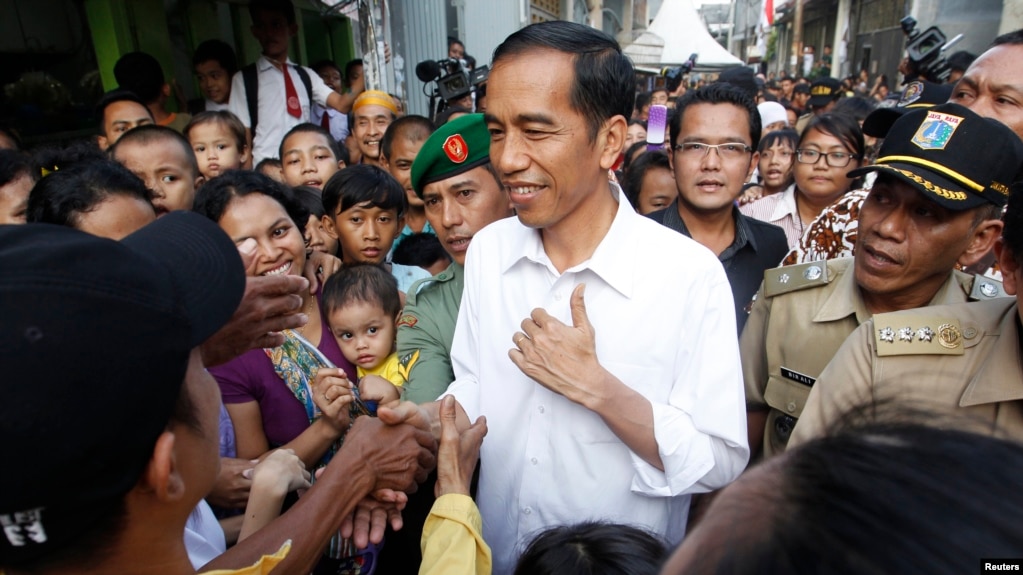
When Widodo won the Presidency in 2014 the world’s media went ga-ga claiming the slim, mild-mannered heavy-metal fan was the new face of the maturing democracy determined on change.  Blusukan (market walkabouts) became his trademark. 


(Credit VOA)


Farewell KKN (Korupsi, Kolusi, Nepotism) and the ‘octopus of the oligarchy’, even though it’s made a post-revolution comeback like the Bourbons in 19th century France.


Human rights would prevail.  The poor would find work, foreign investors form queues, the economy boom.  Seven per cent GDP was promised.   Before the plague it was five – now crashed to one.


This is serious stuff.  If inflation results and a demagogue appears, riots could follow. 


Bland looked past the eulogies, noticing the desired qualities were not being displayed.  Widodo’s fans were projecting their expectations on a man free of ideology, a narrow thinker and poor defender of democracy.  He lacked the will to stamp out the endemic graft corroding the economy and voters’ trust.


Instead he’s wed to concrete issues - roads, ports and rail lines, a can-do guy, differing from his can-talk predecessors.  He’s been spectacularly successful, thanks to Chinese funds and technology.  Before Covid-19 the plan was to use his second five-year term on developing human resources.


His strong work ethic is rooted in his struggles as a small furniture manufacturer for 15 years.  Like his US counterpart, he isn’t into reading and taking advice, running the palace ‘more as an imperial court than a chief executive’s office’.


With local-lad-makes-good yarns, myths become reality.  Indonesians were told Widodo grew up on the riverbank, offering images of slums and mud.  Bland writes the family was ‘certainly not destitute’.  Uncle Miyono was in business and employed his nephew.


As a Westerner Bland puts much of his subject’s success to timing and luck; the President reasons this is fate, which makes sense to an electorate where spiritualism throbs.  Born Mulyono and a sickly child, his parents renamed him to get well.   When Covid-19 erupted he promoted jamu, a traditional herbal cure-all.


Locals will choke on Bland’s paper because much is about their hero’s failings.  It’s a page-turner written with clarity pitched to a knowledgeable readership.  


Details of Widodo’s personal life would draw a wider audience, necessary to boost our knowledge of the people next door.  What sort of believer is the leader of a nation where 88 per cent claim to follow Islam?  He’s more abangan blending traditional Javanese mysticism than the orthodox santri, so often accused of not being a ‘proper’ Muslim.


How did he get into the prestigious Gadjah Mada Uni and his family find the money?  How was he as a forestry student?  How did he meet his wife Iriana (named after the province), reportedly his one and only girlfriend?  She’s often with him in public and seldom wears a headscarf – suggesting she’s her own woman. Does she advise?


What are his relationships with his kids, particularly his Singapore-educated surly son Gibran, 32, who now has political ambitions despite earlier distancing himself from Dad? Hints here of work eclipsing parenting.  Such details would compose a more substantial figure.   


 Also absent is more information on Javanese culture and the sharing codes which bind society, and where Widodo is an exemplar.  None of this can be understood using the Western templates of Judaeo-Christian values and left-right politics.


Bland knows this: ‘Unhelpfully for outsiders looking for straight-forward analytical frameworks, there are no easy dividing lines over ideology or policy.’ He tries to explain but needs more space.


In his early days as President the peanut didn’t forget his shell, as the Javanese proverb tells.  Widodo continued relating to the wong cilik (wee folk) who helped him into the palace defeating the blustering, aggressive former general Prabowo Subianto.  In the hierarchical culture of Java, this was an extraordinary feat, but the word-shy Widodo is no charismatic spell-binder like the nation’s proclamator Soekarno who’ll be remembered next Monday.

As Jakarta Governor Widodo stared down radicals demanding he replace a Christian community leader with a Muslim, saying he prioritised merit.  But when his ethnic Chinese Christian friend Basuki Tjahaja (Ahok) Purnama efficient successor was jailed on a devious charge of blasphemy, Widodo as President backed away, choosing political expediency above moral leadership. 


Bland thinks Widodo isn’t corrupt and genuinely wants to lift living conditions, health and education. But he’s become neo-authoritarian, ‘Soeharto lite’ – a label he might like.  He rants about red tape clogging progress and scaring foreign investors – yet he’s also a socialist, pandering to nationalists by boosting the nation’s 100-plus state-owned enterprises.  Bland ranks these as ‘more pervasive in Indonesia than in any other major economy apart from China’.

The first biography of Widodo in English is a good primer.  The cyclopaedia is Australian Dr Greg Barton’s Gus Dur, a close examination of fourth president Abdurrahman Wahid, the near-blind idiosyncratic Muslim scholar and human rights champion who died in 2009.


Barton had almost full-time access to the liberal democrat and his family.  It’s now difficult to get near Widodo.  He’s indifferent to foreign media and unwilling to intellectualise his ideas.  The best he gave Bland was ‘democracy is about improving the lives of the people.’


Bland’s conclusion isn’t sanguine: ‘Jokowi (now 59) still has four years to go, and it seems he will do little more than muddle through his final term as president. He may once more demonstrate that being underestimated is his greatest strength. I hope so. But I fear that while Jokowi’s story shows what is possible in Indonesia, it also shows the limits.’

First published in Pearls and Irritations, 11 August 2020: 
https://johnmenadue.com/duncan-graham-is-indonesias-dreamy-idealist-losing-the-plot/