FAITH IN INDONESIA

FAITH IN INDONESIA
The shape of the world a generation from now will be influenced far more by how we communicate the values of our society to others than by military or diplomatic superiority. William Fulbright, 1964

Sunday, September 08, 2013

LAKE TONDANO; KILLING WITH GREEN

When green isn’t clean         


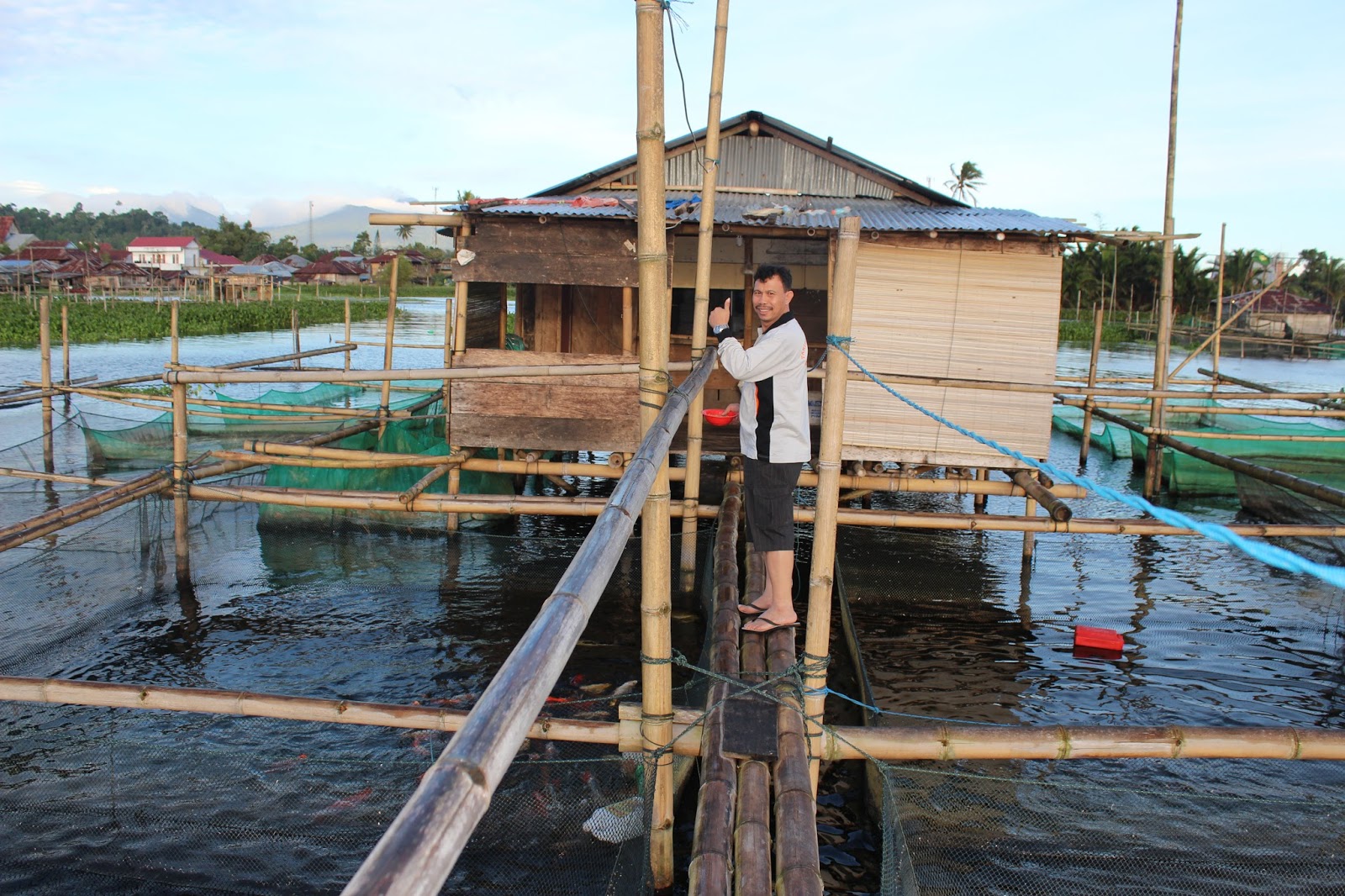
Two years ago the fish farmers of Kakas in the Minahasa highlands of North Sulawesi gave up their fight.  To stay in business they had to shift a further 150 meters into clearer water and abandon their shoreline investments.
“What else could we do?” said Petrus Lamongi (above) whose family raises goldfish.  “We’ve tried most things but with no success.  It’s such a huge problem.”
No scientific knowledge is required to understand this story of gross aquatic damage, reported to be among the most severe in Indonesia. There’ll be no dispute about the facts, no sceptics to neuter concerns, as in the global warming debate.
Microscopes aren’t needed.  Just a squint for a second is proof enough.
Lake Tondano, the once splendid sparkling center of the Republic’s most northern province, is being garrotted. The noose circling its banks is lush green and pretty pink, seductively enchanting, but eceng gondok is a rapacious coloniser and ruthless killer.
Elsewhere it’s known as a type of water hyacinth.  It came from the Amazon Basin and was exported as a decorative pond plant.  Then it escaped to become the world’s most invasive plant.
Whoever dropped a runner in Lake Tondano about 20 years ago should be tried for corrupting the environment.
The free floating perennial isn’t the only threat to the 4,300 hectare freshwater lake in the caldera of an ancient volcano, 600 meters above sea level.  Nutrients from surrounding paddy and sediment from the clear-felled hills are also doing awful damage.
In 1934 Dutch engineers measured the lake’s depth at an average 40 meters.  Forty years later it was 28 meters and two years ago just 12, according to the North Sulawesi Environmental Management Agency.
If it was just another tourist attraction then the harm would be limited.  But Lake Tondano is ‘the heart of North Sulawesi, representing the source of water supply for a large proportion of the population,’ according to a report by international consultants Mott MacDonald.
‘It is also a source of water for gravity irrigation of crops - mainly rice… it’s the center of cage-reared fish of northern Sulawesi. Equally important is its role in electric energy in a cascade of dams under the lake.’ 
Between 2003 and 2005 the lake and its surrounds were mapped and researched.  About a third of the watershed was identified at risk.
Areas of land were replanted with around 10,000 trees. Erosion banks were installed in 21 demonstration plots that included crop rotation to reduce runoff.
The long term aim was to help lift incomes and living standards for the people who rely on the lake for food and irrigation. The Minahasa Region, centered on Tondano town, has a population of more than 300,000.
Suitably impressed the Czech Republic began funding a five-year US $415,000 (Rp 4.3 billion) rehabilitation project through its development agency in association with the Minahasa Regency.  That was in late 2008 – and it couldn’t have started at a worse time.
The global economic crisis hit Europe and within two years the funds had vanished.  But not the weed.  Locals had dragged some of the huge green carpets ashore to dry but the task is Herculean.  Enthusiasm wilted when the cash flow stopped.

Small sheds were erected on the lakeside housing engine-powered shredders so the dried nitrogen-rich material could be processed into fertiliser.
The machines stand idle, quietly rusting while the wind-whipped weed laughs its way to the further bank, dropping seeds that can last up to 30 years. Rabbits are supposed to be prolific, but eceng gondok can double its population in just over a month.
Despite its criminal record, that includes harboring mosquitoes and starving the lake’s nike fish of oxygen, the weed has some redeeming qualities.  It sucks up heavy metals including arsenic so can purify polluted water, particularly from industrial sites.
The dried stems are strong, particularly when braided into ropes. Woven through wood or bamboo slats it makes robust chairs and sofas, though manufacturers say the gray material is too waxy to take paint or varnish. It can also be used to make paper.
“The main aim was to bring new cropping patterns that would benefit farmers and also introduce crops for production of bio fuels,” said the former project manager Dr Karel Peter Kucera.

“There’s a shortage of fuels for transportation and cooking, so farmers have started to cut the trees again. Bio fuels could be used to address this situation.

“We identified about 15,000 hectares that could be used to establish agroforestry plantations. We also recommended harvesting the eceng gondok and use it for production of organic fertiliser, bio gas and furniture.”

In 2011 the Environment Ministry launched a Lake Rescue Plan (GERMADAN) to save 15 lakes, including Tondano.  It is understood most attention is being given to Lake Kerinci in Central Sumatra and Lake Rawapening in Central Java.

This year nine ministries signed an agreement for ‘sustainable management’ of the lakes.  No budget was announced.

An Environment Ministry officer said regional governments had to do more to protect their lakes.  In Tondano’s case allowing the spread of fish farms was aggravating the problem becaus feed and excrement encouraged weed growth.

In April this year North Sulawesi, Governor Sinyo Sarudajang told Antara News that he was committed to handling  the problem. German experts would visit the lake “soon” and see if the weed could be used to make bio-gas. 


 However his staff said it was not known when the German team would arrive.  A circuit of the lake found no sign of control measures, and villagers claimed nothing was being done to halt the invader.

Indonesia isn’t the only victim of eceng gondok, but it seems to be one of the most passive.  Elsewhere a war is being waged with machines, chemical sprays and insects, though all have their downsides.  An infestation in Florida is now reported to be under control.

“The lake should be saved,” said Dr Kucera, “but it needs a good feasibility study and I think honest international and local investors.”

First published in The Sunday Post 8 September 20130


THE TROUBLE WITH WOMEN IN INDONESIA

BTW: Putting women in their place
Let’s get this straight:  News of schoolgirl virginity tests is a splendid sign of progress.  Only an education authority that’s created a world-class learning system would have enough time left to put the carnal ahead of the cerebral.
So watch out for a flowering of PhDs and Nobel Prizewinners from Prabumulih, South Sumatra, every one intact.
Is it jealousy of young women, their vitality and power, that so arouses our leaders - or the revenge of the impotent?
In Amsterdam they’d be wearing dark glasses in De Wallen, nervously fidgeting under the red lights, but here they’re the saluted, chauffeured self-appointed custodians of other folks’ morality.  
Like Governor Rusli Habibie who’s banned women secretaries in his province’s public service.
Seeing a khaki-clad posterior makes staff focus on bottom lines beyond the accounts.  The edict is to stop affairs, - but suppose the bureaucrats are gay?  Silly thought – this is Gorontalo, not Gomorrah.
Misogyny yarns keep us from worrying about politics and poverty and we haven’t had a good one since Banda Aceh banned ladies straddling motorbikes. So thank you, provincial prudes, for revving up the debate about the proper place of women in society as decreed by us, masters of the universe.
Remember the story in the Good Book:  Sage Adam was happy in the garden reflecting on higher matters when Eva sashayed past with the apple.  And the world has gone to custard since.  If she’d just stayed in the kitchen we’d all be living in harmony, brothers in arms, not armed. 
Women are delicate creatures as every bruised husband knows well.  The term ‘fairer s*x’ relates to skin color, not justice.
 It’s up to us gentle men to suggest laws that will protect their sensitivities and ensure we are not seduced into sin. Here are some more:
Extend the straddle ban to bicycles. How does a woman cycle side-saddle? That’s not our problem.  We just pass the edicts. When it comes to s*x we just can’t help ourselves so you must control yourselves.
Back to the list: Women should be banned from Merdeka Square so they can’t see Monas.  Mockingly known as Soekarno’s last erection, the 132 meter tower thrusting into the sky is a Freudian challenge to lesser lads. 
Only men should work in fuel station forecourts pumping gas. Cars are male and should not be treated like women.  This is a straight society.
The front seats of bemos are to be reserved for men.  A woman sitting alongside a driver who constantly plays with his gear stick is clearly in a perilous situation – particularly if he withdraws and selects reverse while hurtling forward.  We won’t even mention pulling on the handbrake.
And while talking about traffic there has to be a total ban on women wearing seatbelts. It’s true the law requires belts to be used, but it’s secular and therefore wrong.  The strap goes across a woman’s, er, upper torso and separates her, er, feminine features.
This gives them prominence and causes distress to male passengers who are otherwise studying worthy texts, learned writings or playing Angry Birds.
What happens in an accident?  Thank you for asking, that shows your caring nature. Don’t worry – we men will belt up and be safe.
Some women like music.  That’s halal.  But playing a double bass is absolutely haram. The sight of a large instrument in such an intimate position can drive male concert goers into a frenzy when we came to be stimulated intellectually, not emotionally.
Another job on the banned list is piloting aircraft.  Grasping a joy stick, sitting in the cockpit and then heading for heaven is not right. It’s true angels have wings but you’ll never see one commanding a 747.
So if you hear the pilot welcome you aboard in a feminine voice, leave the aircraft immediately to preserve your honor.  Even if it’s at 10,000 meters.
I could go on, but you get the drift. Women and men are different and the latter must always be on top.  Otherwise we’ll feel insecure and start doing improper things to the economy and the running of the nation, and it will be all your fault.

(First published in The Sundayh Post 8 September 2013)
 ##


Wednesday, September 04, 2013

GOING SHOPPING? DON'T FORGET YOUR WITS

Beware! Retail therapy can make you sick       
This sign saying returns not accepted is illegal
                              
The contaminated New Zealand milk products scare highlighted the need for robust consumer protection.  How does Indonesia fare? The Sunday Post investigates:
Even hardened community activists agree: Indonesia has fine consumer protection laws, as good as any found overseas.
Yet few shoppers know they’re shielded. Rights are whispered when they should be shouted. Adequate laws are policed inadequately.
Although governments try to guard consumers’ wallets and health, administrators’ efforts are hit-and-miss, and resources limited.
They are failing to explain how the system works, particularly to the most vulnerable - those with limited education and low incomes.
While supermarkets used by the middle classes get food safety spot checks, traditional unrefrigerated markets sell meat and fish in the open, threatening public health.
In short, Indonesian consumers are still babes in the market jungle, easily savaged by sharp-fanged vendors unburdened by ethics. The present system of checks and balances has passed its use-by date.
Despite a brief push in Malang to clear shelves of stale an­­d contaminated food during Ramadhan, law enforcers face an uphill task to lift shopper security to international levels.
It’s not just the government’s fault – buyers are also failing to flex their legal muscle and keep traders honest.
“Why don’t they? That’s a really easy question, and there’s a really difficult answer,” said veteran consumer advocate Indah Suksmaningsih, former chair of the Indonesian Consumers’ Foundation (YLKI) and now chair of the Southeast Asian Consumer Council.
“People are so brave to speak up in a group, but not as individuals.
“We are also very forgiving and tend to forget.  Things are getting better for consumers largely because of competition among retailers and the rising middle-class becoming more discriminating. 
“However the big issue isn’t whether people are getting value for money, but whether people are being valued, and their rights to basic needs are being met.”
If awareness is measured by the number of grievances, then Indonesia is staggering and far behind its neighbors.  YLKI’s counterpart in Kuala Lumpur reportedly gets 40 times more calls and letters.
However this masks the fact that the Malaysian office just receives complaints while the Foundation takes action, according to Indah.
“When we raised the specific issue of electricity services we got 2,000 complaints in a month,” she said.
“Indonesians get very angry if we just talk about problems and do nothing.  We’re here to help but we’re not complainers’ servants. This is not a way for people to get a lot of money out of a company.”
So how do consumers get their gripes taken seriously?  With great difficulty – and that includes negotiating thickets of acronyms to determine who does what and where.
The government publishes a handful of posters and brochures but these are not widely available, according to Soemito, head of the Malang Consumers’ Foundation (YLKM)
“I’ve lectured on the law at universities and departments, including the police,” said the former Jakarta tour guide who gave up his business to arouse and inform consumers.
“This job should be done by the government, and that includes classes in schools.  The authorities talk a lot, but it’s NATO (no action, talk only).
“Frankly speaking they are not committed.”

­­­Heading to the mall? Caveat emptor   

                   
At first glance Indonesia’s electronic superstores look just like those overseas. Seductive rows of white washers, icy fridges and shimmering widescreen TVs.
All the big international brands are there to comfort quality-conscious consumers.  Uniformed sales people and neon-saturated showrooms complete the picture, apart from one striking addition:  A test bench, bristling with power sockets. 
Hawk-eyed customers watch while staff struggle with tightly-fitted Styrofoam moulds and shrink-wrapped plastic so the device can be checked.
Do the LED lights glow, the screen flicker and the blades turn?  OK, it’s a deal.
It’s also a clear statement of distrust.  Caveat emptor, as the lawyers say. Let the buyer beware.
In nations where strong consumer protection laws are enforced shoppers take their goods still factory-sealed.  If they malfunction, retailers refund or exchange to keep customers happy – and stay the right side of the law.
 “We have good consumer laws in Indonesia, and they’ve been in existence since 1999,” said Tulus Abadi, spokesman for the Indonesian Consumers’ Foundation (YLKI)
“However consumers aren’t well informed about their rights and how to get redress. The law isn’t being implemented well.”
The foundation is a 40-year old Jakarta-based non-government association with 22 staff.  It’s funded by donations (including from the Jakarta Governor) to ‘raise critical awareness’ of consumers’ rights and responsibilities.
It produces the magazine Konsumen edited by Tulus free of advertisements apart from community service promotions, like the World Health Organization’s pleas to ban tobacco sponsorship. It publishes reports of product tests and dangerous goods alerts, along with news about law changes.
A non-scientific survey by The Sunday Post of academic staff at a Malang tertiary institution showed most were unaware of consumer protection laws.  However all said they had returned goods at some time and been satisfied.
Ironically the well-signed office of YLKM, a local non-government consumers’ advocacy, is just opposite the campus back gate where it has been for 13 years.
YLKM director Soemito and his volunteer colleagues get up to 20 calls a day because their number is  just inside the yellow pages phone directory (under the rubric ‘YLKM’ though there’s no indicator of the meaning).
 However only five per cent follow through with formal complaints.
Consumers’ main concerns are with electricity supplier PLN, the banks and financial services. Soemito said borrowers often failed to read the small print – or if they did the meaning wasn’t clear.
Imposts, like charges for early loan repayments, riled customers.  “There’s little point in approaching lawyers,” he said.  “Few understand the law or have bothered to read it.”
Under the 1999 Consumers’ Rights legislation every district (there are more than 430) should have a consumer’s dispute resolution center (BPSK).  So far almost 170 have been established across the archipelago.
Where strong consumer laws operate retailers exercise caution when buying from wholesalers.  Handling dud goods is costly and damages reputation.
That’s not a concern where market kiosks sell cheap goods cheaply.  In the crowded caverns where bargain hunters stalk and scammers lurk the dangers of being ripped off are greatest.
These are also the places where NO RETURN signs thrive, though the photos in this story were shot in mainstreet stores.  Tulus said such notices are against the law.  So is the practise of marking up goods, then discounting the higher price in a supposed sale.
Another trick seen in an electronic goods store is labelling with two tags.  Buyers who pay the low sum have to take faulty goods back to the agent for repairs or exchange.   
Postage to a distant factory may not be worth the cost and hassle.  For a premium the shop will handle returns.
Black goods are also a problem, though easily spotted.  Panasanic radios and Tashiba TVs are obvious frauds, but careless buyers can be blinded to the difference by low price tags.
Shops changing use-by-dates, particularly on imported goods, is another unscrupulous dealers’ tactic.  Any tampering with the date stamp should alert shoppers to be cautious.
“Despite these and other problems the bigger nation-wide stores are starting to comply with the law,” said Tulus.  “It’s a slow process that could be accelerated by buyers avoiding shops that sell low quality goods – and demanding their rights when things go wrong.”
Another reason for few complaints may be the well-publicised treatment given to Tangerang housewife Prita Mulyasari, jailed in 2009 for defamation after criticising a medical service.
The YLKI says complainants should first approach the store manager.  Be clear about the problem and keep receipts and packaging.  If no action, send a letter saying if unresolved within seven days the matter will be referred to the YLKI.
If that doesn’t work the next step is the BPSK dispute resolution center.  The one in Malang handled just 34 complaints last year (27 so far this year) and claims a 90 per cent success rate.
 In January the Trade Ministry set up a national on-line system for disgruntled consumers (http://siswaspk.kemendag.go.id/) In July 60 complaints were recorded and apparently resolved.  Its website logo has a bespectacled kangaroo urging citizens to be ‘thorough before buying’. Calls to the Jakarta office to check figures went unanswered.
Tulus said YLKI welcomed the initiative though he said it was still early days to judge its effectiveness. 
Head offices of the three major national retailers were contacted by phone and e-mail for their policies on consumers’ rights, PT Matahari which runs a department store of the same name and the Hypermart supermarkets did not reply.
Neither did the PT Hero Group that has supermarkets Hero and Giant. However individual store managers confirmed refunds and exchanges were available if customers returned goods within a few days.  There were no notices seen advertising this policy.
The supermarket PT Carrefour also failed to reply but does display large signs near checkouts claiming ‘100 per cent refunds’ for intact goods, excluding underwear, returned with invoice within seven days.
The Indonesian Retail Merchants’ Association (APRINDO) was invited to comment on its advice to members regarding consumers’ rights but did not respond.

The burning of the beef


It looked like another staged media stunt when a government hit squad forced the branch of a major national supermarket to torch more than 20 kilos of prime meat contaminated with maggots while The Sunday Post was present.
Two search and destroy teams, each of seven public servants from public order, health, pharmacy and agriculture were led by Yenny Mariati of Malang’s Consumer Protection Department.
Staff were mustered in a car park.  They were given secret instructions and the list of targets only when ready to roll.  The exercise appeared genuine.
“This is routine before Idul Fitri and Christmas,” said Yenny. “We make random checks and shops aren’t alerted.”
Yet a few streets away beef of questionable ancestry was being chopped on a roadside block and fish gutted on the floor of a market where the poor shop. Ms Hygiene was noticeably absent.
“We’d like to do more, but I have only five staff,” said Yenny.
“Not good enough,” countered Ary Widy Hartuno, a volunteer with consumer advocacy group YLKM who watched the cremation with a ho-hum air.  “This sort of action should be happening all the time.
“We get complaints and forward them, but not all are pursued by officials They need to be tougher, proactive and confiscate more.  Of course they should have extra staff.
“At the same time we must be aware of bad buyers trying to cheat shops.  We’ve had examples of people seeking to return goods like laptops that have been altered or parts taken.” 

Consumer watchdogs Ary Widy Hartuno (left) and Soemito
                                                                             
Ary, a public servant in an unrelated department, said he fought a protracted battle with PLN (the State electricity supplier) overcharging for power installation and tardy services.
He eventually won and got compensation, but the experience was so tortuous he decided to campaign for consumers’ rights, joining YLKM to prod bureaucrats into effective refereeing.
“PLN is a monopoly and government owned,” he said.  “That makes many officials think they don’t have to treat their customers properly.  That’s clearly wrong.”
Earlier the khaki –clad inspectors had swooped on a suburban mini-mart and seized jams, biscuits, jellies, flour  and baby food.  Two plainclothes policemen were present in case of trouble, but startled shop owner I Wayan Sudirya offered no resistance.

Shop owner I Wayan Sudirya (white T shirt) is forced to destroy goods as public service inspectors watch

“I’m not angry – they’re just doing their duty,” he said as the bureaucrats made him empty jars and rip up packets, then sign a document confirming the destruction. 
“Suppliers have been dumping old stock, and I’ll take this up with them.  I don’t have enough staff to check every item.”
Titik Mujiati of Malang BPSK, who has been ransacking shelves for five years so customers aren’t put at risk, said offences committed included incorrect or no labelling, and out-of-date merchandise.
She said her forays tended to net the same quantity and type of foods every time – indicating that some retailers reckon the chances of getting caught are slim so taking risks worthwhile.
“Perhaps I’ve been a little bit stupid,” said Wayan, a grocer for 23 years.  “I must be more careful in the future.”
YOUR RIGHTS
The law says shoppers have rights to:
  • Convenience, safety and security.
  • Quality goods and services with warranties.
  • Clear, correct and factual information.
  •  Consumer education.
  • Be treated equally and truthfully.
  • Compensation or replacement if goods don’t match description or fail.
First published in The Sunday Post 18 August 2013
The YLKI website is www.ylki.or.id


.


Thursday, August 29, 2013

HENGKI HERWANTO


Highwayman blues                                        

When Hengki Herwanto weaves his fat four-wheel drive between dirt diggers down unfinished highways the music in his CD player is progressive rock.
Which is the right choice for the man in charge of building new toll roads in East Java. 
He might have selected Roger Miller’s King of the Road. But as he’s not an arrogant fellow and likes ballads, starting off with a bit of Willie Nelson’s On the Road Again sounds just right.
Completing his shift with the late John Denver’s Country Roads, Take me Home seems apt, even though the overloaded highways are close to gridlock, and driving a migraine-making test of nerves.
Jobs where staff can indulge their hobbies during work time without getting reprimands or worse are rare.  Though not if you’re director of Transmarga Jatim Pasuruan, a company in the giant PT Jasa Marga toll-road group and the duties include site inspections and long spells behind the wheel.
You may have heard of Hengki, or at least recognise his jolly features from his time as media spokesman for Jasa Marga.  Then he was discussing mega-million construction budgets and explaining why land acquisition problems are holding up road plans.
Now 56 he should have retired last year but has been kept on to push through some major projects, including extending the Surabaya-Malang highway.
What you probably don’t know is that the genial civil engineer is just nuts about music, despite being unable to play any instrument. Does this indicate a frustrated muso? After a four-beat pause and a backing track of chuckles: “Maybe.
“When I hear good music there’s something there that creates a new spirit in me. I love ballads, rock and country – every type has its own quality, but I prefer the music of the 70s and 80s.
“I’m still trying to understand gamelan. So much modern music is easily forgotten. Perhaps I’m just a romantic.”
If so he’s also practical. Four years ago Hengki and his old school mates who also live in a state of suspended adolescence, set up a library in a large rented house.  It holds more than 10,000 donated discs, cassettes and vinyl records.  Some, like their custodians, go back more than half a century.
A wall of honor recognises 70 local bands and performers.  Malang isn’t Tin Pan Alley but it has a large student population from across the Archipelago so Hengki thinks the chances of a local sound emerging are high given the right space.
“The United Nations’ headquarters is in New York,” he said, “so we have United Music in Malang with music from every country in the world.
“Here anyone can listen and be inspired by music they’ve not heard before.  We care about preserving the past.”
So caring that they are collecting donations to buy laminated sleeves for 50,000 unprotected vinyl records held in Solo by the Lokananta Studio.  The 57-year old company is State owned.
 “It’s not managed well and we’re worried about the collection,” said Hengki, showing photos of jumbled records in open wooden boxes. “A donation of just Rp 2,000 (US 20 cents) buys protection for one disc.”
Lokananta’s storage problems aren’t duplicated in the spacious Malang museum, though the volunteer organisers prefer to call it Galeri Malang Bernyanyi. The translation curiously suggests singing, but that’s not the intent.  “We thought young people might be put off by the word ‘museum’,” Hengki explained.
The walls are covered with framed posters of men with hairy armpits and outrageous make-up, thrusting their crotches and electric guitars.  The girls are leggy, though by overseas standards more sterile than seductive.
The East Java all girl mop-top pop band Dara Puspita is well featured, wholesome as Disney princesses. Tikkie, Takkie, Suzy and Lee (were those their real names?) toured Europe twice in the late 1960s and cut eight albums, 30 years ahead of the Spice Girls.
The memorabilia is marvellous, splendid posters from yesteryear that even now carry the enticement of a great night out despite the fading colors.
Hengki came from a military family but marched to a different drum from Dad.  For a while he worked a journalist for the music magazine Aktuil, which collapsed in 1978 after 254 editions.
In those heady days he followed the British heavy metal rock group Deep Purple and was present at their 1975 Jakarta concert.  Rolling Stone magazine reported 150,000 fans, 200 injured, and police with machine guns and Doberman dogs.   
Teendom is heady, but it doesn’t pay the bills. Hengki left a life of screaming kids for the roar of diesel engines.  “I went into engineering to help build Indonesia’s infrastructure,” he said.
Music can’t be borrowed from the gallery, though that policy may change. The immediate plan is to digitise and catalogue the cassettes that are most at risk. Plastic tapes stretch and magnetic oxide coatings flake.
The gallery won’t duplicate and sell recordings.  As many supporters are in the music industry they say they respect copyright. So far about 300 people have donated their private collections.
There’s a keyboard, recording equipment and electric guitars, including one painted with batik designs.  Musicians, including New Zealand gamelan players who toured Java and Bali in July, have dropped in.
Visitors sometimes run clinics for local talent. The gallery holds discussion groups and promotes events. 
“Dangdut is popular in the regions though not the big cities,” said Hengki.  “There’s too much Western influence, but we are developing indigenous styles.   Instruments like the angklung (bamboo tubes that are struck and shaken) and gamelan are distinctly Indonesian.
“The center for music is Jakarta. Most people seem to pick up trends through television promotion.  Radio doesn’t feature so much, like it does overseas.
 “Our vision is to maintain and promote Indonesian music, but also carry examples of music from other nations.
“Indonesia is internationally known for corruption.  That’s negative.  We want our country to be famous for its music.” Or as Hengki’s hero Iwan Fals, Indonesia’s Bob Dylan, sings: Salam Reformasi.
##
First published in The Jakarta Post 27 August 2013


Monday, August 19, 2013

DR LYDIA KIEVEN - - REMEMBERING MAJAPAHIT

 No relief from vandals    

                             
When Dr Lydia Kieven returned to a small sanctuary high on East Java’s Mount Penanggungan she expected to be enchanted and awed yet again.
Instead she burst into tears. Vandals had hit the mid 15th century shrine known as Candi Kendalisodo since her last visit and chiselled off part of a relief.  This showed Arjuna, one of the Pandawa brothers being tempted by Bimasuci in a tale from the Indian Mahabharata epic.
“I felt really hurt,” said the German art historian and cultural archaeologist.”It was like a blow to the stomach.  At the same time I wondered whether my work had highlighted the site and made others think it had value so could be exploited.  It’s an ethical question.”
At first blush such reasoning seems flawed. To know of the site’s importance requires any Philistine to be well-read and diligent. Dr Kieven’s specialized research is unlikely to be found by the average bookshop browser or Internet scavenger.
Then there’s the steep unposted track to the site, half a kilometer below the 1653 meter summit.  It takes more than two hours to climb from the foothills of Trawas so only the determined and hardy make the journey.  Some are pilgrims for there are signs of offerings; worshippers are unlikely to destroy what they revere.
Maybe unprincipled collectors have done their research and ordered parts to be plundered.
“I don’t know, but vandalism continues even now,” said Dr Kieven as she prepared for another hike to the site, this time to commemorate 100 days following the death of her friend Suryo Prawiroatmodjo, a pioneer conservationist and promoter of Majapahit history.  His ashes have been interred at Kendalisodo.
“A panel about a meter square dating from 1450 has also now gone to who knows where. What to do? No-one is going to sit up there watching for 24 hours a day. Sadly isolation is no protection.
“My approach is to help build knowledge, understanding and appreciation. That way people  may get to see the richness and importance of their history and become carers.”
She’s doing this by acting as a tour guide and lecturing, including at the Pusat Pendidikan Lingkungan Hidup (PPLH – environmental education center) on the slopes of Mt Penanggungan and started by Suryo. She has also helped run local cultural festivals.
She also plans to produce a shortened Indonesian version of her latest book – Following the figure with the cap – a new look at the religious function of East Javanese temples. This examines carvings depicting the indigenous stories of the East Java Prince Panji, whose adventures feature on many temple reliefs.
There are at least a dozen versions of his romance with Candrakirana (Princess Moonbeam). It’s the universal tale of handsome boy meets lovely girl; boy loses girl, boy finds girl again – though not till after he’s had a few affairs along the way.
Dr Kieven’s journey to become one of the world’s leading experts on East Java temple art started in a small village outside Cologne.  Gifted with curiosity, wanderlust and the ability to master languages she was desperate to explore beyond her “too tiny” town.
That had been the unfulfilled ambition of her grandfather and businessman father. They stayed in Germany, so Lydia lived their dream.
At first the goal was India. “I don’t know why,” she said.  “Maybe because someone brought me a toy elephant, or because I read 1001 Nights when I was around ten.”
Instead she studied mathematics and art history at university.  She failed the first but did well at the second, then became a tour guide in France.  A friend looking for a travel companion suggested Bali, “not India, but at least a little India”.
Suddenly all her wanderings became focussed. She avoided Kuta, headed for Ubud and saw a picture of Borobudur and its astonishing reliefs. 
“Now I knew what I wanted - and I wanted to come back. I also realized I had to study the language” 
Back home she took an MA in Indonesian language and literature, then to Yogyakarta to study at Universitas Gadjah Mada (UGM).  She now speaks Indonesian like a local, plays in the gamelan and can also wrap her dexterous tongue around Javanese.
Her tour guiding now took in Indonesia, giving her opportunities to stay and research when the Europeans headed home.  Her interest in the Panji stories led her to cultural historian Professor Adrian Vickers who supervised her PhD at Sydney University.
Mount Penanggungan is so rich in history that it probably deserves world heritage listing and protection.  There are at least 81 sites, including temple remains and bathing pools, like the popular and easily accessible Candi Jolotundo (below), built around 977.


Here visitors can walk through plastic trash, hear high volume pop music and see the latest graffiti carved on surrounding rocks.
But it would be wrong to blame all despoliation on young people who know not what they do, and whose school history lessons started at the 1945 Revolution.  The Dutch colonialists were wanton plunderers of precious artefacts, shipping some back to Holland, giving others to visiting dignitaries, or scattering statuary across the archipelago.
Dr Kieven found one of only two known three-dimensional figures wearing the curious half-moon shaped Panji Cap hidden in a Bandung library.
The Majapahit kingdom collapsed early in the 16th century. The remnants fled to Bali and East Java’s Bromo highlands.
“I can’t write the final word on Panji,” said Dr Kieven who will soon return to teaching Southeast Asian Studies at Frankfurt’s Goethe University.  “I’m still trying to understand so much,
“My theory is that although Panji belongs to daily life he was also an aristocrat and pointing a way to the Tantric path (of Hindu meditation). 
“Now I want to write about Penataran (near Blitar and the largest Hindu temple complex in East Java built over 250 years). I hope I can apply my knowledge and give just a little help to lift self-esteem regarding Javanese history.  It’s my contribution against globalization and Arabization.”

(First published in The Jakarta Post, 19 August 2013

##

Tuesday, August 13, 2013

JOMPET KUSWIDANANTO

                                                                          Finding freedom to express 
                                
Javanese artist Jompet Kuswidananto’s hand gets a good work out in his home town of Yogyakarta.
While walking through a preview of the spectacular Art / Jog Maritime Culture art exhibition at the city’s Taman Budaya (cultural center) it seemed that administrators, curators and – most importantly – overseas critics and buyers - all wanted a piece of the man.
Although the exhibition is supposed to have a marine theme it’s a mark of Jompet’s importance that organizers included one of his installations. 


I was Hamlet is based on the ideas of German post-modernist theater director Heiner Muller’s Hamletmachine. It features old and broken sound systems, symbols of the authoritarian New Order government that dictated Indonesians’ lives and thoughts for 32 years.  It might have been naughty once, but it’s not nautical.  
Successfully jostling for prominence in the crowded art world doesn’t appear to have infected Jompet with arrogance, the virus of fickle fame. 
“It seems the definition of ‘emerging young talent’ ends when the artist reaches 35,” he joked, shortly after returning from a residency in Vietnam.
“I’m almost 37 so that probably rules me out. Being an installation artist restricts my market, but fortunately my wife Inna Deshitta is an architect in Bali.
“Having a professional partner allows me time to explore. I’ve been going alone on my motorbike into quiet places to think. I hate to be in a routine.
“For the past four years I’ve been working with my ghost figures. Maybe it’s time for new directions. Sometimes I ask myself whether it’s all been over-discussed.”
Original talent and an attractive personality aren’t the only qualities that make the self-taught artist an ideal candidate for overseas support.  He doesn’t present like the stereotyped Indonesian bohemian, no red headband and dreadlocks, no reeking of kretek smoke.
Then there’s his fluent English and easy access to a lexicon describing, exploring and covering the canvas of abstract art with ease, making him a stimulating conversationist.
But the crunch factor is that Jompet used to inhabit the once dangerous territory of anti -Soeharto social commentary.  He’s passed though the rebel stage unscathed and earned his veteran’s stripes. 
Now he faces the curse of being mainstreamed, and the need to find the next big cause.
There’s no stand-out enemy.  Poverty and corruption, dirty politics and inequality are major foes, but amorphous.  All things perceived to be wrong once coalesced in a single bogey man - the nation’s second president.
“Are we free now? That’s the big question,” Jompet said. “It’s something I think about a lot.
“We thought we were after 1998 (the downfall of Soeharto), and able to reclaim our rights. Now we can all speak but no-one is listening because it’s so noisy.
“Today the cry is: ‘What is democracy?’  It’s a destination, not a journey. But we must not let it be defined by others.
“Democracy also provides a place for radicalism, which can create the downfall of democracy.  The state is now absent from our daily lives.  So we have to learn how to resolve our own problems, see them in different ways, and be creative.
“My topics are local, but I’m pretty sure they’re also public issues. Everyone has to question their world view because we’re no longer taught what to think. Not all are happy with this situation.” 
Underlying his point are stickers and T-shirts on sale in Yogya featuring the face of the smiling general who dominated the Republic’s politics for 32 years above the caption: Piyo kabare bro ...? Enak jamanku to .. (How are you, brother? My era was good, eh…)
The son of a farmer, Jompet grew up in a Yogya kampung, played protest music on guitar and joined a theater club.  At Yogya’s Universitas Gadjah Mada (UGM) he studied communications and experimented with music and art, laced with anti-government action.
“We read underground news from overseas,” he said. “We already realised something was wrong with the State. I threw stones at the police, but fortunately wasn’t arrested.”
He read widely and was inspired by the work of the Cypriot-Australian performance artist Stelarc who famously proclaimed that ‘the human body is obsolete’ before taking on an academic career.
In 2003 Jompet’s work appeared overseas in a Seoul group exhibition.  It was followed by displays in Shanghai, Mumbai, Singapore, Hong Kong and South Africa.  His first solo show was in Yogya in 2008.
The same year Jompet was noticed when Java’s Machine: Phantasmagoria was shown at the Yokohama Triennale. It featured images of body-less Yogya kraton guards as the interface of competing cultures and the ‘war against homogenization.’
For the past five years Jompet has commuted between Yogya and Bali where his wife was practising, but there are no maidens-in-paddy influences in his work.
During the last Southern Hemisphere summer his installation The Commoners, along with works by Eko Nugroho, another Yogya artist, dominated the foyer of the National Gallery of Victoria in Melbourne. 
The catalogue said: ‘As a pairing, they shine light on the effervescent contemporary Indonesian art scene and present a wide-ranging, yet precise snapshot of this world’.
Jompet’s major work featured ranks of ‘ghost figures’ made substantial only by boots, hats and tools.  Occasionally they beat drums and waved flags.
Like his work in Art / Jog, a buyer would need a large and lofty lounge to accommodate the installation – though Jompet is prepared to make smaller, more compact versions.
The Melbourne exhibit was acquired by the NGV whose director Tony Ellwood has been in Yogya with a chequebook.  In the past 11 months the gallery has bought seven contemporary Indonesian pieces to boost its collection of 196 works from the archipelago, though many are batik and puppets.
“There are now local buyers - not all interest is from overseas,” said Jompet. “It’s a more critical market. I’m optimistic about the future of contemporary art in Indonesia.  This exhibition (Art /Jog) proves it.”


First published in The Jakarta Post 13 August 2013

Sunday, August 04, 2013

RELAX ON NZ's MOUNT DOOM

    Snow season is no season for indoors    


Mount Ruapehu is set to erupt.

Not with major ash storms and larva flow – that last happened in 2007, though there have been several alerts since on New Zealand’s most active volcano. 

The expected eruption is the opening of the ski season, probably at the end of this month (June).  That’s when thousands from NZ and around the world start arriving to try out the country’s two major ski zones covering 64 separate fields.

When The Sunday Post visited in mid June the car parks were empty. Ski-lift staff were greasing wheels and checking cables.  Meanwhile their colleagues were studying weather maps, ready to fire up snow-making machines should the right stuff not come in quantity to soften the summit.

Like most outdoor sports skiing depends on the weather. This year the winter, following a dry fall, has been unusually mild and late.  The situation is better in the South Island where enough snow has already settled on the higher Southern Alps for some ski fields to open.

But they are not Ruapehu, the South Pacific island’s most active volcano with three major peaks – the highest 2,797 meters.  They were used in Peter Jackson’s The Lord of the Rings film trilogy as the fictional Mount Doom.

By Indonesian standards Ruapehu is just a bump compared to Puncak Jaya in West Papua at 4884 meters, a mountain with snow and glaciers, though these are reported to be retreating so fast they’ll be gone by 2015.

The highest point in Java is Mount Semeru near Malang.  It towers 879 meters above Ruapehu, its snow free peak often chugging smoke like an old steam train.

By contrast Ruapehu still looks like a cake topped with icing, even in summer when the best views are from the Desert Road on the mountain’s eastern flank.

In 2008 hundreds of skiers and staff were trapped overnight on the mountain when a sudden violent turn in the weather closed the road. 

An eruption a year earlier closed roads and emptied ski lodges, but all was well as the lahar flowed as forecast.  That wasn’t the case in 1953 when a crater lake emptied and lahar swept away a railway bridge as an express train approached. The death toll was 151.

It’s clear (or not so clear) why the mountain can be so unpredictable.  At one moment it was easy to see for kilometers, even down to the magnificent Chateau Tongariro hotel on the lowlands (left)  Blink and it disappeared.

Chateau was built in 1929 before the Great Depression struck and reflects the hopeful opulence of the period between the two world wars. A Malaysian company owns the 115- room hotel.

There are disputes over the meaning of the mountain’s name which may refer to a pair of explosions, or a beautiful, though faithless woman in Maori legends – perhaps an attempt to explain Ruapehu’s fickle behavior

Standing in the center of NZ’s North Island the ski fields depend on their popularity for the same factor that drives real estate sales – location.  It takes less than five hours to reach Ohakune, the town nearest the summit, from Auckland, the nation’s biggest city. Wellington, the capital is even closer. Both link by rail.

Some bus trips are available but best use a hire car to enjoy stunning scenery and see more sheep than people.


Ohakune was originally best known for its horticulture, particularly carrots that thrive in the cool climate and well-drained soils.  A kitsch memorial to the vegetable greets visitors, but other symbols are more sober and in keeping with the majestic landscape.

More recently Ohakune has become the service center for skiers and visitors. Pros don’t dominate - there’s plenty to excite those whose only interest is lobbing snowballs – an activity that always seems to excite Indonesians.

However if you’re serious about snow don’t forget to pack a plump wallet to cushion the shocks.  Lessons start at NZ $60 (Rp 460,000) while an all-day pass on the ski lifts rises to NZ $97 (Rp 750,000).

Ohakune sits on the southern side of the world-heritage listed Tongariro National Park that includes Ruapehu.  Although it’s almost 20 kilometers from the nearest ski lift at Turoa and a further 30 to the bigger skifield at Whakapapa, the town is often described as a base camp.

That term suggests unshaven campers shivering under goatskins. Wrong. The only things trembling are the over-stretched credit card terminals.

The town stores sell everything fashion conscious snow bunnies might need, from luminous outer gear to accessories like reflective goggles and global positioning systems.

Should you vanish under an avalanche you can transmit a precise location and still look chic when rescued.


Accommodation goes from bunks in dormitories full of sweaty backpackers to centrally heated boutique hotels where the tariff can match the altitude.

There are even cafes at the ski lifts to accommodate the competent and the curious; you don’t need frostbite to get service.  For those who shun softness in the search for real character challenges, there’s the Tongariro Alpine Crossing, a 25-kilometer trek that’s becoming the must-do adventure for foreign visitors.

Hotels trying to keep trading when the ski season ends in October now offer packages where walkers are bussed to the start of the crossing – then picked up later at the far end.

The crossing was closed last year when a small eruption showered the track with ash and rocks, fortunately not hitting trampers. 

For those more interested in history and the natural sciences than making a fool of themselves on the slopes there are riches for free. 

The Department of Conservation runs a splendid mini-museum and information center at Whakapapa covering everything from rock types thrown out of an angry volcano through to changing fashions in the snow.


(First published in The Sunday Post, 4 August 2013)