ADVENTURES IN THE MAID TRADE © Duncan Graham 2006
Manpower Minister Erman Suparno has been reported as saying 2.7 million Indonesians are working overseas. By year’s end that number is expected to reach three million.
They remit about $ 2.4 billion (Rp 22,300 trillion) a year – making labor exports a major part of the nation’s economy. How does the money get back – and where does it go? Duncan Graham reports from Malang in East Java, a major maid recruitment center:
“It takes at least three months to get an inexperienced village girl ready for deployment,” said licensed manpower contractor Karnaka. “One of the difficulties is their inadequate knowledge of the banking system and money, and how to use it effectively.
“Schools in Indonesia should be helping young people understand the basics of finance. They are vulnerable and easily ripped off by the unscrupulous. The system of education just isn’t good enough. This is the job of the schools, not the banks.”
With his wife Kristiana Purwaningsih, Karnaka runs PT Binamandiri Muliaraharja. The company currently sends about 50 young women to jobs in the Asia Pacific region every month.
There are about 60 licensed agents in East Java, and according to Karnaka “hundreds” of illegal operators.
The Tenaga Kerja Wanita (TKW) (women’s work force), being cheated of some of their earnings by corrupt transport operators and officials at Jakarta’s Soekarno-Hatta international airport has long been a concern. Rip-offs were rare at Surabaya’s Juanda international airport where controls were tighter, he said.
However many fail to achieve their dream of coming back with a sizeable sum to start a small business or build a new home because they can’t budget properly, are gullible and aren’t aware of the pitfalls.
Now Binamandiri Muliaraharja, in association with two major banks, runs a one-day financial workshop for potential TKW as part of their in-house training. Bank officers visit the training centre to help the women open an account and get an ATM card.
In what Karnaka said was a special deal for East Java TKW, one bank allows saving accounts to be opened with as little as Rp 10,000 (US $ 1) while the other requires a minimum balance of Rp 25,000 (US $2.50). Most banks usually require start-ups of around Rp 500,000 (US $50).
“In many cases this is the first time the maids have had any dealing with a bank,” Karnaka said. “There are few branches in the villages and markets. The idea of using a financial institution and saving money is rare.
“So people employ other ways to borrow, like loan sharks and bank titil.
This is an informal, traditional system where people get small sums from friends and neighbours and repay little-by-little, day-by-day.”
Trusting others in money matters can have awful consequences. Karnaka said he advised workers to send home only basic amounts for specific purposes, like school fees. The maid should keep most earnings.
One woman who ignored this advice and remitted all her salary to her husband committed suicide when she returned after two years overseas to find her spouse had lost Rp 60 million (US $6,500) on gambling.
Others have had their savings stolen by people they thought were honest friends and relatives. Earning comparatively large sums sometimes goes to the heads of TKW who go on a splurge of handphones and accessories when the money had been set aside for other purposes.
“The standard way of sending cash back to the family is through a relative or friend from the same Indonesian village, and who has finished her contract and is returning home,” he said.
“Of course this is fraught with hazards. Imagine the responsibility of someone carrying, for example, thousands of Hong Kong dollars for a neighbour. We tell them that he may be your father or husband but you shouldn’t always trust.
“Not everyone takes that advice. Others bring back their own money, and then transfer it into rupiah through moneychangers – not banks. They don’t always know the rate or compare with other dealers.
“It would be ideal if they could put their earnings into an account overseas but some countries won’t allow foreigners to do this.”
The formal banking system is also in for its cut, with Karnaka telling of a woman moving Rp 1.7 million (US $ 183) from Taiwan to Indonesia. She had Rp 300,000 (US $32) – or about 18 per cent - deducted for transfer fees, conversions, administration and wire service – and all fees were legal.
Binamandiri Muliaraharja has now opened an account in Hong Kong where maids can deposit their money. For a transaction fee of Rp 50,000 (US $ 5) and using the Internet the money can be accessed in Indonesia in rupiah and sent to a village post office where charges are not imposed.
An Asian Development Bank study released earlier this year claimed billions of dollars was bypassing the banks as overseas workers used informal remittance systems. The Philippines-based ADB urged a relaxation of regulations and lowering of fees to encourage workers to use banks.
By ignoring this trade the banks were also losing the chance to get new customers and sell other products, the study said.
Karnaka said Binamandiri Muliaraharja was started by his mother Tuti Sanarto in 1985 to empower village women and help those being exploited in the Middle East. It was transferred to her son last year.
Up to 750 young women live and study at the company’s five training centres in Malang. Here they learn Cantonese and Mandarin in a 30-booth language laboratory, master the arts of Chinese cooking and discover the complexities of Western toilets.
There’s even a mock Singapore flat where trainees can learn to wash high-rise apartment windows without tumbling to their death. The laundry is equipped with ancient bump-and-grind twin tub washing machines through to the latest beeping computer-controlled front-end loaders. Theoretically the TKW should be able to handle any gadget they might encounter once they leave the archipelago.
Cultural knowledge, like sweeping dust from the front of a Chinese house to the back so the money won’t escape, is also taught.
The placement fee is Rp 9 million (US $900), which is taken in instalments from the woman’s salary. Since starting business the company says it has sent 50,000 Indonesians to Hong Kong, Taiwan, Singapore, Malaysia and Brunei. It is now considering deploying workers to Australia which is suffering a labor shortage.
“Companies that send young women overseas to work must be responsible,” Karnaka said. “We can advise maids on how to handle their money, to never carry more than Rp 100,000 (US $11) and the best way to transfer funds internationally. But in the end it’s up to them what they do and many want to express themselves.
“One woman rejected the use of our bus to transfer her home from the airport and took a taxi to impress her village.
“But when she got out to buy souvenirs the driver vanished with her bag and Rp 30 million. Sadly she hadn’t taken a note of the cab number. And there went her reason for working overseas in the first place.”
(First published in The Jakarta Post 9 October 2006)
##
">Link
FAITH IN INDONESIA

The shape of the world a generation from now will be influenced far more by how we communicate the values of our society to others than by military or diplomatic superiority. William Fulbright, 1964
Tuesday, October 10, 2006

LE PARKOUR MALANG
NO FEAR OF FLYING © Duncan Graham 2006
They look scruffy enough to be up to no good as they prowl the campus. In a pack they’re intimidating, though maybe that’s a bit of Western prejudice, for passers-by seem unconcerned.
In most countries if you saw youths misusing public facilities you’d call the cops. Barriers are there for a purpose. Buildings require respect. Signs say what they mean.
Concrete garbage bins are for rubbish – not cat jumps. Hedges are to mark the edges of domains; they’re not hurdles to leap. Steps are for sedately walking up or down – they’re not launch pads for lads with apparently nothing better to do than attempt to defy gravity.
The spring-heeled Jacks in Malang’s Play-On Parkour may seem like Tarzans in ferroconcrete forests, but there’s luminescence amongst the lunacy. These Superman wannabes leaping tall (well, medium size) bits of buildings at a single bound are really serious young men with a mission.
Why in Malang, a small sedate city in central East Java? Well it’s also a university town, cool and hilly, ideal for outside aerobatics.
The de-facto leader of an activity that strives for individualistic expression is Agus Purwanto, 21. “Le Parkour, also known as Free Running, is seen by some as an extreme urban sport,” he said. “But it’s also a philosophy.
“Our lives are full of problems. The question is – ‘how do we overcome them?’ We have to find a way to defeat the difficulties, so that’s what we do on the campus of Malang State University, literally and metaphorically.”
Bored with waiting in a queue between steel rails designed by pedestrian bureaucrats to maintain order? Why follow the rules? Vault the wretched restrictions!
Why bother using the stairs when a class is over? Be ahead of the rest - plunge through the window.
Petty restrictions driving you up the wall? OK, just run up the wall.
The shortest distance between two points is a straight line. Take it – no worries that there’s a drain and a barbed wire fence in between.
Despise authorities erecting ‘Do Not’ signs? Don’t rip them down, that’s senseless and we’re smart. Use them to climb, spin, gyrate, twist and soar. The closed minds in Departments of University Maintenance of Buildings (DUMB) need opening to the limitless trapeze possibilities of geometric advertising frames.
To Agus and his 25 mates, including a couple of daring young women, campuses are just one giant outdoor gym. All that’s needed is a touch of imagination clearly lacking when architects designed the place. Their creative juices may have dried up but Play-On Parkour’s talents are flowing liberally.
So is the blood and mucous when some crash land, including Agus who slipped doing a flip across a concrete wall for The Jakarta Post.
Why not wear shin and elbow protective gear like the well-dressed skateboarders in the US? Or a helmet and body armour, as in gridiron?
“No money,” said Agus who saved for two months to buy his Rp 340,000 (US $37) street-smart speed-sneakers that can put him into overdrive. The visual arts student rents a 9 square metre kampung attic for Rp 1 million (US $110) a year to sleep and study, so there’s nothing left for a health club subscription.
In any case, why tramp treadmills in Lycra leggings or pedal stationary bikes for a fee, when there’s the whole outdoors waiting to be vaulted and vanquished for free?
To understand this story you need to remember what it was like to be young, before you learned to look before you leap. When your taut new body had a tank full of hormones and you didn’t need a bottle of extra anything to run past the world and catch it on the way back.
Malang’s Play-On Parkour isn’t a mob of anarchistic vandals. Between stunts the Muslims put in some quality time at the mosque. Their backpacks don’t contain spray cans for a spot of graffiti – just texts for the next class.
Security guards are used to them flying over closed gates, though they hit strife at Muhammadiyah University planning a six-storey high rooftop-run and had to apologise. There’s also an element of bravado.
In reserved Indonesia Sweet Young Things don’t gape at the antics of their shirtless classmates. However many were stealing admiring peeps from under their headscarves (though seeming to be indifferent) as the muscle men ricocheted off the architraves.
While their staid mates hang out in shopping malls eyeing the possibilities, Agus and the Risk Takers hang off the high-rises, making anything possible.
“We do it because it’s fun and we want to stay fit,” said Agus. “We’re alive. We are life! When we jump we fly! We feel brave. When we get injured we have to reflect. When we stop we know what it’s like to be old.”
So do some of his mates. Only the charismatic and elastic Agus doesn’t smoke and he can out-sprint them all with choreographed challenges and athletic displays.
Inspired by the French film Yamakasi and the Le Parkour movement in Europe (see sidebar) Agus started bouncing his body off any hard surface back in 2003. Other saw him tumbling from balconies and rabbit hopping desks so joined him in his daily exercises.
There are small Le Parkour gangs in Jakarta, Bandung and Surabaya, but Malang claims to have the biggest and most experienced team in Indonesia. They’ve made a video of their work and maybe one day they’ll compete against others.
Provided they survive. Indonesian university administrations seem tolerant - unlike their Western counterparts who’d slap on bans, fearing litigation from injuries. For concrete is unforgiving and asphalt scarifying.
Kerbs crumble, rails rust; wet ceramic is like ice. Sharp edges are everywhere, though often hidden. Malang University is Campus Hazard, Dangerville Central. Or so it appeared to this writer.
Or maybe I’ve just got too old.
(Sidebar)
JUMPING FOR JOY
Le Parkour (a corruption of the French word parcours for ‘course’) had its origins in army combat training where soldiers scramble through obstacles. It got a major boost with the French film hit Yamakasi (2001).
This was shown in Indonesia about three years ago. A further surge of interest came with the BBC TV documentary Jump London.
Banlieue 13, another film in the same genre has already been shown overseas but has yet to react the archipelago. This is reported to feature David Belle, the leading exponent of Le Parkour though he’s now in his 30s.
Participants are known as ‘traceurs’. Originally meaning ‘to trace’, it’s now used for ‘going fast.’
The purists say Le Parkour must have elegant movements and be more of a dance than a clumsy scramble over walls. Traceurs use words like ‘escape’ and ‘reach’ – clearly indicating frustration with the constraints of city life.
Movements have to be fluid, not jerky and each jump has a special term – in French, of course. You don’t do a cat jump, but a saut de chat.
Le Parkour is universal and relies on the Internet to gain fame. All that’s required is the desire to express your joie de vivre.
(First published in the SundayPost 8 October 2006)
##
">Link
They look scruffy enough to be up to no good as they prowl the campus. In a pack they’re intimidating, though maybe that’s a bit of Western prejudice, for passers-by seem unconcerned.
In most countries if you saw youths misusing public facilities you’d call the cops. Barriers are there for a purpose. Buildings require respect. Signs say what they mean.
Concrete garbage bins are for rubbish – not cat jumps. Hedges are to mark the edges of domains; they’re not hurdles to leap. Steps are for sedately walking up or down – they’re not launch pads for lads with apparently nothing better to do than attempt to defy gravity.
The spring-heeled Jacks in Malang’s Play-On Parkour may seem like Tarzans in ferroconcrete forests, but there’s luminescence amongst the lunacy. These Superman wannabes leaping tall (well, medium size) bits of buildings at a single bound are really serious young men with a mission.
Why in Malang, a small sedate city in central East Java? Well it’s also a university town, cool and hilly, ideal for outside aerobatics.
The de-facto leader of an activity that strives for individualistic expression is Agus Purwanto, 21. “Le Parkour, also known as Free Running, is seen by some as an extreme urban sport,” he said. “But it’s also a philosophy.
“Our lives are full of problems. The question is – ‘how do we overcome them?’ We have to find a way to defeat the difficulties, so that’s what we do on the campus of Malang State University, literally and metaphorically.”
Bored with waiting in a queue between steel rails designed by pedestrian bureaucrats to maintain order? Why follow the rules? Vault the wretched restrictions!
Why bother using the stairs when a class is over? Be ahead of the rest - plunge through the window.
Petty restrictions driving you up the wall? OK, just run up the wall.
The shortest distance between two points is a straight line. Take it – no worries that there’s a drain and a barbed wire fence in between.
Despise authorities erecting ‘Do Not’ signs? Don’t rip them down, that’s senseless and we’re smart. Use them to climb, spin, gyrate, twist and soar. The closed minds in Departments of University Maintenance of Buildings (DUMB) need opening to the limitless trapeze possibilities of geometric advertising frames.
To Agus and his 25 mates, including a couple of daring young women, campuses are just one giant outdoor gym. All that’s needed is a touch of imagination clearly lacking when architects designed the place. Their creative juices may have dried up but Play-On Parkour’s talents are flowing liberally.
So is the blood and mucous when some crash land, including Agus who slipped doing a flip across a concrete wall for The Jakarta Post.
Why not wear shin and elbow protective gear like the well-dressed skateboarders in the US? Or a helmet and body armour, as in gridiron?
“No money,” said Agus who saved for two months to buy his Rp 340,000 (US $37) street-smart speed-sneakers that can put him into overdrive. The visual arts student rents a 9 square metre kampung attic for Rp 1 million (US $110) a year to sleep and study, so there’s nothing left for a health club subscription.
In any case, why tramp treadmills in Lycra leggings or pedal stationary bikes for a fee, when there’s the whole outdoors waiting to be vaulted and vanquished for free?
To understand this story you need to remember what it was like to be young, before you learned to look before you leap. When your taut new body had a tank full of hormones and you didn’t need a bottle of extra anything to run past the world and catch it on the way back.
Malang’s Play-On Parkour isn’t a mob of anarchistic vandals. Between stunts the Muslims put in some quality time at the mosque. Their backpacks don’t contain spray cans for a spot of graffiti – just texts for the next class.
Security guards are used to them flying over closed gates, though they hit strife at Muhammadiyah University planning a six-storey high rooftop-run and had to apologise. There’s also an element of bravado.
In reserved Indonesia Sweet Young Things don’t gape at the antics of their shirtless classmates. However many were stealing admiring peeps from under their headscarves (though seeming to be indifferent) as the muscle men ricocheted off the architraves.
While their staid mates hang out in shopping malls eyeing the possibilities, Agus and the Risk Takers hang off the high-rises, making anything possible.
“We do it because it’s fun and we want to stay fit,” said Agus. “We’re alive. We are life! When we jump we fly! We feel brave. When we get injured we have to reflect. When we stop we know what it’s like to be old.”
So do some of his mates. Only the charismatic and elastic Agus doesn’t smoke and he can out-sprint them all with choreographed challenges and athletic displays.
Inspired by the French film Yamakasi and the Le Parkour movement in Europe (see sidebar) Agus started bouncing his body off any hard surface back in 2003. Other saw him tumbling from balconies and rabbit hopping desks so joined him in his daily exercises.
There are small Le Parkour gangs in Jakarta, Bandung and Surabaya, but Malang claims to have the biggest and most experienced team in Indonesia. They’ve made a video of their work and maybe one day they’ll compete against others.
Provided they survive. Indonesian university administrations seem tolerant - unlike their Western counterparts who’d slap on bans, fearing litigation from injuries. For concrete is unforgiving and asphalt scarifying.
Kerbs crumble, rails rust; wet ceramic is like ice. Sharp edges are everywhere, though often hidden. Malang University is Campus Hazard, Dangerville Central. Or so it appeared to this writer.
Or maybe I’ve just got too old.
(Sidebar)
JUMPING FOR JOY
Le Parkour (a corruption of the French word parcours for ‘course’) had its origins in army combat training where soldiers scramble through obstacles. It got a major boost with the French film hit Yamakasi (2001).
This was shown in Indonesia about three years ago. A further surge of interest came with the BBC TV documentary Jump London.
Banlieue 13, another film in the same genre has already been shown overseas but has yet to react the archipelago. This is reported to feature David Belle, the leading exponent of Le Parkour though he’s now in his 30s.
Participants are known as ‘traceurs’. Originally meaning ‘to trace’, it’s now used for ‘going fast.’
The purists say Le Parkour must have elegant movements and be more of a dance than a clumsy scramble over walls. Traceurs use words like ‘escape’ and ‘reach’ – clearly indicating frustration with the constraints of city life.
Movements have to be fluid, not jerky and each jump has a special term – in French, of course. You don’t do a cat jump, but a saut de chat.
Le Parkour is universal and relies on the Internet to gain fame. All that’s required is the desire to express your joie de vivre.
(First published in the SundayPost 8 October 2006)
##
">Link
Sunday, October 08, 2006
ACHMAD JAINURI
MUSLIMS TRYING TO GET BACK TO BASICS © Duncan Graham 2006
On 8 October in Surabaya, Professor Achmad Jainuri will face about 600 Islamic clerics and scholars from across East Java. They’ll all be members of Muhammadiyah, the second biggest Muslim organisation in Indonesia with an estimated 30 million members.
In his address the Canadian-educated academic will be urging the ‘revitalisation’ of Muhammadiyah. He’ll be reminding delegates that Achmad Dahlan, the founder of Muhammadiyah early last century, regularly and freely discussed social and religious issues with Catholic and Protestant leaders.
Professor Jainuri, 54, dean of theology at the Islamic State University in Surabaya, will also stress that interfaith relations almost a century ago were harmonious and respectful, and that society was more liberal than today.
He talked to Duncan Graham in Surabaya before giving his speech:
How do you expect to be received?
Well, I hope. If not I’ll have to force them to listen! I expect them to have open minds, though some in Muhammadiyah don’t accept the ideas of my friends and myself. They think of us as foreigners.
When I was doing my doctorate in Montreal (at McGill University) I was accused by some of being an unbeliever just because I studied in the West. Yet I had access to classical texts not available in Indonesia.
We need to discuss things more openly with each other and other faiths. We used to do that – we don’t now. Since Achmad Dahlan’s time the conservatives have taken over.
How to return Muhammadiyah to its roots – that’s the question.
You’ve studied Islamic terrorism and now lecture on the topic. You’d know that not all Christians were dismayed at Pope Benedict XVI’s speech linking Islam and violence.
I have no problems with the Pope speaking like that. The difficulty is when his speech is heard and read by certain groups that don’t want to debate and argue.
Radical Muslims, the bombers and others, come from a small group in the community. They think they have the right and the power to solve political problems themselves.
They think the United Nations is powerless, that the Indonesian government is powerless, so they do it themselves. They never hear alternative opinions. They never read my articles in the newspapers. Their minds are shut. I can’t even get into their pesantren (Islamic boarding schools).
They think they have to fight unbelievers and the evils, and that they have to do this forever. This is their jihad.
The majority of Muslims believe that the jihad is within us, and the battle is to cleanse our minds and souls and do good work. That’s how we read the Koran.
Why don’t the radicals concentrate on the real evils in society – like poverty and the exploitation of children instead of trashing nightclubs? Just down the road from this religious campus little kids are begging at the traffic lights. That’s evil.
Yes, but if the radicals give money to the beggars they have to get money themselves. They don’t have any so it’s easier to throw stones. Maybe the religious elite is manipulating them. The civil law has to be stronger.
Do you condemn Islamic terrorism to your students?
Yes. Of course terrorism is wrong, 100 per cent. For me, that’s not the way to behave. Islam is peaceful and it’s most important to prove this through teaching. I know many in the West don’t understand that.
Why are Muslims seemingly so worried about Christians? Muslims are in the majority. If you’re firm in your faith you have nothing to fear from other religions.
In the past Islam was strong. In modern times it’s weak, economically and socially. In almost every aspect we are behind. My fellow Christians have long-term thinking and orientation.
Why are some afraid of Christians? I don’t know. Maybe because they know that Christianity, like Islam, is a missionary religion seeking to convert.
Our task is the Islamisation of Muslims, particularly the abangan. (People who are indifferent to their faith.)
We have to correct the social problems in Indonesia through building hospitals and schools and homes for old people. That’s what we’re doing in Muhammadiyah.
You’ve lived overseas. You know how Westerners think. How can Muslim’s and Christians communicate?
Please don’t be afraid of us. There are many misperceptions about Islam – and about the West, particularly on issues like individualism, which is not well understood. Indonesians think it means being egoistic – when it’s about being creative.
Most people get their information on other religions and cultures from secondary sources. Few know that even in the secular United States there are strong restrictions on children seeing pornography – though not here.
We need to preach mutual understanding. I will not interfere in your faith and ask why you believe Jesus Christ is God.
Where I live my neighbour on one side is a Chinese Protestant family – on the other side are Catholics. We all get on together, we help each other, but we don’t discuss our religious beliefs.
But isn’t this the point? We can’t keep religion a taboo topic at any level if we’re going to understand each other. Isn’t that why the Pope’s speech was important because it opened up debate?
In some areas we still have to avoid religious discussions to keep the peace. Change is going to take a long time. The target is still far away.
The present generation is better educated and can see things differently. If we concentrate on social activities we can then discuss pluralism, liberalism and rational thinking. It’s not easy.
A long time?
Maybe a generation.
(First published in The Jakarta Post 7 October 2006)
##
">Link
On 8 October in Surabaya, Professor Achmad Jainuri will face about 600 Islamic clerics and scholars from across East Java. They’ll all be members of Muhammadiyah, the second biggest Muslim organisation in Indonesia with an estimated 30 million members.
In his address the Canadian-educated academic will be urging the ‘revitalisation’ of Muhammadiyah. He’ll be reminding delegates that Achmad Dahlan, the founder of Muhammadiyah early last century, regularly and freely discussed social and religious issues with Catholic and Protestant leaders.
Professor Jainuri, 54, dean of theology at the Islamic State University in Surabaya, will also stress that interfaith relations almost a century ago were harmonious and respectful, and that society was more liberal than today.
He talked to Duncan Graham in Surabaya before giving his speech:
How do you expect to be received?
Well, I hope. If not I’ll have to force them to listen! I expect them to have open minds, though some in Muhammadiyah don’t accept the ideas of my friends and myself. They think of us as foreigners.
When I was doing my doctorate in Montreal (at McGill University) I was accused by some of being an unbeliever just because I studied in the West. Yet I had access to classical texts not available in Indonesia.
We need to discuss things more openly with each other and other faiths. We used to do that – we don’t now. Since Achmad Dahlan’s time the conservatives have taken over.
How to return Muhammadiyah to its roots – that’s the question.
You’ve studied Islamic terrorism and now lecture on the topic. You’d know that not all Christians were dismayed at Pope Benedict XVI’s speech linking Islam and violence.
I have no problems with the Pope speaking like that. The difficulty is when his speech is heard and read by certain groups that don’t want to debate and argue.
Radical Muslims, the bombers and others, come from a small group in the community. They think they have the right and the power to solve political problems themselves.
They think the United Nations is powerless, that the Indonesian government is powerless, so they do it themselves. They never hear alternative opinions. They never read my articles in the newspapers. Their minds are shut. I can’t even get into their pesantren (Islamic boarding schools).
They think they have to fight unbelievers and the evils, and that they have to do this forever. This is their jihad.
The majority of Muslims believe that the jihad is within us, and the battle is to cleanse our minds and souls and do good work. That’s how we read the Koran.
Why don’t the radicals concentrate on the real evils in society – like poverty and the exploitation of children instead of trashing nightclubs? Just down the road from this religious campus little kids are begging at the traffic lights. That’s evil.
Yes, but if the radicals give money to the beggars they have to get money themselves. They don’t have any so it’s easier to throw stones. Maybe the religious elite is manipulating them. The civil law has to be stronger.
Do you condemn Islamic terrorism to your students?
Yes. Of course terrorism is wrong, 100 per cent. For me, that’s not the way to behave. Islam is peaceful and it’s most important to prove this through teaching. I know many in the West don’t understand that.
Why are Muslims seemingly so worried about Christians? Muslims are in the majority. If you’re firm in your faith you have nothing to fear from other religions.
In the past Islam was strong. In modern times it’s weak, economically and socially. In almost every aspect we are behind. My fellow Christians have long-term thinking and orientation.
Why are some afraid of Christians? I don’t know. Maybe because they know that Christianity, like Islam, is a missionary religion seeking to convert.
Our task is the Islamisation of Muslims, particularly the abangan. (People who are indifferent to their faith.)
We have to correct the social problems in Indonesia through building hospitals and schools and homes for old people. That’s what we’re doing in Muhammadiyah.
You’ve lived overseas. You know how Westerners think. How can Muslim’s and Christians communicate?
Please don’t be afraid of us. There are many misperceptions about Islam – and about the West, particularly on issues like individualism, which is not well understood. Indonesians think it means being egoistic – when it’s about being creative.
Most people get their information on other religions and cultures from secondary sources. Few know that even in the secular United States there are strong restrictions on children seeing pornography – though not here.
We need to preach mutual understanding. I will not interfere in your faith and ask why you believe Jesus Christ is God.
Where I live my neighbour on one side is a Chinese Protestant family – on the other side are Catholics. We all get on together, we help each other, but we don’t discuss our religious beliefs.
But isn’t this the point? We can’t keep religion a taboo topic at any level if we’re going to understand each other. Isn’t that why the Pope’s speech was important because it opened up debate?
In some areas we still have to avoid religious discussions to keep the peace. Change is going to take a long time. The target is still far away.
The present generation is better educated and can see things differently. If we concentrate on social activities we can then discuss pluralism, liberalism and rational thinking. It’s not easy.
A long time?
Maybe a generation.
(First published in The Jakarta Post 7 October 2006)
##
">Link
Tuesday, October 03, 2006
AGRA GOTHAMA
THE FRUSTRATIONS OF SOCIAL ENGINEERING © Duncan Graham 2006
The researchers have done their job and found that some of our behaviors are harmful. So the government passes laws to alert the public to the dangers of smoking, or riding motorbikes without helmets, or using drugs.
But it doesn’t necessarily follow that we’ll take note, however compelling the statistics.
Getting complex scientific ideas across to the public isn’t easy in any culture. More so when education levels are low and suspicion of experts high.
Finding the right way to change behavior is a complex business particularly on the land, as entomologist Dr Agra Gothama is discovering. He works for the Research Institute for Tobacco and Fibre Crops in Malang, East Java.
“It’s a difficult job convincing farmer to do things differently,” he said. “So far everything we’ve tried has been unsuccessful. It’s extremely frustrating.”
Originally from Bali, Agra was sent overseas by the national government to get the best possible education so Indonesia could be in the front ranks of agricultural research. Although insects proliferate, the number of people studying their behaviour is microscopic – and most are with chemical companies.
For a country where close to 70 per cent of the population is involved in food production, keeping farming efficient and productive is a critical issue.
So Agra was despatched to the United States where he completed first a master’s degree, then a doctorate at the Mississippi State University. He returned to his homeland and set about the task of persuading farmers to use modern technology and ideas.
Unfortunately for Agra this seemingly worthy ambition coincided with the collapse of the authoritarian regime of Suharto, and with it all the administrative machinery that ensured the president’s dictates were followed.
One of those instructions was to grow high-yielding hybrid varieties to boost production. The farmers didn’t like this interference in their industry, but there was little they could do –particularly when the bureaucracy backed by the military enforced the rules.
These included the heavy use of pesticides and fertilisers. If it wiggled or bored stems or chewed leaves it had to be nuked. Collateral damage to innocent insects? This was War on Termites; sacrifices were regrettable, but inevitable.
Leaves that looked limp had to be boosted with white powders. Like kids on narcotics the roots turned idle; they gave up digging deep for nutrients and building robust plants.
Now science knows that excessive use of chemicals pollutes. It’s also creating smart new breeds of bugs that Say No To Drugs. So Agra and his colleagues are trying to persuade growers to forget the Suharto solutions, to use less and be choosy.
In particular they want farmers to count the number of pests in a few square metres of their crop and calculate whether they need to spray.
“Unfortunately this never works,” he said. “We show them how to do it and it’s really very simple. We’ve provided pegboards – we’ve made and distributed thousands – so they can easily determine the number of insects or worms without having to write anything down.
“It takes only 30 minutes at daybreak to do this once every five days. When we run workshops they’ll do it. But once we’ve gone they go back to their old ways and spray or dose everything at high level. I don’t like saying this but I think some people who work on the land are a bit lazy.
“It’s ironical, because the farmers are poor and the chemicals expensive. They can’t afford to use heavy amounts of fertilisers and insecticides, but they do and the downstream impact on the environment is severe.”
One technique used by Agra and his colleagues was to choose one local farmer from a collective who would be the pest assessor for the group and determine whether to spray or not.
“But this didn’t work because the farmers didn’t trust the people we selected,” he said. “Spraying is needed only when pest numbers get to a certain level. But the growers want to see everything dead so they soak their crops.
“It’s also very hard to persuade them to use protective clothing, like masks and boots, or to stop smoking when they’re spraying. They don’t understand the long term damage to their health which could be occurring.”
The problem isn’t exclusive to Indonesia. Western nations with their supposedly educated public also face huge obstacles in social engineering – particularly with tobacco use.
No one lights up and falls dead. Hardened puffers can always point to a fit nonagenarian nicotine addict. So the cause and effect factor requires an acceptance that scientific data is more reliable than personal observation. It also needs a consistent message; sudden policy changes damage credibility.
Indonesian farmers also fear the city men with clipboards and magnifying lenses could have another agenda or be in the pay of someone other than their real employer. Trust, said Agra, was in short supply everywhere in Indonesia.
Faced with this obduracy the scientists are going back to their test tubes and looking for other solutions. These include the use of enzymatic fertilisers which stimulate the growth of essential bacteria, and the cultivation of viruses to kill harmful insects but leave the benign beasties unharmed. The current buzz term is Integrated Pest Management (IPM).
“Even this is difficult because Indonesia spends so little on research and development,” Agra said. “We have the people with the qualifications, but not the money to do the research. We write proposals, but don’t get the funding.
“For example, South Korea spends 2.0 per cent of its national budget on research and development. We spend 0.003 per cent.
“In the past everyone has blamed farmers for the problems, but it’s time for science to take a more multidisciplinary approach.
“Fortunately the government is no longer accepting individual applications for research money. Instead there has to be an integrated approach that includes economists and sociologists. We can no longer work separately.”
And getting through to farmers with the latest scientific information?
“We just have to keep trying,” he said.
(First published in The Jakarta Post 3 October 2006)
##
">Link
The researchers have done their job and found that some of our behaviors are harmful. So the government passes laws to alert the public to the dangers of smoking, or riding motorbikes without helmets, or using drugs.
But it doesn’t necessarily follow that we’ll take note, however compelling the statistics.
Getting complex scientific ideas across to the public isn’t easy in any culture. More so when education levels are low and suspicion of experts high.
Finding the right way to change behavior is a complex business particularly on the land, as entomologist Dr Agra Gothama is discovering. He works for the Research Institute for Tobacco and Fibre Crops in Malang, East Java.
“It’s a difficult job convincing farmer to do things differently,” he said. “So far everything we’ve tried has been unsuccessful. It’s extremely frustrating.”
Originally from Bali, Agra was sent overseas by the national government to get the best possible education so Indonesia could be in the front ranks of agricultural research. Although insects proliferate, the number of people studying their behaviour is microscopic – and most are with chemical companies.
For a country where close to 70 per cent of the population is involved in food production, keeping farming efficient and productive is a critical issue.
So Agra was despatched to the United States where he completed first a master’s degree, then a doctorate at the Mississippi State University. He returned to his homeland and set about the task of persuading farmers to use modern technology and ideas.
Unfortunately for Agra this seemingly worthy ambition coincided with the collapse of the authoritarian regime of Suharto, and with it all the administrative machinery that ensured the president’s dictates were followed.
One of those instructions was to grow high-yielding hybrid varieties to boost production. The farmers didn’t like this interference in their industry, but there was little they could do –particularly when the bureaucracy backed by the military enforced the rules.
These included the heavy use of pesticides and fertilisers. If it wiggled or bored stems or chewed leaves it had to be nuked. Collateral damage to innocent insects? This was War on Termites; sacrifices were regrettable, but inevitable.
Leaves that looked limp had to be boosted with white powders. Like kids on narcotics the roots turned idle; they gave up digging deep for nutrients and building robust plants.
Now science knows that excessive use of chemicals pollutes. It’s also creating smart new breeds of bugs that Say No To Drugs. So Agra and his colleagues are trying to persuade growers to forget the Suharto solutions, to use less and be choosy.
In particular they want farmers to count the number of pests in a few square metres of their crop and calculate whether they need to spray.
“Unfortunately this never works,” he said. “We show them how to do it and it’s really very simple. We’ve provided pegboards – we’ve made and distributed thousands – so they can easily determine the number of insects or worms without having to write anything down.
“It takes only 30 minutes at daybreak to do this once every five days. When we run workshops they’ll do it. But once we’ve gone they go back to their old ways and spray or dose everything at high level. I don’t like saying this but I think some people who work on the land are a bit lazy.
“It’s ironical, because the farmers are poor and the chemicals expensive. They can’t afford to use heavy amounts of fertilisers and insecticides, but they do and the downstream impact on the environment is severe.”
One technique used by Agra and his colleagues was to choose one local farmer from a collective who would be the pest assessor for the group and determine whether to spray or not.
“But this didn’t work because the farmers didn’t trust the people we selected,” he said. “Spraying is needed only when pest numbers get to a certain level. But the growers want to see everything dead so they soak their crops.
“It’s also very hard to persuade them to use protective clothing, like masks and boots, or to stop smoking when they’re spraying. They don’t understand the long term damage to their health which could be occurring.”
The problem isn’t exclusive to Indonesia. Western nations with their supposedly educated public also face huge obstacles in social engineering – particularly with tobacco use.
No one lights up and falls dead. Hardened puffers can always point to a fit nonagenarian nicotine addict. So the cause and effect factor requires an acceptance that scientific data is more reliable than personal observation. It also needs a consistent message; sudden policy changes damage credibility.
Indonesian farmers also fear the city men with clipboards and magnifying lenses could have another agenda or be in the pay of someone other than their real employer. Trust, said Agra, was in short supply everywhere in Indonesia.
Faced with this obduracy the scientists are going back to their test tubes and looking for other solutions. These include the use of enzymatic fertilisers which stimulate the growth of essential bacteria, and the cultivation of viruses to kill harmful insects but leave the benign beasties unharmed. The current buzz term is Integrated Pest Management (IPM).
“Even this is difficult because Indonesia spends so little on research and development,” Agra said. “We have the people with the qualifications, but not the money to do the research. We write proposals, but don’t get the funding.
“For example, South Korea spends 2.0 per cent of its national budget on research and development. We spend 0.003 per cent.
“In the past everyone has blamed farmers for the problems, but it’s time for science to take a more multidisciplinary approach.
“Fortunately the government is no longer accepting individual applications for research money. Instead there has to be an integrated approach that includes economists and sociologists. We can no longer work separately.”
And getting through to farmers with the latest scientific information?
“We just have to keep trying,” he said.
(First published in The Jakarta Post 3 October 2006)
##
">Link
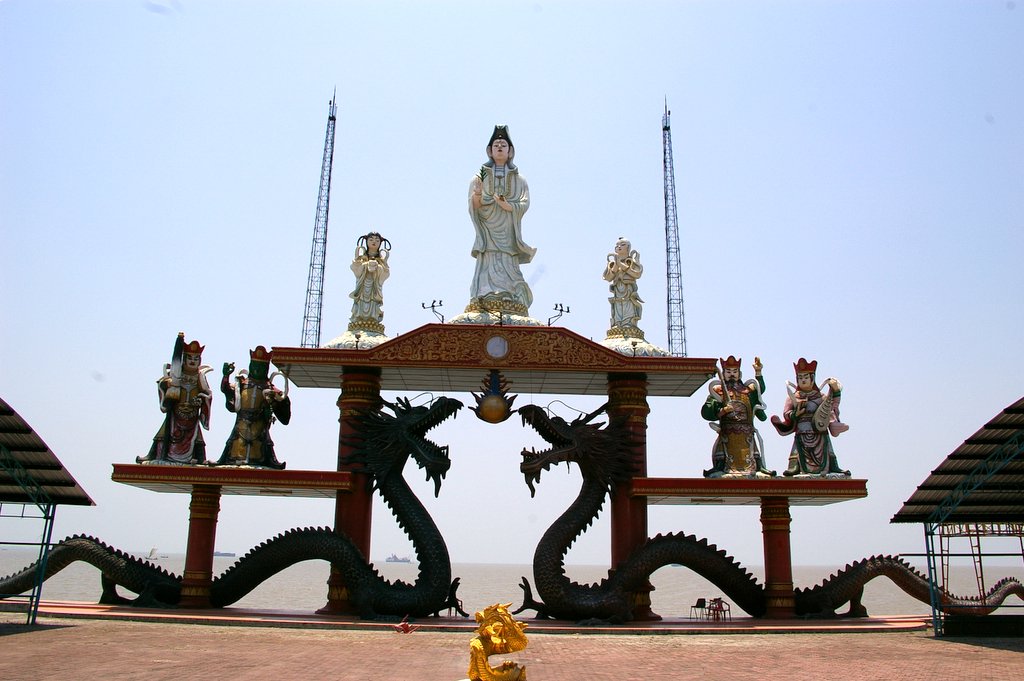

CHINESE MOON FESTIVAL
HAVE FAITH IN TOURISM © Duncan Graham 2006
There’s a monument missing from the coastal Kenjeran Panorama Ria Keluarga (also known as Ken Park) recreation centre on the east side of Surabaya, location for the annual Moon Festival.
There’s religious statuary aplenty – a cementery if you like - and all of it recent. More are planned, including a full size replica of the Temple of Heaven in Beijing’s Forbidden City. But there’s nothing to commemorate the man who allowed them to be built and displayed – or the man with the money behind the project.
During the New Order government of General Suharto there were heavy restrictions on the Chinese and their culture. These included the use of Chinese languages in print and public discourse, and performances of events like the lion dance.
Indonesia’s fourth president, Abdurrahman Wahid scrapped the controls, and adult Chinese who remember the past seem forever grateful.
“I think we all respect Gus Dur (the former president’s popular name) and what he did,” said Surabayan businessman and low-profile philanthropist Soetiadji Yudho.
“Without him there would be no traditional Chinese activities in public. We could not have done anything. Now we feel free and happy.”
Soetiadji and his colleagues have wasted no time in making amends.
They’ve used their capital and new found liberties to go on a religious building spree in the East Java capital, with a massive four-faced Brahma under a 36 metre high gold-colored dome as the latest edition.
It takes some time for a Western visitor with a limited understanding of Eastern religions to work it all out. For there are four faiths celebrating their presence on the same site - Buddhism, Hinduism, Confucianism and Taoism.
Size apparently matters. The four-faced statue is supposed to be the biggest Brahma in Indonesia, and only slightly smaller than a similar one in Thailand. There’s another in central Denpasar.
It’s widely regarded as a Buddha by the locals and is a Buddhist deity. However according to Soetiadji the statue represents Brahma, the Hindu creator god (also known as Dewa Catur Muka – the Four-faced God.)
The faces reflect mercy, magnanimity, fairness and meditation, while the multiple hands hold holy books, beads, water vessels and other artefacts.
Earlier erections nearby include a vaulting 20 metre high statue of the Goddess of Mercy, Kwan Im Po Sat flanked by two daughters and four men on the level below. These are above a couple of dragons, apparently fighting for a magic jewel ball. Soetiadji said these images were part of Taoism.
Although set high above the seashore, all the figures have their backs to the ocean. In most Western traditions, seashore statues look to the horizon for lands to conquer or invaders to repel.
“The goddess has come from another dimension and is looking inland to bring blessings to people and make the world peaceful,” said Soetiadji. “It doesn’t matter whether you think her beautiful or not – that’s not important. The message is to lead a happy life and be open, honest and truthful.”
The central temple is more conventional with several Buddhas, many burning candles and grandfather clocks. The atmosphere is relaxed with men and women mingling freely, burning incense and praying, indifferent to onlookers.
The place is mercifully free of beggars and touts, and the people who show you around don’t expect a tip. All religions (and presumably those with no religion) seem to be welcome.
There are no plaques at Ken Park naming Soetiadji as the benefactor, and staff are told not to mention his name. He’s a stocky friendly man with a large central city hotel, another being built, a jewellery factory and other enterprises. Despite these assets he’s not a big note guy.
He declined to say how much he’d spent at Ken Park or to have his photo taken for The Jakarta Post. He said it was enough for the public to know his philosophy.
“My father built a small temple about 30 years ago when such things were still allowed,” he said. “I’m a Buddhist and I put up the new temple in his memory. Then Kwan Im Po Sat, and later the Four Faced Brahma.
“Religion is in my heart. It’s personal. I respect your beliefs, please respect mine. Don’t ask me details of the meanings of the statues – I just know how to build!
“If people come and pray and get lucky, then I’m happy. Maybe some of that joy and luck will reflect on me. But I don’t know.
“Why did I do it? Because I like big projects! Surabaya is my hometown and I have the land. I didn’t do it to attract tourists though many now visit. That’s a secondary concern.
“This is my way of life. I feel happy doing this, and I hope visitors get happiness. That’s my private philosophy. Now you know what’s in my deepest heart.”
The Chinese corner is the only section of the 100 hectare park which deserves a visit – and don’t take the word of a jaded journalist for this observation. When the East Java Tourism News website writes of the park’s ‘filthy, dirty or untidy image’ then it’s clear changes need to be made.
Soetiadji says renovation plans are in place and include a seafood restaurant, a science education centre and a riding school. Watch this space.
The park looks as though maintenance wasn’t included as an ongoing budget item when first designed and built on reclaimed land. There are wide streets, but hazards lurk in the sunken paving. Someone’s idea of murals are peeling Disney characters. Statues of various animals are suffering in the last stages of concrete cancer.
The views to sea are better at night when the heat is less and only the bobbing lights of passing boats can be seen while you dine at one of the scores of food stalls. By day the advertised ‘beach’ can be more accurately described as a mud flat. If the floatation characteristics of black plastic bags fascinates, then this is the spot to be.
Please don’t be deterred by these criticisms, made only in the interests of balance. (And maybe because the car’s suspension took a beating during a drive around the complex.)
Go after sunset, particularly during the Moon Festival next Friday (the 15th day in the 8th lunar month of the Chinese calendar, year 2557) and enjoy the celebrations, including lion dances and martial arts displays.
Have a romantic evening, for this is what the Moon Festival is about, along with family reunions. Make your own sense of the religious imagery. It’s all benign.
(First published in The Jakarta Post 3 October 06)
">Link
There’s a monument missing from the coastal Kenjeran Panorama Ria Keluarga (also known as Ken Park) recreation centre on the east side of Surabaya, location for the annual Moon Festival.
There’s religious statuary aplenty – a cementery if you like - and all of it recent. More are planned, including a full size replica of the Temple of Heaven in Beijing’s Forbidden City. But there’s nothing to commemorate the man who allowed them to be built and displayed – or the man with the money behind the project.
During the New Order government of General Suharto there were heavy restrictions on the Chinese and their culture. These included the use of Chinese languages in print and public discourse, and performances of events like the lion dance.
Indonesia’s fourth president, Abdurrahman Wahid scrapped the controls, and adult Chinese who remember the past seem forever grateful.
“I think we all respect Gus Dur (the former president’s popular name) and what he did,” said Surabayan businessman and low-profile philanthropist Soetiadji Yudho.
“Without him there would be no traditional Chinese activities in public. We could not have done anything. Now we feel free and happy.”
Soetiadji and his colleagues have wasted no time in making amends.
They’ve used their capital and new found liberties to go on a religious building spree in the East Java capital, with a massive four-faced Brahma under a 36 metre high gold-colored dome as the latest edition.
It takes some time for a Western visitor with a limited understanding of Eastern religions to work it all out. For there are four faiths celebrating their presence on the same site - Buddhism, Hinduism, Confucianism and Taoism.
Size apparently matters. The four-faced statue is supposed to be the biggest Brahma in Indonesia, and only slightly smaller than a similar one in Thailand. There’s another in central Denpasar.
It’s widely regarded as a Buddha by the locals and is a Buddhist deity. However according to Soetiadji the statue represents Brahma, the Hindu creator god (also known as Dewa Catur Muka – the Four-faced God.)
The faces reflect mercy, magnanimity, fairness and meditation, while the multiple hands hold holy books, beads, water vessels and other artefacts.
Earlier erections nearby include a vaulting 20 metre high statue of the Goddess of Mercy, Kwan Im Po Sat flanked by two daughters and four men on the level below. These are above a couple of dragons, apparently fighting for a magic jewel ball. Soetiadji said these images were part of Taoism.
Although set high above the seashore, all the figures have their backs to the ocean. In most Western traditions, seashore statues look to the horizon for lands to conquer or invaders to repel.
“The goddess has come from another dimension and is looking inland to bring blessings to people and make the world peaceful,” said Soetiadji. “It doesn’t matter whether you think her beautiful or not – that’s not important. The message is to lead a happy life and be open, honest and truthful.”
The central temple is more conventional with several Buddhas, many burning candles and grandfather clocks. The atmosphere is relaxed with men and women mingling freely, burning incense and praying, indifferent to onlookers.
The place is mercifully free of beggars and touts, and the people who show you around don’t expect a tip. All religions (and presumably those with no religion) seem to be welcome.
There are no plaques at Ken Park naming Soetiadji as the benefactor, and staff are told not to mention his name. He’s a stocky friendly man with a large central city hotel, another being built, a jewellery factory and other enterprises. Despite these assets he’s not a big note guy.
He declined to say how much he’d spent at Ken Park or to have his photo taken for The Jakarta Post. He said it was enough for the public to know his philosophy.
“My father built a small temple about 30 years ago when such things were still allowed,” he said. “I’m a Buddhist and I put up the new temple in his memory. Then Kwan Im Po Sat, and later the Four Faced Brahma.
“Religion is in my heart. It’s personal. I respect your beliefs, please respect mine. Don’t ask me details of the meanings of the statues – I just know how to build!
“If people come and pray and get lucky, then I’m happy. Maybe some of that joy and luck will reflect on me. But I don’t know.
“Why did I do it? Because I like big projects! Surabaya is my hometown and I have the land. I didn’t do it to attract tourists though many now visit. That’s a secondary concern.
“This is my way of life. I feel happy doing this, and I hope visitors get happiness. That’s my private philosophy. Now you know what’s in my deepest heart.”
The Chinese corner is the only section of the 100 hectare park which deserves a visit – and don’t take the word of a jaded journalist for this observation. When the East Java Tourism News website writes of the park’s ‘filthy, dirty or untidy image’ then it’s clear changes need to be made.
Soetiadji says renovation plans are in place and include a seafood restaurant, a science education centre and a riding school. Watch this space.
The park looks as though maintenance wasn’t included as an ongoing budget item when first designed and built on reclaimed land. There are wide streets, but hazards lurk in the sunken paving. Someone’s idea of murals are peeling Disney characters. Statues of various animals are suffering in the last stages of concrete cancer.
The views to sea are better at night when the heat is less and only the bobbing lights of passing boats can be seen while you dine at one of the scores of food stalls. By day the advertised ‘beach’ can be more accurately described as a mud flat. If the floatation characteristics of black plastic bags fascinates, then this is the spot to be.
Please don’t be deterred by these criticisms, made only in the interests of balance. (And maybe because the car’s suspension took a beating during a drive around the complex.)
Go after sunset, particularly during the Moon Festival next Friday (the 15th day in the 8th lunar month of the Chinese calendar, year 2557) and enjoy the celebrations, including lion dances and martial arts displays.
Have a romantic evening, for this is what the Moon Festival is about, along with family reunions. Make your own sense of the religious imagery. It’s all benign.
(First published in The Jakarta Post 3 October 06)
">Link
Monday, October 02, 2006
ABU BAKAR BA'ASYIR'S SEX HANGUPS
NUDE ALERT
Abu Bakar Ba’asyir is right to say naked ladies are more dangerous than bombs. In fact they can be equally lethal fully clothed – that’s why they’re so often dressed to kill.
As the crazed cleric must have noted in his study of the English language (well, the coarse American version), many young women are labelled ‘blond bombshells’. Or ‘atomic dames’. A few years later and they become ‘old boilers’. These can also be dangerously unstable when overheated.
The more crass dub certain pointed parts of a woman’s anatomy as ‘bazookas’ while those us who are refined are content to admire a woman’s arms. As in armaments.
Obviously for good reason.
Ground crew at US air bases in Vietnam used to paint pictures of buxom bimbos on the ordnance primed to be dropped by B52s on the Ho Chi Minh trail.
The Americans lost that war, which should negate the whitebeard’s point. But nothing can neutralise his ridiculous reasoning.
All husbands know domestic life can sometimes be more blast than bliss. It certainly leads to explosive moments.
How many times has she stormed out and banged the door? Or slammed down the phone? Or her foot?
The toothy radical and former jailbird is spot-on: Bang, bang, bang. That’s marriage. Take cover.
In any contest over ownership when she refers to ‘mine’ it’s usually the Claymore version. Think of the language of fashion and how much is about weaponry: Tank tops, needlepoint, stilettos, chokers … That didn’t happen by chance.
Miss isn’t an honorific – it’s an abbreviation. For Missile. And usually unguided.
A man’s role in a relationship requires him to be on red alert at all times, as in a bomb squad, ready to defuse a volatile situation. Like suggesting the dinner might be more palatable if it hadn’t been nuked in the oven while she gossiped on the phone.
In this example any misplaced word is likely to result in the launch of a verbal grenade.
In fact it’s unfair to mock. Ba’asyir may outrage the feminists but he’s in good company with his observations, though almost 400 years out of date. The English dramatist William Congreve warned us in more elegant terms with his lines:
Heaven hath no rage like love to hatred turned / Nor hell a fury like a woman scorned.
So hearken, all singles of whatever faith, to the wise words of the sage of shariah.
Stick with nitro-glycerine – it’s more stable than wedlock. But a lot less fun.
(First published in The Jakarta Post 2 October 06)
">Link
Abu Bakar Ba’asyir is right to say naked ladies are more dangerous than bombs. In fact they can be equally lethal fully clothed – that’s why they’re so often dressed to kill.
As the crazed cleric must have noted in his study of the English language (well, the coarse American version), many young women are labelled ‘blond bombshells’. Or ‘atomic dames’. A few years later and they become ‘old boilers’. These can also be dangerously unstable when overheated.
The more crass dub certain pointed parts of a woman’s anatomy as ‘bazookas’ while those us who are refined are content to admire a woman’s arms. As in armaments.
Obviously for good reason.
Ground crew at US air bases in Vietnam used to paint pictures of buxom bimbos on the ordnance primed to be dropped by B52s on the Ho Chi Minh trail.
The Americans lost that war, which should negate the whitebeard’s point. But nothing can neutralise his ridiculous reasoning.
All husbands know domestic life can sometimes be more blast than bliss. It certainly leads to explosive moments.
How many times has she stormed out and banged the door? Or slammed down the phone? Or her foot?
The toothy radical and former jailbird is spot-on: Bang, bang, bang. That’s marriage. Take cover.
In any contest over ownership when she refers to ‘mine’ it’s usually the Claymore version. Think of the language of fashion and how much is about weaponry: Tank tops, needlepoint, stilettos, chokers … That didn’t happen by chance.
Miss isn’t an honorific – it’s an abbreviation. For Missile. And usually unguided.
A man’s role in a relationship requires him to be on red alert at all times, as in a bomb squad, ready to defuse a volatile situation. Like suggesting the dinner might be more palatable if it hadn’t been nuked in the oven while she gossiped on the phone.
In this example any misplaced word is likely to result in the launch of a verbal grenade.
In fact it’s unfair to mock. Ba’asyir may outrage the feminists but he’s in good company with his observations, though almost 400 years out of date. The English dramatist William Congreve warned us in more elegant terms with his lines:
Heaven hath no rage like love to hatred turned / Nor hell a fury like a woman scorned.
So hearken, all singles of whatever faith, to the wise words of the sage of shariah.
Stick with nitro-glycerine – it’s more stable than wedlock. But a lot less fun.
(First published in The Jakarta Post 2 October 06)
">Link
Subscribe to:
Posts (Atom)