
Take a tadpole ride
on the wild side

Here are three things you won’t find in Indonesia:
A Javan tiger; an unsweetened coffee – even when you’ve
stressed pahit and the waitperson has
nodded vigorously - and a fat becak (pedicab)
cyclist. But this slimming suggestion
won’t be featured in women’s magazines.
“That’s right, you never get overweight,” said Tukiran who
at 78 claims to be the oldest becak driver
in Malang. “It’s a job that really keeps you fit. I’ve never been sick.” As proof he showed his calf muscles, worth
admiring despite being of more interest to a vascular surgeon.
In the principles of honest journalism, but to the grief of the
Quit lobby, it has to be disclosed that Tukiran’s recipe for longevity includes
nurturing asphalt-coated lungs. He
smokes the coarse hand rolled kretek clove
cigarettes. These are so lethal that -
unlike handguns – they’re banned in the US.
These are not the refined and processed products promoted on
TV by heedless hipsters skydiving off razor-tipped cliffs and skindiving among
sabre-toothed tiger sharks.
If the smoke ad models wanted to confront real danger they’d
clamber out of their gull-winged Mercedes and fly through the traffic in a
Malang becak.
Unlike rickshaws, invented about 150 years
ago with the rider alongside, the pedicabs in the East Java city have the
passenger in front. Designers call this the ‘tadpole’ model. It’s more efficient than the sidecar version
and can squeeze through narrow lanes.
 Training as a health and safety officer is not needed to know
that in any collision the passenger will be the human bumper, or if rammed from
behind, an instant projectile. If your
dream is to be a space explorer, this is your moment of glory before gore.
Training as a health and safety officer is not needed to know
that in any collision the passenger will be the human bumper, or if rammed from
behind, an instant projectile. If your
dream is to be a space explorer, this is your moment of glory before gore.
However if you plan to study the orifices of truck exhaust systems
for a mechanical engineering degree then this is the place for research.
There are positives; becak
are pollution free and next to noiseless apart from the grunts of the
driver.
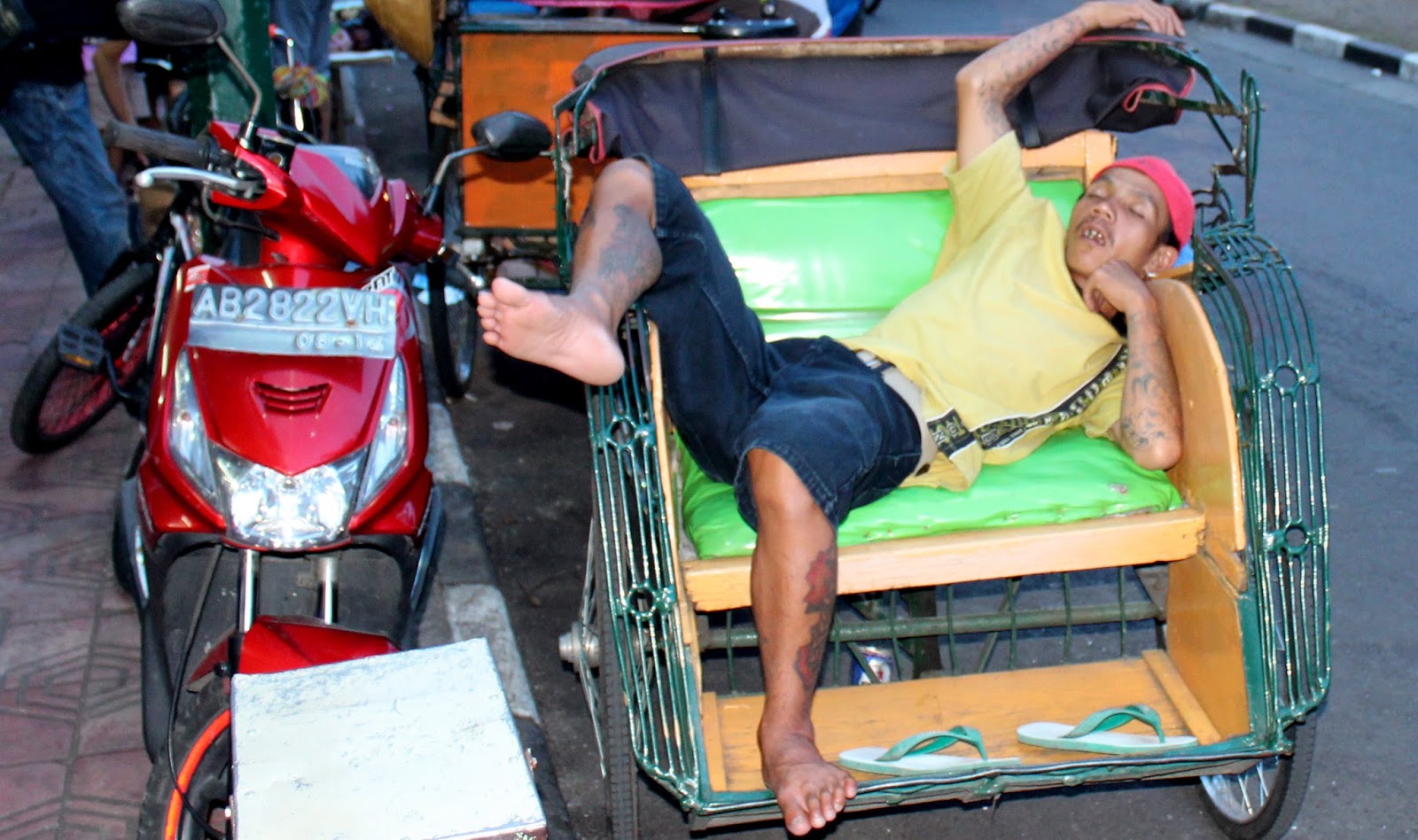
For those too poor to have a home, a becak can serves as an abode.
Passengers get to spot potholes before the driver and brace
for the shock, though there’s nothing to hold onto unless you are riding with
your beloved.
The bench seats are designed for two slim-hipped pre-teens,
not wide-bottomed bule (foreigner);
enjoy knees in mouth like airline economy class and hunchback headroom.
If love is in the air travel at night in the rain - wheels
hissing through puddles - with a plastic curtain windshield. To suggest the material is waterproof would
be a misprint, but the joy is that passengers can see out, well just, and
others can’t see in.
As this is a family magazine we’ll go no further along this
road, just leave the direction to your imagination.

Despite the obvious hazards Tukiran (right) claims he’s never had an
accident. He calls the becak which he owns Sabar meaning ‘be patient, tolerant and calm’.
A splendid motto for preservation when the steel four-wheelers
jostling for the same road space drive to discredit these ancient Javanese
qualities.
If readers get the impression Tukiran is arrogant then this
story needs a rewrite. His title of Becak Opa (Grandpop Pedicab) was
bestowed by his mates on the corner of the alun-alun
(town square) and he only laughingly acknowledged the rank.
Perhaps he blushed, but we’ll never know. Almost eight decades of exposure to sun and
smog, rain and dust have turned his skin near to buffalo brown.
If lucky he’ll earn Rp 50,000 (US$ 3.70) a day starting at 7
am and finishing around 4 pm. He’s
competing with around 2,000 others and a boom in privately-owned motorcycles so
fares are getting rare. A becak driver plays the waiting game.
His younger mates have handphones with subscribers on
speed-dial to regularly ferry kids to school or maids to market. The elderly and disabled reckon they’re handy
because this public transport is easy to access.
Loads too big for motorbikes and too small for pick-ups are
also part of the business.

The other threat is the bentor
(motorised pedicab) cobbled from old motorbikes and becak cut in half and crudely welded together.
“The problem is that there’s no front brake,” said Suwoho,
38, one of the younger bentor drivers. “The police say they’re illegal if unregistered
and can only be used outside the city.
We have to play a cat-and-mouse game.’
If so the feline must be well fed. While talking to a group
of drivers and assorted hangers on, including cigarette hawkers and ladies of
the night on the day shift, police cars cruised past.
No-one jumped into drains. Today the cops were displaying
their perfected blindness to minor malfeasance by those too poor for a
shakedown.
Suwoho doesn’t own his motorised second-hand three-wheeler –
he’s paying off the Rp 800,000 (US$ 60) loan at Rp 100,000 a month – if he gets
enough customers.
“It’s no good if people are stingy,” he said, resigned to
reality. “What I earn depends on the blessings of God.”
Becak and bentor don’t
have meters so the cost has to be negotiated.
That’s a skill mastered by the drivers though not easily learned by
outsiders, particularly tourists.
They tend to convert rupiah into their own currency and
measure the cost against a cab fare in their homeland. “What, only Rp 100,000 to the Post Office? It would cost five times that in Chicago –
what a deal!”
It would cost five time less if they’d asked locals for the
right rate.

The becak men know
they’re heading down a no-through road. Tukiran started pedalling when he was
12 and hasn’t stopped since. His Pop was
also in the trade, but his two sons have found other jobs.
The story of Jakarta authorities briefly cleaning up the
capital by dumping thousands of becak in
the ocean is well known. Less understood
is that Yogyakarta has spruced up its becak
to make them tourist attractions.
“This work is only for those who don’t have another job and
who left school early,” said Suwoho.
But when shown pictures of a new design being explored in
the US for Asia (see breakout) he urged that the idea be introduced to the city
mayor.
Reinventing the wheel
· Catapult Design, based in Denver,
Colorado, has won a US$340,000 (Rp 4.5 billion) one-year contract from the
Asian Development Bank (ADB) to ‘redesign the existing rickshaw into a modern
pedicab’.
Project team leader Bradley Schroeder
calls himself a ‘bicycologist’. He’s
written a book about cycling and studied pedicabs in 11 countries.
“I’ve worked quite a bit in Indonesia,” he
told J-Plus. “The project would be applicable
in many cities. I believe the status of
the car is declining among the younger generation.
“Take Bandung for example. The mayor (architect Ridwan Kamil) is very
focussed on creating a liveable city and
managing traffic. Jakarta is a really
tough place because of the street sizes and the national and local politics.
Medan has a long way to go.
“Catapult will also make 60 prototype
vehicles and test them in Kathmandu and Lumbini (the birth place of Buddha) in
Nepal with a further ADB grant of US $150,000 (Rp 2 billion).
“It’s important to note that the
prototype cost will be significantly higher than production costs. So a simple
division does not represent the true cost of the manufactured vehicle once in
production.”
· Half
the pedicabs will be pedal powered costing around US $750 (Rp 10 million), the
rest assisted by an electric motor.
The pedicabs, made of aluminium with an
enclosed drive train, will be lighter; the GPS touchscreen could also be used
for advertising.
“The design will be open source,” said
Schroeder. “This means that any
manufacturer can use the ideas without violating copyright.”
(First published in J-Plus - The Jakarta Post 10 April 2016)


