FAITH IN INDONESIA

FAITH IN INDONESIA
The shape of the world a generation from now will be influenced far more by how we communicate the values of our society to others than by military or diplomatic superiority. William Fulbright, 1964
Showing posts with label Paul Keating. Show all posts

Thursday, October 14, 2021

THE CHANCES WE LOST


            The Kampong of Broken Dreams    

Paul Keating, Dtuck in an 80s Rut | International Interiors 

(Image - International Interiors)

Had Paul Keating’s initiative in securing the 1995 Security Agreement with Indonesia survived we’d have a local ally so wouldn’t need AUKUS,  or old-timers from Defence and DFAT telling our Asian neighbours they’ve nowt to fear from the  Anglosphere.

That’s the logical conclusion from reading Professor James Curran’s revelations on this website of the secret negotiations leading to the agreement, described by researchers as one of the most important recent developments in Australian foreign and defence policy’.

The deal, though short-lived, encouraged Jakarta  to reappraise its neighbour, and shift Canberra to see possibilities based on geography rather than history.  It collapsed partly through clumsy dealings with the idiosyncratic Bacharuddin Jusuf (BJ) Habibie over the future of East Timor.

John Howard’s suggestions for getting rid of the ‘pebble in the shoe’ were mishandled by the impetuous third president.  This led to a referendum and the former Indonesian province securing  independence.  Hundreds were killed, thousands displaced and property destroyed in a scorched earth retreat by the losers.

East Timor is independent, but the pebble is now a rock reminding nationalist Indonesians of their defeat and shame at the hands of a minor foreign power.

Had more diplomatically adroit and culturally cautious leaders been around we might still be benefitting from Keating’s vision.  Now the US and China are jostling to get Indonesia on-side and being rebuffed while we’re trying to repair the self-inflicted damage done by siding with Washington and London to counter Beijing’s aggression. 

The SMH reports senior diplomat and first ambassador to ASEAN Simon Merrifield will review Australia’s relationship with Indonesia.  Three former defence chiefs will march around explaining we’re cuddly bunnies, despite buying nuclear-powered subs and stationing US troops on our northern shores facing the region.

It might be more effective to send smart Asia-literate youngsters in tune with the times to tell of Australia’s worries and intentions. Almost a third of Indonesia’s population was born this century and knows nothing of the 32 years when the corrupt dictator and kleptomaniac ($35 billion according to some accounts) Soeharto ruled with the military.

Curran’s account of Keating’s attachment to Indonesia illuminates some of our troubled recent history with the people next door. Tragically, the former PM’s ‘magnificent obsession’ with Asia hasn’t infected his successors, though they always chant the mantra about the Republic’s importance while peering over their listeners’ heads to the distant north.

Our biggest embassy / fortress is in Central Jakarta, but it might as well be in a kampong lean-to for all the good it’s doing to build better people-to-people relations.  It does little to persuade Indonesians that we’re friendly folk deeply interested in their nation beyond Kuta – the lives, beliefs and history of a complex people in an ancient archipelago.

Our inability or refusal to get close is matched by Jakarta’s indifference to Canberra under current president Joko Widodo who shows little interest in foreign affairs.
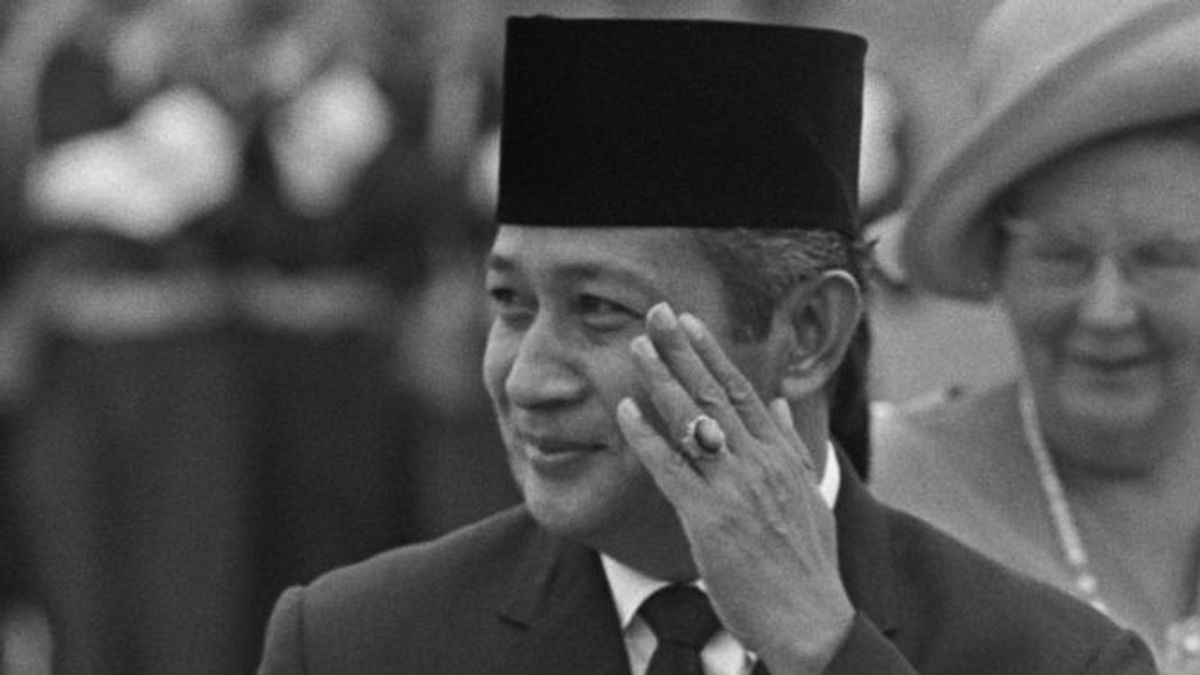
Nasihat Guru Spiritual, Rama Dijat yang Dituruti dan Ditolak Soeharto:  Selamat dan Petaka Orde Baru

(Image VOI id)

Curran’s article raises many questions.  When Keating was dealing with Soeharto he knew the Indonesian leader was a villain. The former general had overseen the slaughter of an estimated 500,000 real or imagined Communists after the 1965 coup and sent thousands of the nation’s best and brightest to an island concentration camp.

The CIA labelled it ‘one of the worst  mass murders of the 20th century, along with the Soviet purges of the 1930s, the Nazi mass murders during the Second World War, and the Maoist bloodbath of the early 1950s.’

Australian scholar Dr Jess Melvin, who exposed the army’s role in organising militias to do the butchery, called it a genocide.

How could an Australian Labor Party leader get so close to Indonesia’s Goebbels? That the two apparently hit it off when neither could speak the other’s language is weird.

One man was a rationalist, hard-wired into Western values, the other an ill-educated street-smart soldier steeped in Javanese mysticism. Soeharto thought it OK to sacrifice half a million of his nation’s citizens to halt his predecessor’s journey to the left and embrace the US which rewarded the shift with goodies galore reinforcing graft.

The timing of Keating’s initiative damaged the result.  By December 1995 when the agreement was signed Soeharto’s authority was waning.  Access to the Internet and fearless journalism from Tempo magazine was rousing dissent. Photocopies of banned Western magazines exposing Indonesia’s woes were openly offered to motorists at intersections.

Keating’s motives were strategically right but morally wrong.  It seems he believed pragmatism crushed standards and no ghastly history showing his counterpart was saturated in gore could drown a determination to have his policy prevail. 

If that’s right so are the cynics who claim there are no principles in politics that aren’t expendable - however deeply embedded in a culture and hardened by time.  As Niccolò Machiavelli wrote, ‘the ends justify the means’.

Last century’s idea that Indonesia might be a threat was ridiculous.  It was founded on Australian ignorance and fear of Asians, exploited by malicious politicians.  Even the most belligerent generals and Muslim extremists dreaming of a Caliphate never had the resources or will to attack Australia, so Soeharto’s assurances were easy to give.

Keating’s work placated the xenophobes, but more significantly the security agreement created a foundation for others to reinforce.  It was all the more remarkable because it ran counter to the non-alignment ‘free and active’ rule usually attributed to first vice president Mohammad Hatta.

Since then it’s been hardened by the 1955 Non-Alignment Movement and sixth president Susilo Bambang Yudhoyono’s tagline of ‘having a million friends and zero enemies.’

No chance now of another agreement with Australia.

First published in Pearls & Irritations 14 October 2012: https://johnmenadue.com/paul-keatings-indonesian-vision-has-been-undone-by-his-successors/


Saturday, July 10, 2021

KOREA'S DANCING DIPLOMATS


                        Pop goes Korea, plop goes Australia  


No WA BTS Asli yang Sering Banget Dicari oleh Para Penggemar - Fakta.id


From afar it looked like a demo, though the location was wrong.  An Indonesian McDonald’s restaurant, not the town hall or government office where placard-wavers usually gather.  And much of the tight-packed crowd spilling into the street wore the green gear of GoJek motorcycle carriers. Maybe a pay dispute?

Wrong on all counts. The bikers were collecting online orders of chicken nuggets packed in boxes promoting the K-pop boy band BTS.  The tsunami of customers was so pressing the police forced 32 stores to close.

The McDonald’s event was weird but Indonesian infatuation with all things Korean isn’t new.  In 2019, a Korean government portal claimed Indonesia ‘topped the global ranking of K-pop content viewership on YouTube with 2.62 billion views.’


The genre is addictive, the choreography simple, production values faultless, the pimple-free performers more like sci-fi androids.  Most songs are in senseless English, the lyrics probably written by AI. Sample: ‘Word up, talk the talk, just move like we off the wall.’ The sound is the swish of swiped credit cards.

Marketing agency head Michael Patent told The Jakarta Post K-pop appealed to youngsters seeking escapism and a sense of belonging to an international community:

 ‘K-pop is an art, but it’s also business. The management companies have created a system in which a product that gets delivered to consumers is of really high quality. It’s been produced to specifically appeal to a certain taste.’  In brief, creating a need and coining tons of won.


The ROK makes earth movers, smartphones and cars.  Also in its catalogue are K-pop soft sells, music, videos, pictures, make-up, food, fashion and more.


Australia feeds Indonesia grains and meats.  Its add-ons tend to be cerebral, scholarships, elite exhibitions and on-campus film festivals.  Worthy stuff, though no match for sashaying beardless boys and cutesy girl groups sending the fandom frothing.


Indonesia’s mean age is 29.7 – Australia’s 38. The UN Population Fund puts 28 per cent of Indonesian citizens in the 10-24 age bracket.  Suits spread-sheeting tariffs may not be the best way to snare Gen Z’s attention.

The last time Australian popular culture elated Indonesians was in the late 1980s with the TV series Return to Eden.  In 1992 the show’s star Rebecca Gilling was mobbed when she visited Jakarta, with the Australian Financial Review reporting the then 40-year old actress ‘may for a time have been more popular in Indonesia than she was in Australia.’

Bemused Australian Embassy staff in Jakarta might ponder this simple question:  How come South Korea’s youth excites Indonesians who only know of the East Asian nation on smartphone screens - while the folks next door rarely raise a yawn? 

Maybe it’s all too tough.  In Strangers Next Door?  Melbourne University’s Tim Lindsey and David McRae write bluntly: ‘There are no two neighbouring countries anywhere in the world that are more different than Indonesia and Australia. They differ hugely in religion, language, culture, history, geography, race, economics, worldview and population.

‘In fact, Indonesia and Australia have almost nothing in common other than the accident of geographic proximity.’

That disheartening list isn’t contested, with the mismatches aggravated by distance.  The peninsula nation’s heritage and values bear little resemblance to the islands where 350 years of Dutch colonialism implanted many aspects of Western thinking.


So why the lack of love?  We Australians tell ourselves we’re matey but rarely relate beyond backslaps with foreigners who don’t drink beer or play cricket. As long as the bulk containers keep sailing with full holds it seems they’re not going to tackle the tough stuff.

In 2017 the Department of Foreign Affairs and Trade started reviewing policies on soft power, defined ‘as the ability to influence the behaviour or thinking of others through the power of attraction and ideas.’

After 130 concerned individuals and organisations had lodged submissions the show was ditched. DFAT blamed the pandemic making the project ‘no longer as relevant to the significantly changed global environment.’  The Koreans think otherwise, churning out their products and currently running a TV sport drama series Racket Boys with an Indonesian storyline.

As reported in Australian Outlook in May, a survey by Singapore’s ISEAS – Yusof Ishak Institute showed an awkward reality: Indonesians think Australia has little influence and its aid is too tiny to be felt. 

Now we have the other side’s feelings.  Last month the Lowy Institute released its annual poll on Australian attitudes to those across the Arafura Sea.  Yet again it showed what the director of LI’s Southeast Asia Program Ben Bland called in The Interpreter website “a dispiriting exercise”.


 ‘Whether asked about their warmth toward Indonesia, confidence in its leaders, or even their level of basic knowledge about their biggest neighbour, Australians tend to show a combination of disinterest and distrust.’

Reasons include the gutting of Indonesian language courses in schools and unis and the shallow media coverage of archipelagic affairs. 

President Joko Widodo focuses on domestic matters.  His more worldly predecessor Dr Susilo Bambang Yudhoyono, told the Australian parliament in 2010 the issues were improving mutual public understanding, managing diplomatic differences, boosting economic ties and adapting to emerging regional problems.


Commented Bland, who is also Widodo’s biographer: ‘More than a decade later, both countries have made steady progress on the last three challenges. However (the Lowy poll) shows that there is still much work to do on the first.’


In 1994 the then PM Paul Keating said: ‘No country is more important to Australia than Indonesia - If we fail to get this relationship right, and nurture and develop it, the whole web of our foreign relations is incomplete.’

In the 27 years since every Australian leader has said much the same, often with the enthusiasm of making a dental appointment.  None have asked Aussie kids how to connect with their maybe-friends next door.

As all parents eventually and gladly discover, adolescence doesn’t last. The brightest of Jakarta’s K-poppers are set to remain movers and shakers when they graduate from dance floor to boardroom.  Canberra wants them tapping policies to the rhythm of Oz, but the beat is set by Seoul.

Buttoned-down diplomats face a new reality: Gyrating teens flaunting flesh can also be a tool of statecraft.


First published in Australian Outlook, 9 July 2021:  https://www.internationalaffairs.org.au/australianoutlook/pop-goes-korea-plop-goes-australia/