FAITH IN INDONESIA

FAITH IN INDONESIA
The shape of the world a generation from now will be influenced far more by how we communicate the values of our society to others than by military or diplomatic superiority. William Fulbright, 1964
Showing posts with label Gus Dur. Show all posts

Monday, December 18, 2023

RI POLITICS: NO ROOM FOR SMART WOMEN


Equality is risky - best stay with blokes    


Indonesians have just witnessed a messy, badly produced TV ‘debate’ between the politicians jostling to run the world’s fourth largest democracy facing a national election in less than two months.


Just a few weeks ago it seemed Indonesian politics was edging towards modernity by recognising that half the voters are women with different values, needs and expectations.  


Not to be. The oligarchs have spoken: In a nation that claims to be progressive and tolerant there's no place for a woman in any leadership team The six candidates for the Presidency and Vice Presidency are men, all Javanese, all Muslim.


For a short but hopeful time in the juggling for positions, it seemed possible that a woman might get a go.   Mid-year three ferociously ambitious mega-rich guys were seeking a partner for the 14 February poll. What date could be more auspicious for starting anew?


The paramours were lusting after a Vice President who could relate to those who’ve matured this century in a democracy, albeit flawed. Voting is voluntary. In the 2019 presidential election, the turnout was 82 per cent.


The obvious choice was Yenny Wahid, 49, and she was willing. 


The second daughter of the Republic’s fourth president, the late Abdurrahman (Gus Dur) Wahid (1940 - 2009), had the professional and personal qualifications for high office, so who’d win her hand? It was the sinetron (soapie) spellbinding the nation.


 The lady most likely headed a tiny socialist party with Buckley’s chance of scoring even a footstool in the 575-seat national parliament by going alone. She was being wooed for her qualities, ancestry and reputation for relating to the young. 


When the Indonesian Army trashed East Timor after locals rejected Indonesian rule in the 1999 referendum, Yenny was a correspondent with the then Fairfax Press, a journo in the coverage team that won a Walkley Award, Australia's highest prize in journalism.


(Use of forenames is Indonesian style. It doesn’t imply partiality.)


 Now she heads the Wahid Institute, an Islamic think-tank working for ‘the development of both Indonesian as well as Islamic society, improving the welfare of lower classes … building democracy and fundamental justice, and expanding peace and non-violence.’


In 2009 the World Economic Forum named Yenny a young global leader. She has a Harvard master's degree, a persuasive personality and international experience.


She’s a liberal Muslim with all the credentials. Her great-grandfather Hasyim Asy'ari founded the world's largest Muslim organisation Nahdatul Ulama (NU) which claims close to 100 million members.


In Indonesian culture the way women dress and behave is scrutinised for signs of unorthodoxy; Yenny, a married Mum of three, came across as an Ibu Ibu, a safe homely matron, which doesn’t mean a soft touch. 


In an earlier interview, she quashed suggestions of subservience: This is the way I express my right to wear what I want. (She uses a half-jilbab headscarf.) It’s my symbol of struggle.


It might be easier if I was a man in this macho society, but then the pressures could be physical rather than mental.


Youngish voters will dominate the  February ballot according to The Jakarta Post: Around 114 million Indonesians eligible to vote next year are under 40.


ThKompas national newspaper commented: Young people are always the target of the contestants' votes (but) not many policies are in favour of the younger generation. 


The quinquennial election is the only time the ignored feel frisky. Indonesia’s teals have clustered around the centre-left Partai Solidaritas Indonesia (PSI) which includes Yenny’s politician husband Dhohir Farisi, and the socialist   New Indonesian Nation Sovereignty Party (PKBIB) chaired by Yenny.


Both were formed this century by student Utopians after Reformasi - the 1998 fall of the autocrat General Soeharto who ran the nation for 32 years. 


In the late 1700s, the French Revolution beheaded the ruling royalty to ensure they’d never return. In 1998 the Indonesian activists who brought down Soeharto naively assumed his cronies would disappear along with the king of the kleptocrats, all wreathed in shame.


The students were too soft, so last century’s oligarchs still rule and plunder, promise and default. A Macbethian tragedy wrote one academic. Another commented that Indonesia’s experiment with democracy has been hijacked by the dark forces that held the country back before.


Yenny’s problem shouldn’t have been gender, except among ultra-conservatives. The world’s most populous Muslim-majority nation had its first female president in 2001. As vice president Megawati Soekarnoputri inherited the job when Yenny’s father was impeached.


Even as coalitions, the small parties don’t have enough cash and candidates to steer the state, so their best chance of getting close to the driver is as VP. 


The PSI nominated Yenny to stand with Ganjar Pranowo, 54, of Mega’s PDIP - the Indonesian Democratic Party of Struggle.


But Mega has no love for the Wahid family,  so no-go. Likewise with disgraced general Prabowo Subianto, 72, Indonesia's Donald Trump. 


Insiders then predicted Yenny pairing with the former Jakarta Governor Dr Anies Baswedan, 54. The one-time Education Minister and University Rector has the skills needed to work with a smart female.


The US-educated Anies has been nominated by the secular centrist Partai NasDem (National Democrat) which has 59 seats in the current Parliament.


While Yenny’s swains thought she had the youth ratings, in the end, they feared her liberal values.  So Prabowo selected outgoing President Joko (Jokowi) Widodo’s eldest son Gibran Rakabuming Raka, 36.


Ganjar Prabono (from Mega’s Democratic Party of Struggle - PDIP) went for former Constitutional Court justice Mohammad Mahfud Mahmodin while Anies picked Muhaimin Iskandar, the deputy house speaker but more importantly religiously close to Yenny’s late father through the NU Islamic organisation.


Though not so near as his daughter.  


 First published in Pearls & Irritations, 18 December 2023: https://johnmenadue.com/equality-is-risky-best-stay-with-blokes/


Sunday, March 24, 2019

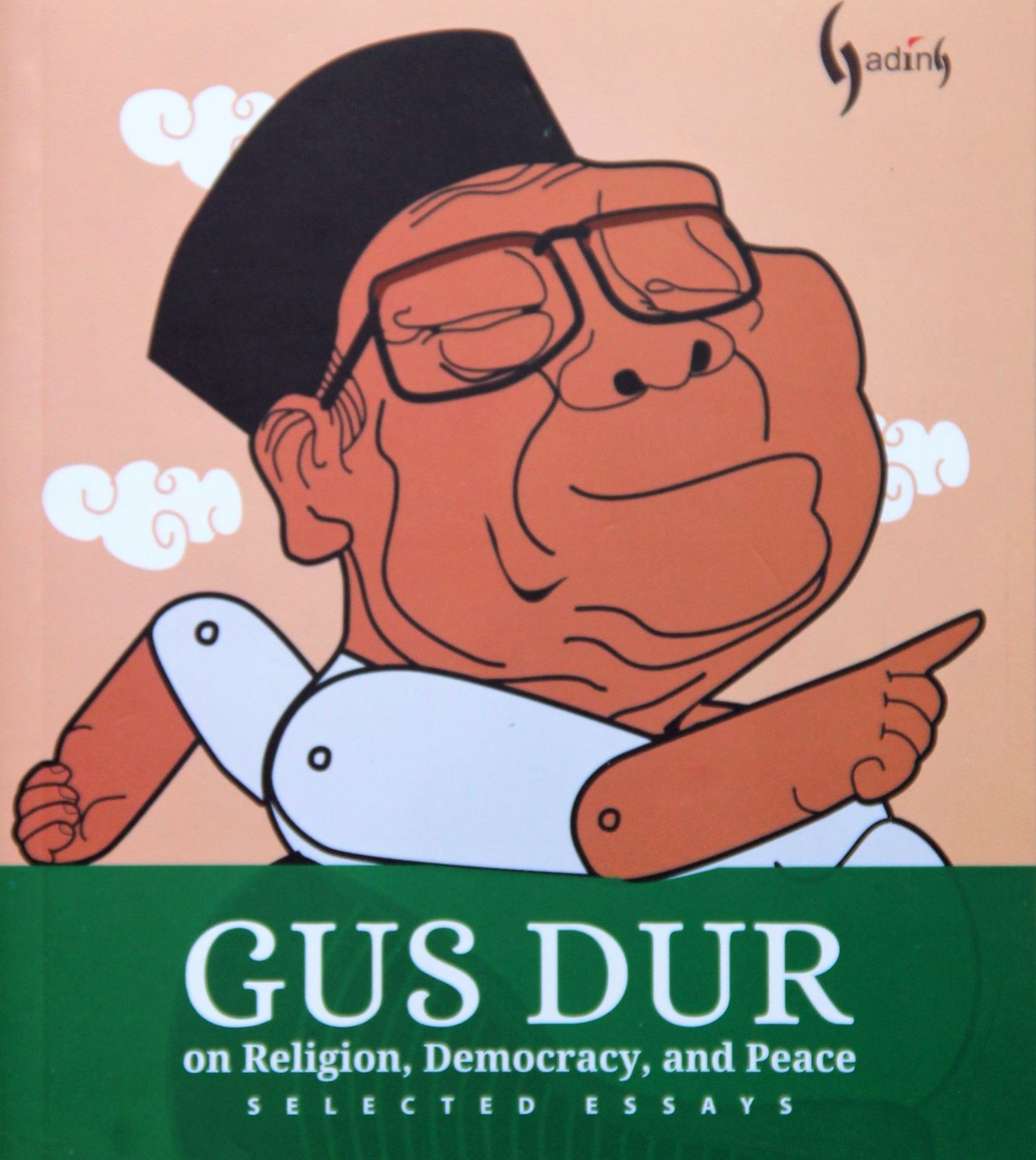
GUS DUR ON RELIGION, DEMOCRACY AND PEACE


Showcasing an Indonesian intellectual       

'Gus Dur on Religion, Democracy and Peace’: Showcasing an Indonesian intellectual           

How to get the golden egg without disturbing the hen?
This was a typical conundrum posed by Indonesia’s fourth President the late Abdurrahman Wahid.  Better known as Gus Dur, he was one of this nation’s most prominent theologians, a committed democrat and lover of metaphors. 

One of the eggs was reform and a return to the more accepting indigenous Islam.  This needed to be secured without arousing the wrath of the broody bird, the rigid Saudi form known as Wahhabism then becoming popular.

Gus Dur died in late 2009 aged 69.  Before entering politics he was head of Nahdlatul Ulama (NU), the biggest Islamic organization in the world.

His 19 months as President between 1999 and 2001 were chaotic after the fall of the long time dictator and former army general Soeharto. 

Gus Dur was a bad economist, a lousy administrator, a decent humanist and a good social reformer. He lost the top job after being threatened with impeachment.

There aren’t too many NU members who don’t have an anecdote about their former leader.  Apart from being a religious scholar the polymath was also a passionate soccer fan and all-round funny man with a sackful of jokes. He used these to start meetings and defuse tensions:

A Madurese was caught ignoring a sign banning pedicabs. ‘I saw the picture Sir,’ he told the policeman, ‘but it showed an empty becak; mine had a passenger.’

“You're stupid. Can't you read the words under the picture?’

‘No Sir. If I could read I’d be a clever man like you.’

One of Gus Dur’s favorite verses from the Koran reads: ‘I have made you nations and tribes so that you may know one another’, a robust rebuff to the parochialism preached by today’s separatists.

He wrote essays and newspaper articles till restricted by loss of sight; these were always in Indonesian though he was a self-taught polyglot.

Now the Gusdurians, the young followers of his liberal thinking, have offered some selected works to a wider audience.  Seven translators have put 13 of his essays into English as Gus Dur on Religion, Democracy and Peace.

Behind the book are the NGOs Infid (International Forum on Indonesian Development) and Yayasan Lembaga Kajian Islam dan Sosial (Islamic and Social Studies Institute).

The ambition of giving their hero’s wisdoms to the world is fine, and the book important, offering many stimulating observations. But sadly it will get rejected by some potential buyers put off by sloppy English, even on the back cover blurb:

‘Not much people know that Gus Dur wrote many reliable and high quality articles … (he) does not simply rejects negative ideas about Islam, he also proposes and advocates positive ideas about on the other hand.’

We get the gist; Gus Dur’s fans will read this book anyway and forgive the errors, but this is 2018 and the public expects English of the quality they find in this newspaper.

The uncommitted curious will put it back on the shelf. Two proof readers are listed in the credits. I doubt they read the book.

However the rest of us should, if only to lift our spirits, to remind us of the complex diversity of Islam, a faith so often portrayed in the West as violent and intolerant.

Gus Dur was an eclectic reader as confident with the holy books of other faiths as with his own, often quoting the Bible.  In 1985 - when Soeharto’s authoritarian New Order government was at its peak – the cleric gave a sermon about the ‘Revival of Islamic Civilization’ and asked ‘is it happening?’

His conclusion was positive - though this was before urgers for a caliphate donned suicide vests and rode into crowds: ‘The richness of (Islam’s) heritage from its deep perception on (sic) a true place for humanity in life, to its great tolerance make a strong base for the Muslims to sail through the revival process.’

These are qualities we need now.

Gus Dur’s second daughter Yenny is a prominent public figure helping maintain her Dad’s legacy. But at the moment there’s a dearth of dynamic elders from outside the family offering the world a counter view to the ugliness of demonstrations against those of other faiths.

Into the gap have jumped the myopic polemicists.

What might Gus Dur have said to supporters of the so-called Reuni 2/12 in December? If true to form he would have condemned their celebration of getting the ethnic-Chinese Christian former Governor of Jakarta, Basuki ‘Ahok’ Tjahaja Purnama, jailed for blasphemy.

This law has been erased from the statutes of most modern nations; it’s better covered by prohibitions on individuals deliberately and maliciously causing egregious offence, and not just against faith.

The black-banner wavers around Monas have struck fear into the hearts of Indonesia’s minorities and dismayed the Republic’s foreign friends – something Gus Dur would have opposed with conviction.

He wasn’t just a thinker – he physically confronted crazed mobs who’d fired churches.

His essay The Republic of Earth in Heaven: Another side of religious motives within social movements, written 35 years ago is apposite today.  He warns of ‘an endless process of fragmentation … diversity sacrificed to revolution’.

The revival he sought was not through terror, but the art, literature, architecture and learning that once enriched the world, making Islam universally admired.

Gus Dur on Religion, Democracy and Peace
Gading Publishing, Yogyakarta, 2018
142 pages

(First published in  The Jakarta Post J Plus 23 March 2019)


Friday, December 14, 2018

LIBERAL? MAYBE... BUT THERE ARE LIMITS


Help! What would Gus have done?


They’re idealists working out of the center of Javanese arts, culture and education. They want to promote harmony, but are bumping into difficulties with the acceptance philosophy of their guru.

The fourth President of Indonesia, the late Abdurrahman Wahid, was better known as Gus Dur. So his followers have dubbed themselves Gusdurians. 

Asian Currents teased out a few sometimes-taboo ideas with a group of sharp and bright young Gusdurians at their national headquarters in Yogyakarta. 

When asked if they’d marry a person of another faith they found a score of excuses; most centered on the hurt it would cause their extended families and separation from friends and community.
They had lists of negatives; the joys of discovering difference and compromise seemed of little importance. 

So better to marry a bad Muslim than a good Christian? “Well, not so easy.” said Ahmad Aminuddin, 26, who recognized the possibility that love can smite in unplanned ways. “There are other factors of customs and culture. We want to keep our identity. It’s complicated.” 

Though not to someone brought up in the secular West where families often leave faith choices to their kids when they reach the age of discretion. But this is Indonesia where the question: ‘What’s your religion?’ is as common as ‘cold enough for you?’ in Hobart or ‘this one’s a scorcher, eh?’ in Sydney.
The organization has 110 branches around the archipelago and a few overseas, including Malaysia, the Philippines and Thailand. It was established to keep Gus Dur’s nine values alive.
These are respecting and practicing faith, humanity, justice, equality, liberation, simplicity, brotherhood, chivalry and local wisdom. 

The internationally famous humanist was 69 and in ill health when he died in late 2009.
His 19 months in office between 1999 and 2001 after the fall of the long time dictator and former army general Soeharto, followed by the brief Presidency of B J Habibie, were chaotic.
The near-blind Islamic intellectual and all-round funny man often diffused tensions by starting meetings with a joke, frequently poking fun at religion.  He was a bad economist and administrator, but a good social reformer.

After being threatened with impeachment he yielded to deputy Megawati Soekarnoputri. To his biographer, Australian academic Dr Greg Barton, Gus Dur was a ‘non-politician politician’ who refused to make deals with the army, so gathered enough enemies to bring about his downfall.
He supplied ample ammunition by liberating the ethnic Chinese minority of racist controls, reforming the police, forgiving former Communists and preaching harmony. 

The Gusdurians say they are a community network; their HQ is a small and sparsely furnished kampong house owned by Gus Dur’s eldest daughter, psychologist Alissa Qotrunnada. She was overseas when Asian Currents visited. 

His activist second daughter Yenny runs The Wahid Institute research center in Jakarta.
Few Gusdurians ever encountered their hero, only his essays; they’ve translated 13 into English in the just-published Gus Dur on Religion, Democracy and Peace ‘to share his words with the world’.
Caricatures abound, showing the plump scholar looking more like Semar, the wayang character in Javanese mythology. At one level he’s a clown, but is also divine and wise. The name translates as ‘mysterious’. 
 
Seated – Jay Akhmad; standing from left Rifqiya Hidayatul, Ahmad Aminuddin and Nofa Safitription


The Gusdurians in Yogyakarta are all Muslims but in other centers like Malang, Catholics and Protestants are in the front ranks. Last December an unnamed group in the East Java city lined roads with posters urging Muslims not to wish Christians a Happy Christmas; the Gusdurians organized a rapid removal. 

Gusdurians push multiculturalism but their concept would be better labeled  ‘multiethnic within the Republic’; it’s not the definition used by nations with massive migration programs like Australia where people from across the world have settled. 

For Aminuddin the term means Acehnese through to Papuans living together within the archipelago.
The more cosmopolitan Akhmad Agus Fajari, aka Jay Akhmad, national coordinator of the Gusdurians, has traveled overseas where Islam is the minority faith, so understands the broader interpretation. 

At a 2018 convention which drew 650, he said the Gusdurians were not a fan club or supporter of the former president, just the new generation wanting to spread his ideas. 

There’s another partially similar NGO operating in the Republic. Islam Nusantara seems to be better funded, producing well-made films promoting indigenous culture-based Islam as opposed to the puritan Saudi Wahhabism version that’s long been dominant. Akhmad said Gusdurians were “in line” with Islam Nusantara. 

MORE IMPORTANT THAN POLITICS IS HUMANITY

“Gus Dur is the tree – we’re the twigs,” he explained. “We need to see language and definitions in context. This is one of the challenges.” It’s a word that jumps into many of his statements along with “struggle”.
Another notion that sparks much heat and little light: What’s a liberal? 

For fundamentalists it’s a synonym for Western decadence, for others it means freedom to think independently and be open-minded, difficult when some faiths demand rigid acceptance of their scriptures. 
They were surprised to know that in Australia the major conservative political party is called Liberal. 

Nofa Safitri, 24, plays with these ideas like the academic she’s probably destined to become. Raised in Bukittinggi in West Sumatra she chose Yogyakarta’s Jesuit Sanata Dharma University for her education, dismissing relatives’ fears she’d be converted. 

“I remember going into the classroom and seeing a cross on the wall,” she said. “I was at first concerned but five minutes later I’d accepted this was the environment. I never suffered discrimination. 

“One lecturer joked about pictures of Jesus showing him with a ‘six-pack body’ and saying he needed to be fit to carry the cross. We couldn’t talk like that about our Prophet.” 

Rifqiya Hidayatul, 25, has found that being a Gusdurian carries unexpected responsibilities. The night before she’d been contacted by a family seeking help for domestic difficulties; they assumed she’d inherited the former leader’s reconciliation skills. 

Gus Dur’s thinking on the rights of minorities looks unassailably reasonable – till real events intrude. The Gusdurians were nonplussed by the idea of same sex weddings and gay clergy, unthinkable in the Republic but now accepted even in countries as deeply religious as Ireland. 

Values shift. The wisdom of the elders doesn’t always answer dilemmas unforeseen last century. The Gusdurians have a model, but will have to till their own field.
##

  
(First published in Asian Currents 14 December 2028.  http://asaa.asn.au/help-gus-done/


Monday, June 19, 2017

YENNY WAHID - MAINTAINING DAD'S LEGACY

Indonesia’s woman to watch                                              


Yenny Wahid knows her place:  It’s everywhere.
With the collapse of other contenders the second daughter of the late Abdurrahman Wahid (Gus Dur), the fourth President of Indonesia, has become the face of struggling religious harmony in the nation with the largest population of Muslims in the world.
It’s a role she seems to enjoy despite it ravaging her personal life.  “Maybe not my fate but an obligation,” she said while running late between public engagements.  “I also need to work smarter and manage time better.” This last hope lacked conviction.
In late April Wahid spoke to 1,000 women splendidly dressed in batik sarongs and tight lace kebaya blouses at the Jakarta headquarters of the Japanese-Buddhist movement Soka Gakkai.
Followers had gathered to honour Indonesia’s 19th century women’s rights advocate Raden Adjeng Kartini under the banner The World is Yours to Change. Wahid was the keynote speaker.  Although lionized she never looked prideful, wandering off the red carpet to chat to bystanders.
 In her speech Wahid suggested deletion of the ‘Y’ in the title but wrapped this with an easy demeanour which diluted organisers’ embarrassment.
Next stop a distant hotel to moderate a discussion.  Here the gender imbalance was flipped. At the Kongres Ekonomi Umat (Muslim Economic Congress) elderly men ruled ten to one.
A speaker who complained of insufficient cash to open a university because he had two wives drew titters.  Wahid didn’t react.  She preaches equality and respect but is too smart to behave like some feminists and slap down a misogynist among mates.
The smile never subsides because everyone is paparazzi ready to record a slip but up close the hard brown eyes tell another story: Controlled determination. 
Wahid comes across as bright and polite, but she’s also firm and a little wary; she’s accompanied by an ‘adjutant’ who carries police ID but keeps his distance.
During his two five-year terms President Susilo Bambang Yudhoyono wore the moderate Muslim crown.  He was welcomed in the West and given entrée to the speaking circuit after retirement in 2014.
SBY lost the eminence grise lustre late last year when he waded into the political sewer in a failed attempt to get his oldest son Agus elected Governor of Jakarta.  He denied allegations of funding mobs to bully voters but the stench stuck.
Another claimant to the coronet was Dr Anies Baswedan, former university rector and Education Minister celebrated for his Indonesia Mengajar project putting volunteer teachers into remote schools. Descriptors included ‘intellectual’ and ‘moderate’.  The latter is now seldom heard.
The US-educated academic abdicated when he teamed up with some of the more dubious players in the power game.  Their goal was to defeat the ethnic Chinese Protestant Governor of Jakarta Basuki Tjahaja (Ahok) Purnama at whatever cost; it seems Baswedan didn’t care that his side was using xenophobia and vile threats like denying burial rites to Ahok voters.
His supporters included the Front Pembela Islam (Islamic Defenders Front) street thugs who masquerade as pious Muslims, and failed presidential candidate Prabowo Subianto who helped bankroll Baswedan’s successful bid for the capital’s top job.
The departures of men with feet of clay now leaves Zannuba Ariffah Chafsoh Rahman (Yenny) Wahid as a singular voice; her task is to explain that the national motto Bhinneka Tunggal Ika (Unity in Diversity) applies to all Indonesians – even the kafir (unbelievers).
She’s no neophyte – as Director of the Wahid Institute she’s been articulating the organisation’s values of ‘seeding plural and peaceful Islam’ since her father died in 2009. 
Gus Dur and his wife Sinta Nuriyah had four daughters, but Wahid says she was closest to her Dad sharing his interest in politics. Her Mum (below, right) is also active in reconciliation despite being confined to a wheelchair since a car crash in 1992.

Wahid reported for the Fairfax Press when the Indonesian Army trashed East Timor after locals broke free of Indonesian rule in the UN-supervised 1999 referendum. The team including Wahid won a Walkley Award, Australia’s highest prize in journalism. 
She got a master’s degree in public administration from Harvard, and returned home as an advisor to SBY.  While lobbying as secretary general for the Muslim Partai Kebangkitan Bangsa (National Awakening Party) Wahid met her future husband Dhohir Farisi. Now a businessman he used to be with Subianto’s Gerindra (Great Indonesia Movement) party.
Wahid’s reputation is rising.  She talked to US VP Mike Pence on his visit to Jakarta and will meet the Pope in the Vatican.  She’s also ambitious and won’t discount a future role in the UN.
“I’d like a Cabinet position, maybe Foreign Affairs, but would worry about being away from my family,” she said. In Indonesia ministers can be appointed from outside the Parliament.
“We need to link Indonesian Islam to the world, to bring enlightenment and influence to other countries, to show that there’s another way of Islam.
“I get my values and spirit from my Dad.  He said ‘be brave, don’t hate and don’t lie’.
He followed the Javanese principle of sumeleh which means love of God and acceptance when all things that can be done have been done.  It’s not fatalism.

“It might be easier if I was a man in this macho society, but then the pressures could be physical rather than mental.” 

As in many cultures the way women dress and behave is minutely scrutinised for signs of unorthodoxy; pragmatic Wahid, 42, comes across as an Ibu, a safe homely matron.
She mentions her spouse more than her qualifications and sometimes brings her children to events, which softens the image of activists as joyless agitators.  One daughter came to the Soka Gakkai, skipped, charmed and stayed with Grandma when Wahid left. All very domestic.
She’s made the pilgrimage to Mecca but won’t use the honorific Hajja “because I don’t want to make it an issue.”

She wears a half headscarf, frustrating accusers hinting of Western values, but appeasing those who see the jilbab as a mark of oppression.

“This is the way I express my right to wear what I want,” she said. “My grandmother covered like this – it’s my symbol of struggle. I sleep well.” 

## 

First published in Inside Indonesia, 19 June 2017: http://www.insideindonesia.org/indonesia-s-woman-to-watch


Monday, May 29, 2017

THE MAN WHO HELPED AUSTRALIA DISCOVER ASIA

Thriving on a zigzag life      

                                   
Back in the 1970s when Australia ‘discovered’ Asia there were few books to guide newcomers to the Republic.
Texts about the 1965 coup that felled first president Soekarno were mainly academic.  More relevant was American travel writer Bill Dalton’s Indonesia Handbook and the translated works of Pramoedya Ananta Toer made more exciting because they’d been banned by second President Soeharto – though few outsiders could understand why. 
Blanche d’Alpuget’s Monkeys in the Dark and Christopher Koch’s The Year of Living Dangerously both featured reporters in Jakarta.  Koch, surprised by success mused that the public wanted ‘to see the Australian imagination cross that little bridge into Asia’.

There was another must-read – Australian journalist Bruce Grant’s Indonesia, 1964 and revised in 1996 proving its enduring relevance.  Looking back he describes it as ‘a young man’s book … with a brash and critical tone.’
Although now eclipsed by time, events and Elizabeth Pisani’s Indonesia Etc, 

Grant’s book was once an essential for any Westerner trying to wrap her or his mind around this complex, compound nation.
Now Grant, 92, has released his autobiography Subtle Moments.  The author is a polymath with the enviable knack of locating himself at the center of major events as a reporter, diplomat, academic, novelist and lover during his ‘zigzag life’.   
Above all he is an informed prosemaster from a pre-Facebook time when Australian newspapers demanded excellence and editors debated viewpoints with their contributors.
 Born in Western Australia Grant won scholarships which took him to university and a world wider than the wheatbelt where ‘space and heat … the baked earth and lack of rain meant that growth was sparse and low.  The hills were worn down’.
As an only son he could have inherited the family farm.  Instead his inquiring mind lured him into a world of learning and adventure as a foreign correspondent covering the Hungarian Uprising and the Suez Crisis, both in 1956.
He worked for The Age where his elegant style suited the quality Melbourne broadsheet.  He found journalism ‘a useful antidote to daydreaming’ while deadlines helped sharpen his natural skills.
Covering Southeast Asia out of Singapore he became friends with the late Ananta Toer (they were the same age), and the Indonesian’s nemesis, journalist Mochtar Lubis.
Later Grant was appointed High Commissioner to India and was close to the reformist Australian Prime Minister Gough Whitlam (1972 – 75); the two men realised their country needed to refocus its interests from Europe to Asia.
Grant had studied ‘the sardonic, mocking, fatalistic message of Australian history’ so understood its fears and foibles.  As a public intellectual involved in statecraft he took part in pivotal debates about Australia’s mates and neighbors.
He cites the joint Australian-Indonesian police co-operation approach to terrorism after the 2002 Bali bomb as a model to follow rather than aggressive military action like that taken in Iraq by the US with Australia riding pillion.
This is a book that will have many important Indonesians rushing to read because Grant doesn’t shy from details about his complex personal life – including painful correspondence from his son about remarriage.
 After divorcing his Australian sweetheart Enid Walters he settled with American poet Joan Pennell, but that relationship became ‘essentially an intellectual commitment to reforming the world.’
He then wedded Kompas correspondent Ratih Hardjono – they had worked together on assignment in Croatia. She wrote another essential volume though this time for Indonesians - The White Tribe of Asia – an analysis of Australian history, politics and culture.
When the marriage started to crumble and his wife turned to Islam Grant sought advice from Abdurrahman Wahid (Gus Dur).  By then Hardjono was running the State Secretariat and had fallen for a much younger man in the Islamic organization Nahdlatul Ulama.
After the former fourth president passed away in 2009 Grant wrote a newspaper obituary disclosing the Indonesian leader had asked for details of their correspondence to be kept confidential.
Now Grant reveals the intimate contents of this and other letters:  ‘May God bless us together in finding our different targets in life although with the same aim: To make other people happy while we ourselves are suffering,’ wrote Gus Dur.

Grant’s fiction includes a trilogy about affairs between older Australian men and younger Asian women, which start well but end badly.  As academic Alison Broinowski has noted, ‘the metaphor for the relationship between Australia and Asia is overt.’


Writes Grant: ‘The novels are hopeful in tone and neighborly in disposition, but in recognition of reality, none has a happy ending.’

(Cartoon from the book of Australian PM Gough Whitlam
 ‘discovering’ Asia by Indian cartoonist Abu Abraham.)


In Crossing the Arafura Sea (2015) the principals are an Australian businessman hoping his nation will ‘count for something important in its region’ while ‘she is the daughter of an Indonesian mystic whose secret hope is that she will become the country's president.
 Grant parallels his autobiography, which he subtexts as Scenes on a Life’s Journey, with Australia seeking its international role.  He concludes his nation, first settled by Europeans in the late 18th century and only federated in 1901, is ‘still a kid’ in its relationships with Asia as he said in a recent broadcast.


This is not a stationary list of triumphs and big names but the restless story of recent times told by an articulate hack still gripped by the journalist’s three-letter palsy - Why?


Adventurers heading to the Archipelago and concerned they might be seduced by Indonesia should consult this splendid book before jumping the next jet to Ngurah Rai.


Subtle Moments by Bruce Grant                                                                                                    Monash University Publishing 2017                                                                                          


(First published in The Jakarta Post 29 May 2017)


Tuesday, April 25, 2017

MORE RECONCILIATION REQUIRED

Rough and bad – but still committed to democracy       
                         

Overseas observers of Indonesian politics should not be too disheartened by the divisive Jakarta gubernatorial election campaign despite the trauma and the result, according to religious peace activist Yenny Wahid (left)

“The campaign and result will be seen badly by the rest of the world,” the director of the faith-freedom watchdog Wahid Institute told Strategic Review.

“Radicals did not control their excesses.  We are not happy that politics is being driven by religious sentiment.

“It opened a Pandora’s Box but it’s also important not to jump to conclusions.  Investors should stay engaged. We are still committed to democracy and the protection of minority rights.  We must keep talking to each other.”

The campaign featured mass protests - one drew a crowd of half-a-million – organized by Islamists fervently opposed to Governor Basuki (Ahok) Tjahaja Purnama. 

The ‘double-minority’ politician (he’s an ethnic Chinese and Protestant) conceded defeat to Muslim candidate and former Education Minister Dr Anies Baswedan after the 19 April election when unofficial quick counts showed a 57-43 percent result.

Turnout was just under 78 percent of the Indonesian capital’s 7.2 million registered voters according to the General Elections Commission.
The campaign was interpreted by some foreign media as a ‘triumph of prejudice over pluralism’.  The Jakarta Post dubbed it ‘the dirtiest, most polarizing and most divisive the nation has ever seen’. 

Stirring the mud was a blasphemy charge against Ahok. In a stump speech last year he allegedly suggested a verse in the Koran was being misused to mean voting for a kafir (unbeliever) was sinful.

The radicals claimed the Jakarta Governor had insulted the Holy Book and should be jailed; Ahok responded that his targets were preachers using religion in politics.

“What we’re seeing, more or less, is an Indonesian version of the US with the Trump win, the Brexit vote in Britain and the rise of (National Front leader) Marine Le Pen in France,” said Wahid.

“The economic gap is getting wider everywhere and people are frustrated… they feel left out of the system and the structure doesn’t allow them to move up a level.”

(This year Oxfam reported that the four richest men in Indonesia have more wealth than the poorest 100 million and that ‘inequality is slowing down poverty reduction, dampening economic growth and threatening social cohesion’.)

The Jakarta-based Wahid Institute is named after Abdurrahman Wahid (Gus Dur) who died in 2009.  Prior to becoming Indonesia’s fourth President in 1999 he led the Nahdlatul Ulama, Indonesia’s largest Islamic organization with 40 million members.

Wahid helped her father during his 21 months in office.  She has a master’s degree in public administration from Harvard and worked as a journalist for Australia’s Fairfax newspapers.  In 2009 she was named a Young Global Leader by the World Economic Forum. 

She’s become the face of religious harmony in Indonesia with her views sought by international leaders.  This month [april] she met US Vice President Mike Pence and will talk to the Pope in the Vatican next month. [may]

Wahid, 42, constantly addresses all faith groups to promote respect for diversity.  Freedom of worship is guaranteed in the 1945 Constitution which holds that the nation is secular.  There are six government-approved religions.

However Indonesia is also the world’s largest Muslim country with around 88 per cent of its 250 million population as adherents.  Extremists argue these statistics warrant an Islamic state. In 2005 the Majelis Ulama Indonesia (MUI Council of Indonesian Scholars) issued a fatwa (religious instruction) outlawing pluralism, secularism and liberalism.

“It (being director of the Wahid Institute) is hard emotionally because I have family commitments with a husband and three daughters,” Wahid said.  “It might be easier if I was a man in this macho society, but then the pressures could be physical rather than mental.

“I get my values and spirit from my Dad.  He said ‘be brave, don’t hate and don’t lie’. I feel that I have to work for religious understanding – it’s an obligation.

“Dad followed the Javanese principle of sumeleh which means love of God and acceptance when all things that can be done have been done.  It’s not fatalism.

 “Of course we were disappointed with the election result. We expected Ahok to be given a second chance.


“But I was surprised to discover many older Chinese voted for Anies because they feared the whole brouhaha of the campaign and personal intimidation if Ahok won.  Some human rights activists voted against Ahok because they disapproved of his forced slum-clearance policies.”

 Baswedan, 47, a US-educated former university rector, has been labelled a moderate. He is now expected to be either a contender in the 2019 Presidential election or use his power base as Jakarta Governor to champion former army general Prabowo Subianto, 65 who narrowly lost to Joko (Jokowi) Widodo in 2014. 

Subianto’s Gerindra (Great Indonesia Movement) Party supported Baswedan’s campaign.
Wahid rejected the suggestion that strict Islamic sharia law would be enforced in Jakarta to placate the extremists who helped defeat Ahok
Gerindra is basically a secular party and they would be the first to feel the heat,” she said.  “They would push back vigorously against sharia. Many members and backers, like business tycoon Hary Tanoesoedibjo, are Chinese Christians.
“How do you answer this (conundrum)? I’m told that if anyone other than Ahok had made comments about the Koranic verse there would have been no worries.
“As a former journalist I understand why editors pick photos of fist shaking radicals waving posters over pictures of nice moderates – but the political situation in Indonesia is not clear cut or as bad as some think.
“There are many versions of Islam. Indonesian Islam in its moderate form can bring enlightenment to the world - and show that there are other ways than extremism. Despite the Jakarta election campaign that’s the message I want others to hear.  We just have to work harder.”

##


First published in Strategic Review, 25 April 2017: http://sr-indonesia.com/web-exclusives/view/bad-news-but-still-committed-to-democracy

Monday, October 10, 2016

A MAP FOR A FAITH'S JOURNEY

Traditionalists versus Progressives:  Who’s winning?             

Protestants once happily belted out the mid 19th century hymn Onward Christian soldiers. It was composed by Sir Arthur Sullivan (of G & S opera fame) and has a seductively rollicking rhythm.
The sturdy language reinforced the righteousness of the singers’ beliefs. It became a Salvation Army ballad. Now it’s seldom heard –except with new lyrics.
It took more than a century for congregations to realise the gross offensiveness of the words and their opposition to teachings of love and forgiveness. Compassion had been hijacked by the military-minded who saw other beliefs as pagan lands to be colonized.
Traditionalists argued that the hymn’s roots were well embedded in Biblical tales justifying violence. It’s taken a long time for the self-styled Progressive Christians to start reinterpreting the scriptures for those who believe religions should promote peace.
Is the same thing happening with Islam in Indonesia, though extremists still use the more vengeful passages of Al Quran to justify violence?

Islamic scholar Dr Rumadi, (right) originally from Central Java, thinks similar reform may be underway. In 2008 he wrote Post Traditionalisme Islam: Wacana Intelektualisme dalam Komunitas NU. 
The book has now been translated into English as Islamic Post-Traditionalism in Indonesia. The forward by the late Abdurrahman Wahid (Gus Dur) Indonesia’s fourth president and former leader of the mass organisation Nahdlatul Ulama, is surprisingly critical.
He writes that the book does not cover the ‘dialogue’ between Islam and nationalism which predates the foundation of NU (in 1926), adding:
‘The attitude of viewing post-traditionalism as the essence of NU ‘revival’ is frankly quite dangerous because it can be easily misused.’
Rumadi declined to attack the comments: “Gus Dur is not wrong, of course not. But things have been changing.  Since he died (in 2009) there’s been much development of an Indonesian version of Islam that’s different from the Saudi interpretation.” 
Yet every time a progressive tries to release Islam from the intellectual prison of fundamentalist interpretations there seems to be a lashback.
President Joko Widodo recently issued a decree to establish an international Islamic campus.
“I expect this university to be a source of knowledge, Islamic studies, the moral light of Islam and a bastion of balanced Islamic values, tolerant and egalitarian Islam,” he reportedly said.
“Islam in Indonesia is like a patent medical prescription, which is moderate Islam, while other countries are still seeking the formula.”
But the dose had gone wrong in North Sumatra where Buddhists were picking over the ashes of their temples allegedly firebombed by an enraged mob. News reports said the men had reacted after a Chinese woman complained about noise from a nearby mosque.
It’s not just non-Muslims who get offended by high-volume calls to prayer; Vice President Jusuf Kalla is on record asking mosques to remember that at least 25 million Indonesians follow other faiths and turn down their amplifiers for azan.
Tolerance goes beyond accepting all have a right to peace.  The next logical position is that respecting other beliefs dilutes commitment to your own which opens the door to doubts. For some that’s a step too far.  For others it can be exciting to have their views tested – yet still hold strong.
Eight years ago the little-known Cirebon-based Fahmina Institute based on the ‘religious and intellectual practices of traditional Indonesian Islamic boarding schools’ produced Rumadi’s book.

The English translation by Melbourne University academic Rebecca Lunnon released this year gives Rumadi’s study an international readership. It has been published by Singapore’s prestigious Institute of Southeast Asian Studies, recognising the book’s importance in understanding Indonesian Islam as interpreted through the NU prism. 
Although the prose reads well the free flow of the text falters when it hits the speed bumps of names of minor players. Their contributions could have been left to endnotes.
There is also much attention given to tiny points of difference, leading to the assumption that some discussions are more peacock displays of individuals’ erudition than genuine attempts to find answers.
Just as medieval Christian scholars debated the number of angels that could dance on a pin, some schools of Islam (and other faiths) need to get back to the basics of family, morality, worldly purpose and the afterlife – if there is one.
Rumadi, 46, is not a polemicist.  He used to be involved with the Jakarta-based Wahid Institute, a research center founded by Gus Dur, so his writing is not impartial, a fact he acknowledges. 
There are no references in his book to Muhammadiyah (founded 1912), the second largest Islamic organization in Indonesia with around 30 million mainly urban members – a fact readers must constantly keep in mind.
The author lectures in Islamic law at UIN in Jakarta and is also a Commissioner at the government’s National Information Commission in Jakarta.
His education has been entirely in Indonesia and includes a PhD from the State Islamic University (UIN) in Jakarta.   His reputation and analytical skills could be enhanced with overseas qualifications, preferably from a secular campus.
Despite these handicaps Rumadi, 46, has the courage to get stuck into NU.  Publishing criticisms can be dangerous. His friend Ulil Abshar-Abdalla, founder of the Liberal Islamic Network got death threats and a letter bomb after writing in the newspaper Kompas about ‘rejuvenating Islamic understanding’ an article some considered heretical.
Rumadi said he’d had no problems even though writing: ‘The NU theological structure … is unable to wrestle with the wild anarchy of meaning, fails to accommodate rapidly changing social dynamics and is too fragile to be the foundation for social empowerment towards a more social, humanitarian and democratic society.’
Hope for peaceful co-existence now lies, though not exclusively, with the Islam Nusantara (Islam of the Archipelago) movement.  This has been established by NU since Rumadi’s original book was written.
It aims to develop ‘Indonesian as well as Islamic society, improving the welfare of lower classes of society, building democracy and fundamental justice, and expanding peace and non-violence throughout the world.’ Onward, faithful peacemakers.
##
(First published in The Jakarta Post 10 October 2016)