FAITH IN INDONESIA

FAITH IN INDONESIA
The shape of the world a generation from now will be influenced far more by how we communicate the values of our society to others than by military or diplomatic superiority. William Fulbright, 1964
Showing posts with label Minahasa. Show all posts

Sunday, September 08, 2013

LAKE TONDANO; KILLING WITH GREEN

When green isn’t clean         
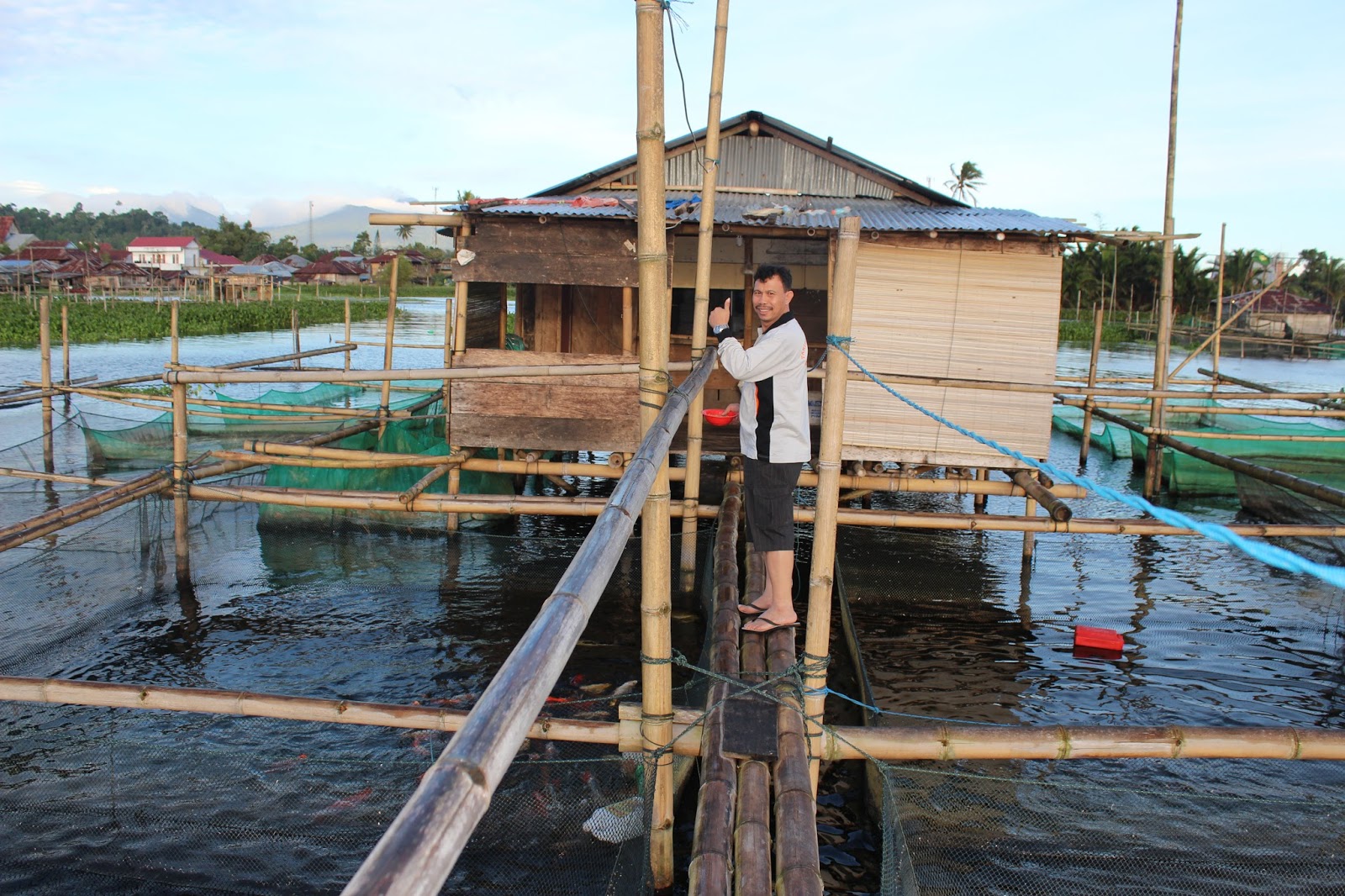

                                                
Two years ago the fish farmers of Kakas in the Minahasa highlands of North Sulawesi gave up their fight.  To stay in business they had to shift a further 150 meters into clearer water and abandon their shoreline investments.
“What else could we do?” said Petrus Lamongi (above) whose family raises goldfish.  “We’ve tried most things but with no success.  It’s such a huge problem.”
No scientific knowledge is required to understand this story of gross aquatic damage, reported to be among the most severe in Indonesia. There’ll be no dispute about the facts, no sceptics to neuter concerns, as in the global warming debate.
Microscopes aren’t needed.  Just a squint for a second is proof enough.
Lake Tondano, the once splendid sparkling center of the Republic’s most northern province, is being garrotted. The noose circling its banks is lush green and pretty pink, seductively enchanting, but eceng gondok is a rapacious coloniser and ruthless killer.
Elsewhere it’s known as a type of water hyacinth.  It came from the Amazon Basin and was exported as a decorative pond plant.  Then it escaped to become the world’s most invasive plant.
Whoever dropped a runner in Lake Tondano about 20 years ago should be tried for corrupting the environment.
The free floating perennial isn’t the only threat to the 4,300 hectare freshwater lake in the caldera of an ancient volcano, 600 meters above sea level.  Nutrients from surrounding paddy and sediment from the clear-felled hills are also doing awful damage.
In 1934 Dutch engineers measured the lake’s depth at an average 40 meters.  Forty years later it was 28 meters and two years ago just 12, according to the North Sulawesi Environmental Management Agency.
If it was just another tourist attraction then the harm would be limited.  But Lake Tondano is ‘the heart of North Sulawesi, representing the source of water supply for a large proportion of the population,’ according to a report by international consultants Mott MacDonald.
‘It is also a source of water for gravity irrigation of crops - mainly rice… it’s the center of cage-reared fish of northern Sulawesi. Equally important is its role in electric energy in a cascade of dams under the lake.’ 
Between 2003 and 2005 the lake and its surrounds were mapped and researched.  About a third of the watershed was identified at risk.
Areas of land were replanted with around 10,000 trees. Erosion banks were installed in 21 demonstration plots that included crop rotation to reduce runoff.
The long term aim was to help lift incomes and living standards for the people who rely on the lake for food and irrigation. The Minahasa Region, centered on Tondano town, has a population of more than 300,000.
Suitably impressed the Czech Republic began funding a five-year US $415,000 (Rp 4.3 billion) rehabilitation project through its development agency in association with the Minahasa Regency.  That was in late 2008 – and it couldn’t have started at a worse time.
The global economic crisis hit Europe and within two years the funds had vanished.  But not the weed.  Locals had dragged some of the huge green carpets ashore to dry but the task is Herculean.  Enthusiasm wilted when the cash flow stopped.

Small sheds were erected on the lakeside housing engine-powered shredders so the dried nitrogen-rich material could be processed into fertiliser.
The machines stand idle, quietly rusting while the wind-whipped weed laughs its way to the further bank, dropping seeds that can last up to 30 years. Rabbits are supposed to be prolific, but eceng gondok can double its population in just over a month.
Despite its criminal record, that includes harboring mosquitoes and starving the lake’s nike fish of oxygen, the weed has some redeeming qualities.  It sucks up heavy metals including arsenic so can purify polluted water, particularly from industrial sites.
The dried stems are strong, particularly when braided into ropes. Woven through wood or bamboo slats it makes robust chairs and sofas, though manufacturers say the gray material is too waxy to take paint or varnish. It can also be used to make paper.
“The main aim was to bring new cropping patterns that would benefit farmers and also introduce crops for production of bio fuels,” said the former project manager Dr Karel Peter Kucera.

“There’s a shortage of fuels for transportation and cooking, so farmers have started to cut the trees again. Bio fuels could be used to address this situation.

“We identified about 15,000 hectares that could be used to establish agroforestry plantations. We also recommended harvesting the eceng gondok and use it for production of organic fertiliser, bio gas and furniture.”

In 2011 the Environment Ministry launched a Lake Rescue Plan (GERMADAN) to save 15 lakes, including Tondano.  It is understood most attention is being given to Lake Kerinci in Central Sumatra and Lake Rawapening in Central Java.

This year nine ministries signed an agreement for ‘sustainable management’ of the lakes.  No budget was announced.

An Environment Ministry officer said regional governments had to do more to protect their lakes.  In Tondano’s case allowing the spread of fish farms was aggravating the problem becaus feed and excrement encouraged weed growth.

In April this year North Sulawesi, Governor Sinyo Sarudajang told Antara News that he was committed to handling  the problem. German experts would visit the lake “soon” and see if the weed could be used to make bio-gas. 


 However his staff said it was not known when the German team would arrive.  A circuit of the lake found no sign of control measures, and villagers claimed nothing was being done to halt the invader.

Indonesia isn’t the only victim of eceng gondok, but it seems to be one of the most passive.  Elsewhere a war is being waged with machines, chemical sprays and insects, though all have their downsides.  An infestation in Florida is now reported to be under control.

“The lake should be saved,” said Dr Kucera, “but it needs a good feasibility study and I think honest international and local investors.”

First published in The Sunday Post 8 September 20130


Monday, November 05, 2007

ARIE TULUS

Recovering missionary-suppressed art © 2007 Duncan Graham

Tomohon isn’t a place you’d normally bracket with the internationally known arts centers like Ubud in Bali and Yogyakarta in Central Java.

That could change if poet and painter Arie Tulus succeeds in his campaign to put the North Sulawesi hill town on the Indonesian cultural map.

Sulut (Sulawesi Utara, North Sulawesi) is already well established as the Republic’s most Christian province through its status as a missionary hive.

It has also been dubbed the ‘city of flowers’ though that’s nothing special. There are many garden centers throughout the archipelago, usually just outside the bigger lowland cities and at the higher altitudes that favor floriculture and horticulture.

Tomohon is pretty in a haphazard way, though not for its slab-concrete and toilet-tile architecture that’s elbowing aside the lovely old traditional two-storey timber houses. The charm comes from the flower sellers that line the main road from the capital Manado, 45 minutes drive distant.

A few overseas tourists, mainly backpackers attracted by diving on the reefs off the nearby islands occasionally detour to the cool hills. But apart from some historic sites including caves built during the Japanese occupation to store ammunition, peak-and-lake scenery that’s easy on the eyes, and the chance to hike without sharing the track with thousands, there’s little to keep visitors.

“We used to have a rich artistic heritage,” said Arie. “You can see this expressed in carvings on the ancient above-ground stone tombs known as waruga. (The images on these sarcophagi are unique, showing jolly, saucer-eyed faces and frock-coated figures.)

“However much of this was lost when the Dutch banned burials in waruga because they feared the spread of disease. The missionary influence was powerful and suppressed our pre-Christian animist culture.”

The Minahasa and other tribal groups in North Sulawesi are unusual because in the early 19th century the people made a wholesale switch from animism to Christianity, primarily Protestantism.

This gained them job and education benefits from the colonists, but it didn’t make them popular with the Muslim Javanese. Soldiers from Manado condemned as ‘Dutch dogs’ were used to put down dissent in the Java War that started in 1825.

After independence there were ill-fated bids to go it alone that resulted in the Indonesian air force bombing Manado in 1958, but if there are any remnants of separatism left they are well hidden. Now the bid is to promote a local identity within the current political structure.

“The character of the Minahasa people is open to all,” said Arie. “We are tolerant and friendly, and although we want to see the renaissance of our art we are not closed to outsiders, though we don’t want to see Bali-style development.

“So if Indonesian or European artists want to come here and work, well that’s fine. We are trying to develop the Mawale (home-coming) Art Community that will reflect this land and its people and inspire others. I have no real fear that newcomers will change the quiet character of this place.”

Arie, 45, is a multi-skilled craftsman, as artists must be to survive in Indonesia where patrons are few and governments great with supportive rhetoric though not with rupiah. “I paint because I enjoy it,” he said. “I don’t do it to make a living.”

He was educated in the local Christian schools, then studied art at the Manado teachers’ college under the late Johny Rondonuwu who used the waruga motifs in his work. Arie later took a degree in management and now teaches art at the University of Manado.

Just up the road and across a fast-running stream is the Pniel church where a large and busy mural created by Arie above the timber-framed altar draws parishioners’ eyes during dull sermons. It shows Jesus in a landscape of Old Testament scenes, including a guilty couple making a dash from the Garden of Eden.

In the maze of his little studio in the farming village of Kakaskasen, close to the home of his parents, Arie has been preparing a set of seven life-size statues. These were commissioned by the relatives of a local family wiped out in the Flight 574 Adam Air crash of 1 January this year.

All stand in formal black and white Western wedding dress, the spooky figures staring blankly at the goose-bumped onlooker. When there’s no work underway Arie wisely shrouds the statues’ faces lest they unnerve visitors.

Then comes the contrast: In the front room are stark, simple-line semi-abstract nudes that might well offend conservatives elsewhere. Arie claims no problems – maybe because he’s a well-regarded local known for his faith, or because Sulut is more tolerant.

Round the corner are shrill acrylic landscapes in the style of the European impressionists, some stacked by the walls, others tacked to the ceiling, for this man is prolific and painting himself out of space. The troubled Dutch expressionist Vincent Van Gogh is one of Arie’s art heroes, along with the American splash-and-smear abstractionist Jackson Pollock.

Elsewhere are large collections of miniatures he’s done of village life; bullock carts rocking and rumbling over the potholed roads, kids reluctantly dragging themselves to school, dancers rehearsing. Five books of poetry, all illustrated. Love is a constant theme.

Arie’s self portraits are mildly schizophrenic. Some show an unkempt Salvador Dali-like wildman, others a neat monkish figure praying (or wringing his hands) over a Bible, titled Prayer for Indonesia. Coming to terms with an intolerant Christianity that tried to eliminate art considered pagan takes some intellectual gymnastics.

With a group of like-minded friends he started the Mawale Art Community this year. The MAC publishes prose and poetry, and runs readings and workshops on Minahasa art, culture, music and history. Some members’ work is on the Web at www.sastra-minahasa.blogspot.com

About 200 meters beyond his studio rise the foothills of smoldering Mount Lokon, its green slopes giving no hint of the rumblings within this active, 1580 meter-high volcano. It’s another source of inspiration in a hugely rich and little exploited environment.

“We should never try to limit ourselves in our expression,” Arie said. “My hope is that the influence of Tomohon can help lift other artists to express themselves.

(First published in The Jakarta Post 5 Nov 07)

##