FAITH IN INDONESIA

FAITH IN INDONESIA
The shape of the world a generation from now will be influenced far more by how we communicate the values of our society to others than by military or diplomatic superiority. William Fulbright, 1964
Showing posts with label BJ Habibie. Show all posts

Monday, October 10, 2022

THE BOMBS THAT KILLED & MAIMED PEOPLE - AND NATIONS


    The blasts that blew neighbours apart
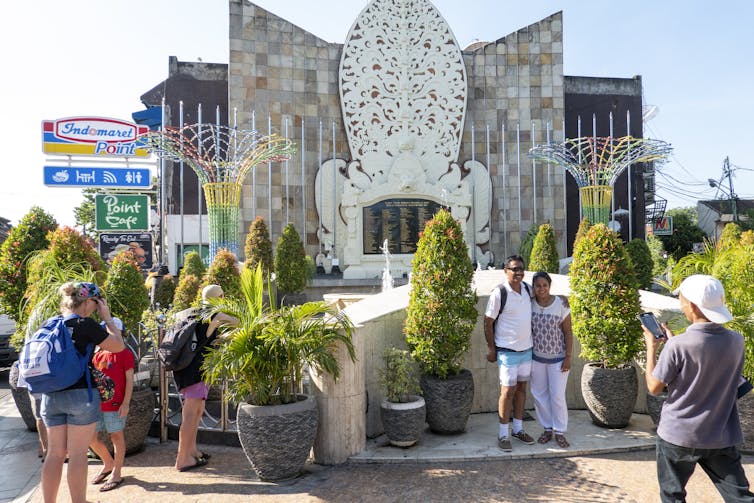
 

 The site of the Bali bombings has been a vacant lot for 16 years. It's time  to build a proper memorial

 The Kuta memorial Credit The Conversation.

The Bali bombings of two decades ago and remembered with anger and sadness did much more than kill 202 partygoers, wound 209 and scar families for years. The blasts also ripped a relationship that’s slumped into indifference.

The early 1990s marked a zenity in Indonesia-Australia friendships.  We saw possibilities, not problems.  President Soeharto’s dictatorship was rupturing as millions learned to bypass censorship finding that official accounts of their nation didn’t tally with facts.

The enthusiasm was electric. Sensing change, our schools and unis pushed Indonesian language and culture, boosted by increasing trade and diplomatic contact aided by PM Paul Keating’s famous 1994 statement: ‘No country is more important to Australia than Indonesia’. His successors have run similar though less portentous lines.

Few tourists who descended on the Hindu province of Bali realised they were in the world’s most populous Muslim nation.  Currency changers in Perth airport advertised ‘Bali Money’.

Even if they’d been aware, concerns would have been anaesthetised by politicians and traders bent on business-as-usual.  They chorused the unexamined assurance that Indonesian Islam was moderate and the people benign.  What about the 1965 genocide?  Hush, hush, they were killing Reds, not Whites.

The Asian Monetary Crisis of 1998 fuelled student dissent and Soeharto quit after 32 years of authoritarianism and kleptocracy. Then came the former aerospace engineer Bacharuddin Jusuf Habibie and all seemed well until the third president deliberately or accidentally misread a letter from John Howard.

The PM had cautiously suggested a slow resolution to the ‘pebble in the shoe’ problem, the irritating East Timor independence movement supported not just by Aussie lefties but also Diggers who’d fought the Japanese on the island.  On 19 December 1998 Howard wrote to Habibie: 

‘It has been a longstanding Australian position that the interests of Australia, Indonesia and East Timor are best served by East Timor remaining part of Indonesia’, before suggesting an eventual  ‘autonomy package’.

Although Europe-educated Dr Habibie (he died in 2019) was smart and multilingual, his countryfolk thought him eccentric. He reacted impetuously to Howard’s note with a referendum believing reports that the Timorese loved their invaders.

Those who thought military intelligence an oxymoron feared a breakaway could inspire other provinces, the so-called ‘domino effect’, a popular metaphor at the time.

 In the 1999 vote 80 per cent opted to break free.  Indonesian soldiers reacted by scorching the earth.  Australia headed a UN peacekeeping mission.

The friendship fractured and the split was seismic.  We were no longer mates, but a perceived agency of disunity.  The national motto Bhinneka Tunggal Ika, unity in diversity, has the force of holy writ.  

On the evening of Saturday 12 October 2002, hundreds were drinking and dancing at Paddy’s Pub in Kuta when a suicide bomber triggered his backpack device.  The crowds rushed outside seeking safety in the street.  A parked Mitsubishi L 200 van was waiting for them laden with a tonne of high explosives.  

Nationals from 23 countries were victims, the majority Australians and Indonesians (88 and 38).  The outrage was condemned as terrorism by world leaders.  

The faith identifier was added when the transnational extremist Jemaah Islamiyah (Islamic Congregation) claimed responsibility, apparently to avenge the West’s support for the East Timor referendum. 

Then the Sunni Islamic extremist group al-Qaeda founded by the Arab businessman  Osama bin Laden of 9-11 infamy said it was behind the Bali blast because of  ‘the American war on terror’. A third bomb was set outside the US Consulate in Bali with no casualties.

The stated reasons were political, not religious.  The perpetrators were Muslims but that was largely incidental.  Their violence also felled fellow believers.

The fact that East Timor (now Timor Leste) was overwhelmingly Catholic rarely bothered Jakarta during its 25-year control.   Soeharto even gave a ‘present’ - the 27-metre-high Cristo Rei (Christ the King) statue which dominates the capital Dili.

It’s cruel to write and no comfort to the victims, but some positives have come from the outrage.  As Jakarta-based researcher Sidney Jones of the international NGO Human Rights Watch has written

‘The bombing served to strengthen the power and capacity of the police at a critical time, underscore Indonesia’s then strong commitment to democratic norms, and add an important new dimension to the Australia–Indonesia relationship.’

That’s true at the highest levels where both countries appear united in tackling terrorism. However, tactics differ as Indonesia considers many offenders to be pious people who’ve gone astray and are worthy of rehabilitation. Forgiveness isn’t just a Christian virtue. 

The feared anti-terror squad Densus 88 tends to point first and ponder later.  Late one night on a toll road in December 2020, police killed six alleged supporters of the banned radical Islam Defenders Front and its oft-imprisoned leader Rizieq Shihab.  No prisoners or witnesses. Since then reports of terrorism have been rare.

Boomers fantasise that as the US ‘deputy sheriff’ we plan to invade, plunder the natural resources and ‘Balkanise’ the nation. Later generations who’ve never heard of Yugoslavia have drifted into indifference. Zoomers reckon South Korea - which vigorously promotes its culture - is cool and Oz sclerotic.

Meanwhile, we harbour images of 273 million fanatics bent on converting a continent of 25 million godless hedonists.  If not, why make access to visas tougher for Indonesians than Malaysians and Singaporeans?

It took a decade to get a free trade agreement because both nations did better stuff-ups than drunk Oz hoons pissing in temples. President Joko (Jokowi) Widodo ignored high-level pleas to save two of the Bali Nine drug smugglers from the firing squad, angering millions. Australian agencies refined arrogance by hacking the phone of sixth president Susilo Bambang Yudhoyono, till then a fan of the people next door.

Some are trying to repair the damage, though not the media which has largely abandoned Jakarta. A few unis and NGOs run seminars and exchange programmes.  All good, though not penetrating pubs, clubs and shopping malls.

Perhaps guidance can come from the new monarch whose subjects -according to a UK uni survey - are almost three times more likely to hold prejudiced views of Islam than of other religions – a position probably duplicated here.

In 2010 HRH, who once tried to learn Arabic, offered this insight: ‘The Islamic world is the custodian of one of the greatest treasuries of accumulated wisdom and spiritual knowledge available to humanity’.   We may not want Charlie on our $5 note, but on this issue his views carry currency.

First published in Peals & Irritations, 10 October 2022: https://johnmenadue.com/the-blasts-that-blew-neighbours-apart/


##

Friday, August 27, 2021

SOMEDAY WE'LL THINK FOR OURSELVES


              The fastest gaffes in the West

Australians who reckon we’re recognised as an independent player on the world stage haven’t had to confront the neighbours’ scepticism.  Apart from the Union Jack on the flag and the Queen’s likeness on our coinage, there’s also the matter of our US badge.

Our law enforcement commission happened this way: In December 1998 John Howard wrote to Indonesian President BJ Habibie suggesting his government start negotiating with East Timorese leaders calling for self-determination. The PM anticipated a prolonged process, maybe resulting in the grant of some special autonomy.

 Instead, and to widespread surprise, Habibie announced a referendum. In August 1999 the East Timorese voted 78.5 per cent for independence.

Violence followed with Australia carrying most of the peacekeeping burden. INTERFET (International Force East Timor) led by Australia contributed over 5,500 men and women. After killing and torching homes, schools and clinics, the Indonesians withdrew at the end of October.

We saw our involvement as noble.  Indonesians reckoned we were US agents with another agenda. Sadly we’ve aggravated the distrust.

The late Australian scholar Jamie Mackie commented: ‘Australia came in for the blame and much criticism as the party mainly responsible for Indonesia’s sudden, humiliating loss of East Timor. Wildly distorted though many Indonesian accounts of what happened there in 1999 have been, the effect was to generate deeper resentment towards us across many segments of Indonesian society than at any time since 1945.’

Although an estimated 1,400 civilians died and thousands fled to West Timor the situation could have been much worse. The Indonesians had been shamed and were deeply angry.  It was not a time for triumphalism, but the PM could not resist.

‘In the excitement following the East Timor intervention, John Howard allowed Australia to be labelled America’s regional deputy sheriff’, wrote La Trobe Emeritus Professor Robert Manne.

 ‘So enthusiastic was his government about Washington’s new doctrine of the ‘pre-emptive strike’, that the PM even applied it – clumsily, purposelessly and at considerable diplomatic cost – to a hypothetical presence somewhere in Southeast Asia of an anti-Australian terrorist cell.’

After the bombing of the Jakarta Embassy in 2004, Professor Greg Fealy at the Australian National University reportedly said: ‘The Howard government remains one of the most unpopular foreign governments in Indonesia. The two countries certainly work together as neighbours, but it's pragmatic. There's no warmth in the relationship.’

Years after the referendum and the departure of Howard from Parliament the suspicions that we wear the Capitol Hill star and Stetson lingers at all levels of Indonesian society.

‘Don’t say you’re Australian,’ warned our Surabaya landlord, a senior bureaucrat heading a sector dealing with  Australia when paying a courtesy call to the Rukun Tetangga, head of the local community group. ‘I’ll tell him you’re from New Zealand.  No-one thinks badly about that country.’

That was in 2013 and the issue which drove his caution was former PM Julia Gillard alongside  President Barack Obama announcing that up to 2,500 US Marines would be stationed in Darwin.

Jakarta alleged it hadn’t been consulted so a storm of suspicion followed, with assertions a US plot to invade the archipelago would be launched from the Top End.  Indonesia's then foreign minister, the ANU-educated Marty Natalegawa, reportedly said the Darwin deal would generate a 'vicious circle of tension and mistrust.’ The Jakarta Post opined the US troops were 'simply too close for comfort.’

Concerns were flicked aside and the base expanded. This year more than $500 million will be spent upgrading four northern facilities for bigger training exercises involving local and US forces.

The ruling group in Indonesia are the Javanese, famous for radiating bonhomie while brooding for generations over real or imagined slurs.  Most Australians have probably forgotten their nation’s role in the East Timor referendum but Indonesians have not.  They see it as another Western attempt to fracture the ‘unitary state’ with the US as the dalang, jerking the stick limbs of the shadow puppets Down Under.

Yet in 1999 when Australia needed muscle for the East Timor crisis the US was literally out of sight with a cruiser stationed over the horizon. US President Bill Clinton said his nation would ‘contribute to the (peacekeeping) force in a limited, but essential, way’.

About 200 Americans were eventually deployed.  That seems to shoot down the rumour that Washington was choreographing the show, though there’s no limit to conspiracy theories.

In the past, there was a clear separation of Australian and US policies on Indonesia.

During the 1945-49 revolutionary war of independence, Australian trade unionists challenged the pro-Dutch policies of the Menzies government and actively helped the revolutionaries by black-banning supplies for the colonialists.   Australian diplomats successfully pressured The Hague to withdraw its military and abandon hopes of recovering its colony.

However, the US saw an independent Indonesia under the nationalist left-leaning Soekarno as a threat to its determination to stop communism usurping capitalism so tried for a regime change.

In 1957 an Indian newspaper headlined an ‘American plot to overthrow Soekarno’. The failed coup revealed the differences in Western policies towards Indonesia:  US analysis is driven by ideology, Australia by proximity.  Washington is 16,400 km from Jakarta and in a different hemisphere.  Darwin is just 825 km from Kupang in Flores, and even closer to some outlying islands.

The insensitivities continue adding to the suspicions. In October 2018 Scott Morrison suggested the Australian embassy in Israel might follow the US and move to Jerusalem.

The idea was to boost the Wentworth election chances of Dave Sharma, a former ambassador to Israel.  Maybe smart domestic politics, but a dud in Jakarta.

FM Retno Marsudi hit out: ‘Indonesia conveys our strong concern on the announcement and questions the merit of the announcement.’ There were claims that a free trade deal between Australia might be cancelled.  Eventually, the shift was shelved.

The gaffes go on. This month the ABC reported FM Marise Payne and Defence Minister Peter Dutton plan travel to the US, India and Indonesia for ‘meetings with their counterparts.’  No info on agendas or who else is on the plane, all fuelling Indonesian intrigues.

Are the ministers visiting Washington first to get instructions on handling Indonesia?  Are they couriers delivering US policy as their own?  If the archipelago is as important as the rhetoric runs, then it deserves a dedicated visit, not just a pop-in on the return trip should time allow.  As seasoned foreign observers and psychologists like to say, perception is the true reality.

This is how sceptics sell the story: Australia, at the behest of the US, is planning to ‘balkanise’ the Unitary State and plunder its resources.  To Australians this is loony talk, but to our paranoid neighbour the dots connect.

Earlier this year Nine News reported Canberra was talking to Washington about stockpiling weapons and munitions at bases in the NT, including US-designed ballistic missiles.  The type and range has not been disclosed and the obvious target in Australian eyes would be a Chinese invasion force

Though not to those Indonesians who remember the Menzies government buying the US F-111  fighter-bomber because it had the range to offload over Jakarta and return.  The deal was done in 1963 when President Soekarno was prosecuting his Konfrontasi policy against Malaysia. 

By the time the planes were delivered in 1973, the new President Soeharto was friendly to the West and the emergency was over.  

The former Malaysian PM Mahathir Mohamad has never been a fan of Australia. Paul Keating labelled him ‘recalcitrant’ and John Howard damned a comment as ‘offensive anti-Semitism.’

But other quotes are worth considering if the arrogance can be set aside: 'Australia liked to be an appendage of the US and if that is what it wants, then so be it.

‘You can’t simply decide to be Asian. You must have an Asian culture. This means, for a start, changing your attitude and improving your manners.’ 

Australian academics, traders and long-tooth diplomats know more about Indonesia and how to gather intelligence, handle the protocols and sensitivities through decades of personal contact and research than probably any other country.  This puts Canberra in a prime position to drive an independent policy separate from Washington and which might eventually erase the gunslinger image.

Mackie has the final word: ‘If a new Cold War develops between China and the US, backed by its allies, Japan and Australia, the role played by Indonesia and the other ASEAN countries may be crucial for us …  if our policies diverge too radically, we could find ourselves facing serious difficulties’.


First published in Pearls & Irritations, 25 August 2021 https://johnmenadue.com/the-fastest-gaffes-in-the-west/


Monday, September 16, 2019

LOVE CONQUERS ALL - EVEN BOFFINS


 Indonesia’s Dr Strangelove takes final flight                    

Indonesia’s fourth president, the late Abdurrahman ‘Gus Dur’ Wahid, was never short of a quip.

“First president (Soekarno, who had nine wives) was crazy about women. The second (Soeharto, who allegedly stole US$35 billion) was crazy about money.  The third (Habibie) is just crazy.”  Assessing himself, Wahid added:  “I just drive people crazy.”

That was also an attribute of Bacharuddin Jusuf ‘Rudy’ Habibie who died last week. 

The former aeronautical engineer ran the world’s most populous Islamic country from 1998 to 1999; as vice-president he took over when Soeharto was forced by student riots and the economic crisis to end his 32-year dictatorship.

The Indonesia media has been treating Habibie’s passing as though he was a soldier hero of the 1945 revolution against the Dutch, when for much of his 83 years he was more a distant figure of bemusement and failed grandiose dreams.

He was born in Sulawesi and spent many years in the Netherlands and Germany, studying and working for Messerschmitt; he eventually designed a commuter turboprop for his homeland called the IPTN N-250.  This never took off.

He was much smarter than the thick generals who ruled Indonesia last century and still flick backroom switches.  To them he was Dr Strangelove, an Indonesian version of the mad scientist in Stanley Kubrick's cult classic film, but had to be tolerated because he was protected by Soeharto.
 
A Sydney Morning Herald backgrounder once reported: “Habibie is short, speaks shrilly and gesticulates wildly, has a decidedly Teutonic manner from his German education, has the ear of his president, and wants to build aircraft, rockets, ships and nuclear power plants.”

Between 1978 and 1998, when Habibie was Minister for Research and Technology, his weird theories were tagged ‘Habibienomics’.  He argued for up-down interest rates plus heavy government involvement in technology rather than encouraging private business to invest.

When Soeharto made him vice president - knowing he’d be no personal threat as he wasn’t a Javanese general - the rupiah crashed to 17,000 against the US dollar after being pegged at 2,500.  It’s now around 14,000.

Jealous of the business clout of the mainly Christian Chinese community he created the Indonesian Muslim Intellectuals’ Association,

Among his errors was buying the East German Navy in 1994.  One of the 39 warships sank on its way to Surabaya where the rest rust for want of parts.  Tempo newsmagazine exposed the scandal and was banned.

But when Habibie became president he used his 17 months as a reformer, giving the media back its freedom, releasing political prisoners and clearing the way for democracy.  Most curiously he ordered a referendum on the future of the former Portuguese colony of East Timor, invaded and occupied by Indonesia in 1974.

One version has Habibie getting a letter from the then Australian Prime Minister John Howard suggesting a decade of autonomy for the province; the idea was to remove ‘the pebble in the shoe’ that had long irritated relationships.

Habibie, furious at what he saw as foreign interference in a domestic issue, went one-better and called a vote.

Some wonder why the all-powerful Army didn’t stage a coup and oust Habibie for threatening the Unitary State.  The generals hesitated because they were confident the Timorese loved Indonesia and would vote to stay in the Republic.

This belief was based on ‘intelligence reports’ from the field claiming no support for independence.  Which is what wise folk say when questioned by men with guns, holding clipboards and noting names.

The four-to-one result threw the military into a fury, taking revenge by scorching the earth, killing and plundering.  Their hate for Habibie was boundless, but he was soon  replaced by Wahid.
Apart from his late social reforms Habibie was till recently thought more a harmless boffin, remote from the serious gamers who carry swagger sticks.  

Indonesia Institute president Ross Taylor met him in 2013 and heard him say that his duty was to ‘build a just, open and democratic society’ after Soeharto’s 32-year dictatorship.

“In some respects Habibie’s greatest weakness was his intelligence,” said Taylor.  “An incredibly clever and articulate thinker, Habibie was perhaps too advanced for most people, including me.
“He found it difficult to work at a level that was connected to the common person. Yet he was in every respect a visionary with a brilliant mind.”

In the last few years Habibie’s egghead image has been cracked through two biopics about his courtship of high school sweetheart Dr Hasri Ainun Besari.  The 48-year union was apparently marked by genuine mutual respect and depicted as a grand romance.

After his physician wife died in 2010 Habibie reportedly visited her grave daily.  He is now buried by her side.

Habibie’s engineering and political career won little acclaim, but the Rudy and Ainun love story has gripped the public’s attention and admiration.  Indonesia’s third president is being remembered less as a Dr Strangelove, more as an advanced feminist in a culture that’s still largely patriarchal..


First published in Pearls & Irritations 16 Sept 2019: https://johnmenadue.com/duncan-graham-indonesias-dr-strangelove-takes-final-flight/