FAITH IN INDONESIA

FAITH IN INDONESIA
The shape of the world a generation from now will be influenced far more by how we communicate the values of our society to others than by military or diplomatic superiority. William Fulbright, 1964
Showing posts with label Peniwen. Show all posts

Friday, March 04, 2022

DUTCH DISCOVER THE HARDEST WORD


How the Netherlands is confronting  war crimes      


How is Dutch colonial rule remembered by Indonesians? - Quora 

Source: Quora

The Dutch are squaring up to the wrongs of their nation’s colonial past, pushed by the conscience of young Hollanders shamed by revelations of villainy by their forebears.

In 2013 The Hague expressed remorse for atrocities committed by its military in Indonesia’s 1945-49 war of independence. During a 2020 State visit, King Willem-Alexander formally regretted his country’s past aggression.

The latest nostra culpa came this year when PM Mark Rutte apologised to Indonesia after government-funded research proved ‘systematic and widespread extreme violence on the part of the Dutch side in those years and the consistent way previous Cabinets looked away’. The five-year study, Beyond the Pale, involved 25 Dutch academics and 11 Indonesian researchers.

A bit of background.  After the defeat of the Japanese, who had occupied the archipelago since 1942, and Soekarno’s 17 August 1945 proclamation of the Republic, Indonesia plunged into a period of chaos known as bersiap (be prepared).  Revolutionaries fought the British trying to help reinstall the colonialists who’d plundered the ‘Dutch East Indies’ for more than three centuries.

The Battle of Surabaya has been well documented by Australian journalist and former foreign correspondent Dr Frank Palmos who called it ‘Indonesia’s Gallipoli’.   The locals were routed but retreated to form guerilla units starting the four-year on-off War of Independence.

The lid of the cauldron of crimes was first lifted in 1969 when veteran Joop Hueting spoke on TV about evils he’d witnessed.  He claimed these were not occasional outrages by unhinged individuals but planned by the Koninklijk Nederlands Indisch Leger (military) and widespread.

An inquiry into Hueting’s assertions called a Memorandum on Excesses concluded there had been ‘incidents’ but these were not war crimes, and the KNIL as a whole had behaved correctly in Indonesia.’  That didn’t stop the discord.


Court cases initiated by witnesses disclosed harrowing details. Lawyer Liesbeth Zegveld (who last year resigned from compensation cases) successfully sued the state on behalf of survivors for killings in Rawagede (now Balongsari) on the north coast of Java in 1947. An estimated 431 men were shot when villagers refused to disclose a guerrilla’s location.

Other civil cases concerned executions in South Sulawesi in 1946 by special forces led by the British-trained commando Captain Raymond Westerling, originally a hero in Holland but labelled the Dutch Hitler in Indonesia. Some reports claim 400 were executed under his direct command.

Compensation of 20,000 Euros (AUD 32,000) has been paid to each surviving victim. An estimated 100,000 Indonesians and 6,500 Dutch died during the conflict, but the real figure is unknown.

Post-war researchers, like Dr Gert Oostindie, have been writing about the horrors for years.  He collected ‘ego documents’, the letters, diaries, memoirs and other accounts written by Dutch soldiers: ‘They knew the war had been on the wrong side of history but didn’t want to ask why’.

(History is a poor teacher.  Jakarta is allegedly pursuing a forceful and largely secret military campaign to crush separatists/independence fighters in West Papua.)

Some Dutch veterans’ groups called Beyond the Pale’s findings unbalanced, arguing Indonesian guerrillas also used ‘intense violence’.  That’s true.  Real or imagined spies were targeted.  These were often ethnic Chinese.  In one gruesome case in Malang (Mergosono), 30 men and women were tortured and burned to death in a factory.

An advocacy group (Elsam) has urged President Joko Widodo to follow the Dutch initiatives and make amends over past mass gross human rights violations.

The  KNIL concocted the euphemism ‘police actions’ to make two major strikes sound legal and constrained: Operation Product in mid-1947 and Operation Kraai (Crow) in late 1948.  Indonesians had a blunter term: Agresi Militer Belanda (Dutch Military Aggression). 

As tales of brutality surfaced international pressure involving Australia forced the Dutch to negotiate and on 27 December 1949, the Netherlands recognized the new nation’s independence,

In a 2016 interview, Oostindie said that in 1945: ‘The paternalistic Dutch thought Indonesians loved them and needed to accomplish their mission of repairing the nation and building schools and bridges. 

‘Indonesian propaganda showed them as monsters, drunk, brutal and crude.  But many soldiers were ill-prepared farm boys lost in a world they didn’t recognize.  Not all were involved in atrocities.’


The last outrage was in Peniwen (Central East Java) where news of killings spurred action to end the war. Ironically the village was more like a Dutch hamlet with well-built homes behind trimmed hedges and neat lawns. No mosques. Dogs running loose. A barn-style church little different from those in the
soldiers’ homeland. 

Had the conscripts been properly briefed they would have known that Peniwen was a Christian village established a century earlier by missionaries promoting values of hygiene and personal responsibility.

So the people had built the Panti Husada polyclinic, one of the first in the region and staffed by Red Cross workers.  This was the soldiers’ target.

The rolling country around Peniwen is rich in jungle cut by twisting rivers and patches of cultivation – a good place to disappear. It had been invaded twice by Dutch patrols, shooting one man and capturing others who were ‘maltreated’ to make them disclose where Brigade 16 guerrillas were hiding.


What happened on Saturday 19 February 1949 is unclear, but it seems certain that 12 unarmed and unresisting men including two patients were pushed out of the clinic, tied up and shot dead.  Three women working in the clinic were raped and the place was ransacked.

The Dutch returned a few days later unsuccessfully hunting for the village Pastor Martodipuro who had already alerted the World Council of Churches to the slaughter.   His action put international pressure on the Dutch, eventually leading to the ceasefire signed three months later.

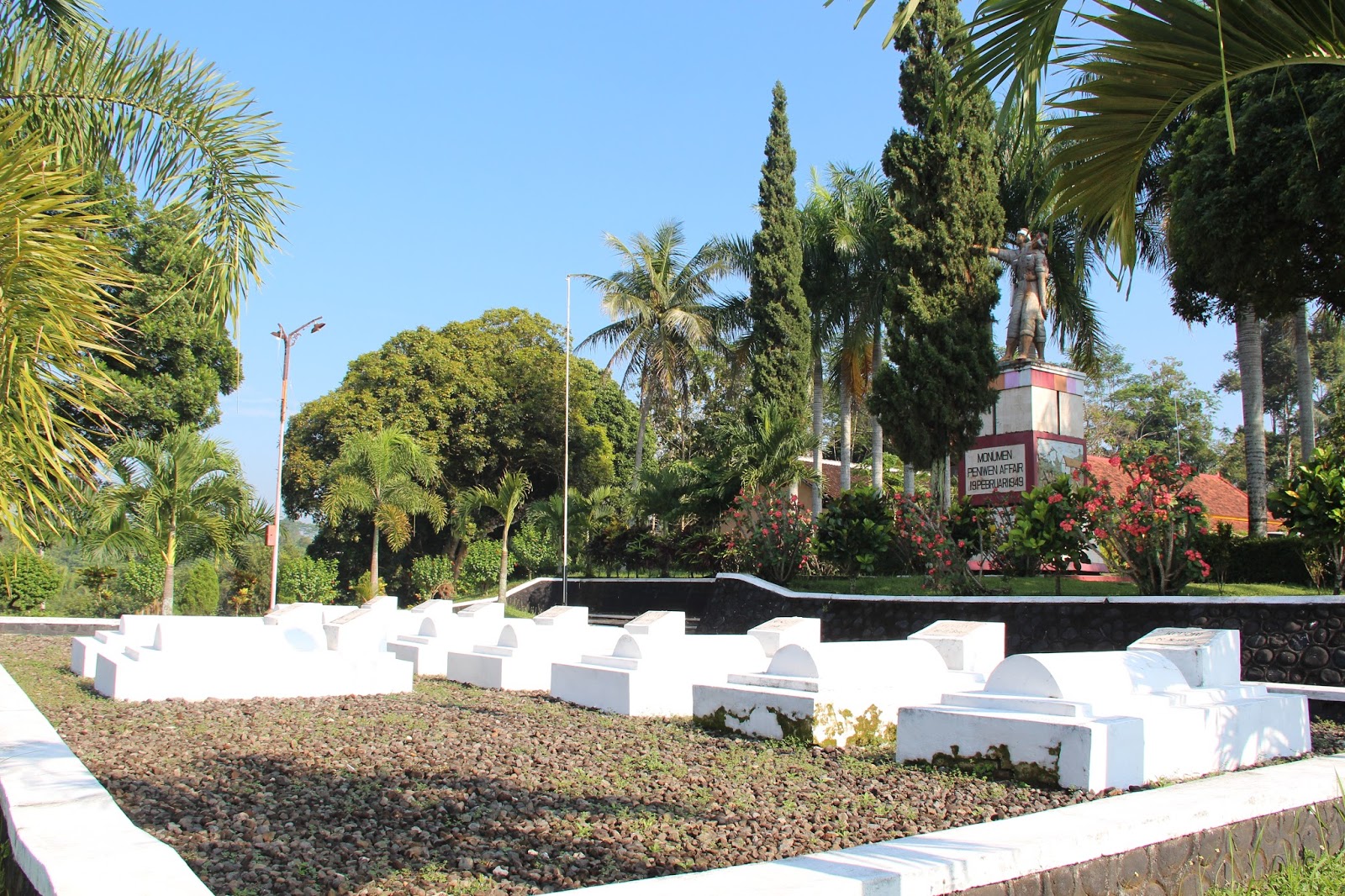
A monument stands above the graves.  The polyclinic has gone and a primary school now occupies the site overlooking a hundred shades of green tumbling below. 

The Javanese name means a beautiful and wealthy place.  Revisited last month it looks clean, prosperous and spacious with no graffiti and little plastic in the creeks. It’s still primarily Protestant.

First published in Pearls & Irritations, 4 March 2022:  https://johnmenadue.com/how-the-netherlands-is-confronting-past-war-crimes-in-indonesia/

Pics of Peniwen:  Erlinawati Graham


Monday, October 03, 2016

CRIMES OF COLONIALISM

Recalling the killing times      
                                                         
Dr Gert Oostindie is not a man for euphemisms. Particular dislikes are words that soften war. Like ‘police actions’. 
They sound so comforting – cops catching naughty people, putting them before the courts and keeping citizens safe. 
But there was nothing so civilised when the Dutch returned to Indonesia in 1945 determined to regain their former colony after three years of Japanese occupation. 
There were two ‘police actions’ during the four-year conflict: Operation Product between 21 July and 5 August 1947, and Operation Kraai (Crow) from December 1948 until January 1949 when President Soekarno was arrested in Yogyakarta. Indonesians had another term: Agresi Militer Belanda (Dutch Military Aggression). 
Oostindie is the director of the Royal Netherlands Institute of Southeast Asian and Caribbean Studies (KITLV).  With a team of researchers he’s been collecting ‘ego documents’, the letters, diaries, memoirs and other accounts written by the veterans of the war, now published as Serdadu Belanda Di Indonesia 1945-1950 (Dutch Soldiers in Indonesia).
When the units executed unarmed civilians and prisoners, raped women, stole property and destroyed homes their actions were labelled ‘excesses’.
“Our finds total about 100,000 pages,” Oostindie said.  “Twenty per cent speak of war crimes. 
“The Netherlands government now acknowledges this but estimates of victims are in the hundreds. (First president) Soekarno told the United Nations it was 40,000.  Until there’s further research we just don’t know.”

Oostindie, 61, (left)says he hoped the book (reviewed in The Jakarta Post (19 September) would stimulate young Indonesian academics to research “history from below” – and quickly.  The last known extrajudicial executions occurred in Peniwen in February 1949 (See Breakout) so witnesses are unlikely to live much longer.
It’s taken decades for the Dutch to confront their past.  There were mutterings about massacres over the years, but few were keen to investigate. 
“The attitude was we lost, you won, so let’s look at the future not the past,” said Oostindie.  “They knew the war had been on the wrong side of history but didn’t want to ask why.”
Oostindie said the door to the dark secrets was first pushed open in 1969 by a former veteran Joop Hueting who used a television program to tell of the atrocities he’d witnessed.
He alleged the incidents were not occasional outrages by unhinged individuals who’d disobeyed orders and were then court martialed, but were structured and widespread.
Hueting’s claims both shocked and angered. He’d broken the military code that what happens on the battlefield stays there.
But a new generation watching the program had different values including, ironically, protesting against the war in Vietnam.  The Dutch were becoming known as world leaders in human rights so the veteran’s stories had to be investigated.
The government’s response, according to Oostindie, was a “quick and dirty” three-month inquiry searching Dutch archives. It was called a Memorandum on Excesses and concluded that though there had been ‘incidents’ these were not war crimes.
Years later lawyer Liesbeth Zegveld successfully sued the Dutch state on behalf of survivors for atrocities committed in the village of Rawagede (now Balongsari) on the north coast of Java in 1947.
Further civil cases were tried concerning executions in South Sulawesi in 1946 by troops commanded by the British-trained commando Captain Raymond Westerling, originally a hero in Holland but a villain in Indonesia. Three years ago compensation of 20,000 Euros (Rp 300 million) was paid to each surviving victim.
An official apology came from the Dutch government though Oostindie says the official position is that the crimes were not structural.
Zegveld said she had won the case for one of the women raped at Peniwen who was 18 at the time.  However the State has appealed.

“Since 2008 we are litigating on behalf of widows of men executed by the Dutch during the independence war,” she said. “We are also assisting a torture victim, his case is still pending.”

Surprisingly the Indonesian government seems disinterested in helping pursue other cases or fund inquiries.
“There’s still a lot of reticence,” said Oostindie.  “The Foreign Minister (Retno Marsudi, a former Ambassador to the Netherlands) has told me more research is not a priority. Like the Dutch they don’t want to jeopardise relationships.  Maybe they fear it will open a Pandora’s Box.”
After the defeat of the Japanese and proclamation of independence Indonesia plunged into a period of chaos known as bersiap (be prepared) as revolutionaries fought the British who had come to help reinstall the Dutch government and open the internment camps.
The Japanese had imprisoned thousands of Europeans, Chinese and Eurasians known as ‘Indos’.  Many were killed by Indonesian militias who ran amuck.
Oostindie said the Dutch wanted Indonesia and its wealth to recover from the war in Europe.  “Otherwise the Netherlands would be demoted to the rank of Denmark, a country without a colony as one document claimed,” he said, “even though anti-colonialism was then sweeping the world.
“The paternalistic Dutch thought Indonesians loved them and needed to accomplish their mission of repairing the nation and building schools and bridges. 
“Indonesian propaganda showed them as monsters, drunk, brutal and crude.  But many soldiers were ill prepared farm boys lost in a world they didn’t recognize.  Not all were involved in atrocities.
“They’d never seen a dark-skinned person, knew nothing of Islam and were unsure why they had been sent to Indonesia.  Their leaders had problems understanding Indonesian reality.
“It’s important to get behind the caricatures and see what was happening.  I feel the war was wrong, but I don’t know how I would have thought in 1945.  Can you find a war without war crimes? I’m pessimistic.”


The Red Cross massacre
The killers must have been puzzled as their trucks crawled along farm tracks towards the massacre site.
This was no ordinary ramshackle Indonesian village, but more like a Dutch hamlet with well-built homes behind trimmed hedges and neat lawns. No mosques. Dogs running loose. They passed by a church, its barn-style architecture little different from those in their homeland. 
Had the conscripts been properly briefed they would have known that Peniwen, 40 kilometers south west of Malang, was a Christian village established a century earlier by missionaries promoting Dutch values of hygiene and personal responsibility.
So the people had built the Panti Husada polyclinic, one of the first in the region and staffed by Red Cross workers.  This was the soldiers’ target.

“The Dutch though the clinic was the headquarters of our military campaign to get the colonialists out of our beloved country,” said veteran Yunas Supratman, 88. (right)  He was a 21 year old guerrilla fighter at the time, and living in the jungle nearby.
“There were wounded soldiers being cared for, but this was not the control center.”
The rolling country around Peniwen is rich in jungle cut by twisting rivers and patches of cultivation – a good place to disappear.  It had already been invaded twice by Dutch patrols, shooting one man and capturing others who were ‘maltreated’ to make them disclose where Brigade 16 fighters were hiding.
What happened next on Saturday 19 February is unclear, but it seems certain that 12 unarmed and unresisting men including two patients were pushed out of the clinic, tied up and shot dead.  Three women working in the clinic were raped and the place was ransacked.
Supratman entered the village next morning and found the bodies had already been buried.  The Dutch returned a few days later unsuccessfully hunting for Pastor Martodipuro who had already lodged a protest with the World Council of Churches. 

The Dutch army was forced to investigate but claimed witnesses could not be found.
 Martodipuro’s action alerted the US and European nations which put pressure on the Dutch, eventually leading to the ceasefire brokered by the  Roem – van Roijen Agreement signed in May 1949.
In 1983 a monument was erected above the graves of ten men.  The polyclinic has gone and a primary school now occupies the site overlooking a thousand shades of green tumbling below. 
There are about 1,300 households in Peniwen, 90 per cent Protestant according to Pastor Sutrijo, current head of the village church. The village was first settled in the early 19th century by 20 families migrating from Central Java seeking new land. They were led by Zangkioes, apparently a charismatic Muslim who converted to Christianity.
The Javanese name means a beautiful and wealthy place.  It looks clean, prosperous and spacious with no graffiti and little plastic in the creeks.

“In Peniwen no-one goes hungry,” said Supratman who later became the village head.  “We live in peace.  We remember the killings but we forgive. As Christians we must love our enemy.  We are not allowed to hate.”
Another book on the atrocities by Swiss-Dutch historian Remy Limpach is due out this month [sept]. Oostindie says it includes “devastating conclusions”.

(First published in The Jakarta Post 3 October 2016)