FAITH IN INDONESIA

FAITH IN INDONESIA
The shape of the world a generation from now will be influenced far more by how we communicate the values of our society to others than by military or diplomatic superiority. William Fulbright, 1964
Showing posts with label Grace Pamungkas. Show all posts

Wednesday, August 28, 2019

FAREWELL JAKARTA'S HISTORY MAN


Never forget the past         


Adolf Heuken’s publishing experiences offer a droll comment on the interests of Indonesian and expat readers.

The prolific writer produced scores of books during his 55-year career which ended eight days after his 90th birthday late last month.

He spent most of his time in Jakarta where he built a reputation as the foremost historian of the nation’s capital and its cityscape.

In his book-filled Menteng study late last year I asked about his most popular title.  Was it Historical Sites of Jakarta, or Deutsch-Indonesisches Worterbuch - Kamus Jerman-Indonesia the German-Indonesia dictionary, first published in the 1980s and still in print?

Or perhaps even Mesjid-mesjid tua di Jakarta, a catalogue of old mosques in the capital compiled by a Catholic primarily for Muslims?

“None of these,” he replied, slowly shuffling his walking frame from a high desk; he worked in a semi-upright position after suffering back problems, though his mind stayed sharp 

‘It’s this - Ensiklopedi Orang Kudus (Encyclopedia of Saints) and its spin-offs,” gesturing to a row of small booklets, each one featuring a name.

For a serious scholar working in his adopted land these books were a sideshow.  Yet they are still popular and sought by expectant Catholic and Protestant parents seeking ideas for their offspring’s name, its origins and associations. 

They’re also purchased as presents by well-wishers for religious junctures in a child’s life, like Christening and first Communion.

But the German-born Jesuit who arrived in this country in 1963, and later became an Indonesian citizen, is most likely to be remembered by Indonphiles for his well-illustrated coffee-table books on the old buildings of the city once known as Batavia.

In many cases his records are the only ones easily accessible; rock drills and backhoes have smashed to rubble so many old and gracious buildings as developers with more money than taste compete to build higher and more garish apartment blocks and shopping malls.

When lost for ideas they have a line of galloping horses at the entrance to disguise the rows of stables at the rear masquerading as houses.

However a new generation of architects and landscape artists aware that the public hankers for buildings with character and sober standout qualities have Heuken’s work for inspiration.  This is his legacy and the future Jakarta will be richer as a result.

Heuken was born in Coesfeld in North Rhine-Westphalia, near the university city of Münster, where he planned to become a monk. Instead he studied to enter the Society of Jesus, the Catholic congregation mainly favored by intellectuals.  His interest was always history and this began to flower as Jakarta developed.

A skilled linguist he wrote in German, Indonesian and English.  He could also read and write in Dutch, which he said was essential for anyone trying to understand the history of the archipelago.

Following the 1965 coup Heuken, became concerned with the activities of a fellow Jesuit, Joop Beek (1917-1983). 

Heuken alleged the Amsterdam-born priest who came to Indonesia before the war and was imprisoned first by the Japanese and then by Javanese militia who thought him a colonialist, was straying far from his ministry.

Beek had moved from Yogyakarta where he was teaching to Jakarta; in the capital he became a militant Red-hater and advisor to second President Soeharto.

Beek trained student activists backing the Indonesian Army and doubled as a spy, telling Western intelligence operatives of events in Jakarta during the months after the 30 September 1965 coup when an estimated 500,000 real of imagined Communists were killed.

Heuken was so worried by his colleague’s partisanship that he wrote to the Vatican and for a while Beek was withdrawn from Indonesia.

Dr Grace Pamungkas who co-wrote  two books with Heuken before moving to New Zealand for her doctorate, said she was blessed that she’d met Heuken at a seminar in 1998 when studying architecture.  He offered her work as a researcher and she later became an author.

“I have learned to be super critical about the originality of references when they’ve been acknowledged and formally recognized in public, or even in scientific forums,” she said.

“In so many ways we have to check to make sure we are using the most original information about any historical event, or someone’s life, or a building before we publish.

“A favorite phrase which he used in English was ‘a city without old buildings is like a man without a memory’.  He also quoted first President Soekarno: ‘Jangan sekali-kali meninggalkan sejarah’ – never forget the past..

“I hope I’m not biased when I say he’s the only Indonesian historian readers can trust in presenting historical works based on the best available original sources.

“Sometimes he seemed like a senior doctor who’d know of something wrong in another doctor's report or a medical journal. He got angry when he found misinformed writing on Indonesian history – which was almost every day.  But through this frustration he maintained his principle of always producing high quality work.”

Heuken was disciplined, a habit enforced by his parents  when he was a child.  He started each day with Mass in a Menteng chapel at Jalan Prof Muh Yamin before opening his books at 8 am and working through till 1.30 in the afternoon.  He’d return to reading and writing later in the day and often stayed studying into the night.

His research included visiting sites, questioning occupiers and trying to find previous owners.

In 2008 Heuken received the Das Bundesverdienstkreuz am Bande award (Star of the German Federal Republic) for his work in developing German-Indonesian relations.

It’s the highest German Government recognition for a lay person’s service to the State.

First published in Indonesian Expat, 28 August 2019

##


Wednesday, February 01, 2017

SUSTAINABILITY SUSTAINED

The village that knows its limits          

                                
Some societies have giant boots; they stamp and shuffle, trampling shoots, raising choking dust.  Other cultures are more delicate:  They tiptoe, taking care not to disturb the sacred soil.
When academic Dr Grace Pamungkas was growing up in Bandung last century national development under President Soeharto was being thrust ahead with missionary zeal.  GDP rises were proof of prosperity – then a synonym for happiness and wellbeing.
Neither she nor anyone else had heard of ‘ecological footprints’ a metaphor that would have aroused mirth, not concern. Green was for grass, not an ideology.
But the little girl did know that leaving just one grain of rice on her plate was naughty.  Waste not, want not, scowled Mom. The daughter is less pernickety now but the message hasn’t been deleted.
Instead it has been expanded, given academic credibility and published for the world to consider – and maybe a plan for others to follow.
“Throwing something away means we don’t know our limits - which is a most difficult thing to understand,” Pamungkas said. “We’ve become a growth-focused economy.  We buy what we’ve been told we want by advertisers, but don’t necessarily need.
“That may be good for business though not for the environment. We can run our lives differently. The problem is defining the question: What is enough?”
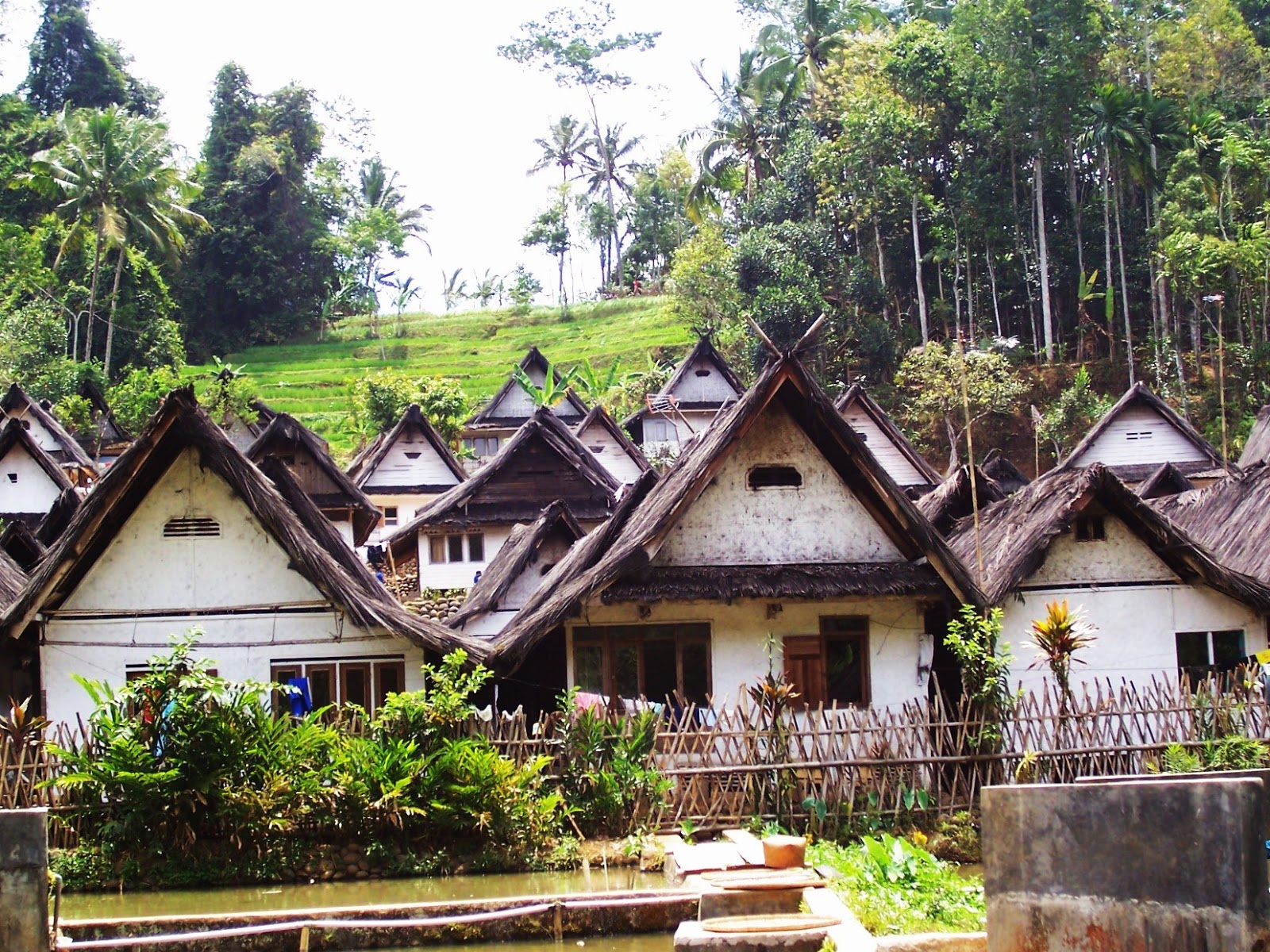
One secluded West Java village has known the answer for decades – maybe centuries.  Kampong Naga, 30 kilometers from Tasikmalaya, is a living museum in a hidden valley which has avoided consumerism. 

It has done this partly through location – it’s even unreachable by motorbike, which makes it rare indeed.  Access is only down more than 300 steps. The other factor is residents maintaining rituals which emphasize the sacredness of frugal living.
The 500 Sundanese on the Ciwulan River valley floor call themselves Sanaga, which is also the name of their religion.  Though technically Muslims they follow the teachings of Sembah Dalam Singaparna, a real of maybe mythological being who passed down eight codes of living to his followers.
Some commandments appear joyless but overall are egalitarian - no-one lives better than anyone else.
Pamungkas, 45, now a leading expert on Kampong Naga, is an architect. Other scholars have focused on the cluster of 110 furniture-free thatched homes built from local materials, but the University of Indonesia architecture graduate took a different approach.
For her doctorate at the Victoria University of Wellington Pamungkas studied the ecology of the mysterious village and the way spiritual beliefs can underpin sustainable development.
Through four years research she’s discovered that the Sanaga’s light tread on the land offers a lesson on living without plundering resources.
This is despite the villagers having limited education and contact with the outside world.  They have a battery-powered television but use it only to watch football.  No smartphones. No trash in the river, though the men smoke factory-made cigarettes.
Pamungkas’ road to Kampong Naga meandered. She was recording colonial- era buildings in Jakarta when offered a scholarship to study art history in the Netherlands.
Completion of a course in academic English was a pre-requisite. A colleague recommended   NZ.  While learning how to fill pages with italicized references she met two Kiwi academics keen to know Kampong Naga’s use and re-use secrets.

As an Indonesian who also understood Dutch (the few records were mainly written by the colonialists) Pamungkas was the ideal candidate for a scholarship. She graduated just before Christmas and is now working as a university tutor.
“My supervisor Professor Barbara Vale commented that Western science thinks it’s smart but in some ways the Sanaga are smarter,” said Pamungkas. “Few books, but inherited knowledge. There’s no clinic but they are clearly healthy and fast regularly.
“Kampong Naga applies the principles of sustainable living, something few other societies have achieved. They use ancient beliefs to determine limits – not just through consumption of outside goods - but also by restricting growth and marking areas with a bamboo fence. It’s applied mythology. Taboo breakers could bring curses on all.
“No more houses will be built because they’ve reached the sacred boundary with forest, fields and river.  Families wanting to grow move out.  But they always return for the six annual pilgrimages to the Great Ancestor’s forest grave so I’m confident the culture will survive.”  The tomb has not been seen by outsiders.
Frustrating for any scholar is the dearth of records.  Much was lost in 1956 when the village was torched by Islamic extremists.  A 13th century engraved copper plate, which has since disappeared, is the only known reference to Sembah Dalam Singaparna.
He is supposed to have been one of seven brothers.  Six were capable and smart, while the village founder’s only attribute was leading a humble life.
Most of the limited information is stored not in Indonesia or Holland but the National Library in Australia.
Pamungkas’ mother insisting on a clean plate echoed an ancient Sanaga proverb directed at kids: ‘If you don’t finish your rice you’ll make Dwi Sri cry’.  The rice goddess is a powerful figure in the mythology and at the center of many “heartfelt rituals” apparently related to Hinduism which pre-dated Islam in Java.
“It’s all fascinating and I want to learn more on how religious beliefs can have practical applications,” said Pamungkas who is considering rewriting her 383-page thesis into a more accessible book.
“The only things I couldn’t stand in the village were the smells of decaying bamboo and feces from toilets above fish ponds designed to handle waste and grow food.
“The people are not closed to new ideas – I noticed a solar panel on one visit – so they may build compost toilets or methane gas generators in the future.  But they do consider every step most carefully, measuring changes against the founder’s instructions.
“The message for all is this: Materialism can be checked by traditional beliefs so all have a fair share.”
##
(First published in The Jakarta Post 31 January 2017