FAITH IN INDONESIA

FAITH IN INDONESIA
The shape of the world a generation from now will be influenced far more by how we communicate the values of our society to others than by military or diplomatic superiority. William Fulbright, 1964
Showing posts with label John Darling. Show all posts

Tuesday, January 10, 2023

SEEING BALI SENSITIVELY

 The searcher who cared and shared
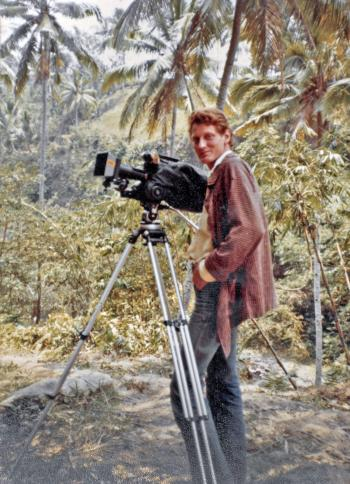

John Darling making Lempad of Bali


Through special visas Sandiago Uno wants access to the wallets of ‘digital nomads’, Gen Zedders with laptops in their backpacks and access to flawless Wi-Fi.


The Tourism Minister thinks that once among Bali’s palms and paddy they’ll spend their overseas earnings on local services. Whether they’ll leave any positive legacy like earlier visitors is another matter. 


Before Bali was transformed from a relaxed, magical and accepting culture to a money machine driven by outside investors, footloose creatives had embraced the island’s rich spirituality. One was Australian John Darling, a young man with a fine education and assured career.


Despite these advantages he didn’t have much idea of what he wanted to do and where to go.  His university lecturer reportedly told him he’d make ‘a far greater contribution by increasing Australian understanding of Indonesia through living and researching Bali and other areas of the archipelago’.


As so often happens to open-minded seekers, the purpose found him and it came with a rare culture, an exotic environment and a cine camera.


Now thanks to admirers of his thoughtful films we have a tribute to a contemplator who came to know Bali better than most, accepted what he’d found, and sought to share.


John Darling, an Australian filmmaker in Bali, is a collection of 21 essays assembled by Australasian academics Graeme MacRae and Anton Lucas.  There are photos and a few poems:


‘In the mountains / I saw a river/ running rapid

For Buddha /a deep pool / ripples / out from centre


In a quiet place / a fat frog/ croaks content

Trapping his needs / from a flying world.


John seemed a most unlikely member of the Bali Lovers League. He was born in Melbourne in 1946 and raised among the elite. His father James Darling was headmaster at Geelong Grammar, one of Australia’s most prestigious schools. 


His son’s paved path was heading straight to an academic career, but capricious fate added turns. After uni John lost his way; mates suggested Indonesia, a puzzling land to most Australians.


He disembarked in Jakarta, slowly headed east, and then into Bali where serendipity intervened.


According to the book revelation came one dawn in a paddy where he met I Gusti Nyoman Lempad the famous Balinese sculptor and artist, then aged 108. He squatted and smoked with a restive Aussie 84 years younger, ‘seeking a place in which to develop my obscure talents.’  


These required celluloid and a mate with technical knowledge. That was to be Lorne Blair, a filmmaker from the UK who became internationally famous for his TV series Ring of Fire, an Indonesian Odyssey made with his brother Lawrence.


Lempad died in 1978 and so began a prolonged set of elaborate funeral rituals which the two outsiders filmed. Because John was an accepted member of the community and by now could speak Balinese he had open access to all preparations for the cremation.


Forty-three years later and online, Lempad of Bali has lost little across the decades. It could have been an ethnographic exercise of limited interest outside social anthropology courses, but it was made as a story of interest to all.  


That ability to make serious cinema accessible helped the producers win the Documentary Award at the Asian Film Festival, and set John’s future not just as a director but also lecturer, writer and poet.


I worked with him on one film and found him introspective – yet engaging. Some saw him as ‘shy and very cerebral … a latter-day Romantic poet.’


Others report a funny man with ‘good manners’, and a ‘dashing dandyish figure.’  Toby Miller, a student who became a friend and is now teaches cultural-studies writes;


‘Despite his fame Johnny needed a lot of care – and was himself full of caring love. He was vulnerable and strong in equal parts.’


John’s later films shown on mainstream television internationally included Bali Hash, Slow Boat from Surabaya, Master of the Shadow and Bali Triptych, described as


Equally memorable was Below the Wind telling of the Sama Bajo, the sea nomads of South Sulawesi.


John’s final work when he was sick with a genetic disease that took his life in 2012 was The Healing of Bali after the 2002 Kuta night club blasts which killed 202. There was a rush of journalists to the island. Other camera crews focused on the terrorists. John’s production concentrates on the survivors and how they are coping with the horror.


There’s no foreign voice-over. The people speak for themselves. The grief is raw.  The viewer is there.


David Hanan, an Australian film-studies lecturer writes that a major theme of the film ‘is the lack of discrimination, indeed the underlying warmth of the religiously tolerant Balinese people – including those most impacted by the events – towards local Muslim residents.’


Reviewer David Reeve concluded: ‘This film is about the healing of Indonesia too, and indeed the world. It is expertly crafted and I pay tribute to the power of the film and its expertise.’


His widow and co-producer Sara offers a moving account of the shoot and this tribute:


‘John was a peaceful man who promoted harmony. He related to everyone, from priests to farmers. His films have helped make Indonesia accessible to the world, particularly Australians who so frequently distrust and misunderstand their northern neighbour.’


Digital nomads need this worthy book to appreciate their second home.  So do all spellbound by Bali, striving - like John – to see if they fit.  And if so, how and why.


Disclosure:  The author is one of the contributors.


First published in Indonesia Expat Ed 292 January 2023: https://web.facebook.com/photo/?fbid=659611166026631&set=pb.100059332612855.-2207520000.


Saturday, December 17, 2022

REVEALING AND RESPECTING CULTURAL DIFFERENCES

 The darling buds of Bali        


Bali is so unlike the rest of Indonesia it seems unmoored from the archipelago.


Before the island was scarred by terrorism and corrupted by commerce it lured foreign adventurers enchanted by the rich spirituality, creating a mystic aura and a pestilence of clichés.  Paradise, abode of peace, island of the gods …


Dutch colonial era artist pioneers included Hollander Rudolf Bonnet (1895-1978) and German Walter Spies (1895 - 1942). Later came Australians like Donald Friend (1950-89) who spent the last two decades of his life painting on the island.  


The work of these creators has been recognised in biographies and art collections. 

Now comes John Darling, an Australian filmmaker in Bali (Monash University Publishing).


This tribute to Bali’s auteur and poet is a 21-essay festschrift edited by Australasian academics, Graeme MacRae and Anton Lucas. An Indonesian translation is expected next year.  It’s enhanced with photos and poems:


the eyes

create the paths 

before us

we travel slowly

taking by-ways

pursuing images …

evening visions of red-eyed infinity

return reversed in dawn’s embrace.


Darling was born in Melbourne in 1946, the only son of an establishment family. His father, later Sir James Darling and ABC chair, was head of Geelong Grammar School.


The lad’s road seemed set as a historian, but after graduating his compass failed.  It was suggested he try Indonesia, a land few Australians knew and fewer understood. Darling wandered across Java to Bali. On a dawn stroll he met I Gusti Nyoman Lempad.


One was a respected and prolific Balinese sculptor and artist, then aged 108. The other a 24-year old drifter from faraway, “seeking a place in which to develop my obscure talents.” They couldn’t share language, yet they connected.


The lost and disgruntled still head to Bali for something they can’t identify, but the Darling days are gone.  Expectations are no longer coloured by ethnographic research but by fantasy romance in Eat, Pray, Love.


So this book is about a place that was, and a time when nomads were curiosities, not ATMs.  Although focusing on one man, it also tells of Bali’s transition from a hippie hideout to a luxury location fit for the G20 suits.


In and around the 60s and early 70s Bali drew surfers to the beaches, intellectuals to the hills and both to magic mushrooms. Ubud became a ‘crossroads of culture’.


At that intersection stood a searcher with no clear plan or purpose, recalls writer Bruce Carpenter, author of a most insightful chapter.  Both men were “refugees of the international youth movement that had filled our generation with naive dreams of blazing new paths and paradigms.”


When Lempad died in 1978 Darling, now fluent in Balinese and close to the family, produced and co-directed with the late British filmmaker Lorne Blair the old man’s spectacular cremation.


 Lempad of Bali won the Documentary Award at the Asian Film Festival. It remains a masterpiece and founded Darling’s reputation.  Watch on YouTube.

For the next 17, years he was known as a filmmaker, poet and lecturer. But a hereditary blood disease forced him to Australia for treatment; he died in 2014, aged 68.


At the funeral Ubud royal Tjokorda Gde Mahatma Putra Kerthyasa said the only outsiders who could live locally were those who loved the island for what it was – not for what they could get out of it.


“John was a man who lived his truth and spoke it.  He didn’t choose an easy life in Bali, he chose a Balinese life. He is remembered … as one of the few foreign custodians of Balinese culture who didn’t take – but shared.”


Darling’s films include Bali Hash, Slow Boat from Surabaya, Master of the Shadow and Bali Triptych.


Veteran Australian broadcaster Phillip Adams (not in the book, but should have been) described Triptych as “one of the most elegant, scholarly and beautifully made documentary series … when you see Darling's loving, luscious, literate films, you'll understand why.”

Darling’s first wife Diana writes: “His films made his poetry visible.” 

Despite applause and acceptance, Darling said that at times he felt like “a bit of a maverick … isolated and an outsider.’ One friend remembers a ‘somewhat other-worldly fellow.”

The late Made Wijaya writes about a “giant ego” and narcissist “in a nice, not a nasty way”, whatever that means. This chapter adds little.

We all see others differently; individuals are complex and facts morph into myths, but disparate recalls confuse. They should have been clarified or cut.

Similarly, pointless anecdotes and lists of names like a club register.  These tarnish finer offerings, such as a pensive analysis by anthropologist E Douglas Lewis.

Fortunately, editor MacRae’s clear writing steers readers back on the road to ponder his subject’s physical and cerebral journey. 


Darling was sick and in Canberra in 2002 when Jemaah Islamiyah fundamentalists bombed a Bali night club killing 202 including 88 Australians and 38 Indonesians.  


Despite his illness, within ten days he was back on the island with his wife Sara as co-producer. Crews from mainstream TV channels focused on the terrorists. The couple’s self-funded Healing of Bali lets victims tell their stories alongside reflections of faith leaders.


Sara addresses her late husband as “an amazing dreamer and wonderful storyteller … through your films, poetry, art, and love of life.”


His accessible interpretations of our northern neighbour’s values make them clearer, hopefully helping those Australians who think differences are threats.  This book should help keep Darling’s legacy alive, help outsiders better appreciate Indonesia and marvel at the work of its creative citizens.


 Disclosure:  The author is one of the contributors.

First published in Antara 15 December 2022: https://en.antaranews.com/news/265675/the-darling-buds-of-bali


Monday, April 14, 2014

LEMPAD'S ART AND LIFE - NOW ON NET AND FREE

Finding the right path 


Minding myself                                                                                                             
 engrossed by the intricacy of a seedling’s growth:                                                                      Startled!                                                                                                                                  
By an old man’s friendly call
One bright dawn in the uphills of Bali the paths of two men merged in a green paddy. The differences between them were as mountain to valley.
One was a respected and prolific Balinese sculptor and artist, then aged 108. The other a footloose Australian from an elite background “seeking a place in which to develop my obscure talents.” He was 24.   Neither spoke the other’s language.
John Darling recalled the moment he first met Gusti Nyoman Lempad:  “He could tell that I was trying to find an unimpeded view of the mountains. He beckoned me to follow him, and so the glory of the morning was laid out before us.  We sat on the grass of a paddy bank to appreciate the short moment of beauty that precedes the day.”
The chance encounter led to one man taking the road less travelled, the other having his talent revealed to the world through television.
Eight years later Lempad died “a conscious death”. John Darling, now fluent in Balinese and a friend of the family (he lived on Lempad’s land), was asked to film the artist’s spectacular cremation in Ubud.
The result was Lempad of Bali, a film shown on TV in Australia and several other  countries.  Now it’s been redigitized and is available free on the Internet, along with John Darling’s book of the same name.
It’s all in an E-package that Jakarta publisher Mark Hanusz believes is probably the first of its kind in Indonesia.
The book is in English and Indonesian and has great pictures.  There are apps for Apple and Android.
John Darling went on to become an ethnographic film maker, poet and lecturer, but fell ill and returned to Perth.  He died in 2011.
Since she scattered her husband’s ashes in Bali, Sara Darling has been preparing John’s work for publication, supported by the Melbourne-based Herb Feith Foundation.  This is named after the famous Australian scholar of Indonesian politics who died in 2001.
“The decision to make the book and film widely available was driven by a desire to fulfil John’s last wish,” Sara said. “He had an unique experience to tell because he lived in Bali for 20 years. Now it’s out there for all to enjoy, along with John’s memoirs and poetry.

Melbourne University Professor Charles Coppel said Herb Feith and John Darling were “ideal examples of Australians committed to better relations with Indonesians.
“They lived for long periods in Indonesia on Indonesian terms that endeared them to their Indonesian friends. That made them stand out among Indonesian ‘experts’ and gave a special quality to their work.”
This quality comes across in film and book, though unfortunately the latter is too short.  Maybe that’s to be expected from a poet who preferred brevity, and a film director who spoke through his images. 
But it leaves great gaps. We learn much about Lempad – we also want to know more of his biographer, and how such an odd couple related and communicated. “John was always a deep thinker, and at heart an artist,” wrote Sara.  So was Lempad.
Other books are promised later this year to coincide with an exhibition in Bali of the work of the man who many consider the island’s greatest artist. These will celebrate Lempad’s work but are unlikely to reveal more about the other man whose destiny was set in a Bali ricefield in 1970.
Since then too many Australians have come to use Bali as their backyard party zone,  cheap and exotic, an inhibition-free week at the poolside bar without ever encountering the mystery and magic of the hinterland and isles beyond. 
For them the rich culture comes in roll-up canvases of saleable sameness, Kuta trinkets, so tawdry it’s clear the sellers have a cynical understanding of foreigners’ tastes and values.
Although beloved of academics, John Darling’s work was never exclusive.  It was made for general viewing and no special appreciation of art or Indonesia is necessary to enjoy the film and book. 
How come people like Herb Feith, a Jewish refugee from Austria who settled in Australia as a child, and John Darling, who left his homeland to study the British Empire in Oxford, fit so well into Indonesia and want to share their insights?
One of many answers has to be accepting the Archipelago on its terms, to get in sync with its pulse and absorb a different world view. Here’s a clue:  “Bali subverted me,” the film maker wrote. “The way of life around me soon dominated my thinking.  It became apparent that here was a story to tell and that I owed it to my friends and neighbors on the island to help them tell it.
 “Poetry and film … have much in common, images, symbols, myth, rhythm and other resonances beyond the immediate.”
Here are fresh ways for Australians to see their northern neighbor, not through commerce and defence, but respect and wonder.  This is the paddy path to build mature people-to-people relationships, the must-have phrase in every politician’s lexicon, so often said, so seldom done.
Elusive knowledge,                                                                                                                      A product of receptive seeing                                                                                            
Coming to us                                                                                                                              
In black and white                                                                                                                   
And hot and cold                                                                                                                      
And nature rhythms                                                                                                                 
Oh, what are we                                                                                                                       
But receptacles                                                                                                                     
Which occasionally overflow.
Lempad of Bali                                                                                                                           E book and embedded video                                                                                                 Published by Equinox Books, Jakarta  , 2014                                                                 Download free: http://www.lempad.net

 (First published in The Jakarta Post 14 April 2014)