FAITH IN INDONESIA

FAITH IN INDONESIA
The shape of the world a generation from now will be influenced far more by how we communicate the values of our society to others than by military or diplomatic superiority. William Fulbright, 1964
Showing posts with label NU. Show all posts

Tuesday, June 18, 2024


INDONESIA'S CARBON CRISIS: WILL ISLAM GET DIRTY HANDS?

 Duncan Graham


Coal River - Samarind

Nahdlatul Ulama (revival of the scholars) is Indonesia and the world's largest Islamic organisation claiming almost 100 million members. If it digs coal it could become mega-rich.  How dirty work marries with sending souls to paradise only Allah knows.

President Joko ’Jokowi’ Widodo has four months left in office, enough time to sow division before handing the job on to the elected former cashiered general Prabowo Subianto.

In May Jokowi signed a decree letting religious groups apply to be the first shovel in the ore for special mining concessions. Not quite a gift from the gods as the Republic is supposed to be monotheistic, but pretty close.

This allows him to make good on an old promise to religious groups to take over mining concessions to raise funds. What the hell has coarse commerce got to do with matters of faith?

One answer:  Politics, or as the Jakarta Post described it clumsily because pig meat is taboo to Muslims, “halal-certified state-sponsored pork barreling”.

It added: “The government has come out with one of the most ridiculous policies in the history of this nation … It’s now up to the country’s largest Muslim organization to back out on moral grounds.”

But will the lure of lucre prevail over Islam’s obligations to be honest, fair and righteous?

NU supported the Prabowo ticket in the February presidential election as did Jokowi who was constitutionally barred from taking a third five-year term.

Instead, he engineered for his eldest son Gibran Rakabuming to contest as number two. He's now Vice-President elect.

The lead-up to the inauguration is a time to settle debts and cement alliances. If enough minor parties join the Prabowo-Gibran winning team, opposition will be left to NGOs.

Most are poor and poorly equipped to do more than their narrow roles, like advocating for human rights.

The churches have already knocked back Jokowi’s offer saying that fossil fuels are not their job and they’re better at consulting holy books than mining manuals. The mosques are dithering.

Second behind NU is Muhammadiyah (followers of Muhammad) with 60 million members. It tends to attract the better-educated middle class.

At present it’s pondering the Jokowi offer, but observers reckon nothing will happen as the gift has been pegged only for the NU.

The six government-approved religions, Islam, Protestantism, Catholicism, Hinduism, Buddhism and Confucianism have charity wings.  They run schools, hospitals, clinics and retirement homes principally for their members and could probably improve their work with mining profits.

But supping with this devil will need a long-arm excavator.

Investment Minister Bahlil Lahadalia was reported as saying  the handout was "in return to their past services during and after the country's struggle for independence … you are investing for the hereafter." That's something most religions have been doing for millennia.

The government says any faith group that accepts the deal has to run the show themselves.  This means they can’t flog off a mining permit or farm out business to an established company, even though it has the gear and expertise.

That rule crimps expectations of the beneficiaries only needing bigger truck parks and tips to take Haulpaks of rupiah.

A few right-wing congregations believe the earth is for exploitation;  the rest take a more environmentally conscious position accepting that despoiling nature is not part of any Deity’s plan.

The better read will know that most responsible nations are moving away from fossil fuels to renewable energy sources.

Indonesia is the world's largest coal exporter and third biggest producer; to the distress of those worried about global warming it shows no sign of slowing down; the compound annual growth rate has been seven per cent since 2019.  This year it expects to produce 710 million tonnes.

There are precedents for Jokowi’s generosity though unfair and distressing.  

Last century then president Soeharto gave forestry concessions. Tens of thousands of hectares of virgin growth mainly in Kalimantan (Borneo island) to relatives and mates, particularly army generals, establishing vast business enterprises.

Many wield enormous power today and are part of the oligarchy. We've yet to hear how the profiteers feel about sharing their spoils with the pious.

##

 First published in Pearls & Irritations, 18 June 2024: https://johnmenadue.com/indonesias-carbon-crisis-will-islam-get-dirty-hands/


Tuesday, December 29, 2020

SEARCHING FOR INSULTS AND PLOTS TO STIR


         Sinophobia as a political weapon

‘Morality racketeering’ is Australian academic Dr Ian Wilson’s shorthand for Indonesian white-clad mobsters who dress themselves in religious righteousness to terrorise their animus-du-jour.  Last century it was vice.  More recently it’s been blasphemers.  Now it’s the government of President Joko Widodo.

An Australian supporter of the ultra-nationalist group Front Pembela Islam (FPI – Islamic Defenders’ Front) explained to TV news this month why he and a few friends were backing the FPI leader Rizieq Shihab, 55, a man who’s no Santa Claus.

They said Widodo had neutered opposition through political alliances.  This left the FPI and its incendiary preacher as the only voice offering alternative policies.

Unfortunately that voice is hate-filled.  If there are plans worthy of being called policies, they’re rooted in sinophobia.  The signs are subtle, more dog whistles than shouts according to another Australian scholar, Dr Quinton Temby based at Singapore’s Institute of Southeast Asian Studies.

Key words in the FPI’s rhetoric include naga, the symbol of a dragon, cacing (worm) and zalim (aka zulm) Arabic for cruelty, exploitation and oppression.  All are linked to China and Communism.

Readers who remember Vietnam War propaganda would recognise the images – a loathsome red creepy-crawly, jaws agape, slithering towards the motherland.

Shihab likes to strike demagogue poses and call himself the Imam Besar (Grand Cleric) descended from the Prophet Muhammad through his ancestors who brought Islam to Indonesia.

Critics have publicly called him a thug, but his claims suggest the man’s also a charlatan.  The Prophet, who died in 632 is supposed to have had 13 wives but only two children.  Islam arrived in Java in the 14th century, popularly through the Walisongo, or nine saints of Islam.

As there are few written records Shihab’s ancestry can’t be proved, but as Donald Trump knows, the more outrageous the notion the more likely to be accepted by the gullible.

How many believers is hard to know.  Temby has taken a stab at 200,000 which is big by Australian standards but tiny in the Republic. The mainstream Islamic organisations Nahdlatul Ulama and Muhammadiyah together claim a membership of 120 million.

As we know, one determined zealot can still do enormous damage, though the FPI’s energies are currently directed to social media manipulation rather than bomb making.

The FPI made a major mistake when it switched targets from boozing foreigners and the unwed in bed to the government.  This enemy has a police force with lots of guns which were used to kill six of Shihab’s ten ‘bodyguards’ on a toll road in the early hours of 7 December.

The police said they had to defend themselves against armed men, but Shihab says his supporters had no weapons.  Guns are rare in Indonesia’s underworld.  So far no independent witnesses have come forward, but the cops’ version looks suspect.

The government has certainly sent a late no-tolerance message, reinforced by the arrest of Shihab for allegedly breaching coronavirus rules on wearing masks and social distancing.

When the preacher returned to Jakarta from three years self exile in Saudi Arabia on 10 November he was met by a huge mob which ignored lockdown laws. 

The crowds caught the Widodo government by surprise.  How could ministers not have known about the flight and planned welcome? Either the State’s ‘intelligence’ service was dozing, or they knew and wanted the FPI to incriminate itself.  Widodo sacked two senior cops and their replacements are cracking knuckles.

Another sinister theory going the rounds is that Shihab’s return was arranged by the FPI’s political paymasters playing a long game to discredit Widodo. Like Trump’s election fraud accusations, no one is producing evidence.

Naturally the FPI is playing victim and promoting the six dead men as martyrs who died for the cause of ‘moral revolution’.    This sounds fine unless a definition is sought.  For the FPI it means making the population live under sharia (Islamic law) and the suppression of ‘minorities’.

This is another code for ethnic Chinese. Most are Christian and probably total less than ten million.  That’s about one in every 30 citizens, though their economic clout is far greater.  

Some families have been in the archipelago for three centuries and helped fight Communism after the 1965 coup.  But that doesn’t disturb the radicals who only see foreigners taking local jobs on Widodo’s infrastructure projects powered by Chinese loans. Jakarta’s debt to Beijing exceeds AUD 23.5 billion.

Its vaccine diplomacy should ensure millions get protected with the Sinovac jab.  Doses are already in the country and will be delivered free if approved.  That should encourage citizens to think favourably towards the donor – but few forget they’re also atheists persecuting Uyghur Muslims.

The FPI has called for citizens to boycott Chinese shops and goods.   If that happened the populace would go hungry, have to quit fags and buying smartphones.

So far China hasn’t retaliated.  Instead coal exports have been increased to replace imports from Australia.  But if its citizens are physically attacked it could withdraw its engineers and throw the massive road and rail upgrades into chaos.

Widodo’s government is in a bind.  Sinophobia is always bubbling beneath the surface.  The last big outbreak of violence in 1998 took the lives of more than a 1,000 shopkeepers and looters.

Anyone offering a sane commentary runs the risk of being painted Red – a straight lift from George W Bush’s ‘for us or agin us’ reductionist lunacy as the ideology has been banned for the past 55 years and shows no sign of germinating.

It’s difficult to know if the FPI is affiliated with the extremist Jemaah Islamiah (Islamic congregation).  The government is trying to persuade citizens that Shihab’s mob is a terrorist group and should be black-listed for spruiking violence – including the beheading of blasphemers.

Human rights activists are also conflicted fearing a ban on one outfit threatening the government will lead to further action against peaceful and rational critics – which is already happening.

The police say they’ve recently arrested 23 JI members including two prize targets - Taufik Bulaga and Zulkarnaen - suspects in the 2002 Bali bombings, in which 202 died, including 88 Australians. The men were also allegedly involved in the 2004 one-tonne suicide bomb hit on the Australian embassy.  Nine died – all Indonesians.  About 150 were injured.

This Christmas and New Year the police are expected to be ramping patrols around churches, a standard precaution every twelvemonth.

Any outrage during the season of goodwill is likely to further frighten the Western investors Widodo so badly needs to balance the Renminbi.  


  First published in Pearls & Irritations 28 December 2020

 https://johnmenadue.com/duncan-graham-sinophobia-as-a-political-weapon/

Sunday, March 24, 2019

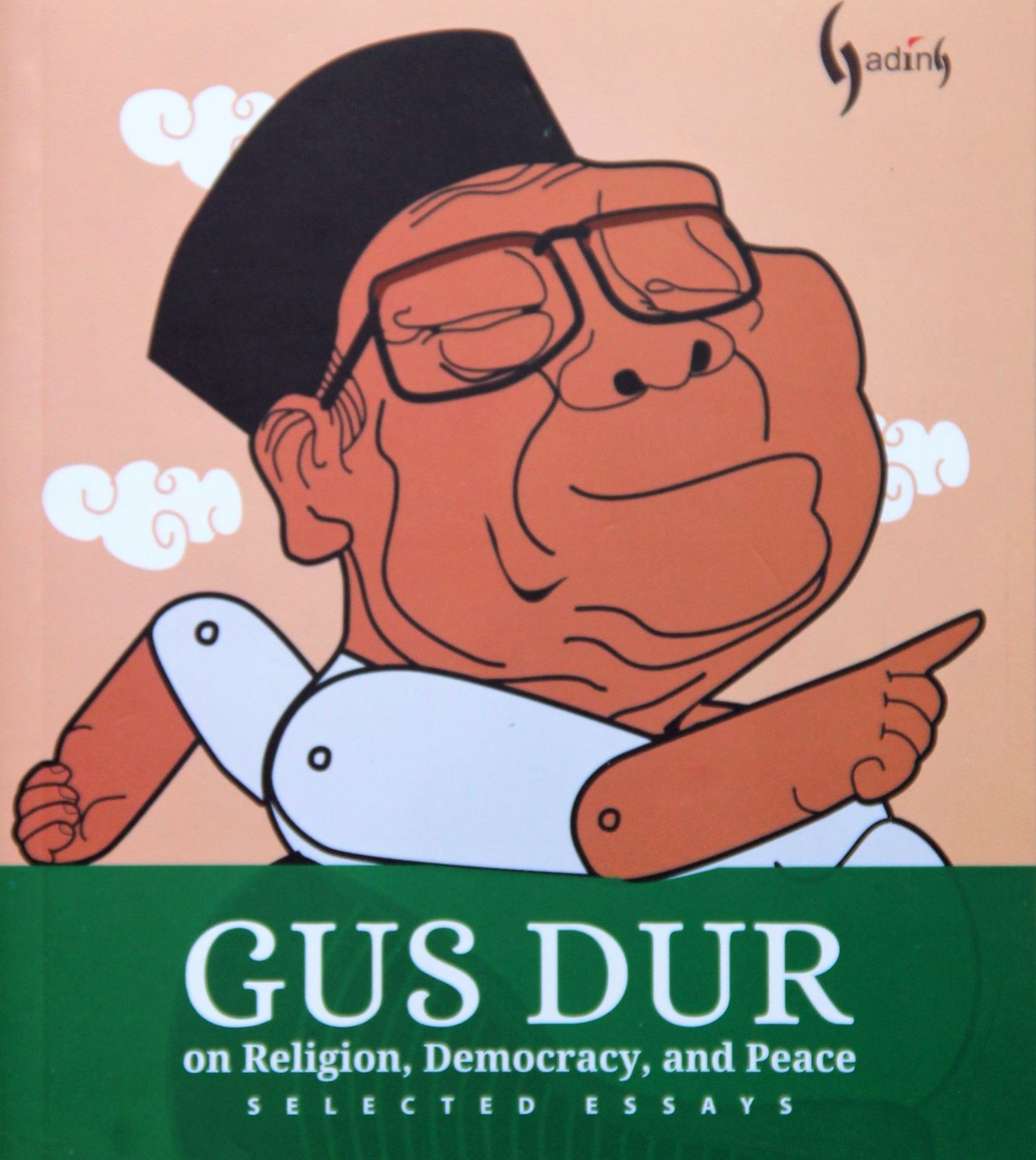
GUS DUR ON RELIGION, DEMOCRACY AND PEACE


Showcasing an Indonesian intellectual       

'Gus Dur on Religion, Democracy and Peace’: Showcasing an Indonesian intellectual           

How to get the golden egg without disturbing the hen?
This was a typical conundrum posed by Indonesia’s fourth President the late Abdurrahman Wahid.  Better known as Gus Dur, he was one of this nation’s most prominent theologians, a committed democrat and lover of metaphors. 

One of the eggs was reform and a return to the more accepting indigenous Islam.  This needed to be secured without arousing the wrath of the broody bird, the rigid Saudi form known as Wahhabism then becoming popular.

Gus Dur died in late 2009 aged 69.  Before entering politics he was head of Nahdlatul Ulama (NU), the biggest Islamic organization in the world.

His 19 months as President between 1999 and 2001 were chaotic after the fall of the long time dictator and former army general Soeharto. 

Gus Dur was a bad economist, a lousy administrator, a decent humanist and a good social reformer. He lost the top job after being threatened with impeachment.

There aren’t too many NU members who don’t have an anecdote about their former leader.  Apart from being a religious scholar the polymath was also a passionate soccer fan and all-round funny man with a sackful of jokes. He used these to start meetings and defuse tensions:

A Madurese was caught ignoring a sign banning pedicabs. ‘I saw the picture Sir,’ he told the policeman, ‘but it showed an empty becak; mine had a passenger.’

“You're stupid. Can't you read the words under the picture?’

‘No Sir. If I could read I’d be a clever man like you.’

One of Gus Dur’s favorite verses from the Koran reads: ‘I have made you nations and tribes so that you may know one another’, a robust rebuff to the parochialism preached by today’s separatists.

He wrote essays and newspaper articles till restricted by loss of sight; these were always in Indonesian though he was a self-taught polyglot.

Now the Gusdurians, the young followers of his liberal thinking, have offered some selected works to a wider audience.  Seven translators have put 13 of his essays into English as Gus Dur on Religion, Democracy and Peace.

Behind the book are the NGOs Infid (International Forum on Indonesian Development) and Yayasan Lembaga Kajian Islam dan Sosial (Islamic and Social Studies Institute).

The ambition of giving their hero’s wisdoms to the world is fine, and the book important, offering many stimulating observations. But sadly it will get rejected by some potential buyers put off by sloppy English, even on the back cover blurb:

‘Not much people know that Gus Dur wrote many reliable and high quality articles … (he) does not simply rejects negative ideas about Islam, he also proposes and advocates positive ideas about on the other hand.’

We get the gist; Gus Dur’s fans will read this book anyway and forgive the errors, but this is 2018 and the public expects English of the quality they find in this newspaper.

The uncommitted curious will put it back on the shelf. Two proof readers are listed in the credits. I doubt they read the book.

However the rest of us should, if only to lift our spirits, to remind us of the complex diversity of Islam, a faith so often portrayed in the West as violent and intolerant.

Gus Dur was an eclectic reader as confident with the holy books of other faiths as with his own, often quoting the Bible.  In 1985 - when Soeharto’s authoritarian New Order government was at its peak – the cleric gave a sermon about the ‘Revival of Islamic Civilization’ and asked ‘is it happening?’

His conclusion was positive - though this was before urgers for a caliphate donned suicide vests and rode into crowds: ‘The richness of (Islam’s) heritage from its deep perception on (sic) a true place for humanity in life, to its great tolerance make a strong base for the Muslims to sail through the revival process.’

These are qualities we need now.

Gus Dur’s second daughter Yenny is a prominent public figure helping maintain her Dad’s legacy. But at the moment there’s a dearth of dynamic elders from outside the family offering the world a counter view to the ugliness of demonstrations against those of other faiths.

Into the gap have jumped the myopic polemicists.

What might Gus Dur have said to supporters of the so-called Reuni 2/12 in December? If true to form he would have condemned their celebration of getting the ethnic-Chinese Christian former Governor of Jakarta, Basuki ‘Ahok’ Tjahaja Purnama, jailed for blasphemy.

This law has been erased from the statutes of most modern nations; it’s better covered by prohibitions on individuals deliberately and maliciously causing egregious offence, and not just against faith.

The black-banner wavers around Monas have struck fear into the hearts of Indonesia’s minorities and dismayed the Republic’s foreign friends – something Gus Dur would have opposed with conviction.

He wasn’t just a thinker – he physically confronted crazed mobs who’d fired churches.

His essay The Republic of Earth in Heaven: Another side of religious motives within social movements, written 35 years ago is apposite today.  He warns of ‘an endless process of fragmentation … diversity sacrificed to revolution’.

The revival he sought was not through terror, but the art, literature, architecture and learning that once enriched the world, making Islam universally admired.

Gus Dur on Religion, Democracy and Peace
Gading Publishing, Yogyakarta, 2018
142 pages

(First published in  The Jakarta Post J Plus 23 March 2019)


Monday, October 10, 2016

A MAP FOR A FAITH'S JOURNEY

Traditionalists versus Progressives:  Who’s winning?             

Protestants once happily belted out the mid 19th century hymn Onward Christian soldiers. It was composed by Sir Arthur Sullivan (of G & S opera fame) and has a seductively rollicking rhythm.
The sturdy language reinforced the righteousness of the singers’ beliefs. It became a Salvation Army ballad. Now it’s seldom heard –except with new lyrics.
It took more than a century for congregations to realise the gross offensiveness of the words and their opposition to teachings of love and forgiveness. Compassion had been hijacked by the military-minded who saw other beliefs as pagan lands to be colonized.
Traditionalists argued that the hymn’s roots were well embedded in Biblical tales justifying violence. It’s taken a long time for the self-styled Progressive Christians to start reinterpreting the scriptures for those who believe religions should promote peace.
Is the same thing happening with Islam in Indonesia, though extremists still use the more vengeful passages of Al Quran to justify violence?

Islamic scholar Dr Rumadi, (right) originally from Central Java, thinks similar reform may be underway. In 2008 he wrote Post Traditionalisme Islam: Wacana Intelektualisme dalam Komunitas NU. 
The book has now been translated into English as Islamic Post-Traditionalism in Indonesia. The forward by the late Abdurrahman Wahid (Gus Dur) Indonesia’s fourth president and former leader of the mass organisation Nahdlatul Ulama, is surprisingly critical.
He writes that the book does not cover the ‘dialogue’ between Islam and nationalism which predates the foundation of NU (in 1926), adding:
‘The attitude of viewing post-traditionalism as the essence of NU ‘revival’ is frankly quite dangerous because it can be easily misused.’
Rumadi declined to attack the comments: “Gus Dur is not wrong, of course not. But things have been changing.  Since he died (in 2009) there’s been much development of an Indonesian version of Islam that’s different from the Saudi interpretation.” 
Yet every time a progressive tries to release Islam from the intellectual prison of fundamentalist interpretations there seems to be a lashback.
President Joko Widodo recently issued a decree to establish an international Islamic campus.
“I expect this university to be a source of knowledge, Islamic studies, the moral light of Islam and a bastion of balanced Islamic values, tolerant and egalitarian Islam,” he reportedly said.
“Islam in Indonesia is like a patent medical prescription, which is moderate Islam, while other countries are still seeking the formula.”
But the dose had gone wrong in North Sumatra where Buddhists were picking over the ashes of their temples allegedly firebombed by an enraged mob. News reports said the men had reacted after a Chinese woman complained about noise from a nearby mosque.
It’s not just non-Muslims who get offended by high-volume calls to prayer; Vice President Jusuf Kalla is on record asking mosques to remember that at least 25 million Indonesians follow other faiths and turn down their amplifiers for azan.
Tolerance goes beyond accepting all have a right to peace.  The next logical position is that respecting other beliefs dilutes commitment to your own which opens the door to doubts. For some that’s a step too far.  For others it can be exciting to have their views tested – yet still hold strong.
Eight years ago the little-known Cirebon-based Fahmina Institute based on the ‘religious and intellectual practices of traditional Indonesian Islamic boarding schools’ produced Rumadi’s book.

The English translation by Melbourne University academic Rebecca Lunnon released this year gives Rumadi’s study an international readership. It has been published by Singapore’s prestigious Institute of Southeast Asian Studies, recognising the book’s importance in understanding Indonesian Islam as interpreted through the NU prism. 
Although the prose reads well the free flow of the text falters when it hits the speed bumps of names of minor players. Their contributions could have been left to endnotes.
There is also much attention given to tiny points of difference, leading to the assumption that some discussions are more peacock displays of individuals’ erudition than genuine attempts to find answers.
Just as medieval Christian scholars debated the number of angels that could dance on a pin, some schools of Islam (and other faiths) need to get back to the basics of family, morality, worldly purpose and the afterlife – if there is one.
Rumadi, 46, is not a polemicist.  He used to be involved with the Jakarta-based Wahid Institute, a research center founded by Gus Dur, so his writing is not impartial, a fact he acknowledges. 
There are no references in his book to Muhammadiyah (founded 1912), the second largest Islamic organization in Indonesia with around 30 million mainly urban members – a fact readers must constantly keep in mind.
The author lectures in Islamic law at UIN in Jakarta and is also a Commissioner at the government’s National Information Commission in Jakarta.
His education has been entirely in Indonesia and includes a PhD from the State Islamic University (UIN) in Jakarta.   His reputation and analytical skills could be enhanced with overseas qualifications, preferably from a secular campus.
Despite these handicaps Rumadi, 46, has the courage to get stuck into NU.  Publishing criticisms can be dangerous. His friend Ulil Abshar-Abdalla, founder of the Liberal Islamic Network got death threats and a letter bomb after writing in the newspaper Kompas about ‘rejuvenating Islamic understanding’ an article some considered heretical.
Rumadi said he’d had no problems even though writing: ‘The NU theological structure … is unable to wrestle with the wild anarchy of meaning, fails to accommodate rapidly changing social dynamics and is too fragile to be the foundation for social empowerment towards a more social, humanitarian and democratic society.’
Hope for peaceful co-existence now lies, though not exclusively, with the Islam Nusantara (Islam of the Archipelago) movement.  This has been established by NU since Rumadi’s original book was written.
It aims to develop ‘Indonesian as well as Islamic society, improving the welfare of lower classes of society, building democracy and fundamental justice, and expanding peace and non-violence throughout the world.’ Onward, faithful peacemakers.
##
(First published in The Jakarta Post 10 October 2016)


Thursday, December 31, 2009

FAREWELL GUS DUR: President RI 20 October 1999 - 23 July 2001

I interviewed Gus Dur for a book on Indonesia and spent most of the time laughing at his jokes. There's one below. He was an extraordinary man, a true democrat, liberal, learned and impossible to dislike. History should treat him kindly - just as he treated others. His impact on Indonesia endures leaving it a far better country after the ravages of Soeharto.
Duncan Graham

THE BIG DEBATE
By Abdurrahman Wahid (Gus Dur)

Back 10 centuries ago, just before the Crusade was launched, the Pope decided all Muslims had to leave Jerusalem peacefully or there’d be bloodshed. Naturally there is a big uproar from the Muslim community. So the Pope strikes a deal. He proposes a debate with a member of the Muslim community. If the Muslim wins the debate, all the Muslims can stay. If the Pope wins, all the Muslims will have to leave.
The Muslims realise they have no choice. They look around for a champion who can defend their faith. No one wants to volunteer, it's too risky. But they finally pick their representative, an old Mullah who unknowingly agrees without understanding what he’s getting himself into. He agrees on the condition that neither side is allowed to talk but communicate by miming, as he’s almost deaf. The Pope agrees.
The day of the great debate comes. The Mullah and the Pope sit opposite each other for a full minute before the Pope raises his hand and shows three fingers. The Mullah raises his middle finger. The Pope waves his fingers in a circle around his head. The Mullah points to the ground and stamps his right foot. The Pope pulls out a wafer and a glass of wine. The Mullah pulls out an apple. The Pope stands up and says: ‘I give up. This man is too good. The Muslims can stay.’
An hour later the cardinals are all around the Pope asking what happened. The Pope says: ‘First I held up three fingers to represent the Trinity. He responded by holding up one finger to remind me that there is still one God common to both our religions. Then I waved my finger around me to show him that God was all about us. He responded by pointing to the ground and stamping his feet, telling me that God was also right here with us. I pulled out the wine and the wafer to show that God absolves us from our sins. He pulled out an apple reminding me of the first sin. He had an answer for everything. What could I do?’
Meanwhile, the Muslim community has crowded around the old Mullah in total astonishment. ‘What happened?’ they ask. ‘Well’ says the Mullah, ‘first, he said we Muslims had three days to leave Jerusalem. I told him - up yours! Then he said this whole city would be cleared of Muslims. I told him none would leave this land!’
‘And then?' asks a woman. ‘He took out his lunch and I took out mine,’ says the Mullah.

Thursday, September 04, 2008

DIN SYAMSUDDIN ON PLURALISM, FATWAS AND THE PRESIDENCY


Confessions of a most misunderstood man

Other faiths and Westerners have nothing to fear from Indonesia, despite a fatwa (binding ruling) against pluralism by religious scholars. Nor should outsiders be concerned about nationalism, according to Professor Din Syamsuddin, head of the Muhammadiyah Islamic organization that claims 30 million members.

On a visit to Malang in central East Java the US trained scholar with a doctorate in political science spoke to Duncan Graham. This is an edited version of the interview on the eve of the possible presidential candidate’s 50th birthday.

The West tends to label you a moderate. Is that accurate and what does it mean?

I don’t come with labels. I don’t know whether I am a moderate or not – that’s for others to decide. I have a principle of taking the median position between left and right in terms of balance.

There’s a lot of misunderstanding – all Muslim organizations suffer from attribution, generalization and stigmatisation.

However I have been strongly against the war on terror. I was misquoted as saying President George W Bush was a drunken horse. I used the metaphor of the kuda lumping (the Javanese hobby-horse trance dance). That was changed in translation and my statement misunderstood.

Now many in the US and the West are supporting my position.

You say you support pluralism, but the MUI (Majelis Ulama Indonesia - the Council of Religious Scholars), where you’ve long held senior positions, has issued a fatwa against pluralism.

I’m still in the MUI, though not active – I have too many other duties. I wasn’t involved in the fatwa. Most of the members of the MUI committee that pronounced the fatwa were members of NU (Nahdlatul Ulama - a second Islamic organization that claims 40 million members.)

(Syamsuddin was raised in a prominent NU family but moved to Muhammadiyah as a student. He said this was “a rational choice based on my understanding of Islam – I was drawn to Muhammadiyah by the combination of ideas and action with our schools, hospitals and other institutions – what some have called ‘Protestant Islam’.”)

So is the fatwa wrong?

The title of the fatwa is wrong. The context and the title are different. The position has been distorted. The truth of religion is in relativism. It was a mistake of the committee in using the term pluralism and not relativism.

What do you mean by relativism?

This is a semantic problem. The Holy Koran has many verses about religious pluralism. It has also been a mistake made by outsiders to exaggerate by saying the fatwa is against pluralism. I am active in many national and international inter-faith groups and promoting dialogue.

At the top level there seems to be no problem. After every inter-faith conference we see media photos of happy leaders from different religions embracing and passing resolutions of tolerance. Meanwhile in some kampongs and villages people of different faiths keep fighting.

There has to be a new paradigm on inter-faith dialogue. We have to include the excluded. We should focus on the state of being, not believing. We should all be in one big tent. The only exceptions are those who encourage violence. The government must deal with them.

But how do you include extremists of any faith who refuse to even discuss other people’s positions?

This is the dilemma. Everything is in a state of change and we must involve the non-religious sectors of society in these problem-solving discussions. Let me make it very clear: I am totally against terrorism and I took an active and very tough stand against the tragic events (the World Trade Center attacks) in the US. I did not escape my responsibilities, like some others.

The West often finds the apparent inferiority complex of some Muslims in Indonesia puzzling. You are the overwhelming majority. Why should you fear other beliefs?

Islam was put in a corner by the Soeharto government. After reform started (in 1998) Islam in Indonesia faced multi-level problems and new challenges. We have been like the Indonesian proverb about a man who falls from a ladder, gets hurt, causes breakages and is then blamed by the ladder’s owner.

I agree there is a need for reform in Islam, but I do not support the Liberal Islamic movement. They confuse liberal with liberated.

We don’t want our society to be divided. I tell Muslims not to feel inferior, not to loose hope and blame others. The Arabs took Islam into the golden age. I see Muslims in South-East Asia leading the way into a new age of tolerance and understanding. Of course there’s a place for other faiths.

The next time we meet will you by a candidate for the vice presidency?

Why the number two position? Nothing is definite yet, but I think I’m able. I’m the president of a great and complex organization that is almost like a state. Many have asked me – probably yes, maybe no. I must be whole hearted.

If you did get the top job what changes would you make?

I’d like to see Indonesia as the world’s third largest democracy enforcing freedom …

Enforcing?

No, that’s too strong a word. Promoting freedom and the people’s social, political and economic rights, and having religious freedom. We need overseas investment from those who accept our sovereign position.

Sounds like nationalism …

I only want what is the most favourable and best possible position for all Indonesians.

I’ve met Kevin Rudd (Australian Prime Minister) and he is a very good man. I like him a lot. We must be good friends with Australia and work together. We are not a threat to each other. Australia needs to become more Asian.

I didn’t get enough time with him. I want to go to Australia soon and propose Australia working with Indonesia, Malaysia, South Korea and Japan to counterbalance the growing power of China and India.

My obsession if for a peaceful and prosperous world. I want to see a mature, modern and moderate Indonesia facing the world with self-confidence. But at times I feel that I have been a most misunderstood person.


(First published in The Jakarta Post 1 September 2008)

##