FAITH IN INDONESIA

FAITH IN INDONESIA
The shape of the world a generation from now will be influenced far more by how we communicate the values of our society to others than by military or diplomatic superiority. William Fulbright, 1964
Showing posts with label Jokowi. Show all posts

Monday, October 21, 2024


ALL CHANGE – THOUGH NOT FOR THE BETTER                     


Nothing civilian about this show 


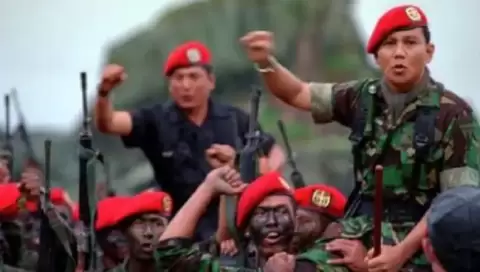
We know more about our neighbours’ new leader from the US media – not our own.  Australian correspondents stationed in the region constantly sought interviews with Prabowo Subianto before he became Indonesia's eighth president of the world’s fourth most populous nation.  We were snubbed. 

Being ignored is an occupational hazard for journos; grow a carapace or switch to PR. But getting to hear and read the views of the new guy next door heading 280 million people is important for all Australians - and vital for our future

Among the razzamatazz of the switch from Joko ‘Jokowi’ Widodo to Prabowo on Sunday were fears this marked the Republic heading backwards – to the New Order autocracy of his late father-in-law and second prez Soeharto.

Some have moaned that Anthony Albanese insulted Jakarta by his absence from the hoopla prioritising a previous engagement with his King.  That could be expeditious.

Should the disgraced former general and alleged human rights abuser become a despot, the PM can remind electors he didn’t personally bless the newcomer. Deputy Richard Marles was sent as Team B.

Prabowo gave Al Jazeera TV a brittle half-hour sit-down in May.  Later he spoke to Time magazine for “over six hours” kissing bubs, and savouring the reporter’s defence line to the jury:

“Prabowo is too complex a character to be distilled as simply the ‘massacre general,’ as he sums up his Western reputation with a resigned eye-roll.” Simply?

Favouring the US and Qatar media over Oz reveals Marle’s  “no relationship more important” line is not reciprocated.

The Indonesian media is being duplicitous by rewriting their new leader as a ‘retired’ general.  That’s a lie. The man was cashiered in 1998 for disobeying orders with his troops ‘disappearing’ student dissidents.  Thirteen are still missing. Prabowo was never charged, a point he likes to throw at critics.

Once sacked he fled to Jordan, only officially returning to Jakarta in 2008 when Soeharto died, his ambitions well bolstered with funds from his younger US dollar billionaire brother Hashim Djojohadikusumo.

What to know about Prabowo?  He’s 73, mercurial and a misogynist. Indonesia has a gossip-fuelled tabloid press but has never pictured the former Defence Minister with anyone since he and wife Siti split in 1998 after 15 years. No First Lady.

This is unusual.  First President Soekarno set the bar for Javanese manhood as a confirmed philogynist with nine known wives.

Prabowo and Siti’s only child Didit is a middle-aged fashion designer living in Europe and whispered to be gay, not a proper public lifestyle in tut-tut Indonesia.

PS is no great shakes on religion but goes through the rituals in a nation that has more Muslims than any other state so leaders must seem pious.

Mum Dora Marie Sigar was a Protestant, Dad Soemitro Djojohadikoesoemo a Dutch-educated Javanese Muslim economist who quit the country after falling out with Soekarno.

With his parents in exile young Prabowo was educated in Britain – and later as a soldier in the US, so handles English well.

When allegations surfaced of unlawful killings by his troops during spells as a Special Forces Commander in East Timor and West Papua, the West was shocked. He was banned from entering Australia and the US till 2019, something Washington and Canberra don’t want to remember.  For a full account see here.

Prabowo also doesn’t favour academic critics. Like Trump, he’s said some awful things about democracy being past its use-by date, but these may not be his present views as the man is a political chameleon. However, he remains on the hard right.

Prabowo currently faces no threats internally as opposition has been bought off with coalitions and ministerial goodies as thank-you notes.  Human rights activists fear he'll target them and help will have to come from outside causing international friction.

His record on problem-solving is to reload and fire, demanding upset foreigners respect his country’s sovereignty.

 Indonesia calls itself the world’s third largest democracy (after India and the US) though now labelled ‘flawed’ by the Economist Intelligence Unit. Endy Bayuni, a former editor of the Jakarta Post has written:

“All Indonesia’s democratic institutions have become virtually dysfunctional with almost all power residing in the hands of the president. There is no incentive for Prabowo or any other future president to change this."

Public concerns have been soothed by promises of lunches for schoolkids, a fine idea as stunting caused by malnutrition is a serious issue, particularly in faraway regions.

The Rp 71 trillion (AUD 6.9 billion) scheme is due to start next year and for sure will be crippled by corruption as many agencies and private companies will be involved in procurement and supply.

Indonesia ranks 89 out of 180 countries in Transparency International's Corruption Perception Index.  One estimate reckons it’ll take a century of reform before the Republic sheds the curse, and that’s going to need brave leaders committed to ethics in public life.

Prabowo doesn’t fit that ideal.

The free-tucker policy and coupling with Jokowi’s eldest son Gibran Rakabuming as vice president gave the couple 58 per cent of the popular vote in the February election.

The Straits Times claims it’s seen a presentation for foreign investors of Prabowo’s plans to lift growth to eight per cent and make the country self-sufficient in food by clearing vast tracts of jungle in West Papua – a horror plan for Western environmentalists.

That won’t faze Prabowo who has close ties to Moscow and Beijing, visiting both recently,  borrowing money and buying goods.  That’s worried the White House hoping he might favour a US alliance.

Wrong.  Indonesia’s no foreign pact policy goes back to Soekarno’s years and there’s little likelihood of change.

We’re close enough to be good mates but can’t be trusted because we polish our star as the region’s US deputy sheriff, the promotion courtesy of past PM John Howard.

 We backed the 1999 East Timor referendum and sent in peacemakers.  We reckon all good, our triumphs. Prabowo recalls all bad, his nation’s shame.  He won’t talk to Oz journos because he fears what we'd ask - and should.

##

First published in Michael West Media, 21 October 2024:  https://michaelwest.com.au/indonesia-has-a-new-president-prabowo-should-we-be-worried/

Monday, September 30, 2024

INDONESIA'S CURSE - THE KKN GORGONS


LOOMING NOW: THE AGE OF UNCERTAINTY


There’ll soon be a new leader next door – ageing hardliner Prabowo Subianto.  He’s           Indonesia’s dark lord with a worrying past of alleged human rights abuses, yet overwhelmingly elected in the February national poll.  He’ll take over on 20 October.

Some expect the change from the calming Joko ‘Jokowi’ Widodo to be seamless.  Others fear his tough guy successor will drive out democracy from the world’s fourth most populous     nation and return to a military-led autocracy – as in last century.

What will Jokowi hand-over after two five-year terms in power? Some differences are huge,

A trip between the East Java capital Surabaya and the province’s major hill city Malang through congested villages was once a five-hour ordeal.  Now the 80-kilometre journey on a toll road takes about an hour, thanks to Pak Infrastruktur.

Since 2014 Jokowi's government put down 2,700 km of bitumen at a dazzling pace using 24/7 Chinese labour and loans; the present debt is reportedly US$27.5 billion.

Projects involving national highways, village roads, airports and dams were all                transformative, speeding trade.  During his decade the population grew by 27 million.  The natural increase matches the number of people living in Australia.


Jokowi in a hard hat symbolised a shovelling aside of the avalanches of blocking bureaucracy.  He dug through by treating the government like a business and finding big backers, mainly from Beijing.

Another achievement already introduced but rapidly enlarged is the national insurance health system.  It has serious flaws as the industry exploits its many weaknesses, but it remains an essential helping ease worries about paying for medical care.

Then came nationalism.  Jokowi’s government peacefully negotiated control of the huge gold and copper Freeport mine in West Papua from the US owners and now has 51 per cent of the company.

Foreign affairs was left to career diplomat Retno Marsudi, a lady of no great achievements.  She’s off to the UN so Prabowo has to find another FM, hopefully a civilian.

All good - but Jokowi’s legacy has been clawed by Indonesia’s Gorgons – Korupsi, Kolusi, Nepotisme.

For Jokowi did dirty deals to keep his family in power ripping his reputation as humble Mr Clean  from a riverside mudbank shack.  His PR story claims he’s a clever climber who got to the top without carrying a rifle or wearing Muslim robes. Nor was he carrying the genes of a feudal Sultanate.

 What he did have then and now is a mentor – US educated former four-star general turned  businessman and prominent Protestant Luhut Binsar Pandjaitan, 77.

Officially he’s Coordinating Minister for Maritime Affairs and Investment but on the street he’s Prince Regent and Lord Luhut, titles that infuriate.  He sued two sniggers for defamation and lost.

Before Jokowi became a poli he partnered with Luhut in a furniture export deal. The younger man got into public life through the mayoralty of the small Central Java city of Solo, then as governor of Jakarta.


Jokowi was seen as pure Javanese, socially low key and physically slim; an ideal model for the nation’s marvellous batik shirts, but insufficiently sinewy to wear the uniform of office. His rank was popularity and here he had five stars.

In 2015 he took then-PM Malcolm Turnbull on a blusukan (walkabout) of public markets.  That happy scene is for the archives.  Today Prabowo is into media control.  He waves from jeeps and shuns the media apart from one awkward tussle with Al Jazeera.

There’ll be little access for independent journos ahead, so anticipate few facts but many rumours.

Only skilled cultural anthropologists noted the kid from the kampung was enigmatic and surreptitiously devious, offering ambiguous “why not?” answers to journo’s questions.

Like Icarus he forgot the altimeter.  Denied under the Constitution to extend his stay he used his brother-in-law, a Supreme Court judge to bypass age rules.  That let his eldest son Gibran stand for office and win the vice presidency.  Jokowi’s cleanskin reputation was flayed nationally - likewise his lad’s.

Old social media accounts allegedly published by Gibran rubbishing Prabowo during his earlier tries for the top job have been dismissed as fakes, but the damaging scuttlebutt has spread.

Prabowo is certainly a worry, and not just to his sidekick.   Australian researcher of military crimes in East Timor Pat Walsh has asked if he’s a “fit and proper person” to be president, detailing the commander’s actions in the former Indonesian province. Walsh concluded “no”.

In 1998 Prabowo was cashiered for disobeying orders. That was amid the revolution which saw the authoritarian Soeharto quit the presidency after 32 years of despotic rule.

Prabowo fled to exile in Jordan following his divorce from Soeharto's daughter Siti. He publicly returned in 2008 after his former father-in-law died but failed to get into politics via  any established organisation.

So he started Gerindra (Great Indonesia Movement), now the third largest party. Calling it right-wing is too simplistic. It’s certainly bombastically nationalistic and carries a whiff of fascism along with contradictory social benefit programmes like free lunches for school kids.

Once hostile minor parties are now clamouring to bed down in Prabowo’s coalition and suckle the teats of power leaving the government to face no opposition.

Helped by a mainly partisan media Prabowo’s people have been erasing mentions of his alleged human rights abuses .  These awkward stories that he dismisses or denies saw him refused entry to the US and Australia earlier this century.

Indonesia street stalls are already selling photoshopped official portraits of the upcoming leaders to mount on lounge walls.  The 73-year old has shed wrinkles; his 38-year deputy has garnered wisdom lines.

An ANU conference of students and scholars in September held an Indonesia Update: How Jokowi changed Indonesia.

Their predictions of Prabowo’s rule run from maybe a matured reformist to the baton-master of Soeharto Mark Two and the flight of what’s left of democracy.  Most agree he’s a chameleon. ANU Associate Professor Marcus Mietzner reportedly said:

“Widodo’s enduring mark on his country may well be his decision and ability to put Prabowo into the presidency after defeating him twice and questioning his abilities.”

To a Westerner raised in the culture of confrontational politics the idea of a winning leader appointing his twice-defeated bitter rival as Minister of Defence sounds as whacky as eating cats - or a splendid example of forgiveness by a Muslim that Christians might emulate.

Whatever, Jokowi’s endorsement has propelled Prabowo into power tethered to Gibran to keep an eye on Daddy’s Nusantara – the new capital on Borneo Island. There are already hints that Prabowo’s not too keen on finding the cash.

Once in control the prez may send his VP into a dead-end job, like encouraging shy investors to rethink Pappa’s project. 

We don’t know – and neither do the bemused ANU conference experts, as confused as those who live in the archipelago.  Expect a political future as changeable as the climate – an age of uncertainty.

##

  First published in Pearls & Irritations 30 September 2024: https://johnmenadue.com/looming-now-in-indonesia-the-age-of-uncertainty/


Thursday, August 08, 2024

IGNORE JOURNOS - THEY GET IN THE WAY OF GOVERNMENT MESSAGES

 HOW TO GET GOOD PUBLICITY?  BAN JOURNOS


A tip for politicians worried about bothersome journos upsetting talking points with  probing questions: Don't invite peskies to your pressies.

Instead, gather a bevy of narcissists who call themselves social media 'influencers' and take them to anything they want to admire while being admired.

Lovelies telling their fans of a wonderful government makes for easier viewing than seeing knockabout wordsmiths stuffing mikes up newsmakers’ nostrils for a denial of the obvious.

It's a more subtle system than the Australian tactic of only inviting on-side journos to junkets, but the policy of outgoing Indonesian President Joko 'Jokowi' Widodo goes further.

He's using it to sell the benefits of his new   cash-hungry separate city project   Ibu Kota - (capital city)  Nusantara on East Kalimantan, a province on Borneo Island.

Objective journalists, economists and academics in Indonesia and overseas -mainly Australia - have been  dissecting the $45 billion (so far) vanity cash splash in a nation with great needs, like helping almost 26 million poor get decent housing rather than the Prez getting a third palace.  

 The pragmatists reckon IKN will drown the Republic in further debt and isn’t the right raft for the sinking, overcrowded and polluted capital Jakarta.

 The problem is serious and a new city one solution - preferably in Java, the political, administrative and cultural centre of the Republic.

Malaysia's answer to an over-stressed Kuala Lumpur was to build Putrajaya 35 km down the rail line and make it the admin centre.  The Parliament and many ministries remain in nearby KL so the shift has been half-hearted.

IKN is 1,200 km northwest of Jakarta, so public servants will need to abandon their families to keep their jobs.  Few are enthusiastic.

Jokowi has stomped around China and the Arab world seeking monster loans to keep the concrete pouring but there’s been much reluctance since the Japanese SoftBank knocked back the chance to be a lead investor.

This was despite tax breaks and other sweeteners, though no guarantees of handsome returns; the new city's business will be manufacturing undesired bureaucracies rather than wanted consumer goods.

Australian super funds haven’t been persuaded by ‘influencers’ to risk members’ monies in the Jokowi dream. Jakarta’s record for corruption (ranked 115th among 180 countries surveyed by Transparency International) would have frightened decision makers.  

Indonesian  Press Council Chairperson Dr Ninik Rahayu wasn’t happy with the new policy of by-passing the media: "I was surprised why the president came yesterday to the IKN and invited YouTubers and influencers.

Her awkward discovery is that superficial presenters pull millions when old media lurking behind paywalls only draws a few lakh. Ninik’s reasoning is right for the public good - though not the pollies’ interests:

“(Jokowi) should have invited the press (to) … see all the comprehensive policies of the IKN so the public knows all about the new capital city”, she said, claiming reporters use journalistic principles, work democratically and professionally and present high-quality news.”

The IPC was set up by the authoritarian Soeharto government last century to keep scribes in check.  Media  conference attendees got snacks and uang lelah, a practice your correspondent has experienced. (The cash was returned to the organisers' astonishment.  The food was eaten.)  

This century the Council became an independent authority. One academic wrote that it has ‘outstanding powers to draft and ratify regulations about media accountability, to arbitrate complaints against journalists, to cultivate media professionalism, and to safeguard press freedom.’

All good - but it can’t stop newsmakers talking to ‘influencers’ rather than the media.

The international agency  Reporters Without Borders press freedom index ranks the world's fourth largest nation at 111 from 180 countries.

Last month Tempo weekly published an analysis of Jokowi's rule titled A Decade of Declining Democracy, claiming he’d “transformed Indonesia into a country characterized by autocratic legalism.”

A day later Jokowi publicly apologised for his shortcomings - the Jakarta Post reported he 'tearfully' accepted he’d made mistakes.

 The daily listed these as “the regression of democratic values and governance with intimidation against government critics and political opponents as well as shrinking public participation in legislation.”

 The Jakarta Post list should have included murder. In late June TV journalist  Rico Sempurna Pasaribu, died alongside his wife, son and grandchild when his home was firebombed.

He’s been investigating a gambling syndicate allegedly involving the military in North Sumatra. Three months earlier in the same region another journo who’d been checking the drug trade also had his house torched.

Last year the Alliance of Independent Journalists recorded 89 cases of attacks and obstruction involving 83 individuals, five groups  and 15 media outlets’.

 Anita Wahid, a daughter of the late  Abdurrahman Wahid (Gus Dur), Indonesia’s reformist fourth president (1999 - 2001), is now a PhD student at ANU.

She’s written   that the targets “were mainly reporting on “public accountability, corruption, social and criminal issues, and environmental issues.

“The attacks included verbal and physical threats (including torture, confinement and kidnappings), gender-based sexual harassment and assaults, terror and intimidation.”

The 1999 Indonesia  Press Law is supposed to guarantee media protection and citizens' right to information.  It doesn't.

Jokowi's fauxpology is a typical Javanese gesture that will make no difference.  His successor taking over in October is the disgraced former general Prabowo Subianto, a man unfamiliar with the word 'sorry'.  

The word on the street is that Prabowo will continue crushing critics. Whether this means more ‘influencers’ and fewer reporters will become apparent as Prabowo settles into the Jakarta Palace.

Anita Wahid again: ”Journalists are needed now more than ever to monitor a government that has adopted increasingly authoritarian practices, in addition to rising corruption and human rights violations.”

Who'd want a journo’s job in Indonesia when the threats are real and fearful?  Better start a shopping website and get the VIPs keen to chat about their smart doings without the scrutiny needed to keep the bastards honest.

First published in Pearls & Irritations, 8 August 2024: https://johnmenadue.com/how-to-get-good-publicity-ban-journos/

##


Tuesday, June 18, 2024


INDONESIA'S CARBON CRISIS: WILL ISLAM GET DIRTY HANDS?

 Duncan Graham


Coal River - Samarind

Nahdlatul Ulama (revival of the scholars) is Indonesia and the world's largest Islamic organisation claiming almost 100 million members. If it digs coal it could become mega-rich.  How dirty work marries with sending souls to paradise only Allah knows.

President Joko ’Jokowi’ Widodo has four months left in office, enough time to sow division before handing the job on to the elected former cashiered general Prabowo Subianto.

In May Jokowi signed a decree letting religious groups apply to be the first shovel in the ore for special mining concessions. Not quite a gift from the gods as the Republic is supposed to be monotheistic, but pretty close.

This allows him to make good on an old promise to religious groups to take over mining concessions to raise funds. What the hell has coarse commerce got to do with matters of faith?

One answer:  Politics, or as the Jakarta Post described it clumsily because pig meat is taboo to Muslims, “halal-certified state-sponsored pork barreling”.

It added: “The government has come out with one of the most ridiculous policies in the history of this nation … It’s now up to the country’s largest Muslim organization to back out on moral grounds.”

But will the lure of lucre prevail over Islam’s obligations to be honest, fair and righteous?

NU supported the Prabowo ticket in the February presidential election as did Jokowi who was constitutionally barred from taking a third five-year term.

Instead, he engineered for his eldest son Gibran Rakabuming to contest as number two. He's now Vice-President elect.

The lead-up to the inauguration is a time to settle debts and cement alliances. If enough minor parties join the Prabowo-Gibran winning team, opposition will be left to NGOs.

Most are poor and poorly equipped to do more than their narrow roles, like advocating for human rights.

The churches have already knocked back Jokowi’s offer saying that fossil fuels are not their job and they’re better at consulting holy books than mining manuals. The mosques are dithering.

Second behind NU is Muhammadiyah (followers of Muhammad) with 60 million members. It tends to attract the better-educated middle class.

At present it’s pondering the Jokowi offer, but observers reckon nothing will happen as the gift has been pegged only for the NU.

The six government-approved religions, Islam, Protestantism, Catholicism, Hinduism, Buddhism and Confucianism have charity wings.  They run schools, hospitals, clinics and retirement homes principally for their members and could probably improve their work with mining profits.

But supping with this devil will need a long-arm excavator.

Investment Minister Bahlil Lahadalia was reported as saying  the handout was "in return to their past services during and after the country's struggle for independence … you are investing for the hereafter." That's something most religions have been doing for millennia.

The government says any faith group that accepts the deal has to run the show themselves.  This means they can’t flog off a mining permit or farm out business to an established company, even though it has the gear and expertise.

That rule crimps expectations of the beneficiaries only needing bigger truck parks and tips to take Haulpaks of rupiah.

A few right-wing congregations believe the earth is for exploitation;  the rest take a more environmentally conscious position accepting that despoiling nature is not part of any Deity’s plan.

The better read will know that most responsible nations are moving away from fossil fuels to renewable energy sources.

Indonesia is the world's largest coal exporter and third biggest producer; to the distress of those worried about global warming it shows no sign of slowing down; the compound annual growth rate has been seven per cent since 2019.  This year it expects to produce 710 million tonnes.

There are precedents for Jokowi’s generosity though unfair and distressing.  

Last century then president Soeharto gave forestry concessions. Tens of thousands of hectares of virgin growth mainly in Kalimantan (Borneo island) to relatives and mates, particularly army generals, establishing vast business enterprises.

Many wield enormous power today and are part of the oligarchy. We've yet to hear how the profiteers feel about sharing their spoils with the pious.

##

 First published in Pearls & Irritations, 18 June 2024: https://johnmenadue.com/indonesias-carbon-crisis-will-islam-get-dirty-hands/


Monday, June 17, 2024

GREAT IDEA - BUT FIRST GET LAND AND MONEY

 RUNNING LOW ON CASH AND TIME         


At the end of 2023, there were three clear signs that Indonesia's new capital city project on Borneo island - personally driven by President Joko 'Jokowi' Widodo - was not going well.

Now it's in deep strife with the show's two top bosses quitting the AUD 45 billion-plus Ibu Kota (capital) Nusantara  plan to relocate sinking, polluted, overcrowded Jakarta to an isolated forest site in East Kalimantan.

(Nusantara is the old Javanese name for the archipelago.)

Displaced Suku Balik people were angry about the compensation they’d been offered for leaving land held for generations.

Earlier they’d taken their case to a UN Human Rights session in Geneva on the Rights of Indigenous Peoples claiming forced removal would destroy their identity.  

Although some families wouldn't move construction work alongside their houses continued, flooding homes. Hardly the best way to win community support.

These were major matters for the wee folk that could have been foreseen during early planning, but the real concern didn’t need to be found by interviewing distressed villagers:  The sign was obvious.


Lines of idle trucks (one had 85) blocked a lane of the main road. They were queuing for diesel outside fuel stations that had run out of supplies.

 This worrying scene was not a one-off but repeated regularly. Ironically the bowsers were surrounded by vast plantations of palms that can be used to make bio-diesel.

Closer to the unfortunately named Ground Zero rises the grandiose  presidential palace where diggers and crawlers were churning the wet season mud. Vehicles regularly spun off the tracks.

For anyone familiar with the security and safety of  Australian construction sites this was chaos.

The 250,000-hectare zone is more than a three-hour drive from the port of  Samarinda. A closer airport is being built.

Locals seemed nonplussed, comforted by regular statements that all was well.  Apart from Jokowi assurances came  from the IKN head  Bambang Susantono, hand-picked from the Asian Development Bank,  and his sidekick Dhony Rahajoe, an architect and real estate developer.

All changed at the start of June when the two men walked off the job ten weeks before the first stage grand official opening planned for 17 August, the Republic's National Day.

This is now to be a split ceremony with VIPs in IKN and Jakarta.

Indonesia’s most credible newspaper Kompas questioned whether the bosses had been sacked weeks earlier than the official resignation announcement. This said they’d left for ‘personal reasons’. At least it omitted the cliche about ‘spending more time with the family.’

In September 12,000 civil servants are set to relocate from Jakarta, 1,200 km south in Java. Jokowi has said he’ll be among them once the plumbing is fixed.

The quitters kept their mouths closed but it soon became obvious that the issue was legal access to land and lack of money to pay the contractors and their 10,000 workers.

IKN had started using public money (by law limited to 20 per cent) while the President dashed around the world seeking investors - including Australians.

He told them he imagined  ‘a smart forest city concept, a modern and environmentally friendly city' with  70 per cent of land in ‘green areas… envisioned to be a heterogeneous forest emulating a rainforest.'

A Melbourne University study offered a different picture: 'Removing genuine public participation ensures (IKN) …will not be a city for all Indonesians. Instead, it looks like (it)  will serve the interests of political and business elites and the people who back them.'

Mulawarman University anthropologist Martinus Nanang told this reporter in Samarinda:‘My colleagues and I asked for all reports and surveys but we’ve never seen them.

‘We fear many decisions are being made without research. They (government planners) are afraid of the reaction by global environmentalists.’  

An Australian-led research team claimed ‘Everyone acknowledged the project was political.’

Under the Indonesian Constitution, a president can run for only two five-year terms.  Jokowi will stand down in October when the new president-elect Prabowo Subianto is inaugurated.

In this year's election campaign, he was supported by Jokowi because it was believed the newcomer would maintain his predecessor's legacy.  

Prabowo has yet to comment on the resignations.

The only serious investor interest came from  Japan's SoftBank Group which reportedly talked of a US$100 billion loan. That hope collapsed in March 2022.

 Big money wants guarantees of good returns, tricky when the proposal  is about administration rather than manufacturing.

There’s also concern about corruption, sadly commonplace in Indonesia, particularly infecting big public works.

Reuters reported Arya Fernandes, an analyst with the Indonesian Center for Strategic and International Studies saying: "The question is how to convince investors that there is no problem.”

The government rushed in two government ministers as replacements for the quitters while Jokowi said he’d be announcing investments soon, naming the United Arab Emirates as the likely saviour.

Ancient kings of Java in the Hindu-Buddhist era built splendid temples to honour their reigns.  Jokowi seems to have similar ambitions.  

## 

First published in Independent Australia 17 June 2024: https://independentaustralia.net/politics/politics-display/indonesias-new-capital-city-project-is-an-ongoing-disaster,18692

Sunday, March 17, 2024

WHAT'S NOT TO LIKE? EVERYTHING

 THE KRAKEN WAKES - CLOSE BY  

O Judgment ! Thou art fled to brutish beasts, and men have lost their reason. ― William Shakespeare, Julius Caesar

The cross-eyed sidekick in Jokowi's eldest son, Gibran Rakabuming


To lead their nation for the next five years Indonesians have picked a sinister military autocrat with a hideous past masquerading as a comic character.

 Through a series of cuddly cartoons, untested promises and silly claims electors were seduced into believing Prabowo Subianto, 72, a cashiered general with a dirty history was really a gemoy,  an adorable and funny guy, fit and proper to run the world’s fourth-largest nation.

Though the two failed candidates (an academic and an administrator) plus 48 civil society watchdogs have alleged  malfeasance, overall the 14 February electoral process seems  likely to withstand challenges.

The campaign had buckets of ballyhoo and thimbles of quality.  The focus was on personalities, not policy.  Avowed piety eclipsed proven merit.

Just as US Republicans backing Donald Trump ignore his gross transgressions and court convictions, so the Indonesian oligarchs, military and big business who run the nation have stamped down a grim past to lift their man into office.

In 2019 President Joko 'Jokowi' Widodo invited his once bitter rival to become Defence Minister, ensuring a platform.  Last month he promoted Prabowo to four-star honorary general giving the disgraced soldier more status and bestowing forgiveness.

That's a gesture not all respect, particularly those who believe electors have been sold more than a pup.  They fear discovering their rights and freedoms have been savaged as Indonesia once again becomes a hard-line military dictatorship.

For 32 years (1966-1998) the country was controlled by General Soeharto, Prabowo’s former father-in-law.  Prabowo and his wife divorced 25 years ago and neither has  remarried.

So who is our neighbour's choice? Is the leader-to-be a fascist, a dictator or a reformed bully?  He's certainly a poor reader claiming a sci-fi novel was a research document predicting the end of Indonesia this decade as rapacious foreigners plundered the archipelago’s riches.

Defence Minister Richard Marles has called him  ‘very much a friend of Australia’.

Not all see him so benignly. One-time UN advisor Pat Walsh doubts Prabowo has the  temperament and skill to govern - or the history.  He’s assembled a backgrounder of Prabowo’s East Timor tours with soldiers and militias under his command allegedly committing murders of unarmed civilians and gross human rights abuses.

Former Australian Senator Rex Patrick and journalist Dr  Philip Dorling have summarised what happened in 1998:  ‘Troops under Prabowo's command kidnapped and tortured democracy activists and the General was implicated in orchestrating mob violence in Jakarta against Indonesians of Chinese descent’.

That same year Prabowo was dishonourably discharged from the army and fled to exile in Jordan. He was banned from the US and Australia till 2014. He eventually returned to his homeland and with family help became a business tycoon and political aspirant.  He has never been charged.

Although it put him in power Prabowo isn’t keen on democracy. He joined the military as a teen. Though he’s been educated in the US, UK, briefly at Duntroon and is a polyglot, these are his Trump-style repetitions  according to The Jakarta Post:

 "I’ve participated in five general elections and let me attest, let me testify, that democracy is really, very, very tiring …very, very messy and costly."

He said much the same a decade ago though better expressed during his first shot at the top job. Two Australian experts on Indonesian politics wrote then that he’d asserted “direct elections were not compatible with the Indonesian cultural character.”

The academics commented: “This is an extraordinary state of affairs. It is very rare in the modern world for would-be autocrats to openly state that they want to destroy the electoral system through which they seek to achieve power.

“They mostly mask such intentions before they’re elected.”

Nor is Prabowo fond of a feisty free media, castigating journalists for allegedly “manipulating democracy”. He’s declined interviews with Western writers (including this correspondent), probably concerned they’d ask about his past and highlight transgressions.  Human Rights Watch said he did not respond to questions.


The real thing

Although his unsubstantiated xenophobia was widely rubbished, the hidden message is that thugs are Christians (the second largest faith group though only ten per cent of the citizenry) or the hated atheists - an even smaller minority. Religion can be an explosive issue.

Western governments have to deal with whoever is delivered by voters. Indonesians have picked Prabowo and Canberra must accept their choice.  That doesn't mean they're right.

## 

First published in Independent Australia, 17 March 2024: https://independentaustralia.net/politics/politics-display/indonesia-elected-former-military-officer-with-autocratic-streak,18429