FAITH IN INDONESIA

FAITH IN INDONESIA
The shape of the world a generation from now will be influenced far more by how we communicate the values of our society to others than by military or diplomatic superiority. William Fulbright, 1964
Showing posts with label Anthony Albanese. Show all posts

Thursday, August 22, 2024

SORRY IF OUR NEEDS OFFEND

 ALLOW US TO INGRATIATE 

All is forgiven - who cares about the past?  Jokowi reinstates Prabowo


There’s a seething and brutal guerrilla war underway in the Indonesian provinces closest to Australia. Thousands have been killed but little is known because foreign journalists and UN inspectors are banned.

At first it was arrows against AK-47s, but the independence-seeking rebels are now better armed and more lethal.

 A just-concluded security deal with Jakarta gives Canberra a chance to offer mediation,  let observers in  and help secure the human rights we uphold in other  conflicts.

Though not this one. Instead we get closer to an antagonist, ignore the abuses and agree to be gagged under the Agreement Between Australia and the Republic of Indonesia on the Framework for Security Cooperation.

 The deal was ticked while Indonesian Defence Minister and President-elect Prabowo Subianto was briefly Down Under.  Defence Minister Richard Marles is reportedly heading to Jakarta soon for the big final inking.

Australians keen to understand what international handshakes are happening  in their name might want to know who we’re dealing with and scrutinise the language.

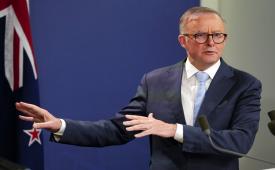
An ‘agreement’ may be a synonym for a ‘pact’, ‘alliance’ or ‘arrangement’ in casual talk, but it’s not a formal ‘treaty’, whatever Anthony Albanese suggested in a joint media statement on Tuesday.  (20 Aug).

Treaties around the world are big time, the most notable being the North Atlantic Treaty Organisation, a military alliance of 32 states founded in 1949. Members agree to defend each other against attacks by third parties. 

The ANZUS Treaty with the US has been our supposed defence bedrock since 1952.

Staged bonhomie is essential in diplomacy - and collaboration better than confrontation. Unfortunately in our dealings with Indonesia straight talk is the casualty.

The PM's office calling Prabowo 'HE General (rtd)' may be polite but untrue. The career soldier was cashiered in 1998 for disobeying orders, then fled into exile in Jordan for seven years.  

Men under his control were allegedly involved in the disappearance of activist students.  Their families have staged Aksi Kamisan (Thursday action) demonstrations outside the Presidential palace in Jakarta every week since 2007 wanting to know what happened to their sons.

Prabowo's record as a commander in East Timor last century is allegedly grim.


Australian researcher Pat Walsh, who was involved in the new nation's Reconciliation Commission (CAVR) has called Prabowo  ”a person with demonstrated disregard for the rule of law, of both the domestic and international kind, and regarded by many as a war criminal.”

Prabowo denies wrongdoing and has never been charged in court. He becomes president in October having decisively won (58 per cent) of the February election.

Understandably, Australian ministers dealing with the world's fourth-largest nation with a population eleven times bigger prefer to dodge historical facts and sell out upholders of human rights.

Before the Tuesday announcement Daniela Gavshon, the local director at Human Rights Watch wrote that Australian government leaders should “raise concerns about the deteriorating human rights situation in the Indonesian provinces of West Papua”.  

She alleged “ongoing abuses against indigenous Papuans include killings, enforced disappearances, torture, and mass displacement of people.”

According to four Australian academics including a former AFP investigator, "hundreds of thousands" have died since 1965 when Indonesia took over the territory.

There's no indication HR issues have ever been discussed during the negotiations.  Though the final text hasn't been released The Australian gave the show a page one paean, imagined multiple benefits, hinted China was a  common threat and  praised all participants.  

Prabowo would be delighted getting homeland-style  treatment in  a nation with a media reputation for tough reporting.

It's understood one article in the agreement bans Australian support, participation or encouragement in activities "including separatism".

There's no mention of West Papua but this is what the words are about - effectively gagging any Australian government from voicing distress and lobbying for resolution.

Far from being outraged Minister Marles has embraced the ban.  In February in Jakarta, he said:

 “There’s no support for any independence movements … we support the territorial sovereignty of Indonesia and that includes those provinces being part of Indonesia, no ifs, no buts, and I want to be clear about that.”

This week’s announcement dubbed by the ABC as an  "upgraded defence agreement",  hardly seems worth bedecking the halls. Yet the PM called it  "the deepest, the most significant agreement that our two countries have ever made."

 Marles likes the adverb ‘profoundly’ using it twice to describe the dealings.

The Australians' glee was not reflected in Prabowo's comments or demeanour. The best he could manage  was to call the deal a “good neighbour relationship.”

Instead, he spoke about the Olympics and illegal drugs,  notably  hosing down his host's ardour and extinguishing any hints of policy change:

"As you know we are, by tradition, non-aligned. By tradition, our people do not want us to be involved in any geopolitical or military alliances or groupings. I myself am determined to continue this policy."

While Albanese and Marles used ‘security’ to spruik the agreement as a defence deal, Prabowo only spoke of  ‘food security’.  No ’treaty’ on his lips, only Albanese’s:

“This historic treaty will bolster our strong defence cooperation by deepening dialogue, strengthening interoperability and enhancing practical arrangements.”

Using the term suggests that the local deal comes  within Coo-ee of NATO or ANZUS.  That’s ridiculous.  There's no suggestion we'll dash into the archipelago to help should anyone invade, or the other way around.

So what’s going to happen?   The PM again: “It will be a vital plank for our two countries to support each other's security, which is vital to both countries, but also to the stability of the region that we share.”

The best interpretation is that the Australian military will continue joint exercises with its Indonesian counterpart (the TNI) currently busy in West Papua.

 Indonesian HRW researcher Andreas Harsono told Michael West Media that any bilateral agreement  should include  defending the rights of all people:

 “I guess Indonesian officers will not be happy if Australian soldiers, involved in atrocities in Afghanistan are to take part in a military training program in Jakarta.

“Vice versa. Australian officers might not feel comfortable to train with abusive Indonesian soldiers who tortured indigenous Papuans.”

It hasn’t all been one-sided: This month guerrillas allegedly killed Kiwi chopper pilot Glen Conning; he was flying for an Indonesian company ferrying local health workers into a remote region.  The six passengers were reportedly unharmed.

Another NZ pilot Phillip Mehrtens was seized early last year by the  West Papua National Liberation Army.  He's reportedly alive and being held hostage.  The rebel group denies murdering Conning and has hinted at military involvement.

The PM said the agreement will see us working together in the global commons to support the rules-based order and, importantly, it will allow us to operate from each other's countries."

Though not West Papua.

First published in Michael West Media, 22 August 2024: https://michaelwest.com.au/when-is-a-treaty-not-a-treaty-the-marles-and-prabowo-canberra-love-in/


##


Thursday, August 11, 2022

THE ABC OF BAD BROADCASTING ABROAD


   A hodge-podge is not an international service


Abc Australia Network | Republika Online

As Opposition Leader touring overseas, Anthony Albanese probably clicked on ABC Australia TV to kill time.  If so his claim that ‘it’s a matter of national security that the ABC makes more content that projects Australian values and interests to the Indo-Pacific region’ sounds like despair driving action.

Albanese playing with the remote in an Indonesian hotel room would have been swamped with shame.  Channels from Britain, the US, Japan, South Korea, Qatar, France, Germany, Singapore, Russia and China – all with programmes showcasing their nations’ ‘identity, values and interests’ (the PM’s words), and doing so in quality English, sometimes with local captions.  Against this line-up Australia isn’t even in the pool.

The PM’s comments were made last week at the ABC's 90th anniversary shin-dig in Sydney.  According to the broadcaster he ‘reaffirmed Labor's previous funding commitments to restore $83.7 million … as well as five-year funding terms and options for financial sustainability which safeguard against political interference.’

This is a shaft at Julie Bishop, the former Foreign Minister who turned off the Australia Network (the predecessor to ABC Australia) in 2014 to the angst of many independent experts, because it ‘had failed to deliver a cost-effective vehicle’.  This followed a heavy artillery assault on the service by Murdoch media

She offered no facts to back the claim leading to the paranoid seeing revenge as Channel 7 once sought public money to go offshore. The then ABC managing director Mark Scott commented that the decision:

‘…runs counter to the approach adopted by the vast majority of G20 countries. Countries around the world are expanding their international broadcasting services as key instruments of public diplomacy.’

Because the ABC Charter forces it to be an international broadcaster the gap had to be filled. The result was Australia Plus now ABC Australia with an allowance of $20 million for three years.

Voice of America’s annual budget is $315 million, all from government funds. It broadcasts and telecasts in more than 40 languages, including Indonesian.

The French Government is reported to spend $169 million a year on France 24 while Russia’s RT channel is believed to get through $434 million every twelvemonth.  (All figures in Australian dollars). Much is propaganda (no balance in the Red channels) but so well packaged the messages are subtle and the pictures usually splendid.

Said Albanese this month: ‘On top of every other consideration, it (international broadcasting) is a prudent investment in our national security as well as our national interest … undervalued by the previous government, even trivialised.’  Reason having failed to move governments, China plonking transmitters around the zone has done the trick.

Labor calls its strategy a ‘strong Australian voice’ in the ‘Indo Pacific’.  But where is this wonderworld?   The term is beloved by politicians, economists and climatologists, though not ABC chair Ita Buttrose who uses ‘Asia Pacific’.

Either way this is a vast area and includes 48 countries, according to the US Transportation Department. They’re as disparate in culture, language, rule and drive as Mongolia is from Singapore, the only commonality being included in ellipses drawn by Western cartographers.

The last ABC annual report claimed ABC Australia is available ‘in more than 38 markets across Asia and the Pacific, and has a monthly viewership of at least 2,553,000.’  Whether these are regulars, or ten second tries-and-goodbyes isn’t known.  Note ‘markets’ not nations.

This is a one-size-fits-all approach.  Business experts say products must be designed for consumers for top sales.  So why telecast full AFL games on three days a week to the democracy next door where all balls are round, and its 273 million citizens don’t care a damn whether Geelong will thrash St Kilda.

ABC Australia programmes are shunted and shifted without notice. A presenter tells what’s coming next - then something different appears. The channel’s Internet TV Guide is a misnomer; TV Guesser would be better.

 Nat Geo docos are subtitled in Indonesian.  Likewise the History Channel, Animal Planet, Discovery, BBC Earth and many others, even crime and food programmes. Exceptions on ABC Australia include some one-off docos, a few science and art shows and the worthy Books that Made Us opening the pages on our culture. 

These translations are a welcome recent innovation – but costly if done well. Machine jobs are imperfect, particularly with slang and idioms, good for giggles, not grasp.

ABC Australia’s flagship is The World a one-hour news bulletin.  Despite its title the programme is padded with parochial yarns. Other news spots get State bulletins wrapped with a local weather forecast. The heat in Halls Creek and rain in Albany may excite viewers in these tiny towns, but get a WTF response in Surabaya and Makassar.

An estimated 64 million households in Indonesia have receivers, the highest saturation rate in Southeast Asia.  No focus-group surveys needed to show viewers want wholesome fare to suit their taste, not innutritious trolley-fillers.

In its 2019 report  A Missed Opportunity for Projecting Australia’s Soft Power the Lowy Institute claimed ‘international broadcasting is one of the most effective forms of public diplomacy, if managed properly…

 ‘Australia is explicitly competing for global and regional influence, yet Australia’s international broadcasting has been weakened through a combination of government inconsistency and neglect, ideology-driven decisions, budget cuts and apparent ABC management indifference.’

Extra money for the ABC is fine and dandy, but this isn’t all about dollars. Albanese’s drive for a meaningful service needs to swerve past managers who reckon any show with a roo and a beach will satisfy foreigners.

Maybe once. Not now.  Like the PM in a Hilton, viewers can click. Getting the turn-offs to turn on will need translations and curated programming by progressive producers who know the ‘market’ has matured.

[Some of this story is based on a two-part Pearls & Irritations 2020 report (here and here) which analysed the ABC’s international offerings.]

First published in Pearls & Irritations, 11 August 2022: https://johnmenadue.com/a-hodge-podge-is-not-an-international-service/


Friday, June 03, 2022

TRUST NEEDED - ON BOTH SIDES

          Dear Albo: Get to know the people next door.


 IN FULL: Anthony Albanese delivers victory speech after clinching win over  Coalition | ABC News - YouTube

On ABC TV’s The Insiders, the then opposition Leader Anthony Albanese said he planned to visit Indonesia ‘as soon as possible’ – a statement rapidly drowned in the mainstream media’s trite election coverage.  In 1994 when the then PM Paul Keating said ‘no country is more important to Australia than Indonesia’, the response was intense.

Why did journos think Albanese’s comments not newsworthy?  One sad answer is that like much of the electorate they take little interest in the adjacent nation unless it’s jailing blasphemers, flogging adulterers or doing something that jars values the West thinks important.

It’s been pointed out – though as far as I can see only in the foreign media  - that Albanese’s first overseas visit as Labor leader was to Indonesia in 2019, as was his first trip as a minister in 2007.

Indonesian politics are more about personalities than policies.  President Joko Widodo first won office through his signature blusukan walkabouts.  In 2015 he drove security details nuts when he took then PM Malcolm Turnbull on a meet-the-people market tour which set a friendly and casual tone, benefitting  both nations.

That’s unlikely to be repeated when Albanese gets to the Big Durian as Widodo’s minders are now more cautious about unscripted tours.  But the Australian would find his poverty- to- power story – which is similar to Widodo’s riverbank shack-to-presidential-palace upbringing - could have a wide impact if well told.  It would certainly help erase the belief that Ozzies are privileged rich prone to belittle.

While Australia yawns or tut-tuts at mentions of matters in the world’s third largest democracy, it’s much the same t’other side of the Arafura Sea.   Last century youngsters were hungry to learn English and other cultures.  Their appetite was met by enthusiastic teachers following a policy of raising a generation equipped to handle the world. 

Instead, the energy has bogged down in ideologies and bureaucracy notwithstanding the intentions of forward-thinkers like Harvard-educated Education Minister Nadiem Anwar Makarim. He’s a 37-year old entrepreneur drafted by President Joko Widodo to shake up schooling, only to collide with the power of reactionaries seeing secularism behind reform.

 Monash Uni has already opened a postgrad campus in Jakarta. If the new Federal Government can back other ventures, preferably at high school and undergrad level and away from the capital, people would get to discover we’re not all Kuta hoons.

ANU-educated Indonesian Ambassador Dr Siswo Pramono (above) has been in Perth  promoting understanding and trust between the neighbours.. Photo:  Erlinawati Graham


Distrust of Western ways and Australian intentions is pervasive so all the more reason to try harder.  That doesn’t seem to be on new Ambassador Penny Williams’ agenda.  Despite knowing the language and past involvement in progressive causes (she’s a former Ambassador for Women and Girls) the lady has yet to make a splash. Since the start of this year she’s put out only ten press statements, mostly on trivial matters, and nothing on the election.

Apart from a tweet from Makassar, it appears she didn’t recognise Australia Day through any speeches or mainstream media.  (Her office hasn’t responded to a request for details.) Here was a chance to tell how Australian unions helped the revolutionaries liberate Indonesia from the colonial Dutch.  It’s a forgotten story for this century’s generation, so needs continuous retelling.


Here’s a job for Albanese if and when he reaches Jakarta and wants to remind the post 1945 Revolution generation that we were on their side.

If that’s currently considered too political for Canberra, Albanese should urge Williams to stress that her nation’s not a British franchise as many think because the Union Jack’s on our flag and the Queen’s image on our currency.

Nor are we the US ‘deputy sheriff’ in the region as former PM John Howard reportedly said.  The offensive tag remains fresh because Australia supported the East Timor referendum in 1999.  We can be proud of our initiatives and peacekeeping, and our billion-dollar aid when the 2004 tsunami ripped Aceh, but that doesn’t mean we’re loved.

For Indonesians, the Unitary State is sacrosanct so the loss of the Portuguese territory it invaded in 1976 has left a deep and weeping wound.  That’s not the only irritant.

Some argue the AUKUS alliance and build-up of foreign troops and weaponry in Northern Australia are ‘too close for comfort’ and could trigger an arms race. These alarms have been addressed, though only lightly.  Another task for Albanese.

Instead of explanation and education, we use trade to find ‘not just a respected partner but a valued one as well’. Former Agriculture Minister David Littleproud’s spiel was monetary: ‘Indonesia is Australia’s fourth-largest market for bulk primary produce … valued at $2.9 billion (last financial) year.’ 

The new PM’s message should be: We don’t just want to feed you, we want to know you.  We’ll listen, not tell.  We’ll talk with you, not at you. Albanese seems to understand this if his quotes are sincere. Before 21 May he said it was important to grow the relationship with a ‘future superpower’.

Despite Covid killing close to 157,000 and infecting six million (Reuters’ figures from official sources and widely considered too low) the Indonesian economy is going gangbusters.

The World Bank's Global Economic Prospects forecasts growth this year will hit 5.2 per cent, but there’ll be minimal trickle-down. Oxfam research shows the four richest men in Indonesia own as much wealth as the country’s poorest 100 million citizens.

Attitudes on both sides need renovating. Just as Australians can be racists, Indonesians aren’t always the pliant friendly folk of tourist brochures. In 1965 a bloody coup in Jakarta was followed by the slaughter of an estimated 500,000 real or imagined Communists and fellow travellers by civilian militias weaponised by the army.

We know of the Holocaust in Europe though not the genocide close by.

There have been other outbursts of violence, often focussing on minorities.  Ethnic Chinese are usually the targets along with so-called deviant Islamic sects.

Another eruption of hate could send a wave of asylum seekers heading our way as they did after the 1998 riots when President Soeharto quit, though they’d most likely come by plane, have full wallets and follow faiths other than Islam.

To ensure a benign view of the people next door, this distressing history is blacked out in Australia by the ‘moderate Muslim’ label. Likewise, the termites of corruption gnaw away in almost every departmental nook and immune to pest controllers. 

The first stage in fixing problems is to accept their presence and examine the reasons.  To date neither Indonesia nor Australia has been inclined to confront ignorance, misunderstanding and distrust which threaten the connections.   If Albanese really is a skilled negotiator he needs to be well briefed by experts outside the ultra-cautious DFAT club, offer friendship but be frank.

They’ll be a wake up when there’s an explosion of fury for some seemingly mild political stumble, like Scott Morrison’s 2019 proposal to move our embassy from Tel Aviv to Jerusalem.  Mobs protested in Indonesia, forcing the closure of two consulates.

Friction points include the low-level insurgency between West Papuan separatists and the Indonesian military, hidden from world view by Jakarta censorship equal to the Chinese cover-up of its alleged anti-Uyghur campaign.

The late Australian Professor Jamie Mackie wrote:The first and most dangerous of the problems ahead — and possibly the most likely — are issues relating to separatist movements in Papua
and the support they garner within Australia.

‘This tends to arouse suspicions in Indonesia that Australians have a hidden agenda to bring
about the dismemberment of Indonesia as a unitary state. Because of the complex, emotionally charged political dynamics within each country associated with this, it could easily get out of hand and prove difficult for both governments to resolve through calm negotiations.

Better to use the spruce up the relationship now than wait till what remains collapses into misunderstandings and ill will.  The next Presidential direct election will be on 14 February 2024 and there’s a chance former General Prabowo Subianto, who’ll then be 72, will have his third crack at the top job.

Prabowo is Indonesia’s Trump lite who’d ignite the wrath of human rights activists worldwide if elected. After his 2019 loss supporters rioted in Jakarta. Eight died and more than 700 were injured. Few think the violence was spontaneous.

Prabowo is now Minister of Defence, drawn into the inner circle by  Widodo who followed US President Lyndon Johnson’s advice on handling FBI Director J Edgar Hoover: ‘It’s probably better to have him inside the tent pissing out, than outside the tent pissing in’.


Australian academics have been quick to offer advice.  Some has been sound like this offering from Professor Rebecca Strating of La Trobe Uni warning that ‘the new government also needs to listen to Southeast Asian perspectives. States like Indonesia don’t want to be forced to make a choice between US and China.


‘Engaging with Indonesia requires creative, nuanced and modulated diplomacy. Sensitivity around sovereignty, autonomy and regional security is key.’ 

All fine and dandy, but these are elite issues which make little impact on the poor and struggling in a nation of more than 273 million. A decade ago Transparency International’s Corruption Perception Index ranked Indonesia 96 among 179 nations.  Its position now is 102.  This frightens the Western investors Widodo says he wants to attract.

All the more reason to get to know the neighbours at all levels.  Mackie offered scores of suggestions in his 155-page Lowy essay – a useful guide for PM Albanese and FM Penny Wong,


First published in Pearls & Irritations, 3 June 2022:  https://johnmenadue.com/how-a-labor-government-could-revamp-our-relationship-with-indonesia/