
The Omnibus has changed routes
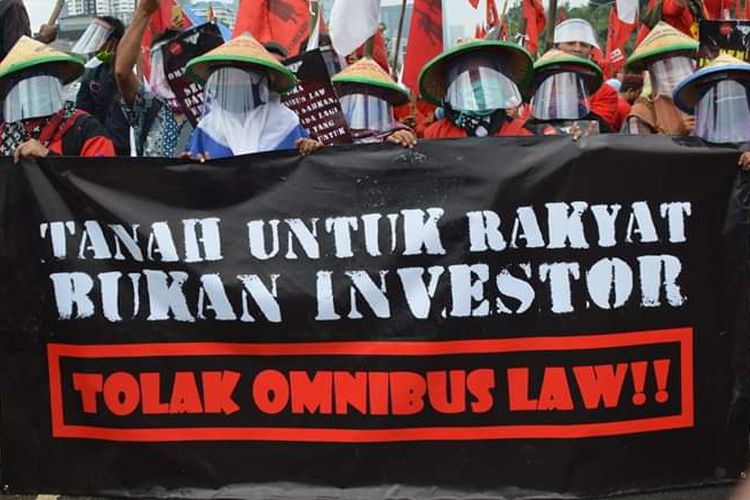
Image: Kompas
In an unexpected win, Indonesian labour unions’ protests against new laws corroding workers’ rights have been trounced by the Mahkamah Konstitusi (MK) Constitutional Court. But the ruling also threatens the government’s hopes to make the Republic a safe place for venture capital.
----------------------------------------------------------------------------------------------------------------------
A year ago academics were labelling the passing of President Joko Widodo’s signature legislation on employment and administrative reform as his ‘political dream come true’. Now he’s scrambling to reassure that the court’s unappealable decision doesn’t mean international lenders should scrub the archipelago off lists of places to park their money.
The Omnibus Law, named because it puts many laws in the same carriage, raced through the Dewan Perwakilan Rakyat (DPR-People's Representative Council) in eight months last year making no stops to pick up workers and greenies waving placards and fists on kerbsides across the nation.
The name above the windscreen read Undang-Undang Cipta Kerja (Job Creation Law). It was furiously driven by Widodo determined to reach his goal of business and workplace reform by scrapping 43,000 regulations on hiring and firing which were said to be roadblocks frightening overseas bankers.
The government predicted the changes would deliver three million jobs for school-leavers and graduates, plus six million for those who have lost work through the pandemic. No sources for these calculations were revealed.
Widodo has long complained that his country’s ranking in the World Bank's Ease of Doing Business Index has stuck in the 70s – far from his aim for position 40. (Singapore =2, Malaysia and Australia = 14.)
Unions argued the law slashed job severance pay-outs and crushed wage increases. As in Australia, the shift to the gig economy is generally welcomed by the top end of town because it gives more space to hire and fire.

Image: Beritakini
Environmentalists complained that impact studies on mines and land clearing for oil-palm plantations would be restricted to major projects allowing smaller development proposals to avoid scrutiny.
Before the new law was signed sacked workers got 32 months’ salary – that was cut to 19 months. The minimum wage also vanished.
Omnibus allowed wages to be linked to business productivity, not the employees’ education, skills and years of service. Holidays were cut from two days a week to one; long-service paid leave was also farewelled.
Big business labelled the changes a ‘breakthrough’ for shredding Indonesia’s notorious red-tape blockages, clearing the way for an online single submission licensing system. However, they were worried the rush meant many route details hadn’t been well considered. Four different drafts, varying from 812 pages through to 1,035, were circulated.
The government promised to make repairs along the way but didn’t imagine being pulled over by nine robed judges. They said the drafting process was handled badly because the Constitution doesn’t recognise an Omnibus Law, particularly one driven over the limit. It ignored well-established rules on making new laws and regulations, nor did it give time for outside interests to get on board.
Then a weird insertion: The DPR must start the lawmaking process again within two years otherwise all laws run over by the Omnibus will be reinstated. So although the new law is unconstitutional it stays in place.
Widodo told the media: ‘In a democratic nation that is based on the rule of law, the government respects and will immediately implement what has been ruled by the Constitutional Court
‘I have instructed the coordinating ministers and other related ministers to immediately follow up on the ruling as soon as possible… I assure you that the Government guarantees investment certainty and security in Indonesia.’
Coordinating Economic Minister Airlangga Hartarto reinforced the President’s position by explaining the court’s decision didn’t nullify regulations made before the MK ruling.
So four special economic zones, which have apparently attracted commitments to invest Rp 90 trillion (AUD 8.6 billion) will still go ahead. Almost 400,000 licenses issued under a law deemed a crock by the highest legal authority in the land will still be honoured.
Singapore-based Australian lawyer Bill Sullivan has written that the Omnibus Law had been presented to the world as Widodo’s plan to boost recovery from the economic crisis triggered by the pandemic through encouraging more foreign investment.
He fears it’s now a public relations disaster revealing a government ‘so careless and, frankly, inept’ that it didn’t bother to follow proper law-making procedures:
‘The next two years is likely to be a difficult time for Indonesia as the government desperately tries to convince investors that they don’t have any reason to doubt the continuity of the Job Creation Law’s reforms much less the competency of the government in providing a reliable legal, policy and regulatory environment.’
There is a plus - the MK has shown a streak of independence. The unions were pessimistic of their chances, expecting the court to back the government. Their success has been applauded by the International Trade Union Confederation.
The mess could be the result of Widodo getting too impatient and cocky, losing touch with his worker base – as Indonesians say, kacang lupa kulit (the peanut has forgotten its shell). After his second win in the 2019 presidential elections, he built a coalition of parties to neutralise opposition. Some academics reckon this ‘appears to his critics to have made him beholden to business interests, especially those businesses owned by members of his own inner circle’.
From now till late 2023 the Republic has a conditionally unconstitutional law. Investors seeking certainty won’t find it in Indonesia.
##
First published in Australian Outlook, 3 December 2021: https://www.internationalaffairs.org.au/australianoutlook/the-omnibus-has-changed-routes/
