YONDER COMES THE GOLDEN DAWN –
A HAPPY FUTURE FREE OF PORN © Duncan Graham 2006
Observers say that if the anti-pornography bill becomes law it’s going to have a major impact on society. Too right.
There’ll be change aplenty – and all positive! Balinese painters, film flunkies, alleged artists and other self-promoting naysayers should just butt out.
The benefits will outweigh the negatives. In the future we’ll applaud the far-sighted visionaries who thought up this most essential legislation.
Think positive. Look ahead to the New Indonesia:
· No more skin cancer, but extra aid. The thousands of young Australians who’ve flopped on Sanur’s sands in monokinis are now quivering on dermatologist’s examination couches. Our big neighbor is the carcinoma centre of the known world. But no more. Keeping clothed in Kuta will save generations to come from a nasty disease. A grateful Australia will reward us with even more aid to milk.
· Productivity will soar. Statistics show Indonesian workers are far less efficient than their counterparts in the region. This is because they’re regularly distracted by the sight of female flesh. It’s widely known that Indonesian men never think of sex unless reminded by women, so they’ll now be able to keep their minds on the job.
· Meetings will have real outcomes. In the past much round table discussion has been involved with navel gazing. With belly-buttons banned important gatherings will make clear decisions with follow-throughs leading to measurable results.
· The young will become more articulate. Sinetron scripts have been largely wordless as actors rely on body language to show emotions. No more panting cleavage to exhibit desire. Instead she’ll say: “I think you’re a personable young man. I’d like my parents to meet your parents to check whether you’d make a suitable life partner.” Inevitably high school kids will follow suit and we’ll understand what they’re talking about.
· Boost to tourism. Globalisation is a bore. Everywhere is the same – novelty’s dead. But not in the New Indonesia. Come to the lush and lovely tropics and share the locals’ experience. Go fully clothed to the beach – it really is great fun and you’ll sweat away kilos! Try doing that in Penang or Phuket – they’ll laugh you off the foreshore.
· The fashion industry will bloom. Let’s face it – there’s not much to designing swimwear. How many variations are there on a theme of three triangles? But our smart young things now in technical colleges will turn their skills to top-to-toe outfits – outdoor wear the modern liberated woman must have to express her personality.
· Advertising will go cerebral. Layout artists won’t be able to drape cheeky bottle-blondes over the bonnet to sell a car. Copywriters will have to provide the vehicle’s statistics, not hers: “This model has two nicely rounded D size headlamps and a smooth 120 centimetre big end.”
· Getting stability back into marriage. Why is the divorce rate so high? Because couples get bored. They’ve seen it all long before the betrothals. But imagine a wedding night of real discovery and the start of lifetime learning. “Darling, what on earth is that? Is it some sort of growth – are you all right?”
· Investors will return in Airbusses packed like bemo. Travel warnings will cease. Armed with the certainty that there’ll be no more demonstrations because there’ll be nothing left to complain about, overseas cash will flow in a torrent. Labourers will stay at their lathes, seamstresses at their spindles. A placid workforce makes for a happy factory and profits to repatriate. Expect more Saudi riyals – and not just to erect minarets.
· Jobs for all. It took decades to build Borobudur – and it’ll take just as long to demolish all those obscene carvings. In its place the State will commission magnificent bas-reliefs from our most imaginative stonemasons. These carvings will celebrate modern Indonesia through the everyday lives of its citizens striving for a better future. The poor denied entry to schools. Workers in feudal sweatshops. The sick dying for want of care. Men hewing timber from protected forests. Women drawing water from polluted wells. Future generations viewing this monumental tribute will marvel at our industry and ask each other: “How did such a society get its priorities so right?”
(First published in The Sunday Post 12 March 2006)
">Link
FAITH IN INDONESIA

The shape of the world a generation from now will be influenced far more by how we communicate the values of our society to others than by military or diplomatic superiority. William Fulbright, 1964
Sunday, March 12, 2006


MUNIR'S WIDOW FIGHTS ON
Suciwati: Fighting for justice and end to impunity
Duncan Graham (c) 2006
Before sociologists and grief counselors got hold of the word, "closure" meant keeping the door shut. Now it refers to the absence of a corpse, unresolved disputes about cause of death, the mystery of a sudden fatality.
And the reason.
And the perpetrator.
Suciwati does not have closure. Maybe she never will. That's not through any lack of energy or dilution of purpose. The widow of slain human rights activist Munir Said Thalib isn't short of determination and drive; but she knows time erodes all things, including memories and campaigns for justice.
One man has been convicted of her husband's murder and is now serving 14 years in jail. A crime has been committed, a criminal found. The gavel has banged down, the file slammed shut.
The story seems to have run its course. It's time to move on to other things.
"I have to keep going to honor the spirit of my husband and so the truth will be revealed," she told The Sunday Post at her home in the hill town of Batu in East Java.
"This is not about revenge, it's about justice. My hope is that the law in Indonesia will be upheld and that there is no impunity for criminals, whatever their rank and contacts. The rule of law must be returned to our country."
But unless there are new and startling revelations Munir's death will slowly slip down the news lists. An issue which once made page one headlines will become a one-paragraph filler on a slow news day, then disappear altogether as other scandals eclipse the murder.
This is not an Indonesian disease; it happens everywhere unless there's a tireless crusader with credibility prepared to keep going where others falter, to put out the statements, to make the speeches, to lobby the influential.
To maintain the rage. To stay focused.
Even when editors spike the stories because they've read them all before, when only the converted come to the meetings to make up the numbers, and the politicians' minders say their bosses are too busy.
Can Suciwati keep going? She's 37 and looks older. Friendly, but cautious. Modest but frank. A no-nonsense woman but not so tough that she's lost her femininity. On the wall just a big photo of Mecca and an ocean of pilgrims. No photos or press clippings, Arabic calligraphy or stirring exhortations from Nelson Mandela in an attempt to display commitment by association.
Understatements everywhere.
She greeted this paper politely in a tracksuit and without makeup, dispensing with the elaborate rituals of a Javanese hostess as though she's been mixing with too many foreigners and their casual-but-serious style has rubbed off. Or that she realizes formal rites are superficial and superfluous; they get in the way of important talk.
The strategy now is to keep up the pressure on the government. She has visited Europe and many countries in Asia to tell her story. She's been boosted by the support of 70 U.S. Congress members who have urged the Indonesian government to uncover the plot -- but knows American backing carries little political clout since the invasion of Iraq.
Some commentators claim resolution of the Munir case is the acid test for the Indonesian government and its commitment to justice. But this is unfair. No administration can be judged by a single case in a country as complex as Indonesia.
It would be great to say Suciwati is still just as resolved as she was in September 2004. That was when she learned that her husband of eight years had been poisoned with arsenic on a Garuda flight heading for Holland.
But her eyes say this is just the beginning and the road ahead may be even harder and longer than the one she's already trod.
When the poisoning was proven she met President Susilo Bambang Yudhoyono. She said she found him sympathetic and concerned but bimbang, meaning indecisive. But he did agree to commissioning a fact-finding inquiry which has reported and been dissolved.
The upshot was Garuda pilot Pollycarpus Budihari Priyanto has been convicted of premeditated murder.
So now it's time for closure.
Not so. Suciwati is tired, but restless. The full report has not been released. Like her colleagues in the NGOs she believes Pollycarpus was just the agent of her husband's death and that other more powerful and sinister figures masterminded the assassination. She believes they are linked to BIN, the state intelligence agency and seemingly a law unto itself.
She has two small and hyperactive children who demand her time. Like her they seem more Western than Javanese. They don't know why Dad's not coming home or why Mom should always be talking to adult strangers and not competing with them on PlayStation. Caring for them is her priority.
She has to live in two places, Jakarta where she works part time as a secretary, and in the middle-class family home in Batu where she has responsibilities for an aging parent.
But she is in demand for speaking engagements in Indonesia and abroad, deputations and demonstrations. Like it or not, she is the public face of the campaign and if she falters, so will others.
They are in a war of attrition against a mighty opponent with limitless resources and countless tricks to delay and divert: The faceless State.
And if she is a continuing success her life may be in danger. Like her late husband.
The package of severed chicken heads delivered after her husband's death with a warning not to implicate the military was well publicized. Not known is that she was recently the victim of a hit-and-run while out on her red motorcycle and believes this was another threat to add to the SMS messages.
Westerners are regularly warned about terrorism and the possibility of kidnapping. Senior politicians fear assassination and have been given extra security.
But the one person who seems most at risk is unprotected.
She sits with her back to an open window. Only three meters separate the house from a major road. Into this space a bomb was lobbed when her husband was still alive.
The front door is open, and so is the gate. People wander in and out, unchallenged, including a man in a full-face helmet. Suciwati is determined not to become a prisoner or be silenced. "My life and future are in God's hands," she said. "Everything is in God's plan."
Even the killing of her husband? "Everything."
If she'd rushed into a retreat and disappeared from public life no reasonable person could have laid blame. Kontras (the Commission for Missing Persons and Victims of Violence, established by Munir in 1998) has plenty of smart activists prosecuting the cause with vigor. In practical terms she doesn't need to be on the front line.
But in issues like this the public wants a face, an ordinary individual they can relate to as an aggrieved fellow human being. They do not want a distant spokesperson for a complex organization discussing abstract concepts.
The former teacher who was educated at the Malang IKIP (Teachers Training College) was once a labor unionist pushing for higher wages for workers. This brought her to Munir's attention in 1991. But after becoming a wife and mother she saw her role as supporting her husband and family.
"We were a partnership," she said. "Although I come from a traditional Muslim family we were a modern couple, respecting each other. There were no gender issues."
In India, Sonia Gandhi became the reluctant politician after her husband Rajiv's assassination in 1991 defying demands that she return to her home in Italy and keep out of Indian affairs.
Suciwati is in the same mold. She doesn't hanker for status and recognition, but she's now the internationally known figure representing Indonesia's awful record on human rights.
Every time she appears in public the world remembers that Indonesia may be a fresh new democracy but sinister forces are busily killing, maiming, destroying and destabilizing the government. A wise administration would back her cause to fruition, if only to keep this meddlesome woman silent and shut up the shame.
"Munir was never stopped by threats," Suciwati said. "Danger is everywhere. I get many messages of support and sympathy. Sometimes not strong. I chose the domestic life, but now I have this other responsibility.
"If you are human, then you must be afraid. But God has a plan for me and I must follow it."
(sidebar)
Dangerous activism
Munir was born in 1966 in Batu, East Java. He trained as a lawyer and started work in Surabaya with a legal aid office. He soon made a name for himself defending victims of abuses by government and business.
In particular he criticized the military and police for their treatment of labor activists and their behavior in Aceh and East Timor.
In 1998 he started Kontras in Jakarta and won several international awards for his promotion of human rights.
Despite controls on the media during the New Order government of former president Soeharto, Munir soon became a famous face on television and newspapers because he was always prepared to speak out. There were plenty of threats and physical violence, culminating in the trashing of the Kontras office in 2003 by a mob of thugs.
Many found this curious as the fall of Soeharto had introduced a new era of open discussion. The political power of the military had been diluted, and people felt more relaxed about criticizing authority.
However Munir and his colleagues were also prying into issues of corruption involving big business and government agencies. Clearly they had made some powerful enemies.
A major problem for the credibility of NGOs in Indonesia is that most are subsidized by foreign funds and consequently open to the charge that they are running agendas set by overseas agencies.
By 2004 Munir felt he was in need of a break and set off to a university in Utrecht. He told friends at the time: "I want to take a rest, to study again and to reflect."
He died on board Garuda flight GA 974 on Sept. 7, two hours from his destination. An autopsy in Holland revealed 456 milligrams of arsenic in his body, three times the lethal dose.
(Pic caption above: Suciwati at home in Batu with Diva Syuki, 3, and Alif Allende, 7)
(First published in The Sunday Post 12 March 2006)
">Link
Duncan Graham (c) 2006
Before sociologists and grief counselors got hold of the word, "closure" meant keeping the door shut. Now it refers to the absence of a corpse, unresolved disputes about cause of death, the mystery of a sudden fatality.
And the reason.
And the perpetrator.
Suciwati does not have closure. Maybe she never will. That's not through any lack of energy or dilution of purpose. The widow of slain human rights activist Munir Said Thalib isn't short of determination and drive; but she knows time erodes all things, including memories and campaigns for justice.
One man has been convicted of her husband's murder and is now serving 14 years in jail. A crime has been committed, a criminal found. The gavel has banged down, the file slammed shut.
The story seems to have run its course. It's time to move on to other things.
"I have to keep going to honor the spirit of my husband and so the truth will be revealed," she told The Sunday Post at her home in the hill town of Batu in East Java.
"This is not about revenge, it's about justice. My hope is that the law in Indonesia will be upheld and that there is no impunity for criminals, whatever their rank and contacts. The rule of law must be returned to our country."
But unless there are new and startling revelations Munir's death will slowly slip down the news lists. An issue which once made page one headlines will become a one-paragraph filler on a slow news day, then disappear altogether as other scandals eclipse the murder.
This is not an Indonesian disease; it happens everywhere unless there's a tireless crusader with credibility prepared to keep going where others falter, to put out the statements, to make the speeches, to lobby the influential.
To maintain the rage. To stay focused.
Even when editors spike the stories because they've read them all before, when only the converted come to the meetings to make up the numbers, and the politicians' minders say their bosses are too busy.
Can Suciwati keep going? She's 37 and looks older. Friendly, but cautious. Modest but frank. A no-nonsense woman but not so tough that she's lost her femininity. On the wall just a big photo of Mecca and an ocean of pilgrims. No photos or press clippings, Arabic calligraphy or stirring exhortations from Nelson Mandela in an attempt to display commitment by association.
Understatements everywhere.
She greeted this paper politely in a tracksuit and without makeup, dispensing with the elaborate rituals of a Javanese hostess as though she's been mixing with too many foreigners and their casual-but-serious style has rubbed off. Or that she realizes formal rites are superficial and superfluous; they get in the way of important talk.
The strategy now is to keep up the pressure on the government. She has visited Europe and many countries in Asia to tell her story. She's been boosted by the support of 70 U.S. Congress members who have urged the Indonesian government to uncover the plot -- but knows American backing carries little political clout since the invasion of Iraq.
Some commentators claim resolution of the Munir case is the acid test for the Indonesian government and its commitment to justice. But this is unfair. No administration can be judged by a single case in a country as complex as Indonesia.
It would be great to say Suciwati is still just as resolved as she was in September 2004. That was when she learned that her husband of eight years had been poisoned with arsenic on a Garuda flight heading for Holland.
But her eyes say this is just the beginning and the road ahead may be even harder and longer than the one she's already trod.
When the poisoning was proven she met President Susilo Bambang Yudhoyono. She said she found him sympathetic and concerned but bimbang, meaning indecisive. But he did agree to commissioning a fact-finding inquiry which has reported and been dissolved.
The upshot was Garuda pilot Pollycarpus Budihari Priyanto has been convicted of premeditated murder.
So now it's time for closure.
Not so. Suciwati is tired, but restless. The full report has not been released. Like her colleagues in the NGOs she believes Pollycarpus was just the agent of her husband's death and that other more powerful and sinister figures masterminded the assassination. She believes they are linked to BIN, the state intelligence agency and seemingly a law unto itself.
She has two small and hyperactive children who demand her time. Like her they seem more Western than Javanese. They don't know why Dad's not coming home or why Mom should always be talking to adult strangers and not competing with them on PlayStation. Caring for them is her priority.
She has to live in two places, Jakarta where she works part time as a secretary, and in the middle-class family home in Batu where she has responsibilities for an aging parent.
But she is in demand for speaking engagements in Indonesia and abroad, deputations and demonstrations. Like it or not, she is the public face of the campaign and if she falters, so will others.
They are in a war of attrition against a mighty opponent with limitless resources and countless tricks to delay and divert: The faceless State.
And if she is a continuing success her life may be in danger. Like her late husband.
The package of severed chicken heads delivered after her husband's death with a warning not to implicate the military was well publicized. Not known is that she was recently the victim of a hit-and-run while out on her red motorcycle and believes this was another threat to add to the SMS messages.
Westerners are regularly warned about terrorism and the possibility of kidnapping. Senior politicians fear assassination and have been given extra security.
But the one person who seems most at risk is unprotected.
She sits with her back to an open window. Only three meters separate the house from a major road. Into this space a bomb was lobbed when her husband was still alive.
The front door is open, and so is the gate. People wander in and out, unchallenged, including a man in a full-face helmet. Suciwati is determined not to become a prisoner or be silenced. "My life and future are in God's hands," she said. "Everything is in God's plan."
Even the killing of her husband? "Everything."
If she'd rushed into a retreat and disappeared from public life no reasonable person could have laid blame. Kontras (the Commission for Missing Persons and Victims of Violence, established by Munir in 1998) has plenty of smart activists prosecuting the cause with vigor. In practical terms she doesn't need to be on the front line.
But in issues like this the public wants a face, an ordinary individual they can relate to as an aggrieved fellow human being. They do not want a distant spokesperson for a complex organization discussing abstract concepts.
The former teacher who was educated at the Malang IKIP (Teachers Training College) was once a labor unionist pushing for higher wages for workers. This brought her to Munir's attention in 1991. But after becoming a wife and mother she saw her role as supporting her husband and family.
"We were a partnership," she said. "Although I come from a traditional Muslim family we were a modern couple, respecting each other. There were no gender issues."
In India, Sonia Gandhi became the reluctant politician after her husband Rajiv's assassination in 1991 defying demands that she return to her home in Italy and keep out of Indian affairs.
Suciwati is in the same mold. She doesn't hanker for status and recognition, but she's now the internationally known figure representing Indonesia's awful record on human rights.
Every time she appears in public the world remembers that Indonesia may be a fresh new democracy but sinister forces are busily killing, maiming, destroying and destabilizing the government. A wise administration would back her cause to fruition, if only to keep this meddlesome woman silent and shut up the shame.
"Munir was never stopped by threats," Suciwati said. "Danger is everywhere. I get many messages of support and sympathy. Sometimes not strong. I chose the domestic life, but now I have this other responsibility.
"If you are human, then you must be afraid. But God has a plan for me and I must follow it."
(sidebar)
Dangerous activism
Munir was born in 1966 in Batu, East Java. He trained as a lawyer and started work in Surabaya with a legal aid office. He soon made a name for himself defending victims of abuses by government and business.
In particular he criticized the military and police for their treatment of labor activists and their behavior in Aceh and East Timor.
In 1998 he started Kontras in Jakarta and won several international awards for his promotion of human rights.
Despite controls on the media during the New Order government of former president Soeharto, Munir soon became a famous face on television and newspapers because he was always prepared to speak out. There were plenty of threats and physical violence, culminating in the trashing of the Kontras office in 2003 by a mob of thugs.
Many found this curious as the fall of Soeharto had introduced a new era of open discussion. The political power of the military had been diluted, and people felt more relaxed about criticizing authority.
However Munir and his colleagues were also prying into issues of corruption involving big business and government agencies. Clearly they had made some powerful enemies.
A major problem for the credibility of NGOs in Indonesia is that most are subsidized by foreign funds and consequently open to the charge that they are running agendas set by overseas agencies.
By 2004 Munir felt he was in need of a break and set off to a university in Utrecht. He told friends at the time: "I want to take a rest, to study again and to reflect."
He died on board Garuda flight GA 974 on Sept. 7, two hours from his destination. An autopsy in Holland revealed 456 milligrams of arsenic in his body, three times the lethal dose.
(Pic caption above: Suciwati at home in Batu with Diva Syuki, 3, and Alif Allende, 7)
(First published in The Sunday Post 12 March 2006)
">Link
Friday, March 10, 2006
INDONESIA'S DRUG WAR
HOW THE DRUG WAR IS BEING LOST © Duncan Graham 2006
The Battle of the Banners is underway in Surabaya and many other cities.
They scream SAY NO TO DRUGS. They’re part of Indonesia’s war against narcotics – a conflict doomed to fail according to experts. Duncan Graham reports:
Dony Agustinus is truly junkie tired, as the addicts say. Though he’s only 25 he carries his lean body like a man who’s long passed 40 and seen too much, crippled with the cares of the world.
Yet he hasn’t had a hit for almost five years. Since 6 June 2001 to be exact – nine years after he started. The reason? “To be cool”.
Like most reformed addicts he knows the precise moment he made the decision to quit. He’d just been diagnosed as HIV positive, probably through sharing dirty needles.
“I didn’t know anything about the disease,” he said. “I thought I had only six months left and I didn’t want to die. So I stopped.”
He’s lived to turn his corroding negative experiences into positive action by starting a drug rehabilitation centre in the hill town of Trawas outside Surabaya.
Wahana Kinasih was funded by Dony’s mother, Margarethna Nanik Sunarni. She stayed the distance with her son through the soul-scarifying years searching for a cure in Indonesia and overseas.
Medication, counselling, shock therapy, religion, brutality – Dony’s had them all. He knows more about drug addiction and failed treatments than a hall full of experts who’ve never felt the soaring thrill of a hit and the wrenching agony of withdrawal.
But he has to sit politely in drug conferences and listen to doctors, government workers, police and others tell addicts to pray feverishly, drink coconut milk, see a paranormal – or just decline.
“The SAY NO TO DRUGS campaign isn’t working for the same reason it didn’t work in Australia 20 years ago,” said Joyce Djaelani Gordon.
“It’s pushed by people who have limited understanding of substance abuse, addiction, social marketing and behavior change.
“If they’d done solid research they’d know the message ‘say no’ is translated as ‘do’. Basic psychology shows most people want to try what they’re told not to do.”
Joyce is a psychologist and founder of the Yayasan Harapan Permata Hati Kita (YAKITA) addiction and treatment centre at Ciawi, Bogor in West Java.
She works with her husband David, also a psychologist and former user, helping addicts. Their strategy is based on a psychological spiritual approach and the 12 steps Narcotics Anonymous program.
This has been built from the internationally famous and proven Alcoholics Anonymous strategy. This provides an instant aftercare program through regular confidential group meetings where experiences are shared.
NA supporters believe addiction is a disease. Users have to take responsibility for their actions and recognise a power greater than themselves. Treatment has to involve the family – often the root of the problem. The spiritual principle is: ‘Trust God, love yourself and help one another.’
Indonesian statistics, as former President Megawati Sukarnoputri once observed, are not to be trusted. Officially the police say they handled almost 6,000 drug cases in Jakarta last year and made almost 8,000 arrests.
The Jakarta Narcotics Agency reckons there are up to 15,000 injecting drug users in the capital alone. NGOs talk about a pandemic and say maybe a quarter of a million people around the archipelago already have HIV – with the number growing daily.
One study involving the National Narcotics Agency and the University of Indonesia claimed Indonesians are spending more than Rp 12 trillion ((US $ 1 billion) on drugs.
Whatever the real numbers no one denies there’s a serious problem. The disputes come over ways to treat it.
At one extreme is the roughhouse heavy-penalty approach. As the junkies say – “if your only tool is a hammer, you see every problem as a nail.”
When politicians announce ‘crackdowns’ and ‘tough stances’ they know they’re on a vote-winner. Electorates everywhere find the issue dirty and too difficult to unscramble. Druggies are not nice people. There’s little sympathy - until a family member becomes a user.
Then the awful education begins.
“Recovery is a long process,” said David Gordon. “There can be four, five or more relapses before an addict gets clean. Parents get tired, disgusted and depressed. They lose faith in ‘cures’ and grow wary of treatments.”
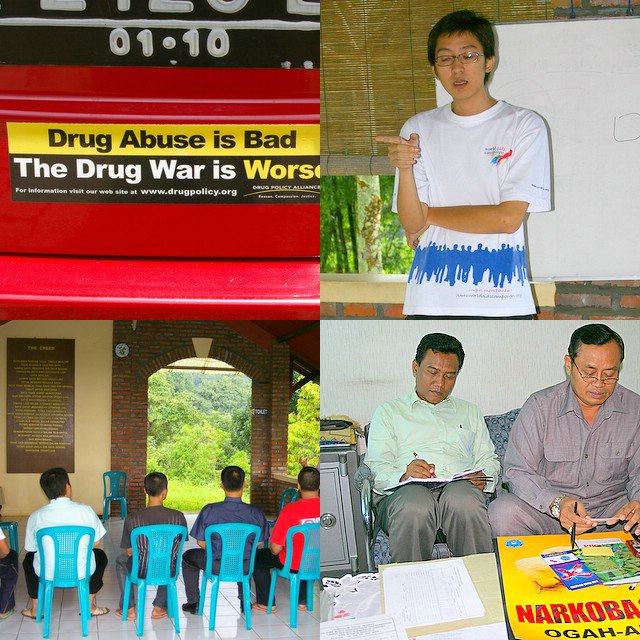
In 2001 then President Megawati declared a ‘war’ against drug trafficking to much acclaim. But despite his past experiences and present front-line commitment Dony refuses to be conscripted. The bumper sticker on his little red car reads: DRUG ABUSE IS BAD; THE DRUG WAR IS WORSE.
The US has been running its drug war for years. Millions of dollars have been spent and nearly 500,000 are behind bars for drug crimes. Yet drugs get cheaper and more readily available.
The US-based Drug Policy Alliance advocates public health alternatives to the criminal justice approach; this means treatment instead of jail for users. The Alliance says the war on drugs has become a war against public health, constitutional rights and families who suffer dreadfully when a breadwinner is jailed.
The reasoning runs that a war has a clearly defined enemy, while the drug issue is too complex for them-and-us, good-and-bad solutions. But like all snappy slogans the appeal lies in the mind-numbing simplicity.
We get warm fuzzies by sponsoring a SAY NO banner, even when it hangs alongside a slick ad promoting cigarettes – which many say is the gateway drug to narcotics.
Drugs have founded a major legal industry in Indonesia. The police, lawyers, jailors (50 per cent of prisoners have been sentenced for drug crimes), bureaucrats, doctors, clinics, journalists, ad agents and many other professionals are making money. They do so by catching, prosecuting, defending, denouncing and treating users. There’s no shortage of work.
CHANGING THINKING
Attitudes alter when the kids of the powerful fall victim. When former Australian Prime Minister Bob Hawke revealed his daughter Roslyn was a user the image of the druggie as a down-and-out lout who deserved no pity took a battering.
The PM’s admission encouraged others to be frank, showing that drug abuse has no class, education, social or religious barriers. Public discussion opened the issue and the old taboos collapsed. A new campaign began.
President Susilo Bambang Yudhoyono has said Indonesia is committed to fighting AIDS, but there is no nationally agreed strategy on prevention and intervention.
“Countries which have adopted harm-reduction programs (like needle exchanges, factual information and easy access to condoms) have brought HIV / AIDS under control,” said Joyce.
“However Indonesia and the US where they’ve focussed on eliminating illicit drug use have seen the diseases spread rapidly.” Commented her husband David: “Indonesia has plans for action, but no action. Few have any idea what to do.”
WHY DO PEOPLE USE DRUGS?
Family breakdown, peer pressure, spiritual crises, avoiding reality, sexual hang-ups and trying to handle the hormonal turbulence of puberty are all factors that turn some people to mood-altering substances.
But not all. Supporters of the disease model of addiction say people with this affliction are like diabetics; they have a genetic code (a yet undiscovered X-factor) not of their making and which can never be cured.
Just as diabetics have to avoid sugar to survive, so junkies must stay clear of narcotics to live. However others without this code can use drugs without becoming dependant – just as not all whisky drinkers become alcoholics.
This is a fact the scare-tacticians won’t admit – but most users know. Drug use doesn’t necessarily lead to a ghastly death and interment in an unconsecrated phantom-filled pit – so shock-horror programs don’t work.
The other fact not recognised in the current campaign is that drugs are fun. They give pleasure, and who doesn’t seek that? That’s why millions use the legal drug nicotine.
Not all psychologists accept the disease model. Others say addiction is learned behavior and can be unlearned. Many of us can become addicts, though not necessarily to drugs. Working, gambling, shopping and eating to excess are all forms of addiction.
HARM REDUCTION OR DRUG PROMOTION?
The idea of responsible drug use by people who know the facts and use clean needles and condoms collides with the current laws and community values.
Harm reduction, as advocated by people like Joyce Djaelani Gordon and other professionals, is interpreted by religious moralists as an encouragement to sin.
Conservatives argue ignorance is bliss because the more people know the more they’re likely to try. Look at the logic: Abstainers never get HIV. Sadly that’s not true, as many monogamous lovers of promiscuous partners have discovered.
Appalling health problems that can impact on the whole community are already here and expanding. In one study of injecting drug users who used prostitutes, the percentage of men who had unprotected sex was far higher in Surabaya than any other Asian city surveyed – including Bangkok and Hanoi.
These same men go from brothel to marriage bed, passing on HIV to their innocent wives – and their future children. Meanwhile their infected sex worker partner continues serving scores of clients.
Experts working in HIV /AIDS programs have calculated that every day another 100 people are infected across the archipelago, and the rate is accelerating.
Nepal, India, Bangladesh and Vietnam have already started harm reduction programs, though these are reportedly being outpaced by disease.
Harm reduction boosters claim it’s impossible to stop people using drugs and having sex. Their opponents say they’re being weak and defeatist – and that people must rise above their basic instincts – as all religions advocate.
SO WHAT CAMPAIGNS WORK?
Human psychology is complex. The government health warnings on cigarette adverts and packages are explicit: You could get cancer, have a heart attack, become impotent … but sales continue to rise.
That’s because every smoker can point to a nicotine addict who’s still alive – and assumes the deaths of others were from natural causes.
Few light a smoke or take a hit and drop dead. The time between cause and effect can be years, so really effective campaigns focus on the immediate result.
Comics produced by Streetwize Communications are in basic language and show situations that kids on the margin can understand. Like users being unable to play sport, getting kicked out of the band and losing mates. The comics are tested for effectiveness with the kids – not the bureaucrats.
Celebrity endorsements help. When pop idol Kylie Minogue got cancer last year thousands of young women who had long ignored medicos urging mammograms suddenly got their breasts checked.
A successful Australian campaign to persuade people to exercise was called Life. Be In It. It didn’t talk about heart attacks and other negatives but concentrated on the fun in playing sport.
Psychologists know that people change their behavior when they realise their lives are unhappy. There are many ways of getting to that point, and most take time.
AT THE FOOTHILLS OF THE MOUNTAIN
Tri Anggun Prihanti and her colleague Diah Laksmi Gumilang assembled their bravest faces and fronted 250 teenagers in a crowded Muhammadiyah junior high school library.
The noise was like Mount Bromo erupting and the sweat enough to start a landslip, but the teachers pushed on with astonishing vigour.
The questions were hardly challenging and included: “What’s a man’s reproductive organ called? Ovary, womb, testicles or vagina?”
Predictably some boys sniggered, but the girls (in a separate group) paid attention. The two young women working for the Empowered Youth Program handled the class well, conscious the school day was ending and extra-curriculum classes are seldom popular.
“Most know about sex but not safe sex,” said the program’s field coordinator Jusuf Agung.
“We’re trying to get information into the schools but not all want us. Some impose restrictions. Often the word ‘condom’ is banned which makes the lesson ineffective. Ideally the topic should be in the curriculum.”
Since the program started late last year more than 10,000 high school students in East Java have been given some information about safe sex and addiction.
Funded by the United Nations Children’s Fund and Yayasan Kita the program has 57 workers around the province wrestling the bureaucracy, school timetables and inadequate funds to inform kids about their bodies.
“I hope that when these kids become parents they’ll be able to communicate with their children about sex,” said Tri. “The present generation finds it so difficult.”
THE BUSINESS OF COUNSELLING
Opening rehabilitation centres has become a racket according to Dony, whose claims are backed by other drug workers. “Some unscrupulous doctors have opened clinics, charged huge fees up front and prescribed expensive medication,” he said.
“When the treatment fails they close up shop. Other religious-based treatments think addiction is a moral flaw caused by a failure to follow ancient teachings. Some are brutal and believe bashing or sexually abusing inmates helps a cure.
“I’ve experienced these ‘treatments’. I’m a Catholic, not an agnostic. Most users are religious.”
In Indonesia there are no controls on who can open a rehabilitation centre or call themselves counsellors. Elsewhere such centres are monitored by the government or professional body, and a ‘counsellor’ must have qualifications from an approved educator.
It’s a very tough job that requires extraordinary skills. By their own admission junkies are very difficult to work with – and experts at manipulating. As the survivors say, it takes “hard wisdom.”
At last count there were around 80 rehab centres, most in Jakarta. But they open and close like curtains and there’s no user guide to the quality or success rate.
Fees charged vary from nothing to hundreds of millions of rupiah. (Dony’s Wahana Kinasih charges Rp 3 million a month for full board and treatment, but waves this when clients are proven poor.)
There are no court diversion programs in Indonesia where addicts are given the choice of rehabilitation instead of incarceration. In any case, said Dony cynically, most would prefer prison knowing that drugs would still be available inside jail and cheaper than on the streets.
Many rehab centres don’t have aftercare or re-entry units. The result is that apparently clean clients go from several months’ treatment straight back into the environment which first caused them to become users.
POLICE HELP – OR HELP, POLICE!
Free rehabilitation centres and de-tox treatments for the poor in East Java aren’t necessary because users come from rich families, according to Police Commander Sarwono.
The province has three hospital-based de-tox units and six rehab centres registered with the police, though many others operate without telling the authorities.
“Users fear that if they go to a rehab centre they’ll be arrested,” he said. “That’s not so – they’re victims. We’re looking for the suppliers, the Mr Bigs. It’s better to prevent than repress.
“The poor can’t afford to use drugs. (Former users say a hit of heroin costs about Rp 100,000 – US$ 11). Sellers target the rich kids.”
Sarwono, who heads the 85-strong drug unit in the East Java Police said last year more than 2,000 suspects were arrested. More than 60 per cent were later convicted of trafficking. Most drugs were found to have come from Thailand and Aceh.
“I’m optimistic about the future,” he said. “The problem is getting bigger but we are also achieving more arrests and finding more drugs and drug factories.
“But to catch the suppliers we must have the support of the community and people who will inform us of drug sales. They should not be frightened to do that. We’ll protect them from any retribution.”
WHO’S RESPONSIBLE?
Drugs have produced a blight of bureaucracies and acronyms to bamboozle the newcomer.
Former president Megawati gave the task of coordinating the anti-drug campaign to the spooks - the National Intelligence Agency (BIN), maintaining the law-and-order approach. Previously the job had been done by the National Narcotics Coordinating Agency (BKKN).
This became the National Narcotics Agency (BNN) with responsibility for implementing programs rather than helping funding agencies and NGOs work together. Critics say this has created a mess of competing and overlapping programs.
The ideal system according to Joyce would have agencies assigned specific tasks and research by one authority so there’s no duplication.
Then there’s GRANAT - the National Anti-Narcotics Movement. This organisation believes about four million Indonesians use drugs – and most are poor. Many use drugs to escape the ugly reality of their almost hopeless position.
Overseas money is widely used to fund agencies running programs to combat HIV / Aids because the disease is considered a global problem. UNICEF, the Ford Foundation, AusAID and many others have all been involved.
WHERE TO GET HELP
Unfortunately there’s no 24 / 7 national hot line for parents seeking help.
For agencies associated with Yayasan Kita call: East Java (031) 503 9228; West Java (0251) 243 077; Bali (0361) 465 203; Makassar (0411) 873 658 or e-mail yakita@cbn.net.id
(First published in The Jakarta Post 8 March 06)
##
">Link
The Battle of the Banners is underway in Surabaya and many other cities.
They scream SAY NO TO DRUGS. They’re part of Indonesia’s war against narcotics – a conflict doomed to fail according to experts. Duncan Graham reports:
Dony Agustinus is truly junkie tired, as the addicts say. Though he’s only 25 he carries his lean body like a man who’s long passed 40 and seen too much, crippled with the cares of the world.
Yet he hasn’t had a hit for almost five years. Since 6 June 2001 to be exact – nine years after he started. The reason? “To be cool”.
Like most reformed addicts he knows the precise moment he made the decision to quit. He’d just been diagnosed as HIV positive, probably through sharing dirty needles.
“I didn’t know anything about the disease,” he said. “I thought I had only six months left and I didn’t want to die. So I stopped.”
He’s lived to turn his corroding negative experiences into positive action by starting a drug rehabilitation centre in the hill town of Trawas outside Surabaya.
Wahana Kinasih was funded by Dony’s mother, Margarethna Nanik Sunarni. She stayed the distance with her son through the soul-scarifying years searching for a cure in Indonesia and overseas.
Medication, counselling, shock therapy, religion, brutality – Dony’s had them all. He knows more about drug addiction and failed treatments than a hall full of experts who’ve never felt the soaring thrill of a hit and the wrenching agony of withdrawal.
But he has to sit politely in drug conferences and listen to doctors, government workers, police and others tell addicts to pray feverishly, drink coconut milk, see a paranormal – or just decline.
“The SAY NO TO DRUGS campaign isn’t working for the same reason it didn’t work in Australia 20 years ago,” said Joyce Djaelani Gordon.
“It’s pushed by people who have limited understanding of substance abuse, addiction, social marketing and behavior change.
“If they’d done solid research they’d know the message ‘say no’ is translated as ‘do’. Basic psychology shows most people want to try what they’re told not to do.”
Joyce is a psychologist and founder of the Yayasan Harapan Permata Hati Kita (YAKITA) addiction and treatment centre at Ciawi, Bogor in West Java.
She works with her husband David, also a psychologist and former user, helping addicts. Their strategy is based on a psychological spiritual approach and the 12 steps Narcotics Anonymous program.
This has been built from the internationally famous and proven Alcoholics Anonymous strategy. This provides an instant aftercare program through regular confidential group meetings where experiences are shared.
NA supporters believe addiction is a disease. Users have to take responsibility for their actions and recognise a power greater than themselves. Treatment has to involve the family – often the root of the problem. The spiritual principle is: ‘Trust God, love yourself and help one another.’
Indonesian statistics, as former President Megawati Sukarnoputri once observed, are not to be trusted. Officially the police say they handled almost 6,000 drug cases in Jakarta last year and made almost 8,000 arrests.
The Jakarta Narcotics Agency reckons there are up to 15,000 injecting drug users in the capital alone. NGOs talk about a pandemic and say maybe a quarter of a million people around the archipelago already have HIV – with the number growing daily.
One study involving the National Narcotics Agency and the University of Indonesia claimed Indonesians are spending more than Rp 12 trillion ((US $ 1 billion) on drugs.
Whatever the real numbers no one denies there’s a serious problem. The disputes come over ways to treat it.
At one extreme is the roughhouse heavy-penalty approach. As the junkies say – “if your only tool is a hammer, you see every problem as a nail.”
When politicians announce ‘crackdowns’ and ‘tough stances’ they know they’re on a vote-winner. Electorates everywhere find the issue dirty and too difficult to unscramble. Druggies are not nice people. There’s little sympathy - until a family member becomes a user.
Then the awful education begins.
“Recovery is a long process,” said David Gordon. “There can be four, five or more relapses before an addict gets clean. Parents get tired, disgusted and depressed. They lose faith in ‘cures’ and grow wary of treatments.”
In 2001 then President Megawati declared a ‘war’ against drug trafficking to much acclaim. But despite his past experiences and present front-line commitment Dony refuses to be conscripted. The bumper sticker on his little red car reads: DRUG ABUSE IS BAD; THE DRUG WAR IS WORSE.
The US has been running its drug war for years. Millions of dollars have been spent and nearly 500,000 are behind bars for drug crimes. Yet drugs get cheaper and more readily available.
The US-based Drug Policy Alliance advocates public health alternatives to the criminal justice approach; this means treatment instead of jail for users. The Alliance says the war on drugs has become a war against public health, constitutional rights and families who suffer dreadfully when a breadwinner is jailed.
The reasoning runs that a war has a clearly defined enemy, while the drug issue is too complex for them-and-us, good-and-bad solutions. But like all snappy slogans the appeal lies in the mind-numbing simplicity.
We get warm fuzzies by sponsoring a SAY NO banner, even when it hangs alongside a slick ad promoting cigarettes – which many say is the gateway drug to narcotics.
Drugs have founded a major legal industry in Indonesia. The police, lawyers, jailors (50 per cent of prisoners have been sentenced for drug crimes), bureaucrats, doctors, clinics, journalists, ad agents and many other professionals are making money. They do so by catching, prosecuting, defending, denouncing and treating users. There’s no shortage of work.
CHANGING THINKING
Attitudes alter when the kids of the powerful fall victim. When former Australian Prime Minister Bob Hawke revealed his daughter Roslyn was a user the image of the druggie as a down-and-out lout who deserved no pity took a battering.
The PM’s admission encouraged others to be frank, showing that drug abuse has no class, education, social or religious barriers. Public discussion opened the issue and the old taboos collapsed. A new campaign began.
President Susilo Bambang Yudhoyono has said Indonesia is committed to fighting AIDS, but there is no nationally agreed strategy on prevention and intervention.
“Countries which have adopted harm-reduction programs (like needle exchanges, factual information and easy access to condoms) have brought HIV / AIDS under control,” said Joyce.
“However Indonesia and the US where they’ve focussed on eliminating illicit drug use have seen the diseases spread rapidly.” Commented her husband David: “Indonesia has plans for action, but no action. Few have any idea what to do.”
WHY DO PEOPLE USE DRUGS?
Family breakdown, peer pressure, spiritual crises, avoiding reality, sexual hang-ups and trying to handle the hormonal turbulence of puberty are all factors that turn some people to mood-altering substances.
But not all. Supporters of the disease model of addiction say people with this affliction are like diabetics; they have a genetic code (a yet undiscovered X-factor) not of their making and which can never be cured.
Just as diabetics have to avoid sugar to survive, so junkies must stay clear of narcotics to live. However others without this code can use drugs without becoming dependant – just as not all whisky drinkers become alcoholics.
This is a fact the scare-tacticians won’t admit – but most users know. Drug use doesn’t necessarily lead to a ghastly death and interment in an unconsecrated phantom-filled pit – so shock-horror programs don’t work.
The other fact not recognised in the current campaign is that drugs are fun. They give pleasure, and who doesn’t seek that? That’s why millions use the legal drug nicotine.
Not all psychologists accept the disease model. Others say addiction is learned behavior and can be unlearned. Many of us can become addicts, though not necessarily to drugs. Working, gambling, shopping and eating to excess are all forms of addiction.
HARM REDUCTION OR DRUG PROMOTION?
The idea of responsible drug use by people who know the facts and use clean needles and condoms collides with the current laws and community values.
Harm reduction, as advocated by people like Joyce Djaelani Gordon and other professionals, is interpreted by religious moralists as an encouragement to sin.
Conservatives argue ignorance is bliss because the more people know the more they’re likely to try. Look at the logic: Abstainers never get HIV. Sadly that’s not true, as many monogamous lovers of promiscuous partners have discovered.
Appalling health problems that can impact on the whole community are already here and expanding. In one study of injecting drug users who used prostitutes, the percentage of men who had unprotected sex was far higher in Surabaya than any other Asian city surveyed – including Bangkok and Hanoi.
These same men go from brothel to marriage bed, passing on HIV to their innocent wives – and their future children. Meanwhile their infected sex worker partner continues serving scores of clients.
Experts working in HIV /AIDS programs have calculated that every day another 100 people are infected across the archipelago, and the rate is accelerating.
Nepal, India, Bangladesh and Vietnam have already started harm reduction programs, though these are reportedly being outpaced by disease.
Harm reduction boosters claim it’s impossible to stop people using drugs and having sex. Their opponents say they’re being weak and defeatist – and that people must rise above their basic instincts – as all religions advocate.
SO WHAT CAMPAIGNS WORK?
Human psychology is complex. The government health warnings on cigarette adverts and packages are explicit: You could get cancer, have a heart attack, become impotent … but sales continue to rise.
That’s because every smoker can point to a nicotine addict who’s still alive – and assumes the deaths of others were from natural causes.
Few light a smoke or take a hit and drop dead. The time between cause and effect can be years, so really effective campaigns focus on the immediate result.
Comics produced by Streetwize Communications are in basic language and show situations that kids on the margin can understand. Like users being unable to play sport, getting kicked out of the band and losing mates. The comics are tested for effectiveness with the kids – not the bureaucrats.
Celebrity endorsements help. When pop idol Kylie Minogue got cancer last year thousands of young women who had long ignored medicos urging mammograms suddenly got their breasts checked.
A successful Australian campaign to persuade people to exercise was called Life. Be In It. It didn’t talk about heart attacks and other negatives but concentrated on the fun in playing sport.
Psychologists know that people change their behavior when they realise their lives are unhappy. There are many ways of getting to that point, and most take time.
AT THE FOOTHILLS OF THE MOUNTAIN
Tri Anggun Prihanti and her colleague Diah Laksmi Gumilang assembled their bravest faces and fronted 250 teenagers in a crowded Muhammadiyah junior high school library.
The noise was like Mount Bromo erupting and the sweat enough to start a landslip, but the teachers pushed on with astonishing vigour.
The questions were hardly challenging and included: “What’s a man’s reproductive organ called? Ovary, womb, testicles or vagina?”
Predictably some boys sniggered, but the girls (in a separate group) paid attention. The two young women working for the Empowered Youth Program handled the class well, conscious the school day was ending and extra-curriculum classes are seldom popular.
“Most know about sex but not safe sex,” said the program’s field coordinator Jusuf Agung.
“We’re trying to get information into the schools but not all want us. Some impose restrictions. Often the word ‘condom’ is banned which makes the lesson ineffective. Ideally the topic should be in the curriculum.”
Since the program started late last year more than 10,000 high school students in East Java have been given some information about safe sex and addiction.
Funded by the United Nations Children’s Fund and Yayasan Kita the program has 57 workers around the province wrestling the bureaucracy, school timetables and inadequate funds to inform kids about their bodies.
“I hope that when these kids become parents they’ll be able to communicate with their children about sex,” said Tri. “The present generation finds it so difficult.”
THE BUSINESS OF COUNSELLING
Opening rehabilitation centres has become a racket according to Dony, whose claims are backed by other drug workers. “Some unscrupulous doctors have opened clinics, charged huge fees up front and prescribed expensive medication,” he said.
“When the treatment fails they close up shop. Other religious-based treatments think addiction is a moral flaw caused by a failure to follow ancient teachings. Some are brutal and believe bashing or sexually abusing inmates helps a cure.
“I’ve experienced these ‘treatments’. I’m a Catholic, not an agnostic. Most users are religious.”
In Indonesia there are no controls on who can open a rehabilitation centre or call themselves counsellors. Elsewhere such centres are monitored by the government or professional body, and a ‘counsellor’ must have qualifications from an approved educator.
It’s a very tough job that requires extraordinary skills. By their own admission junkies are very difficult to work with – and experts at manipulating. As the survivors say, it takes “hard wisdom.”
At last count there were around 80 rehab centres, most in Jakarta. But they open and close like curtains and there’s no user guide to the quality or success rate.
Fees charged vary from nothing to hundreds of millions of rupiah. (Dony’s Wahana Kinasih charges Rp 3 million a month for full board and treatment, but waves this when clients are proven poor.)
There are no court diversion programs in Indonesia where addicts are given the choice of rehabilitation instead of incarceration. In any case, said Dony cynically, most would prefer prison knowing that drugs would still be available inside jail and cheaper than on the streets.
Many rehab centres don’t have aftercare or re-entry units. The result is that apparently clean clients go from several months’ treatment straight back into the environment which first caused them to become users.
POLICE HELP – OR HELP, POLICE!
Free rehabilitation centres and de-tox treatments for the poor in East Java aren’t necessary because users come from rich families, according to Police Commander Sarwono.
The province has three hospital-based de-tox units and six rehab centres registered with the police, though many others operate without telling the authorities.
“Users fear that if they go to a rehab centre they’ll be arrested,” he said. “That’s not so – they’re victims. We’re looking for the suppliers, the Mr Bigs. It’s better to prevent than repress.
“The poor can’t afford to use drugs. (Former users say a hit of heroin costs about Rp 100,000 – US$ 11). Sellers target the rich kids.”
Sarwono, who heads the 85-strong drug unit in the East Java Police said last year more than 2,000 suspects were arrested. More than 60 per cent were later convicted of trafficking. Most drugs were found to have come from Thailand and Aceh.
“I’m optimistic about the future,” he said. “The problem is getting bigger but we are also achieving more arrests and finding more drugs and drug factories.
“But to catch the suppliers we must have the support of the community and people who will inform us of drug sales. They should not be frightened to do that. We’ll protect them from any retribution.”
WHO’S RESPONSIBLE?
Drugs have produced a blight of bureaucracies and acronyms to bamboozle the newcomer.
Former president Megawati gave the task of coordinating the anti-drug campaign to the spooks - the National Intelligence Agency (BIN), maintaining the law-and-order approach. Previously the job had been done by the National Narcotics Coordinating Agency (BKKN).
This became the National Narcotics Agency (BNN) with responsibility for implementing programs rather than helping funding agencies and NGOs work together. Critics say this has created a mess of competing and overlapping programs.
The ideal system according to Joyce would have agencies assigned specific tasks and research by one authority so there’s no duplication.
Then there’s GRANAT - the National Anti-Narcotics Movement. This organisation believes about four million Indonesians use drugs – and most are poor. Many use drugs to escape the ugly reality of their almost hopeless position.
Overseas money is widely used to fund agencies running programs to combat HIV / Aids because the disease is considered a global problem. UNICEF, the Ford Foundation, AusAID and many others have all been involved.
WHERE TO GET HELP
Unfortunately there’s no 24 / 7 national hot line for parents seeking help.
For agencies associated with Yayasan Kita call: East Java (031) 503 9228; West Java (0251) 243 077; Bali (0361) 465 203; Makassar (0411) 873 658 or e-mail yakita@cbn.net.id
(First published in The Jakarta Post 8 March 06)
##
">Link
JUANDA - SURABAYA
SURABAYA’S NEW AIRPORT: NO SPEEDY ACCESS
Flawed planning has created some weird anomalies: For example it usually takes longer to drive from central Jakarta to Soekarno-Hatta Airport than it does to fly from the airport to Surabaya.
Though traffic congestion in the East Java capital is serious it's not quite up to Jakarta standards. Not yet. Just wait till Surabaya's new international airport terminal is opened. Duncan Graham explains:
For the last couple of years commuters in Surabaya have watched with awe the construction of a flyover at the city's southern gate.
Great pillars were speedily hammered into the soil. Huge concrete girders were swung into place with precision.
Disruption to the traffic and trains beneath was minimal. In seemingly record time the job was done and the flyover linked smoothly into Surabaya's exit toll road.
Before leaving workers added the finishing touches; lights, drains, white lines ... and a boom.
Just as well, for this is a bridge going nowhere.
Unless there's a sudden resolution to a very tricky problem and some accelerated roadwork, when President Susilo Bambang Yudhoyono comes to open the new terminal sometime later this year he'll be presiding over an incomplete project.
The Juanda International Airport terminal on the north side of the runway will be the pride of East Java, a fitting entrance statement to the province. It's a beautiful, spacious building. The magnificent multi-colored frescoes and ceilings reflect the art of the Majapahit kingdom 700 years ago.
The tiled floors and gardens are a real delight. Colors match and blend. The stamp of good design is almost everywhere, a tricky accomplishment in a building whose function is to get people in and out.
As a tribute to the skills and talents of Indonesian workers, this will be a showpiece grand.
Whether outside agencies like ticket sellers, check-in staff, Immigration and Customs respect the ambience is another matter.
Keeping the place uncluttered and clean will be a major challenge.
The present terminal on the south side of the runway is overcrowded, inefficient, dirty and unsafe. Many facilities are a disgrace. Staff fumbling at filthy keyboards on computer systems which often crash give the flyer little confidence. If the check-ins are this bad, what's aircraft maintenance like?
The immigration hall has no provision for separate arrivals. Unlike Soekarno-Hatta, workers returning from abroad and being processed as a group are mixed with individual travellers creating long delays.
There's no desk for business travellers using APEC cards as in Bali and Jakarta, so they have to buy tourist visas. The taxi hire system is a dog's breakfast of confusion and security is often lax. The old terminal was flooded earlier last month after heavy rain. The site is only 2.6 meters above sea level.
Hopefully all this will be a bad dream once the new terminal is blessed. No more dashing to busses in the rain, no dodging service trucks in a rush across the blazing bitumen, no more saturated baggage from several aircraft stacked on one carousel.
Eleven air bridges will deliver passengers into aircraft and the terminal with their feet dry and skins cool and white.
Engineers from the Directorate General of Air Communications who didn't want to be identified, said all should be ready by May -- except the access road. This was planned as an extension of the toll road and is an integral part of the terminal development.
The idea was to provide a speedy short-cut bypassing the current 20-kilometer road journey from city to airport. But a failure to secure land has left a 500-metre gap between flyover and the airport access road.
The landowners are said to be asking Rp 2 million (US$215) per square metre; the government says it is worth Rp 400,000 per square metre and negotiations have been underway for years.
The new road also cuts between a kampong and farmers' land -- another issue that will have to be resolved or there is likely to be conflict between commuters with a deadline and goats with an appetite.
So until the problem is resolved all traffic will have to use the existing congested roads to reach the old terminal, and then make a circuitous track round the airfield to the new buildings.
Expect traffic jams and extended delays. Surabaya is catching up with Jakarta.
TERMINAL PLANS NOW 28 YEARS OLD
Civil aircraft started using the military air base at Juanda in 1964. In 1990 the airport became an international gateway.
Planning for the new terminal started in 1978. The master document was completed in 1995 and work started in 2001.
Much of the money has come through a soft loan from Japan totaling Rp 260,000 million (US$28 million) lent at 1.3 per cent interest. Government contributions total Rp 140 billion.
The work includes a new control tower, apron and taxiways, but not another runway. A new cargo terminal will be able to handle 120,000 tons of freight a year.
The old terminal buildings are expected to be renovated and used by the military.
The facilities are designed to cope with five million domestic passenger movements a year and one million international passengers, making Juanda the nation's second-biggest air transport hub.
These numbers are close to those now using the present terminal so there'll soon be a need for expansion. But when planning began almost three decades ago who could have foreseen the birth of low-cost carriers opening a huge new market? A jet setter was once a synonym for the elite.
No longer.
There are currently direct flights from Juanda to Singapore, Kuala Lumpur, Brunei, Hong Kong and Guangzhou in Canton, China. Attempts to start a scheduled direct service to Australia collapsed after the economic crisis of 1998.
(First published in The Jakarta Post 3 March 2006)
">Link
Flawed planning has created some weird anomalies: For example it usually takes longer to drive from central Jakarta to Soekarno-Hatta Airport than it does to fly from the airport to Surabaya.
Though traffic congestion in the East Java capital is serious it's not quite up to Jakarta standards. Not yet. Just wait till Surabaya's new international airport terminal is opened. Duncan Graham explains:
For the last couple of years commuters in Surabaya have watched with awe the construction of a flyover at the city's southern gate.
Great pillars were speedily hammered into the soil. Huge concrete girders were swung into place with precision.
Disruption to the traffic and trains beneath was minimal. In seemingly record time the job was done and the flyover linked smoothly into Surabaya's exit toll road.
Before leaving workers added the finishing touches; lights, drains, white lines ... and a boom.
Just as well, for this is a bridge going nowhere.
Unless there's a sudden resolution to a very tricky problem and some accelerated roadwork, when President Susilo Bambang Yudhoyono comes to open the new terminal sometime later this year he'll be presiding over an incomplete project.
The Juanda International Airport terminal on the north side of the runway will be the pride of East Java, a fitting entrance statement to the province. It's a beautiful, spacious building. The magnificent multi-colored frescoes and ceilings reflect the art of the Majapahit kingdom 700 years ago.
The tiled floors and gardens are a real delight. Colors match and blend. The stamp of good design is almost everywhere, a tricky accomplishment in a building whose function is to get people in and out.
As a tribute to the skills and talents of Indonesian workers, this will be a showpiece grand.
Whether outside agencies like ticket sellers, check-in staff, Immigration and Customs respect the ambience is another matter.
Keeping the place uncluttered and clean will be a major challenge.
The present terminal on the south side of the runway is overcrowded, inefficient, dirty and unsafe. Many facilities are a disgrace. Staff fumbling at filthy keyboards on computer systems which often crash give the flyer little confidence. If the check-ins are this bad, what's aircraft maintenance like?
The immigration hall has no provision for separate arrivals. Unlike Soekarno-Hatta, workers returning from abroad and being processed as a group are mixed with individual travellers creating long delays.
There's no desk for business travellers using APEC cards as in Bali and Jakarta, so they have to buy tourist visas. The taxi hire system is a dog's breakfast of confusion and security is often lax. The old terminal was flooded earlier last month after heavy rain. The site is only 2.6 meters above sea level.
Hopefully all this will be a bad dream once the new terminal is blessed. No more dashing to busses in the rain, no dodging service trucks in a rush across the blazing bitumen, no more saturated baggage from several aircraft stacked on one carousel.
Eleven air bridges will deliver passengers into aircraft and the terminal with their feet dry and skins cool and white.
Engineers from the Directorate General of Air Communications who didn't want to be identified, said all should be ready by May -- except the access road. This was planned as an extension of the toll road and is an integral part of the terminal development.
The idea was to provide a speedy short-cut bypassing the current 20-kilometer road journey from city to airport. But a failure to secure land has left a 500-metre gap between flyover and the airport access road.
The landowners are said to be asking Rp 2 million (US$215) per square metre; the government says it is worth Rp 400,000 per square metre and negotiations have been underway for years.
The new road also cuts between a kampong and farmers' land -- another issue that will have to be resolved or there is likely to be conflict between commuters with a deadline and goats with an appetite.
So until the problem is resolved all traffic will have to use the existing congested roads to reach the old terminal, and then make a circuitous track round the airfield to the new buildings.
Expect traffic jams and extended delays. Surabaya is catching up with Jakarta.
TERMINAL PLANS NOW 28 YEARS OLD
Civil aircraft started using the military air base at Juanda in 1964. In 1990 the airport became an international gateway.
Planning for the new terminal started in 1978. The master document was completed in 1995 and work started in 2001.
Much of the money has come through a soft loan from Japan totaling Rp 260,000 million (US$28 million) lent at 1.3 per cent interest. Government contributions total Rp 140 billion.
The work includes a new control tower, apron and taxiways, but not another runway. A new cargo terminal will be able to handle 120,000 tons of freight a year.
The old terminal buildings are expected to be renovated and used by the military.
The facilities are designed to cope with five million domestic passenger movements a year and one million international passengers, making Juanda the nation's second-biggest air transport hub.
These numbers are close to those now using the present terminal so there'll soon be a need for expansion. But when planning began almost three decades ago who could have foreseen the birth of low-cost carriers opening a huge new market? A jet setter was once a synonym for the elite.
No longer.
There are currently direct flights from Juanda to Singapore, Kuala Lumpur, Brunei, Hong Kong and Guangzhou in Canton, China. Attempts to start a scheduled direct service to Australia collapsed after the economic crisis of 1998.
(First published in The Jakarta Post 3 March 2006)
">Link
Saturday, March 04, 2006
BEER IN INDONESIA
BREWING A CLEAN IMAGE © Duncan Graham 2006
Expats may thirst for their home brews but most find Indonesian pilsners an excellent substitute. Beer originated in chilly Europe, so how is it made in the tropics? Duncan Graham reports from the nation’s most modern brewery in Mojokerto, East Java:
Every morning at 9 o’clock Rob Kwaijtaal and four colleagues sit down in a laboratory to confront several glasses of beer.
It’s clearly an onerous task and it takes time. The atmosphere’s convivial but serious. They’re there to sip, not swig – and their judgements on flavor, colour, texture, smell and taste have to be recorded and compared.
“It’s a subjective process,” admitted Kwaijtaal, the Bintang Brewery manager. “But our tasters are well trained and their results cross checked against others. Their decision-making is constantly evaluated here and in the Netherlands.
“Samples are taken randomly at several points in the production chain.
“They’re also tasting the water because that forms 90 per cent of the product. And we’re also measuring everything scientifically, including the time it takes for the foam to collapse.” (Ideally this should be 250 seconds.)
Bintang is a subsidiary of the giant Dutch brewer Heineken that claims to be the world’s major beer exporter, selling to 180 countries.
The Mojokerto brewery is one of two owned by Bintang (the Indonesia word for star). The old East Java brewery, first opened in Surabaya in 1931 with sections still standing, was replaced by the new factory nine years ago.
At the time it employed state-of- the-art technology and is still a model of automation and efficiency.
Mojokerto, about 90 minutes drive south west of the East Java capital, was chosen for the quality and quantity of its ground water drawn from six deep wells.
Unlike many Indonesian industrial sites the brewery doesn’t have scores of workers hanging around every machine. There are only 115 employees working three shifts so there are seldom more than 40 people on site at any one time. Ninety per cent are Muslim. (See sidebar).
Instead the brewing process is monitored by sensors linked to computers. Staff sit in air-conditioned comfort checking whether tanks are full and the fermenting process proceeding properly without leaving their screens.
It takes up to three weeks to make a pilsner. After packaging the bottles and kegs are kept in quarantine for four days to ensure the beer is free of microorganisms.
The plant can produce 80 million litres a year and is working at almost full capacity. (A bottle holds 0.62 of a litre.) Bintang claims 70 per cent of the Indonesian market.
“Sales are going up and tend to be linked to improvements in the economy,” said Indah Soelistyawati, the company’s marketing director.
“More than 20 per cent of our beer goes to Bali. The second market is East Java, then Jakarta. We also export a few cases to Malaysia and Singapore – even Japan, a nation fanatical about quality.
“Beer sales are a good barometer of the country’s fiscal health. If times are good people want to drink beer and be happy.
“We’re proud to be promoting Indonesia and creating work. Our product is strongly linked to tourism.”
The market is wide open. Less than three per cent of Indonesians drink alcohol and the consumption figures hardly cause a blip on the world scale. Annually Germans drink about 125 litres of beer per person and the Dutch 80 litres.
In Indonesia about one bottle per person is drunk every year.
Beer prices vary across the archipelago, but it’s often possible to buy a bottle in supermarkets for around Rp 10,000 – just over one US dollar. Seventy per cent of the price goes to the government in taxes.
The raw products used to make beer are an international mix. The malt comes from South Australia and Europe the yeast from Holland. No chemicals or sugar are added and the alcohol is generated naturally through the fermentation process.
The old European methods of beer making with big wooden troughs of mash exposed to the elements and subject to weather changes don’t operate at the Mojokerto brewery.
The fermentation goes on in sealed stainless tanks, heated or cooled as required. Climate is not a factor.
The Mojokerto brewery only makes Bintang and the soft drink Green Sands. The West Java brewery at Tangerang also produces Heineken and Guinness.
Kwaijtaal firmly denied the popular rumor that a bottle of Heineken bought in Indonesia is really a Bintang with a different label and higher price.
“The brewing process is entirely different,” he said. “Special fermenting vessels were installed about two years ago. Before that Heineken was imported from Singapore.
“There’s no way the two can be mixed. Nor can you tell by taste whether a Bintang has been made in Mojokerto or Tangerang. The only difference is the code on the label.”
The Mojokerto brewery is well landscaped in a magnificent setting, with Mount Arjuno prominent in the background. For important guests there’s a cosy bar with all the fittings to make an expat feel comfortable including – of course – draught beer.
“If visitors see nature and a clean, green environment they associate these qualities with our beer,” said Kwaijtaal.
“We want drinkers to have the best so we check the whole supply chain. We’re helping restaurants learn how to serve beer properly and at the right temperature. That means no ice, a clean cold glass ant a temperature just below 10 degrees.
“We’re fanatical about quality. A fantastic product can be ruined if it’s served in dirty surroundings.”
HALAL OR HARAM?
Although beer is not labelled halal (allowed) in Indonesia, nor is it haram (forbidden) to Muslims according to the straw poll of Muslims interviewed for this story. They say the religious prohibition is on abusing the drink and getting drunk.
Liberal Muslims joke that because beer is only five per cent alcohol they can drink because they’re only 95 per cent Islamic.
While the image of beer in the West is benign and linked to friendly socialising, in Indonesia alcohol is sometimes associated with criminality and immorality. It’s also saturated in myths. Some believe one mouthful makes you drunk, and confuse beer with wine and spirits.
When the more simplistic sinetrons (TV soap operas) show bad characters they usually pose unshaven actors with long hair swigging beer while plotting evil.
Brothels in Surabaya openly advertise and sell their clients beer, perhaps to dampen their ardour. Alcohol is popularly supposed to be a sexual stimulant, but the reality is otherwise, as the madams doubtless know.
As Shakespeare observed: “It provokes the desire but it takes away the performance. Therefore much drink may be said to be an equivocator with lechery: it makes him and it mars him.” This is the condition popularly known as ‘brewer’s droop’.
(First published in The Jakarta Post Friday 3 March)
##
">Link
Expats may thirst for their home brews but most find Indonesian pilsners an excellent substitute. Beer originated in chilly Europe, so how is it made in the tropics? Duncan Graham reports from the nation’s most modern brewery in Mojokerto, East Java:
Every morning at 9 o’clock Rob Kwaijtaal and four colleagues sit down in a laboratory to confront several glasses of beer.
It’s clearly an onerous task and it takes time. The atmosphere’s convivial but serious. They’re there to sip, not swig – and their judgements on flavor, colour, texture, smell and taste have to be recorded and compared.
“It’s a subjective process,” admitted Kwaijtaal, the Bintang Brewery manager. “But our tasters are well trained and their results cross checked against others. Their decision-making is constantly evaluated here and in the Netherlands.
“Samples are taken randomly at several points in the production chain.
“They’re also tasting the water because that forms 90 per cent of the product. And we’re also measuring everything scientifically, including the time it takes for the foam to collapse.” (Ideally this should be 250 seconds.)
Bintang is a subsidiary of the giant Dutch brewer Heineken that claims to be the world’s major beer exporter, selling to 180 countries.
The Mojokerto brewery is one of two owned by Bintang (the Indonesia word for star). The old East Java brewery, first opened in Surabaya in 1931 with sections still standing, was replaced by the new factory nine years ago.
At the time it employed state-of- the-art technology and is still a model of automation and efficiency.
Mojokerto, about 90 minutes drive south west of the East Java capital, was chosen for the quality and quantity of its ground water drawn from six deep wells.
Unlike many Indonesian industrial sites the brewery doesn’t have scores of workers hanging around every machine. There are only 115 employees working three shifts so there are seldom more than 40 people on site at any one time. Ninety per cent are Muslim. (See sidebar).
Instead the brewing process is monitored by sensors linked to computers. Staff sit in air-conditioned comfort checking whether tanks are full and the fermenting process proceeding properly without leaving their screens.
It takes up to three weeks to make a pilsner. After packaging the bottles and kegs are kept in quarantine for four days to ensure the beer is free of microorganisms.
The plant can produce 80 million litres a year and is working at almost full capacity. (A bottle holds 0.62 of a litre.) Bintang claims 70 per cent of the Indonesian market.
“Sales are going up and tend to be linked to improvements in the economy,” said Indah Soelistyawati, the company’s marketing director.
“More than 20 per cent of our beer goes to Bali. The second market is East Java, then Jakarta. We also export a few cases to Malaysia and Singapore – even Japan, a nation fanatical about quality.
“Beer sales are a good barometer of the country’s fiscal health. If times are good people want to drink beer and be happy.
“We’re proud to be promoting Indonesia and creating work. Our product is strongly linked to tourism.”
The market is wide open. Less than three per cent of Indonesians drink alcohol and the consumption figures hardly cause a blip on the world scale. Annually Germans drink about 125 litres of beer per person and the Dutch 80 litres.
In Indonesia about one bottle per person is drunk every year.
Beer prices vary across the archipelago, but it’s often possible to buy a bottle in supermarkets for around Rp 10,000 – just over one US dollar. Seventy per cent of the price goes to the government in taxes.
The raw products used to make beer are an international mix. The malt comes from South Australia and Europe the yeast from Holland. No chemicals or sugar are added and the alcohol is generated naturally through the fermentation process.
The old European methods of beer making with big wooden troughs of mash exposed to the elements and subject to weather changes don’t operate at the Mojokerto brewery.
The fermentation goes on in sealed stainless tanks, heated or cooled as required. Climate is not a factor.
The Mojokerto brewery only makes Bintang and the soft drink Green Sands. The West Java brewery at Tangerang also produces Heineken and Guinness.
Kwaijtaal firmly denied the popular rumor that a bottle of Heineken bought in Indonesia is really a Bintang with a different label and higher price.
“The brewing process is entirely different,” he said. “Special fermenting vessels were installed about two years ago. Before that Heineken was imported from Singapore.
“There’s no way the two can be mixed. Nor can you tell by taste whether a Bintang has been made in Mojokerto or Tangerang. The only difference is the code on the label.”
The Mojokerto brewery is well landscaped in a magnificent setting, with Mount Arjuno prominent in the background. For important guests there’s a cosy bar with all the fittings to make an expat feel comfortable including – of course – draught beer.
“If visitors see nature and a clean, green environment they associate these qualities with our beer,” said Kwaijtaal.
“We want drinkers to have the best so we check the whole supply chain. We’re helping restaurants learn how to serve beer properly and at the right temperature. That means no ice, a clean cold glass ant a temperature just below 10 degrees.
“We’re fanatical about quality. A fantastic product can be ruined if it’s served in dirty surroundings.”
HALAL OR HARAM?
Although beer is not labelled halal (allowed) in Indonesia, nor is it haram (forbidden) to Muslims according to the straw poll of Muslims interviewed for this story. They say the religious prohibition is on abusing the drink and getting drunk.
Liberal Muslims joke that because beer is only five per cent alcohol they can drink because they’re only 95 per cent Islamic.
While the image of beer in the West is benign and linked to friendly socialising, in Indonesia alcohol is sometimes associated with criminality and immorality. It’s also saturated in myths. Some believe one mouthful makes you drunk, and confuse beer with wine and spirits.
When the more simplistic sinetrons (TV soap operas) show bad characters they usually pose unshaven actors with long hair swigging beer while plotting evil.
Brothels in Surabaya openly advertise and sell their clients beer, perhaps to dampen their ardour. Alcohol is popularly supposed to be a sexual stimulant, but the reality is otherwise, as the madams doubtless know.
As Shakespeare observed: “It provokes the desire but it takes away the performance. Therefore much drink may be said to be an equivocator with lechery: it makes him and it mars him.” This is the condition popularly known as ‘brewer’s droop’.
(First published in The Jakarta Post Friday 3 March)
##
">Link
Subscribe to:
Posts (Atom)