FAITH IN INDONESIA

FAITH IN INDONESIA
The shape of the world a generation from now will be influenced far more by how we communicate the values of our society to others than by military or diplomatic superiority. William Fulbright, 1964
Showing posts with label MUI. Show all posts

Friday, June 10, 2022

PLAYING THE VILE GAME: DEMONIZING MINORITIES


Tolerance of intolerance threatens Indonesia’s image
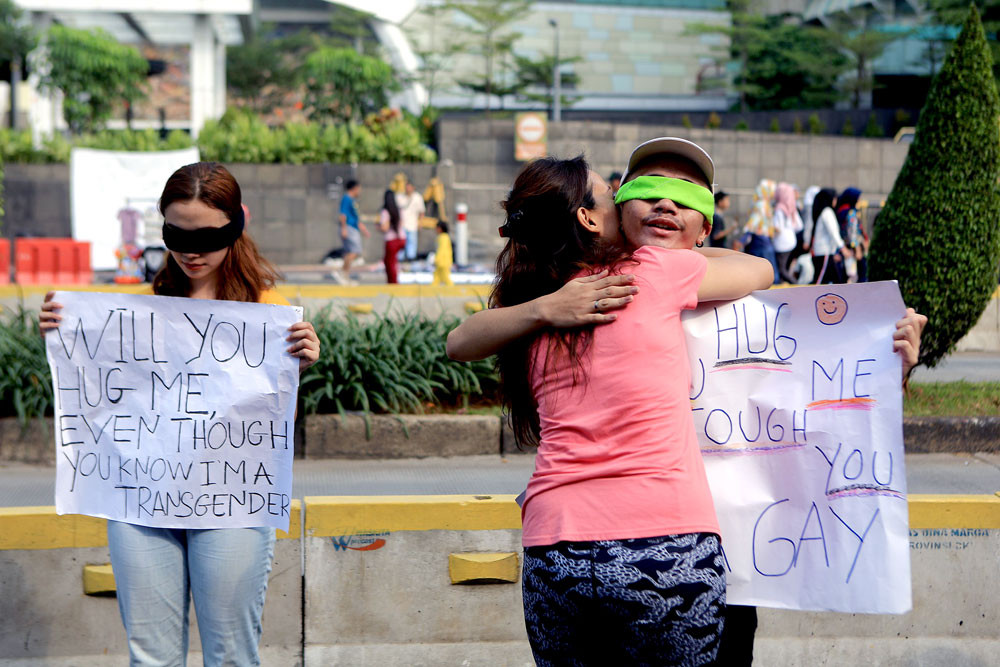
 

 Yes, I am transgender': Indonesian singer braves hostility in emotional  video - National - The Jakarta Post

Image credit:  The Jakarta Post


The LGBTIQ+ community in Australia is cautiously expecting an acceleration of acceptance now the Albanese government has the steering wheel.  But in the nation next door which boasts it runs with moderation, human rights is going in reverse.


There’s a powerful lobby group in Indonesia which gets its energy from pot-stirring.  Driven by mainstream Islamic organisations it duplicates the tactics of Opposition Leader Peter Dutton when he was Home Affairs Minister warning of woke culture sending the nation in the wrong direction.

In English the adjective refers to an awareness of social inequality. There’s plenty of that in Indonesia where the rich make Croesus look like a pauper – and the under-class has more battlers across the archipelago than there are citizens in Australia.

In office Dutton exhorted the government to ‘weed out the people who have done the wrong thing’, a gardening ambition shared by Indonesian religious groups blaming Western liberals for infesting local values.

In his victory speech PM Anthony Albanese envisioned Australia as a country that ‘no matter where you live, who you worship, who you love or what your last name is, that places no restrictions on your journey in life.’

Ten days later at the start of Pride Month, the Majelis Ulama Indonesia (MUI) offered a different vision.  The Islamic Scholars’ Council is demanding President Joko (Jokowi) Widodo and the Dewan Perwakilan Rakyat (Lower House) criminalise LGBT practices and purge the nation of deviancy.

Critics say this has more to do with hard liners trying to impose their version of morality, and enhance the religious parties’ credentials ahead of the 2024 election, widening the gap between traditionalists and the temporal.

So far the mainstream media in Indonesia has avoided alerting the populace to the fact that Australia’s new FM Penny Wong, who has been visiting Jakarta with Albanese, is a lesbian.  Revelation could be a plus. The Malaysian-born Senator is also a practising Protestant, showing that faith and sexual preferences are not incompatible.

Although often tagged an Islamic republic because it has the world’s largest population of Muslims, Indonesia is a constitutionally secular state.  Around ten per cent follow five other government-approved religions with Christians in the majority.

Bundling all ethnic and faith groups in the nation of 273 million together by linking bedroom behaviour with treachery, the MUI stamped gay practices as ‘a violation of the state ideology of Pancasila, the 1945 Constitution and the Marriage Law.’(Pancasila is the five-point philosophy underpinning the State.  The final clause reads: ‘Social justice for all the people of Indonesia’.)

The national criminal code currently doesn’t forbid adult, non-commercial homosexual acts involving consenting adults.  However the police regularly resort to public decency and community disturbance legislation to crack down on gatherings of gays.

In radical contrast to laid-back Bali familiar to holidaying Australians, the rarely visited province of Aceh on the northern tip of Sumatra applies local laws allowed by Jakarta to ban homosexuality.  Offenders are lashed in public, a brutal and primitive punishment that also thrashes the world’s third largest democracy’s cultivated image as a progressive state.

 Indonesian Police Harass Transgender Women

 Image credit HRW.  Police challenge transgenders

MUI Proselytizing Commission Chairperson Ahmad Zubaidi announced that the clerics are demanding  a speedy end to all activities and movements ‘carried out or supported by NGOs as well as international companies in Indonesia which are a manifestation of LGBT in any form or media.’ He didn’t name the foreign businesses allegedly pushing gay rights, but this campaign is more about fantasies than facts.

Like preachers in many faiths he presumed to know the mind of the Creator who apparently labels same-sex sexual relations as fahisyah, an Arabic term meaning lewdness and indecency.

Unfortunately for moderates the government-funded MUI can’t be flicked aside as a fringe group driven by extremists.  The Council is Indonesia’s peak Muslim body and advisor to the government.  Vice President Ma'ruf Amin was chair before entering politics.

The nation’s two major religious organisations dominate the MUI. They’re the grass-roots Nahdlatul Ulama which asserts it’s the world’s largest Islamic organisation with 90 million members, and the more elite Muhammadiyah with a reported 50 million. These figures aren’t audited, so ‘membership’ is more likely a synonym for ‘follower’.

Both promote themselves as supporting tolerance, though their official statements suggest otherwise. In 2005 the MUI issued a fatwa (edict) against pluralism, liberalism, and secularism. Nine years later it proclaimed homosexually as haram – forbidden under Islamic law.

The MUI is seeding fertile ground. A 2020 Pew Research Institute survey reported nine per cent of Indonesians agreed that homosexuality should be accepted by society.  Despite this dismal statistic the gay lobby saw hope because the figure from seven years earlier was just three per cent.

Menaces to gays in Indonesia have accelerated this century.  A 2016 report by Human Rights Watch asserted that the minority had endured ‘sporadic hateful rhetoric and violent attacks over the preceding three decades:

‘That outpouring of intolerance has resulted in proposals of laws which pose a serious long-term threat to the rights and safety of LGBT Indonesians.’

It wasn’t always so. The Serat Centhini (Javanese teachings of life) compilation of ancient wisdoms includes tales of homosexuality and bisexuality.  It has been described by Singapore gays as ‘Southeast Asia’s version of the famed Indian sex manual, the Kama Sutra’.

 Last century, before the austere and prudish Wahhabism sect got a grip on Indonesia largely by funding hundreds of new mosques run by fundamentalists, waria (male to female transgender actors) regularly performed in public, along with transvestite beauty contests.

Lest Australians get too smug it’s worth remembering that despite the party’s name the previous government was not a showcase for liberalism. On The Conversation website, Monash Uni Human Rights Law Professor Paula Gerber wrote that ‘under the Morrison government, LGBTIQ+ people were subjected to a steady stream of attacks’.

Her list included ‘three separate attempts to pass the Religious Discrimination Bills, widely considered a sword with which to attack LGBTIQ+ people rather than a shield to protect people of faith from discrimination’ leading to serious mental health problems.

Although she thinks things will be better under Albanese, his government has not agreed to the Greens proposal for a Minister for Equalities, as in Britain where Liz Truss has the job, though the Tory is much distrusted by the gay community.  In Victoria Health Minister Martin Foley also holds the portfolio of Equality.

Commenting after MUI’s latest assault on difference, former Jakarta Post editor Endy Bayuni alerted readers to his country’s ‘huge problem with increasing intolerance, racism and the way we treat minority groups.’

First published in Pearls &  Irritations, 10 June 2022:  https://johnmenadue.com/tolerance-of-intolerance-threatens-indonesias-image/


Friday, November 05, 2021

YOUR PROBLEM, NOT OURS


Why bother? Everyone speaks English.         


    Health benefits of evening classes revealed | University of Oxford                    

Pic: Oxford Uni

There are no votes in getting to know the neighbours.

How else to explain why successive Australian governments continue to ignore the crash of numbers learning Indonesian, and disregard the continuous and earnest appeals of teachers and academics to halt the slide?

It wasn’t always so.  Late last century, learning the words now used by more than 270 million - plus a further 32 million in Malaysia where the language is similar - was widely accepted.

 In large part the bonding was encouraged by former Prime Minister Paul Keating and his 1994 statement that ‘no country is more important to Australia than Indonesia.’

Successive leaders have said much the same but have failed to follow through.

Indonesian was once the most popular Asian language in Australian classrooms.  Now it’s Japanese and Mandarin with more students exploring vernaculars from distant Europe. Other nations teach the language next door: Spanish in the US, French in the UK.

Philistines might ask - so what?  Indonesian ranks tenth in the world’s top tongues and is little used outside Southeast Asia. Bengali and Arabic are more widespread.  But the Republic is tipped to become an economic world power when Covid-19 is controlled; Australia wants a part and already has a trade agreement in place.

The reluctance can be blamed on xenophobia.  In 1999 Australia supported the referendum on the future of the Indonesian province of East Timor where the locals voted 80 per cent in favour of independence.

Indonesians who expected the reverse result blamed Australia.  A security agreement developed by Keating was shredded by Jakarta.

The scorched-earth campaign by retreating troops and militia was universally condemned as Australia led the international peace-keepers. Then followed the 2002 Bali bombs, the 2004 Jakarta Embassy car blast and other attacks sourced to fundamentalists. 

The Indonesian government was as outraged by the terrorism as its counterpart Down Under but the long-term damage to the relationship continues.  The Lowy Institute’s annual opinion polls measure attitudes to our neighbours.   LI’s Southeast Asia Programme director Ben Bland commented:

‘Whether asked about their warmth toward Indonesia, confidence in its leaders, or even their level of basic knowledge about their biggest neighbour, Australians tend to show a combination of disinterest and distrust.’

Cuts in Australian newsrooms and the withdrawal of correspondents from Jakarta has left the media focussing on natural disasters and controversial issues, like the Supreme Court striking down school enforcement of girls wearing  jilbab (headscarves), charging people with blasphemy and banning alcohol.

In 2005 the Indonesian Majelis Ulama (Islamic Scholars’ Council) issued a fatwa (Islamic law ruling) banning liberalism, pluralism and secularism.  The edicts aren’t binding in civil law but are influential.

Australians who only know relaxed Hindu Bali and not the political, social and religious debates in Java and other islands found these news reports disquieting.

Likewise with Indonesians bemused by stories of Aboriginal deaths in custody, more than 100,000 homeless in a rich nation with universal welfare and importing fruit pickers when 626,000 are unemployed.

The public tone must influence parents and teachers when advising students on courses to pursue. For all their soothing clichés, politicians know electors run cold on Indonesia; why bother helping schools and unis train future generations in understanding our region when there are no ballot box advantages in relating to foreigners except as customers?

It seems the motivation in Canberra for maintaining interest in Indonesia is based on the STDs - Security, Trade and Defence.  It’s certainly not to develop mateship.

Former PM and Liberal Party elder statesman John Howard didn’t help with a display of Anglo arrogance.  Last year he was reported  saying we shouldn’t be too worried about the slump in Asian language learning as English was ‘the lingua franca of Asia’.

True in the five-star hotels where politicians and business executives discuss policies, though false elsewhere across the archipelago. Some ministers and executives are cosmopolitan, though not Joko Widodo.  The president has a poor command of English and shows little enthusiasm for foreign affairs. 

Although learning English is compulsory in Indonesian schools, it’s given little time and badly taught.  Anecdotally interest is also waning fast. School leavers can parse verbs but few can communicate. Native speaker teachers are rare outside expensive private schools.

Data from Melbourne University’s Asia Education Foundation shows how badly the situation has deteriorated.  Five years ago 14,418 Australian primary students were studying Indonesia.  By year 12 the number had ‘fallen off a cliff’ (say educators) to 353.  These are the kids most like to seek further education, but their choices are shrinking.

Of our 42 unis, only a dozen will be meeting needs.  In 1992 Indonesian was taught on 22 campuses to around 2,000 students.

In a bid to persuade parents, students and teachers to abandon hostility towards intercultural learning, the AEF has released its ‘rationale’, Why Indonesia matters in our Schools. The colourful six-page brochure argues that ‘young Australians must learn to engage in the global community, particularly with our neighbours in the Indo-Pacific region.’

Although the AEF ‘partners’ with the Australian Government there’s little to show its advocacy has been effective.  Foundation executive director Hamish Curry has written that ‘Without nation-wide policies, consistent data, funding and collective support, Indonesian could be relegated to a forgotten corner of our education experiences.’

Simon Merrifield, a senior diplomat and first ambassador to ASEAN, has reportedly been appointed to review Australia’s relationship with Indonesia.  He could start by first listening to educators.

First published in Australian Outlook, 5 November 2021:

##https://www.internationalaffairs.org.au/australianoutlook/why-bother-everyone-speaks-english/

Monday, October 04, 2010

A FATWA ON MOTORBIKES

A new solution to traffic jams

Traffic jams are expected to vanish throughout Indonesia once a new edict by a leading agency takes effect.

The surprise fatwa from the MUI (Motorcyclists’ Union of Indonesia) was announced just before mudik, the annual pilgrimage to hometown and parents undertaken by many Indonesians at the end of the slowing month.

MUI secretary Bangbang Twostroke said the fatwa prohibited the use of cars, which were now haram.

Although it was difficult to impose a fatwa on those groups that didn’t follow MUI’s teachings, it was expected that most would accept the ruling to avoid drawing attention to themselves and creating unnecessary conflict.

The roads would be far less congested once the fatwa was in place and all four-wheel vehicles were either locked up or deported. He added that two-wheel transport goes back centuries so reverting to the past would create a purer nation.

“You can’t hide on a motorbike,” Bangbang said. “Everyone can see what you’re up to. Behind the tinted windows of cars all sorts of immorality can take place.

“The MUI has long been concerned about the rise in popularity of other means of transport.

“We’ve had to accept the government’s five-brand policy, but there have been issues in some regions that have disturbed local communities.

“Allegations have been made of moves to Toyotarise Indonesians. I’ve even heard of preman (thugs) with Manado accents trying to Nissanise locals with promises of high trade-ins and cashbacks.

“The Mercedes trinity star is known to have other meanings. Those of us who believe in only one brand find the symbol offensive.”

The police have been instructed not to tolerate attempted conversions from two to four wheels by outside forces with other agendas.

FP1 (Friendly People of Indonesia) squads were ready to assist the police and ensure the fatwa was obeyed. Mr Bangbang rejected reports that FPI members had already started trashing cars as ‘baseless accusations from dark forces planning to overthrow the Unitary State’.

A spokesman for the Ministry of Agama (Automobile, Gasoline and Mechanical Appliances) said no comment would be made on the MUI’s fatwa, though the minister welcomed any moves to restrict the number of road users, particularly those who didn’t follow the number one brand.

“In the past we’ve been tolerant of deviants like Suzuki and Yamaha, but it’s now time to disband them,” he said.

“The Minister realises this is a controversial move. It may be in breach of the Constitution, which allows citizens freedom to ride the brand of their choice. But no matter. Our founding fathers did not appreciate the threats now coming from outside. Public order must be maintained.”

During the slowing month, when petrol tanks may only be filled between dusk and dawn, reports of surly young men in gangs hanging around foodstalls at nightfall astride motorcycles have been causing concern among supporters of cars.

Last month it was claimed motorcycle numbers in Indonesia would double by 2015. Last year 6.5 million pedestrians converted to motorbikes, the majority choosing to follow Honda. For every car that rolls onto the road, five motorbikes take to the streets.

Mr Bangbang said it was clear the infrastructure could not cope. There just wasn’t enough room on public roads, so some users have to go. It was right and proper that those evicted from the highways should be the rich driving foreign cars and taking up too much space.

If action wasn’t taken now Jakarta could suffer a stroke as its traffic arteries became clogged by the cholesterol of unconstrained private transport.

“The reality is that this is a Honda nation,” he said. “Those who want to follow other forms of transport should move to North Sulawesi, Nusa Tenggara or Bali where different brands are tolerated.

“However the transmigration of motorbikes from the overcrowded roads of Java to the quiet tracks of Central Kalimantan and elsewhere will continue. This means that the majorities in those regions may soon become the minorities.

“The alternative if for dissidents to embrace two-wheels with fervor if they want to remain citizens. This is a move that can only enhance democracy by ensuring that all Indonesians follow only one way.”

(First published in The Sunday Post 3 October 2010)

##