FAITH IN INDONESIA

FAITH IN INDONESIA
The shape of the world a generation from now will be influenced far more by how we communicate the values of our society to others than by military or diplomatic superiority. William Fulbright, 1964
Showing posts with label France24. Show all posts

Saturday, January 08, 2022

THE FRENCH MISCONNECTION


               Mais quelle horreur!  Paris poaching in our paddock leased to Washington


 Australia–France relations - Wikipedia


An ancient European power is putting more energy into courting a paramour 11,500 kilometres distant than the young swain next door. The local is forever professing passion but never seems to get his act together.

Australia gives Indonesia just enough oxygen of attention to keep the relationship breathing.  We  take the world’s fourth most populous country for granted – no risk they’ll turn bolshie as they hate Reds, and don’t sign foreign treaties.

Everything favours us. We’re one huge granary and stockyard.  They’re running up the population and running out of farmland, so they’ll need us more than we need them. 

The faraway Franks think differently. Long before Scott Morrison was labelled more fibber than cobber, Emmanuel Macron’s government had already launched an ‘Asia-wide initiative in an attempt to halt declining trade figures and improve its overall leverage with the region’.  Ironically an earlier version was revealed in Sydney in 2018 BC (Before Covid).
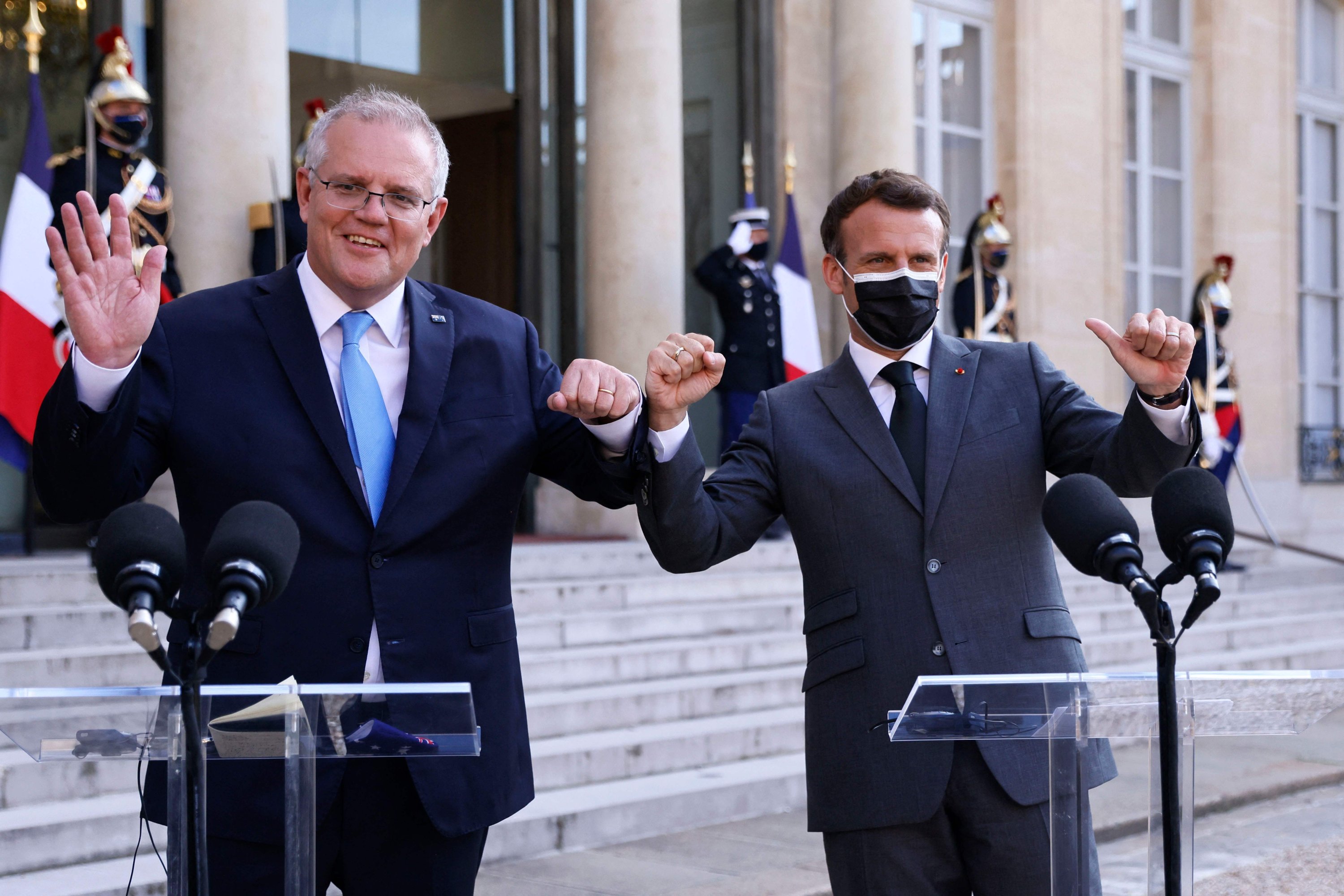
 

 Leaders of France, Australia discuss ties in 1st call since AUKUS | Daily  Sabah

  Entente cordiale no more.    ScoMo unmasked.                                                                   Credit Daily  Sabah

According to Asia expert, Philippe Le Corre of the Carnegie Endowment for International Peace, the Quai d'Orsay has long maintained ‘sustained ambitions in the Asia-Pacific region.’  That was written in 2016 and the effort hasn’t lagged.

Last September’s deal with the US and the UK sank Australia’s $66 billion French submarine contract with all Oz reputations on board.  FM Jean-Yves Le Drian responded: ‘My first comment was some sort of betrayal. The second element is a crisis of trust between historical partners, which is even more of a concern.’

Canberra’s retreat to the cosiness of the Anglosphere infuriated the French, but also re-energised their push into what policy strategists label Australia’s ‘sphere of influence’. By November Le Drian was in Jakarta ‘reaffirming France's commitment to the Indo-Pacific ... and to intensify the relationship with Indonesia.’

While some may think of France as a relic of 19th-century European glamour and the only place to climb the real engineering masterpiece of Gustave Eiffel (there are about 50 imitations around the world), Macron sees his Continental home as ‘a fully-fledged Indo‑Pacific country’.

After the AUKUS decision, Le Corre wrote that France is ‘undoubtedly the most active European country in the Indo-Pacific. The nation has an extensive maritime domain in the region in addition to 1.6 million citizens and a 7,000-men military presence—larger than that of all the other 26 EU member states combined.’

The nuclear-armed Republic is a major arms manufacturer and remains a potent force with eight nuclear-powered subs already underwater.  The Indonesian Air Force (TNI-AU) has reportedly grounded the idea of buying Russian aircraft and is now considering the French fighter Dassault Rafale.

Its overseas territories of New Caledonia (which voted 96.5 per cent to reject independence in a December 2021 referendum), Wallis and Futuna, French Polynesia and Clipperton Island, make France the world’s second-largest maritime domain behind the US. France also has the world’s biggest Exclusive Economic Zone, with 93 per cent in the Indian and Pacific Oceans.

Seventy per cent of European containerized trade passes through the Indian Ocean.  Just days before the AUKUS deal was announced the French updated their Indo-Pacific Strategy stressing others ‘can count on France’s full commitment. We will continue to play a full role in contributing to the stability of this new strategic space, which is at the core of major global challenges.’

French overseas development assistance was last year $16.8 billion compared with Australia’s $2.8 billion.  Another barometer is to measure donations against Gross National Income, aka GNP, where the percentages are 0.44 (France) and 0.22 (Aust).

Le Drian claims the Indo‑Pacific ‘is becoming the world’s strategic centre of gravity and because the security, economic, technological and environmental challenges emerging there are also ours, France and the European Union have interests to defend, values to promote and partnerships
to forge there.’

When he visited Jakarta in November the FM got to meet President Joko Widodo, a privilege not extended to Australia’s FM Marise Payne when she was in the Big Durian in September and again in November.

Then there’s the soft sell.  It’s embarrassing to report that TV channel France 24 – which telecasts in English - outdoes our overseas showcase ABC Australia on every level.  During the summer break, ABC executives decided the centrepiece of its overseas telecasts The World should take a break and be replaced by State bulletins.

So foreigners bemused by reports of parochial premiers announcing more controls to cope with the pandemic and the latest Ashes score (Indonesians don’t play cricket), had to click elsewhere for news of Myanmar massacres and the power struggle in Somalia. 

The best choice – along with Al Jazeera and BBC World – is the French State-owned service.  France 24 treats its viewers as people with interests beyond Home and Away and spends around €100 million (AUD $156 million) a year. In 2019, the ABC's budget for all international operations was $11 million, much the same level as in the 1980s.

Could the French be more reliable as amis de la sécurité than the US? As former PM Paul Keating wrote on this website: ‘America can withdraw from Asia to the safety of its west coast on the other side of the Pacific.’ 

The French could also retreat to their homeland under a different leader (the Presidential election will be in April), though shrinking La France entire would damage Gallic pride, something no serious candidate would suggest.

Maybe it wasn’t such a smart move to reject the croissants and vin rouge and go back to beer and burgers with old mates.  The menu is easier to read, but the indigestion is likely to be painful if – Sacre bleu! - the free trade digestif with the EU—now delayed by the waspish French – never gets to the table. 


First published in Pearls & Irritations, 8 January 2022: https://johnmenadue.com/quelle-horreur-paris-poaching-in-our-paddock-leased-to-washington/


Friday, July 22, 2016

DON'T ADJUST YOUR SET - IT'S THE NETWORK

Through a window darkly     
                                                           
 For Kuta pub managers Australia Plus is the TV channel to screen AFL games.  Who needs Hindu temples and Kecak trance dances when you can watch the big men fly and drink Fosters?
 If you reckon television is an ideal expat’s nipper-pacifier, a substitute for the kids playing in the hazardous outdoors, then Australia Plus is your channel too.
It’s also first choice for those without a device to record a cooking show or travelogue.  No worries.  Your favourite program will be repeated again.  And again.  And again.
However if Australia’s overseas TV  is supposed to project a robust modern Western democracy, a creative explorer of art and technology and a leader in education, then Australia Plus is a turn off. 
Our presentations to the Asia Pacific used to be different. Australian governments once believed that broadcasting and telecasting into the region was an important responsibility, sowing ideas, informing and influencing.  
Radio Australia started in 1939 using shortwave, mainly to counter Japanese propaganda.  After the war it became a ‘soft power diplomacy tool’ in the jargon of foreign affairs.
Millions learned about Australia and its values; many received world news censored by their governments.  RA was a trusted source in a region where facts are often scarce.
 Thousands developed their English skills huddled over crackling transistors, particularly during the 1950s and 60s. 
Technology forced changes. Satellites eclipsed land-based transmitters and enlarged reach.  Rebrands became necessary; but the vision remained and the mission expanded.
In 2006 Foreign Minister Alexander Downer announced that ABC Asia Pacific (formerly Australia Television International) would become Australia Network, with funding from Foreign Affairs and Trade plus advertising.
It would reach 10 million homes and 200,000 hotel rooms in 41 countries; maybe one million viewers a month.
Downer said the ABC would run the network offering “high quality programs about Australia and its engagement with the region.”
Also promised were “extensive news and current affairs programs, Australian-produced education, drama, entertainment and lifestyle programs.”  Note the order of priorities.
The Minister included a homely metaphor with his Reithian principles:  “A key requirement of the service is to provide a credible and independent voice through programs that present a 'window' on Australia and Australian perspectives of the world.” 
Australia Network CEO Ian Carroll added: “Our news and current affairs programs provide more than the headlines – it’s quality world class journalism offering a different view from the London and US-centric networks”.
By then there were other windows to peer though. BBC World, France24, Al Jazeera, NHK (Japan), Deutsche Welle and other international telecasters were offering vistas grand using serious money. The French Government is reported to spend AUD 117 million a year on France 24.
Then in 2014 the government broke its AUD 223 million ten-year deal with the ABC after budget cuts. Eighty staff – some in Asian news rooms – lost their jobs.
As Australia Network faded to black, Australia Plus flickered to life.  Suddenly all the ringing rhetoric about engagement with the region lost its potency. The graffiti scrawled on the cracked and soiled window of the new service asks:  Does anyone care? 
How did this come about?  Blame pronged lobbying by Rupert Murdoch’s Sky TV which wanted to get the contract, spooking governments more concerned with domestic trivia than reaching the neighbours.
Prime among these are the people next door in the world’s third largest democracy.  As Australian leaders recite the mantra that Indonesia is our most important foreign relationship it might be logical to assume we’d be showcasing our best and brightest. .
When Australia Network died the then ABC managing director Mark Scott reportedly said the decision “runs counter to the approach adopted by the vast majority of G20 countries.
“Countries around the world are expanding their international broadcasting services as key instruments of public diplomacy.
“It sends a strange message to the region that the government does not want to use the most powerful communication tools available to it to talk to our regional neighbours about Australia.”
Australia Plus took over as a pay-to-view channel with a stated “mission to provide a television and digital service that informs, entertains and inspires our audience with an uniquely Australian perspective.”  Note the new order of priorities.
Indonesians and others in the region can enjoy a 24-hour service dominated by Bananas in Pyjamas, Play School and Little Ted’s Big Adventure on a loop for much of the morning plus a few English lessons.
ABC News Breakfast does starts at 3 am in Jakarta. World News at 8 pm seems to be the only program created for the channel, not just lifted and dumped, like a Bondi Rescue wave?
At 5.30 pm Java time 7.30 is shown. Q & A runs a day late; there are old editions of Australia Story and the brilliant Jenny Brockie SBS series Insight. Weeklies like Insiders and The Drum get a guernsey. Four Corners does not.  That’s about it for current affairs.
Home and Away fans get five episodes back-to-back, relieved by weird monochrome promotions for Monash University that would puzzle and probably frighten prospective students. 
Other sponsors are vitamin manufacturer Swisse and the tourist promoter Melbourne, Victoria. Tellingly absent are the 360 Australian businesses which launched a mighty assault on the Indonesian market last year.
What’s the target audience for this dog’s breakfast? Asians play soccer, not AFL. Where are the other sports which SBS does well, the docos, the ‘uniquely Australia perspective’ on the region’?
 The fractured Australia Plus window needs ripping out and the gap filled with concrete (a metaphor to warn potential asylum seekers) or reglazed with quality glass, custom made to fit.
None of this seems to concern the major parties. While they enjoy ABC and SBS excellence at home, their neighbours get Australia Minus.
(First published in New Mandala 22 July 2016 http://www.newmandala.org/through-a-window-darkly/