FAITH IN INDONESIA

FAITH IN INDONESIA
The shape of the world a generation from now will be influenced far more by how we communicate the values of our society to others than by military or diplomatic superiority. William Fulbright, 1964
Showing posts with label Yenny Wahid. Show all posts

Monday, December 18, 2023

RI POLITICS: NO ROOM FOR SMART WOMEN


Equality is risky - best stay with blokes    


Indonesians have just witnessed a messy, badly produced TV ‘debate’ between the politicians jostling to run the world’s fourth largest democracy facing a national election in less than two months.


Just a few weeks ago it seemed Indonesian politics was edging towards modernity by recognising that half the voters are women with different values, needs and expectations.  


Not to be. The oligarchs have spoken: In a nation that claims to be progressive and tolerant there's no place for a woman in any leadership team The six candidates for the Presidency and Vice Presidency are men, all Javanese, all Muslim.


For a short but hopeful time in the juggling for positions, it seemed possible that a woman might get a go.   Mid-year three ferociously ambitious mega-rich guys were seeking a partner for the 14 February poll. What date could be more auspicious for starting anew?


The paramours were lusting after a Vice President who could relate to those who’ve matured this century in a democracy, albeit flawed. Voting is voluntary. In the 2019 presidential election, the turnout was 82 per cent.


The obvious choice was Yenny Wahid, 49, and she was willing. 


The second daughter of the Republic’s fourth president, the late Abdurrahman (Gus Dur) Wahid (1940 - 2009), had the professional and personal qualifications for high office, so who’d win her hand? It was the sinetron (soapie) spellbinding the nation.


 The lady most likely headed a tiny socialist party with Buckley’s chance of scoring even a footstool in the 575-seat national parliament by going alone. She was being wooed for her qualities, ancestry and reputation for relating to the young. 


When the Indonesian Army trashed East Timor after locals rejected Indonesian rule in the 1999 referendum, Yenny was a correspondent with the then Fairfax Press, a journo in the coverage team that won a Walkley Award, Australia's highest prize in journalism.


(Use of forenames is Indonesian style. It doesn’t imply partiality.)


 Now she heads the Wahid Institute, an Islamic think-tank working for ‘the development of both Indonesian as well as Islamic society, improving the welfare of lower classes … building democracy and fundamental justice, and expanding peace and non-violence.’


In 2009 the World Economic Forum named Yenny a young global leader. She has a Harvard master's degree, a persuasive personality and international experience.


She’s a liberal Muslim with all the credentials. Her great-grandfather Hasyim Asy'ari founded the world's largest Muslim organisation Nahdatul Ulama (NU) which claims close to 100 million members.


In Indonesian culture the way women dress and behave is scrutinised for signs of unorthodoxy; Yenny, a married Mum of three, came across as an Ibu Ibu, a safe homely matron, which doesn’t mean a soft touch. 


In an earlier interview, she quashed suggestions of subservience: “This is the way I express my right to wear what I want. (She uses a half-jilbab headscarf.) It’s my symbol of struggle.


“It might be easier if I was a man in this macho society, but then the pressures could be physical rather than mental.”


Youngish voters will dominate the  February ballot according to The Jakarta Post: ”Around 114 million Indonesians eligible to vote next year are under 40.”


The Kompas national newspaper commented: “Young people are always the target of the contestants' votes (but) not many policies are in favour of the younger generation.” 


The quinquennial election is the only time the ignored feel frisky. Indonesia’s teals have clustered around the centre-left Partai Solidaritas Indonesia (PSI) which includes Yenny’s politician husband Dhohir Farisi, and the socialist   New Indonesian Nation Sovereignty Party (PKBIB) chaired by Yenny.


Both were formed this century by student Utopians after Reformasi - the 1998 fall of the autocrat General Soeharto who ran the nation for 32 years. 


In the late 1700s, the French Revolution beheaded the ruling royalty to ensure they’d never return. In 1998 the Indonesian activists who brought down Soeharto naively assumed his cronies would disappear along with the king of the kleptocrats, all wreathed in shame.


The students were too soft, so last century’s oligarchs still rule and plunder, promise and default. A Macbethian tragedy wrote one academic. Another commented that Indonesia’s experiment with democracy has ‘been hijacked by the dark forces that held the country back before.’


Yenny’s problem shouldn’t have been gender, except among ultra-conservatives. The world’s most populous Muslim-majority nation had its first female president in 2001. As vice president Megawati Soekarnoputri inherited the job when Yenny’s father was impeached.


Even as coalitions, the small parties don’t have enough cash and candidates to steer the state, so their best chance of getting close to the driver is as VP. 


The PSI nominated Yenny to stand with Ganjar Pranowo, 54, of Mega’s PDIP - the Indonesian Democratic Party of Struggle.


But Mega has no love for the Wahid family,  so no-go. Likewise with disgraced general Prabowo Subianto, 72, Indonesia's Donald Trump. 


Insiders then predicted Yenny pairing with the former Jakarta Governor Dr Anies Baswedan, 54. The one-time Education Minister and University Rector has the skills needed to work with a smart female.


The US-educated Anies has been nominated by the secular centrist Partai NasDem (National Democrat) which has 59 seats in the current Parliament.


While Yenny’s swains thought she had the youth ratings, in the end, they feared her liberal values.  So Prabowo selected outgoing President Joko (Jokowi) Widodo’s eldest son Gibran Rakabuming Raka, 36.


Ganjar Prabono (from Mega’s Democratic Party of Struggle - PDIP) went for former Constitutional Court justice Mohammad Mahfud Mahmodin while Anies picked Muhaimin Iskandar, the deputy house speaker but more importantly religiously close to Yenny’s late father through the NU Islamic organisation.


Though not so near as his daughter.  


 First published in Pearls & Irritations, 18 December 2023: https://johnmenadue.com/equality-is-risky-best-stay-with-blokes/


Friday, July 02, 2021

FASTEN SEAT BELTS, FISCAL TURBULENCE AHEAD


                        The spirit of Indonesia takes a dive


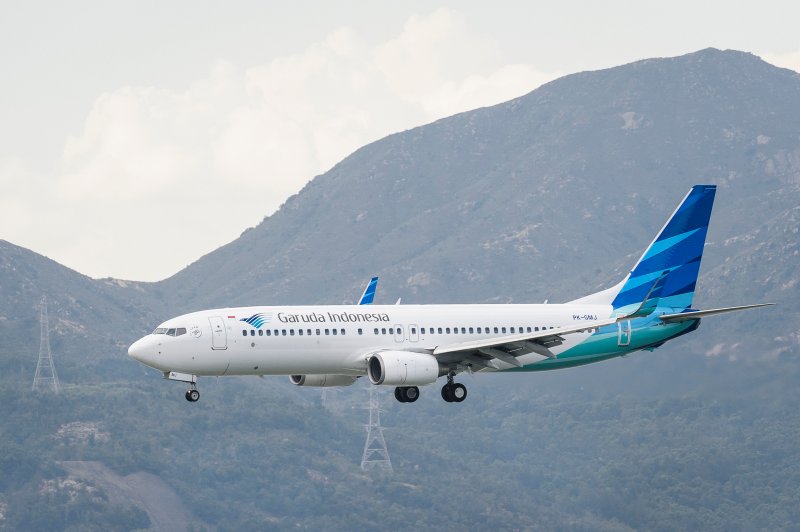
A Boeing 737-8U3 passenger plane belonging to the Garuda Indonesia lands at Hong Kong International Airport. Garuda plans to cancel its 737 MAX contract.

 The financial deck warning lights had been flashing furiously when Indonesia’s Garuda airline welshed on its AUD 660 million sukuk repayments this month after a 14-day grace.

The company, which is more than 60 per cent owned by the government, had already extended the loan’s maturity by three years. A sukuk is a financial certificate which complies with Islamic law prohibiting the receipt of interest while allowing acceptance of profits.

Most big flyers are facing financial headwinds in the wake of Covid-19 but Garuda is particularly airsick and not just through Australia shutting its arrival and departure gates.  The other problem is management. The company has got through eight CEOs so far this century.  Qantas is with its second.

Hundreds of thousands of Australians will have flown Garuda mainly to holiday in Bali.  Other airlines helped carry an estimated 1.4 million visitors in 2019, but when and if the borders reopen they’ll have to find other services.

Garuda CEO Irfan Setiaputra told the Indonesian legislature the Melbourne and Perth flights will end in July, while the Sydney-Jakarta route mainly used by business people and bureaucrats is ‘under evaluation’. 

Other Jakarta-origin Garuda routes likely to be grounded are Amsterdam and Kuala Lumpur. The company’s restructure includes retrenching many of its 20,000 staff (around 1,000 have already been through departures) and cutting the largely leased fleet to around 66 planes. Twenty aircraft are back with lessors.

This is hitting the Indonesian psyche and if minds weren’t focused on surviving the pandemic there’d be outrage at the damage to national pride, with the world’s fourth most populous country having to rely on foreigners to get airborne.


The idea of a civilian airline as an aerial ambassador is ridiculous unless the state which flies the jets makes the machines.  That limits the range to the US, the four-member European Airbus consortium, China and Russia.


Other nations buy or lease, add a logo and parade on airport aprons as though they represent a triumph of their engineering rather than a paint job (livery in PR jargon), and call them flag-carriers. Qantas claims to be the ‘Spirit of Australia’, which sounds like a duty-free purchase.

Garuda is Indonesia’s Qantas minus the Australian’s clean accident record.  It’s named after a mythical bird that appears in Hindu and Buddhist culture carrying the god Vishnu, a curious choice for the world’s largest Islamic country.

A garuda looking more like the US heraldic bald eagle is the national emblem, so much jingoism is embedded in the name. Despite the Republic’s economy bogged in a fiscal quagmire reported in an earlier column, a government rescue of the ailing airline is most likely.

It would be a courageous decision (as in a Yes Minister definition) for President Joko Widodo to let the company, overweight with an AUD 8.6 billion debt, crash and trash the Republic’s place among the world’s high-flyers, even though Garuda is not the biggest in the country. That spot on the runway is held by private Lion Air with a fleet of 140, two more than Garuda pre-pandemic.

Other options are to focus on the domestic market meaning the Garuda name will no longer appear on international departure lounge flight screens further diminishing the nation’s status.

Garuda has been nervous passengers’ no-fly zone with a record of 13 major accidents since 1950.  In-flight service has also been hazardous. In 2004 human rights activist Munir Said Thalib, 38, was heading to Amsterdam via Singapore on a Garuda flight when off-duty pilot Pollycarpus Priyanto slipped arsenic into his drink.  An autopsy showed the dose was three times the fatal level. 

Priyanto, who has since died, was allegedly aided by staff supplying false travel documents.  He was jailed along with Indra Setiawan, former CEO of Garuda. The suspicion continues that the men were fall guys in a plot to silence Thalib’s criticism of the State Intelligence Agency.

 In June 2007 the EU banned Garuda landing rights for two years to improve safety standards.  The order followed a domestic passenger flight over-running the Yogyakarta runway killing 21, including five Australians when it caught fire.  Five years earlier at the same airport, a Boeing suffered a flameout in both engines and ditched in the River Solo, killing one and injuring 13.

In 2009 the company started a five-year expansion plan called ‘Quantum Leap’ which involved more uniform and logo redesigns, though less attention to staffing. Some flight attendants went public alleging sexual harassment and a prostitution ring.

In 2019 the company earned world ridicule when it tried to ban in-flight photography after a passenger uploaded a video of a handwritten menu for business class.

In 2020 CEO Emirsyah Satar was jailed for three months and fined AUD 100,000 for accepting bribes of AUD 4.1 million in deals involving planes and parts from Airbus and Rolls Royce.

After a long investigation one of Satar’s successors, Ari Askhara was jailed for a year for using the delivery of a new Airbus to smuggle a classic Harley Davidson motorcycle and two Brompton folding bicycles.

Garuda’s Independent Commissioner Yenny Wahid was quoted saying the company was carrying a burden ‘because corruption cases in the past have had an impact on Garuda's management.’  Wahid is a human rights activist and anti-graft campaigner. She’s the second daughter of the late Abdurrahman Wahid, aka Gus Dur, the fourth president of Indonesia.  At one stage she worked as a journalist in Australia with The Age and SMH.

Between 2008 and 2010 the Australian Competition and Consumer Commission took legal action against 15 airlines, including Garuda, alleging price-fixing on air freight. This year the Indonesian copped an AUD 14.7 million fine after dropping an appeal to an earlier Federal Court decision.   Most of the other defendants settled out of court.

In the mythology, Vishnu, the god of preservation, rides on the back of Garuda.  If the real Garuda stays aloft it will be shouldered by taxpayers. 

 First published in Pearls & Irritations, 30 June 2021: https://johnmenadue.com/garuda-the-spirit-of-indonesia-takes-a-dive/