FAITH IN INDONESIA

FAITH IN INDONESIA
The shape of the world a generation from now will be influenced far more by how we communicate the values of our society to others than by military or diplomatic superiority. William Fulbright, 1964

Tuesday, November 14, 2023

HOW TO VOTE? THE PHANTOMS ADVISE

THE GHOSTS IN THE VOTE MACHINE        


Indonesian politics are about personalities, not policy. Some among the 20,000 candidates for national and regional office at  the globe’s biggest one-day ballot next year  must be driven by altruism.  But  how to vote?  Who do the dead recommend?


Election info next door comes from TV, social media and outdoor advertising, Thousands of placards, giant posters and banners are trashing calming views of paddy and jungle across the archipelago, an assault on the senses.


Space on the flapping vinyl is limited to meaningless one-liners, the hopeful’s photo - and a shade exhumed from the netherworld of ad agencies.


They’re added to push voters pondering their choice for next year’s Valentine's Day election, porting the message: ’I’ve come from the beyond to tell you this guy’s good.’


Indonesians are addicted to the paranormal whatever their religion.  Spirits roost in the dense aerial roots of the centuries-old banyan figs; they lurk in the crumbling ruins of Dutch colonial villas, even cornices in modern homes.


Not all are sinister. The most used spectre on the ads is the smiling wraith of Soekarno, hovering behind daughter Megawati, peering down on her choice. 


This is former Central Java Governor Ganjar Pranowo, 55, representing the  mildly left nationalist Partai Demokrasi Indonesia Perjuangan (struggle) which Mega runs ruthlessly.


Be not fooled by the D-word. The secular party and its queen are as democratic as North Korea and Kim Jong Un. Ganjar was not elected by the membership but picked from the throne.


If first president Soekarno was alive today he’d be 122, but his images aren’t Halloween. He looks young and handsome, better known for bedding nine wives than stuffing up the economy and playing footsies with the Reds.


He died in 1970, deposed after a failed coup and a military power grab.  More than half the 200 million registered voters are under 40 so their acquaintance is only  as the Proklamator who announced the end of Dutch colonialism on 17 August 1945.


Yet the party gurus believe his pictorial presence will swing votes - which is like channeling Robert Menzies to boost Peter Dutton’s profile.


Ganjar’s main rival is Prabowo Subianto, 72, a hard-right Mussolini figure. His ads use the apparition of Abdurrahman ‘Gus Dur’ Wahid who died in 2009.
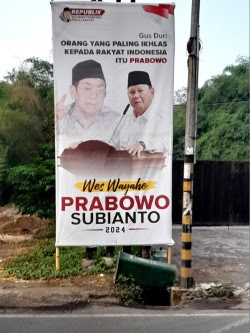
 

The Republic’s fourth president was an enlightened liberal - the antithesis of the man he’s supposed to be endorsing from the grave. The misrepresentation is gross, running parallel with a plot to whitewash the candidate once banned from the US. 


Melbourne University Professor Tim Lindsey describes Prabowo as ‘a cashiered general and former son-in-law of the authoritarian Soeharto, who ruled Indonesia for more than three decades.


‘Prabowo has been accused of human rights abuses, including in Timor and Papua, and alleged involvement in the abduction and murders of activists around the time of the collapse of Soeharto’s New Order regime in 1998.’


When dishonourably discharged for disobeying orders he fled to exile in Jordan. Now he’s back with his own Gerakan Indonesia Raya (Gerindra) Great Indonesia Movement Party for a third crack at the top job.  He’s backed by Jakarta’s business elite - and (not a misprint), his former rival President Joko ‘Jokowi’ Widodo. 


This next bit requires some suspension of Western reason by believers in the them-and-us Westminster system where leaders are only seen together at state funerals.


Last week Jokowi hosted an intimate lunch for the three men fighting to be his successor. Did they share visions, hopes, challenges? No, they discussed the quality of the chicken soup. Indonesians find chatting about food more palatable than the confrontation debates favoured Down Under.


According to the South China Morning Post, ‘all three candidates share some common policy platforms, such as a commitment to modernising Indonesia’s armed forces and maintaining a free and active foreign policy. 


‘But they differ, analysts say, on their economic strategies, campaign rhetoric – and desire to either preserve or abandon the outgoing president’s legacy.’ This is a reference to the US$35 + billion new capital project in Kalimantan, already struggling for investors.


 Absent from this glib report is any mention of resolving the ongoing guerrilla war in West Papua.


While partisans doctor their hero’s past, a supposedly independent Australian-initiated website The Conversation has relabelled Prabowo as a ‘retired general’. The website’s charter  says its journalism is responsible, ethical and supported by evidence.


Chief Editor Ika Krismantari told this writer she knows Prabowo ‘carried a lot of baggage’ but ‘in many websites he still carries the title purnawirawan (retired), even for some military officers he is still considered as mantan jenderal (former general.’  This is the Trump tactic - tell a lie long enough and it morphs into  fact.


The third contestant, and probably the best for Australia though least likely to win, is the US-educated academic and former Jakarta Governor Dr Anies Baswedan, 54. He has Arab ancestors but so far his advisors have been unable to exhume any corpse keen to endorse.


He’s on the Nasional Demokrat ticket. Like Mega’s outfit it has nothing to do with the ancient Greek philosophy as its goal reveals: ‘To build a democracy based on strong people who are called on to bring about a bright future.’ 


NasDem is the fiefdom of Indonesia’s Rupert Murdoch, media baron Surya Paloh, 72, who titles himself ‘the father of Indonesian restoration’. He can’t get into the palace  because he’s from Sumatra, so plays as a dahlang - puppet master.


Political wisdom has only Javanese Muslim blokes stand a chance. Java is the administrative, religious and cultural heart of the archipelago and the most populous island with 56 per cent of enrolled voters. 


The polls currently show no clear winner, meaning there could be a shoot-out between the top two. In this scenario, most of Anies’ votes would likely go to Ganjar.  If Prabowo fails again expect engineered street riots, as with the 2019 election.


The candidates’ images are masterpieces of electronic editing, erasing the decades of revealing reality. The aged pray that Gen Z idealists won’t notice last century's recycled self-seekers,  only see Dorian Grays.   Spooky.


##

  First published in Pearls & Irritations, 14 November 2023: https://johnmenadue.com/the-ghosts-in-the-vote-machine/

Sunday, November 05, 2023

FEAR OF TRADING

 THE CLUMSY NATION CAN’T GET TRADE TRACTION


We claim to be traders but less than four per cent of our goods head to Southeast Asia - a market of more than 688 million. Trade suffers because we won’t relate to our neighbours, don’t know how and don’t care. 


Australian federal elections wrap with a ritual: After the niceties, the winner darts into a phone booth, rips off the soiled rags of domestic politics and dons the statesman’s cape of foreign affairs. First stop Jakarta.


All  leaders since Gough Whitlam have trumpeted hows vital it is to know the locals. Worthy aim, but a policy fail. Now comes yet another bash at the barriers.


It’s doomed through a double fault: The only road we know into the market is through a dodgy Cold War potholed track, and we’re too smug to learn some trade literacy.


In 1992, twenty-two Australian universities were teaching Indonesian language and culture. Now it’s down to a dozen. Indonesia dominates the region on every measure from economy to  people - the fourth most populous in the world, obviously important, yet we yawn.


 It’s 46 times larger than Singapore but our two-way trade with the tiny island is double that of Indonesia.  Despite all the urgings we invested only $3.1 billion in the archipelago.


China has put in four times more; this year it has pledged $104 billion. (All figures AUD).  If investment is married to influence the offspring of this union should thrive.


 Canberra’s response to these irksome realities  has been to ask investment banker Nicholas Moore to come up with fixes.


His 205-page attempted U-turn Southeast Asia Economic Strategy to 2040 won’t get traction  because it follows the old road of seeing the people next door as buyers rather than partners, foreigners instead of mates.  Those folk are in the Anglosphere.


Positions perish and change is hurtling our way.  A new Indonesian president with a fresh ministry and new alliances will be elected next year. They’ll be revisiting policies on accepting foreign business ventures, maybe promoting, possibly rejecting, and most likely squeezing and confusing.


So far the coarsest attempt to try and  get pally with the neighbours is to nuzzle up to ASEAN, a policy inherited  by Foreign Minister Penny Wong from her predecessor, Marise Payne.  This is not through ideology but because there’s no alternative.


Some background: In 1967 during the Vietnam War Indonesia set up ASEAN with Thailand, the Philippines, Malaysia and Singapore to block the advance of Communism.


Ironically two latecomers are Red – Vietnam and Laos, with feudal Cambodia sticking close to China. Tiny Brunei joined in 1984, despotic Myanmar in 1997. Talk of Australia joining the Cold War relic are academic because decisions must be unanimous.


Apart from Singapore, ASEAN’s members are afflicted by what Indonesians openly call KKN Korupsi, Kolusi, Nepotisme.  The Moore report ignores these critical impediments to investors.


Only Indonesia, Malaysia, Singapore and the Philippines follow forms of ‘flawed democracy’ as assessed by the Economist Intelligence Unit.   That doesn’t mean they’re pure, just not so bad as the rest.


The US found AUD$ 142 million this year to support ‘the robust implementation of the ASEAN Outlook.’ FM Wong’s backing is curious because it’s long been a Coalition favourite pushed  by the right-wing  Australian Strategic Policy Institute


The title sounds benign , but former Foreign Minister Bob Carr reckons ASPI has a ‘one-sided, pro-American view of the world’. Much of its money comes from the weapons industry.


While we’re fumbling to get trade right, we know how to get close to Indonesia’s military, a force with a fearful record in human rights abuses.


No unpleasantness obvious in the Australian Defence Department’s jolly account of September’s joint exercises.  ’Big smiles and hugs’ followed a ‘rich series of training’.  Now Canberra is exploring a defence cooperation treaty as Michael West Media has reported.


The only twine stringing the ten disparate nations together isn’t language, culture, history, ideologies or economies. It’s geography.


 Darwin is only 830 kilometres from Kupang, the capital of Indonesia’s East Nusa Tenggara province, but physical proximity means next to nowt in zonal geopolitics. We have little in common with them and vice-versa. We claim we’re in the region. They think we are worlds apart.


That shouldn’t stop us from being friends, doing business and having good relationships, best achieved through the intermix of citizens.


ASEAN citizens can wander visa-free through Southeast Asia, Australia disallows easy access, particularly for Indonesians. Many obstacles mean no trust.


Last year we got just 91,000 Indonesian visitors - but sent them 610,000, mainly to Bali


Labor governments appear to take the issue of relationships with SE Asia more seriously.  That doesn’t mean more successfully. 


Eleven years ago then PM Julia Gillard released the Australia in the Asian Century White Paper ’nurturing deeper and broader relationships … by taking advantage of the opportunities offered by the Asian century.’


It was an advance on the earlier Keating doctrine that Asia is where our future substantially lies, but it  ‘famously disappeared from official websites following the election of Tony Abbott. It became the White Paper that dared not speak its name.’


However, you can read a copy here.


The proposals in Moore’s September report are floundering for attention against the Voice Referendum and its wash ups,  and now the Gaza War


But the question is too important to filed under ‘NOTED”: Why are we so far behind many other countries in doing deals with the neighbours?


The awkward truth is that we put our dollars and goodies into the US, the UK and Europe because we reckon they’re transparent and safe harbours while ASEAN is not.


Moore’s report notes: ‘Some Australian investors continue to view the region’s risk–return trade-off as unattractive.’ Better be blunt: We’re ignorant and fearful. 


His report wants us to ‘lift investment in Southeast Asia literacy at all levels, from stimulating demand and teaching languages and cultural awareness to school and university students to training government officials and senior executives and board directors on Southeast Asian commerce and business practices.’


Our Jakarta Embassy brags about the 63,000 Indonesians who’ve  studied in Australia since 2002.  This  balloon has been pricked by Newcastle University Professor Richard Heller’s notingthat we have twice as many  students from Singapore than from Indonesia. 


Embarrassingly Canada is poaching in our paddock, ‘developing trusted relationships for investment, including having spent more time on the ground understanding markets, taking minority stakes in businesses, joining boards, and building experience in the region.’


Ottawa is 15,600 km from Jakarta;  Canberra a third of that distance.


Southeast Asian states don’t see us as our PR people would have you believe - the land of  cuddly-koalas and barbie hosts.  We’re a Western nation aligned with Northern Hemisphere powers, superior and racist - an image already hardened by the Voice result.


The locals want our wheat, meat, and investment dollars, but they don’t want us.


Time to cremate the absurd notion of joining ASEAN,  this feudal gang, toss the ashes in the Arafura Sea and focus on following Moore’s advice on learning and understanding - then deal with individual nations.


Indonesia’s presidential election will be on 14 February. Here’s a guarantee: The winner will not say his priority destination is Canberra. His first stop will be Mecca.


##


First published in Michael West Media 5 November 2023: https://michaelwest.com.au/the-moore-report-on-south-east-asian-trade-unlikely-to-lead-to-more-trade/

Wednesday, November 01, 2023

STEP UP TO GREAT EVENTS - IF YOU CAN

 IN THE BEGINNING WAS THE WORD - AND IT WAS UWRF

UWRF founder and energiser Janet DeNeefe


Was this year’s Ubud Writers and Readers Festival worthwhile? My word - the people of the book had a literary communion.


Almost two hundred speakers (gleaned from a list four times longer) handled  challenging ideas mainly with aplomb. Not all was fiction - human rights were prominent throughout.


A lively analysis of the Gaza crisis by two articulate writers who knew their stuff -  Australian investigative journalist Antony Loewenstein and American ‘private diplomat’ Michael Vatikiotis - gave the audience a nuanced understanding of the tortured region’s complex history.


Goenawan Mohammad, Indonesia’s leading public intellectual  told of being ‘betrayed’ by the actions of Joko ‘Jokowi’ Widodo - a leader he’d once endorsed. 


No longer. Days earlier he’d written an ‘open letter’  condemning the president for   backing his eldest son Gibran Rakabuming Raka, 36, as a contestant for the vice presidency alongside his former bitter opponent, the cashiered general Prabowo Subianto.


Also striking was Kurdish-Iranian refugee and writer Behrouz Boochani letting loose on his four years on the Australian-run Manus Island detention centre and two more years in Port Moresby. Denied entry to Australia he was eventually accepted in New Zealand where he’s now an academic.


For those from Down Under there was a chance to get close to personalities they only know from TV, like 2021 Australian of the Year, Grace Tame, AI expert Toby Walsh and ABC presenter Leigh Sales who asked why the public is turning away from news.


Maybe because we dish up too much that’s trite - a crime the Festival largely avoided.  


UWRF’s four days in October weren’t just back-to-back speakers. On the touchlines were masterclasses, book launches, art exhibitions, dances, films, craft classes and foodie shows - a speciality of the festival founder Janet DeNeefe.


Born in Melbourne she married Balinese Ketut Suardana and for the past three decades has lived on the island running restaurants. The first festival was staged two years after the 2002 bombings of a Kuta nightclub by Islamic terrorists.


The outrage turned thousands of foreigners away from Bali, emptying hotels and shredding supporting industries. Tens of thousands lost work.


The DeNeefes thought a literary festival might encourage returnees; they were right. Twenty years on their venture has grown into a non-profit drawing international names to Southeast Asia’s biggest literary festival, and a swag of sponsors.


Curiously the US ranks as a higher donor than the Australian  Embassy, though the festival is dominated by Aussies paying $495 for a four-day pass.  Locals got in for $125, students $50. 


The prime language was English and the cosmopolitan young Indonesian wannabe writers and established scribes easily exercised their views. But UWRF is for the well educated and inquisitive.


DeNeefe told this website that readership among Indonesians is far too low, as the education system doesn’t encourage text study. Her views are backed by a UNESCO survey claiming that although the population is almost 100 per cent literate, only one in 1,000 likes to read.


Despite UWRF’s obvious benefits to the economy and literacy, Jakarta threatened the 2015 event.  That was when it planned to cover the 50th anniversary of the 1965 genocide of half a million real or imagined Communists. 


About 100,000 were slaughtered in Bali.  The cascading green terraces ran red; the fear that dare not speak its name lingers still.


The military-organised killings followed a botched coup that installed the 32-year military rule of the despot General Soeharto.


Police threatened to shred the festival permit if discussions on the tragedy went ahead. DeNeefe argued the programme was designed to promote reconciliation, but scrapped the contentious sections to keep the Festival alive


The publicity made the government look fatuous and the festival famous.


This year’s troubles included Muhammad Quraish Shihab, 79, refusing to appear on the stage with the outspoken Andreas Harsono to discuss IslamThe Harvard-educated human rights activist didn’t make a fuss out of respect for his opponent's age; that’s another side of Indonesian culture.


The former Minister for Religious Affairs is best known outside Indonesia for declaring it’s OK for Muslims to wish Christians a ‘Happy Christmas’. Such profundities shape Indonesia’s religious debates. 


Goenawan Mohammad (right)  was publicly asked about his attack on Jokowi by a man clearly not a culture buff, most likely an Intel (intelligence services) operative.


Indonesia’s expanding dark side was hardly noticed by festival audiences enjoying esoteric debates on foreign affairs and thinking they’re in an open democracy.  But for all his blandness and domestic popularity Jokowi is no reformist liberal.


As Melbourne University law professor Tim Lindsey has written, Indonesia under Jokowi has suffered ‘increasing democratic regression  inaction on claims of human rights violations, and litigation to silence critics of the government.’ Last century the Republic was an autocracy. Now it’s a ‘flawed democracy’.


UWRF speakers get away with censure of authorities and policies, as does The Jakarta Post.  Co-founder Jusuf Wanandi told the festival few police can understand English so miss criticisms.


Although the venue was a delight overlooking tumbling forest it was a disaster for the physically challenged.


Stairs up, stairs down, holey rubble-strewn pavements and hazards everywhere. In much of the West public events must follow health and safety rules and include facilities for the disabled. In Indonesia such laws aren’t in place or don’t apply, though there was a medical team on site


The aged, overweight and those needing sticks and friends for support made up a goodly proportion of the 1,500-plus participants. Their cerebral pleasures were marred by physical discomfort. 


 Ubud’s narrow roads are thick with motorbikes, noise and fumes.  The fabled rice paddies are vanishing under concrete as the building boom goes on and on.  That should also be the future for the festival, but it needs pastures fresh.


Disclosure: The author was a guest of the Festival.


First published in Pearls & Irritations, 1 November 2023: https://johnmenadue.com/in-the-beginning-was-the-word-and-the-word-was-uwrf-seeking/


##