FAITH IN INDONESIA

FAITH IN INDONESIA
The shape of the world a generation from now will be influenced far more by how we communicate the values of our society to others than by military or diplomatic superiority. William Fulbright, 1964

Monday, April 04, 2022

A WORLD BEFORE THE DUTCH


The past is another country


Nationalism in the world’s fourth largest nation is rising - but so far unthreatening. Indonesian passions are being driven not by demagoguery but through discovery of the country’s pre-colonial, pre-Islam heritage with added ghosts.


Java is one of the world’s most culturally rich islands, but its ancient history has been smothered by modern politics. Generations were taught everything started in 1945 when Indonesia declared itself a republic after centuries of Dutch rule.

That’s changing, helped by the discovery of several Candi Misterius releasing a surge of wonder at the skills of the nation’s ancestors and pride in their achievements.

The early kingdoms, and particularly the 14th century Majapahit, are becoming the foundations for Indonesian nationalism according to Indonesian historian Dr Wayan Jarrah Sastrawan:

‘The generation of politicians who led the country’s independence movements were concerned to find a historical basis for a united Indonesian nation.

‘Faced with the diversity of languages, customs and religions in the archipelago leaders … turned to the pre-modern past to find powerful states (as) precursors of modern Indonesia.’ They chose Majapahit.

The palm-leaf manuscript Nagarakretagama, written in 1365 and now on UNESCO’s Memory of the World Index, claims Majapahit had 98 tributary states. These ran from Sumatra in the west to New Guinea and included Indonesia, Singapore, Malaysia, Brunei, southern Thailand and the Philippines’ Sulu Archipelago.

Its authority may have been enhanced as the MS was also a PR booster, but most historians seem to agree that the empire was a powerful military force and wide-ranging trader. Fears this discovery could lead to an outbreak of Putin-style belligerence are unlikely under the present leadership.

Indonesia’s last venture to seize territory through President Soekarno’s Konfrontasi (1963 – 66) against emerging Malaysia ended in ignominy.

There are hundreds of historical sites across Indonesia from the ninth-century Buddhist complex Borobudur, not the earliest but now one of the world’s great wonders, to the recent discovery of ‘mystery temples’ plus phantoms.

The best indicator of a special spot has long been a footnote in a Dutch academic journal from colonial times. On the ground, a rusting barbed-wire fence and weathered sign warning of fines facing thieves. With luck, a local elder might remember a track through the jungle leading to a few crumbling rock piles and little else.

Though not at Srigading, an East Java hamlet where even wee kids know the Candi (temple). They no longer call it Cegumuk a toss-away name for a hump in the middle of a flat field of dense sugarcane.

Now it’s the site of a government excavation that’s already yielded artefacts from a thousand years ago, Java’s golden age. Literally, for the top of an urn made from the yellow metal has already been discovered.


So there’s a ban on detectors and a yellow plastic POLICE LINE tape wrapped around the base of what’s most likely a temple from the late Mataram period. This Hindu–Buddhist kingdom ruled much of Central and East Java between the 8th and 11th centuries.

This is the theory of archaeologist and dig supervisor Wicaksono Dwi Nugroho: ‘We only knew of this site this year after a villager told a local businessman who’s helping fund the excavation.’

Labourers collect Rp 150,000 (AUD 15) a day, three times the wage for sweating in the fields. Finders of goodies get a small reward, a reversal of the old policy of threats.

‘Under the topsoil was a large linga and yoni carved from a rock which isn’t found around here,’ said Nugroho.  He thinks the red-brick temple probably stood 11 metres high and covered a ten by ten-metre base.


 ‘Moving the yoni aside revealed a shaft about three by three metres. So far we’ve retrieved three statues, some clay pots and a broken ceramic plate which was probably traded from China.’

A yoni represents the goddess Shakti, the linga its masculine counterpart. The Encyclopaedia of Hinduism defines the icons as ‘the union of the feminine and the masculine that recreates all of existence.’ Although Srigading is largely Muslim, the yoni has been sprinkled with blossom and wrapped in white cloth.

Opening the mound has led to supernatural sightings. Locals told one reporter of ‘strange events’ near the temple and a ‘large black man towering up to more than two meters ... sitting cross-legged on the rock ‘like a ‘guardian’.

The Hindu kingdoms collapsed in the 16th century. The reasons are contested - the spread of Islam, breakups in the ruling families, power shifts or volcanic eruptions. The survivors fled east and mainly settled in Bali which remains Indonesia’s only Hindu province.

The holy places were abandoned, plundered by treasure seekers and builders seeking bricks. The fecund jungle’s creepers soon masked the remains.

For much of the 350 years of colonialism, the Dutch were more interested in guilder than curiosities. But between 1811 and 1814 Thomas Stamford Raffles was the Lieutenant-Governor of Java following the Napoleonic Wars.

A refined Englishman who spoke Malay, Raffles was bewitched by the traditions and masterpieces of architecture and engineering the Dutch had ignored. In 1817 he wrote The History of Java, describing the story of the island from ancient times plus its mores, arts, beliefs, geography, flora, and fauna. It’s available online.

In 1901 the Dutch launched their Ethische Politiek policy, educating selected locals and developing infrastructure. Historians sought and recorded sites and shipped statues to Leiden where many still await repatriation. All crashed with the 1942 Japanese invasion. After the 1945 declaration of independence preservation of the new nation was more important than conserving history.

Now a younger generation is recognising the earlier centuries of their country and venerating pre-colonial heroes, like Majapahit era prime minister Gajah Mada (1290-1364). One of the nation’s most prestigious universities carries his name.

The Alliance of Women Journalists co-opted the 13th century Queen Ken Dedes to celebrate this year’s International Women’s Day at the Singosari Museum. Displays tell the adventures of the legendary Prince (Raden) Panji which have inspired a wealth of dance, poetry, music and drama worthy of Shakespeare.

There’s no independent research to back this personal observation, but there’s growing pride in the nation’s past. The Majapahit story and Panji characters are getting onto bookshelves and street art, elbowing aside the Disney culture that’s long colonised Indonesia.


First published in Pearls & Irritations, 4 April 2022: https://johnmenadue.com/in-indonesia-the-past-is-another-country/




Friday, March 25, 2022

A TALE OF TWO CITIES


                              Keep calm and carry on 

 Blak-blakan Luhut Usai Namanya Masuk Pandora Papers, Simak!

  Luhut Pandjaitan                                            Credit: CNBC Indonesia

There’ll be few Valentine’s Day greetings and faux flower mall displays in Indonesia two years hence. That’s not because Muslim scholars will again warn followers not to celebrate ‘values that are considered to be against the Islamic Sharia.’

The key reason to forget pink hearts and rose bouquets is that Wednesday 14 February 2024 will be presidential Election Day in the world’s third-largest democracy.  Voting isn’t compulsory but past turnouts have been high – 70 per cent in 2014 and 83 per cent in 2019.

The 2019 campaign was brutal.  So was the election. Voters push a nail through the name and photo on the ballot paper to record their vote.  At the count, officials hold up each slip to show it’s valid. More than 220 election officers reportedly died and almost 1,500 fell ill from stress. Riots following the result led to at least six deaths and hundreds injured.

After second president Soeharto spent 32 years in office, the Constitution was changed restricting a president to two five-year terms, meaning Joko ‘Jokowi’ Widodo will have to retire and head back to Solo.

In his Central Java hometown he ran a furniture business before being propelled into the nation’s top job with a humble guy-like-us profile. He wasn’t a retired general or an oligarch asserting the divine right to rule through dubious links to the long-abolished Sultanates.

There’s now a drive to change the Constitution and allow Jokowi and wife Iriana three more years in Jakarta’s Istana Merdeka (Freedom Palace).  The motives are impure, laundered with raggedy reasoning about jobs still to be done and time needed to recover from the pandemic.

 Indicator Politic Indonesia researcher Bawono Kumoro argues people and parties who’ve benefited from having Widodo in power ‘feel anxious that their position of comfort will be undermined when Widodo's leadership comes to an end.’

Particularly twitchy is the Islamic Partai Kebangkitan Bangsa (National Awakening Party).  Although it scored only 58 seats in the 575 seat Dewan Perwakilan Rakyat (People's Representative Council) it holds four key portfolios, including Trade and Manpower.

Without bothering to reveal examinable data, PKB General Chairperson Muhaimin Iskandar said social media agrees with his postpone proposal as does the Golkar Party (85 seats) and the National Mandate Party (44 seats).  The two parties have yet to confirm.

The rest - 388 seats across nine parties - are saying ‘no delay’, or waiting till the wind blows a new mood from the electorate.

Particularly worrying is another wild claim, this time from Coordinating Minister for Maritime Affairs and Investment Luhut Pandjaitan.  His insistence that keeping the Prez in office is backed by 110 million social media box-tickers has been ridiculed as impossible. 

The former general had a business partnership with Widodo and is widely considered his éminence grise.  The 74-year old’s statements are becoming increasingly incoherent and widely mocked.

The urgers face an uphill climb.  An IPI survey last December appeared to show around two of every three respondents want the 2024 elections to go ahead even if Covid still thrives.

Former The Jakarta Post editor Endy Bayuni has no time for taking the electorate’s pulse.  He calls the shilly-shallying ‘subversion’:

‘That is not too strong a word to describe the current attempt by some political leaders to extend the terms of the government, both of the President and the legislature, beyond 2024. Whatever pretext they use in advancing their argument, they are subverting the democratic political processes. And that is nothing less than treason.’

The president is revealing little – but his party secretary-general Hasto Kristiyanto reportedly said a postponement would create a crisis. Yet voters can appreciate ‘the infrastructure president’ wanting to leave a concrete legacy. 

That’s the new national capital Nusantara in the province of Kalimantan 2,000 km north of Jakarta, on Borneo the largest island in Asia shared with Malaysia and Brunei. This month Widodo appointed Bambang Susantono head of the Archipelago Capital Authority for five years. The civil engineer and economist has a PhD in infrastructure planning from UC Berkeley. 


 Indonesia's new capital Nusantara sparks controversy | Financial Times

He told CNN the President wants ‘a city for all … it must be inclusive, it must be green, it must be intelligent, and it must be sustainable’.  Nusantara will cover more than 250,000 hectares of a former industrial forest—more than three times the size of Jakarta—and housing 1.5 million by 2045.

That’s a spit, not a swallow. Jakarta’s population is 11 million; triple that number if the greater metro area is included. Java has 145 million, Kalimantan 17.5. Indonesia’s population growth rate is 1.1 per cent across a nation of 273 million.

The new capital’s budget is AUD $49 billion.  As with all mega projects the figure will rise with the sun every morning, so future administrations facing fiscal stress could reallocate the rupiah to other needs. The Republic’s present debt is projected to hit around AUD 745 billion by the end of this year, about 45 per cent of its GDP.

Then Jokowi’s vision could become another Naypyidaw, the little-used artificial capital of Myanmar.  That’s less likely to happen if Widodo stays in office to ensure the transit mixers keep turning.

Few doubt the need to do something about the capital: The sea is rising by about 3.6 mm per year. One report forecasts much of North Jakarta will drown by 2050.   Traffic congestion is hideous.  So is pollution. The city holds position ten on the list of world’s black spots according to some surveys.

Research shows that Jakartans drilling wells unchecked are producing a ‘massive empty space underground, which becomes the major subsidence area.’

Opponents of the jungle capital are few, though business notes most customers are in Java and shifting will ramp costs.  Government departments can be forced to move but commerce can’t.

Concerns about the exclusion of local and indigenous communities from the planning process look worrying if true.  One British-based website which says it’s ‘a movement for democracy, freedom of information and expression in Southeast Asia’ called Nusantara ‘an internal colonial project in disguise’.

A coalition of NGOs has  asserted the area is ‘controlled by 162 mining concessions, mostly coal companies’ which will sell the city coal-fired electricity.

So far taxpayers have seen designs for an ostentatious palace and little else.  However fast the development and however long he hangs on, the 60-year old president would only glimpse his dream.

The median life expectancy for Indonesian men is 70 years compared to Australia’s 83. The debate should include boosting health care to stay alive and well – not just staying in power.


First published in Pearls & Irritations, 25 March 2022:  https://johnmenadue.com/keep-calm-and-carry-on-with-president-widodo/

Monday, March 14, 2022

HOLLERING THE HOLY


 Measuring the decibels of piety 


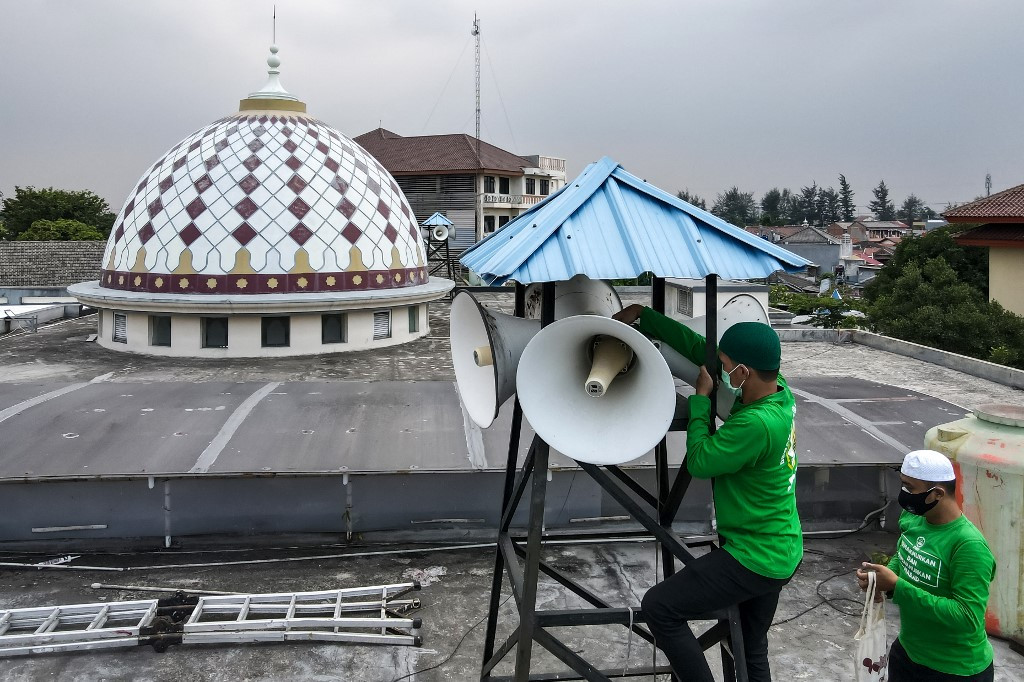
Mosque council mulls 'simultaneous' call to prayer in Greater Jakarta -  Indonesia - The Jakarta Post 

Image - The Jakarta Post

Visitors to Indonesia beware:  Sound off about visual pollution from billboards or trash in rivers or the CO2 assaults on lungs and listeners will nod. But stay mum about noise if the source is a place of worship.  That could be considered blasphemous. The government is tentatively inching towards reform – but not all see a problem.

Compared to its neighbours Indonesia is a relatively liberal state.  The adverb recognises sweeping generalisations get undermined by the termites of details.  First is that ‘liberal’ can be contentious in the world’s most populous Islamic country.

Elsewhere the word usually has positive connotations but for some of our neighbours, ‘liberal’ is synonymous with Western individualism and imagined immorality.  In 2005 the Majelis Ulama Indonesia (MUI - Council of Islamic Scholars) issued a fatwa against pluralism, secularism and liberalism.

Domestic politics were a factor in the peak authority’s prohibition which is not legally binding.  Four years earlier the nation was shaking itself out from under 32-years of President Soeharto’s boot to become a ‘partly free’ democracy.  Leading intellectuals fearing the growth of extremism started the Jaringan Islam Liberal (JIL - Liberal Islam Network), jarring the MUI.

JIL meetings are comfortable places for the open-minded to relax and yarn, but foreigners need to be careful when speaking outside the circle.  It’s OK to whinge about Jakarta traffic and pot-holed roads but shouting against noise pollution can be perilous. 

Sunni Muslims (the majority in Indonesia) believe one of Prophet Muhammad's disciples dreamed that followers needed a continuous reminder of their duties so adzan (call to prayer) was adopted.

No probs in the seventh century when amplification was limited to cupped hands.  But 1200 years later Scottish inventor Alexander Graham Bell started jiggling with electromagnetism, bringing joy to musicians and misery to the reserved.

For Indonesian Muslims loudspeakers have been a godsend, installing them high and turning up the volume to MAX +.   In some mosques, the ustadz recites the prayers and tweaks the knobs with consideration for others. If the preacher can sing the effect can delight whatever the listener’s faith.

At the other extreme small boys learning to recite the Koran and given open mikes provide the best nails-on-chalkboard experiences.

Christians can be just as raucous in provinces where they’re the majority, like North Sulawesi.  On Sunday mornings it’s hard to ponder and impossible to talk when preachers think the Deity is hard of hearing so needs awakening with a good yelling and bell bash.


Grumbling is reserved for the politically and religiously untouchables.  Former Vice President Jusuf Kalla once found the courage to publically remind mosques to keep volumes down, though too little too late.

His call to be reasonable followed a riot in Tanjung Balai, North Sumatra after a middle-aged local woman told a neighbour that noise from a nearby mosque was hurting her ears.

Unfortunately, Meiliana (one name only) is ethnic Chinese and a Buddhist so labelled kafir (unbeliever), an inflammatory combination.  In 2016 fourteen temples were reportedly firebombed and plundered by mobs asserting hurt feelings; the mother of four – who told the court she only wanted the volume turned down - copped 18 months behind bars for blasphemy.

Human Rights Watch claims more than 150 people, mostly from Indonesia’s religious minorities, have been convicted under the blasphemy law since 2004.

Kalla’s request for a show of the tolerance his nation is supposed to display was ignored as mosque management is largely a local matter.  There are no structured levels of authority as in Catholicism.  However, there’s now a slight chance of change with new guidelines announced last month [Feb] by the Ministry of Religious Affairs.

These suggest a limit of 100 decibels; according to one technical site it’s a level ‘considered dangerous to human hearing … and equal to using a lawnmower or a jackhammer.’ The guidelines limit loudspeaker use to the five daily calls, each ten minutes max. 

Times shift according to the positions of the sun, but currently Fajr - 4:48 am, Zuhur - 5:58 am, Dhuhr - 12:05 pm, Asr - 3:10 pm, Maghrib - 6:11 pm and Isha 7:17 pm.

Minister Yaqut Cholil Qoumas claimed the prescribed level will be sufficient ‘to reach the ears of Muslims while preserving harmony with adherents of other faiths at the same time.’  Numerically followers of the five other approved isms – Catholic, Protestant, Buddha, Hindu and Confucius – exceed the population of Australia but are tiny minorities in a nation of 273 million, so usually keep their mouths shut.

All seemingly mild, though not to the right-wing Partai Keadilan Sejahtera (Islamic Prosperous Justice Party) which reckons Qoumas should keep his fingers off the knobs. ‘Let the people manage mosque loudspeakers in accordance with their traditions,’ PKS lawmaker Bukhori Yusuf reportedly said. ‘The rules can differ from one village to another.’

Indeed. This writer counted eight mosques or mushollas (prayer rooms) all with sound systems along a 2.5 km road linking two tiny villages in East Java.  To report that this produces a cacophony might be unwise, so best suggest that some might argue the mix adds to the riches of diversity.

Qoumas has been reported comparing mosque noise with barking canines, animals considered unclean in Islam, but that’s probably a Trump-style dog whistle from his opponents.  Before the pandemic, it was joked that foreigners offered unusually cheap housing should view the property carrying a decibel meter.

One solution is to send calls to prayer on smartphones, heard only by the recipient.  To preserve the peace this idea is best floated by Pak Kalla or Minister Qoumas.

The late Abdurrahman (Gus Dur) Wahid (1940-2009), Indonesia’s fourth president, an outspoken humanitarian and committed liberal, told zealots fossicking through the detritus of casual chat for imagined insults to their faith:  God doesn’t need to be defended.

First published in Pearls & Irritations, 14 March 2022: https://johnmenadue.com/measuring-the-decibels-of-piety-in-indonesia/


Saturday, March 05, 2022

TAKE CARE WHERE YOU AGE


AGED CARE – BETTER HERE THAN THERE?    


Australian politicians like to parade their nation’s welfare and medical credentials, claiming a world-class government-funded system ensures the disadvantaged get the attention they need.

That was the story in the years BC (Before Covid).  It’s different now. The pandemic has exposed policy flaws – particularly with aged care.

If the quote ‘the measure of a civilization is how it treats its weakest members’ often attributed to Indian statesman Mahatma Gandhi (1869-1948) remains apt, then Indonesia is doing better than its Ozzie neighbour.

Here in Indonesia looking after retirees is not a big government responsibility.  Only former public servants, the military and employees of major corporations get pensions, and they’re small.  Just two per cent of the national budget goes on social welfare, while Vietnam and Thailand allocate five per cent. To fill the gap families are expected to protect, watch and provide, and to do so as their cultural duty. 

Readers familiar with kampong and village life will know traditional communities are a mix of newborns, those soon to depart and everyone in-between, students, parents, workers, retirees – every cohort of humanity together.

About 40 per cent of Indonesians live in rural desa (hamlets).  Come dawn the old folk can be seen easing the younger generation’s workload with cleaning and cooking, washing and bathing, much of it in public.

They move slowly, can be forgetful and maybe need a stick for support.  But they’re essential, wanted, not a nuisance.  Those too weak to labour can nurse a babe and expand the littlie’s day with lullabies.

They see neighbours readying kids for school, the mums checking uniforms and satchels. Be tidy, be polite. Never be ashamed. 

  In this mystical mix of ancient traditions, Indonesians show respect for age, the place where we’re all heading.  A quarter of Australians are reported to be lonely. Chance are there’d be only a few Indonesians suffering solitude.


When the old-timers breathe no more, the houses they inherited are passed to the next generation. They’ll lie at the edge of the desa alongside those who’ve shared their lives, like Australians once did in village church graveyards, not a huge and distant impersonal urban cemetery run by a government department.

There are downsides.  The elderly can get grumpy and annoying, especially when criticising young parents’ modern childcare techniques. The facilities are often sub-standard. Most desa have electricity but not potable piped water, leaving rivers to wash, bathe and defecate, which is how President Joko Widodo spent his early years in Solo. 

These villages are nothing like the newer suburbs Down Under where homes commonly house working parents and a couple of kids.  So where are the Grans and Gramps?

In ‘clean, modern, well-supervised residential care’, more commonly known as Old Folks’ Homes.  These began mid last century as a response to women entering the workforce, so no longer available to help aging parents.  At first, the OFHs were small and run by non-profit organisations, often associated with churches and staffed by untrained volunteers.

Then commercial operators moved in. Eldercare has now become big business – and costly. Entry and exit fees, maintenance charges and other imposts often drain savings despite government subsidies. 

Now the dangers are physical.  In one Queensland facility, 100 residents and 82 staff caught the virus. Although the Federal government says victims with other ills are dying ‘with Covid, not from Covid’ the crisis is so bad Army medics have been called in to help with OFH staff shortages.

In Australia Omicron has killed 566 old people and infected 30,000 OFH staff and residents since the first case last November. More than 145,000 coronavirus-related deaths have been reported in Indonesia since the pandemic began two years ago, but we don’t have age data.

We’re all living longer. The numbers of Indonesians over 60 increased from 4.5 per cent in 1971 to 9.6 per cent in 2019. World Bank stats show Indonesian women’s life expectancy is now 74 years and men’s 69.4. Add a decade for the Australian figures.

The Medical Journal of Australia reports Australia has ‘the highest proportion of older people living in institutional care compared with 11 other nations.’

In Australian residential homes, the workers are a rapidly diminishing force. Many are migrants, carers from cultures vastly different from the cared, taking the low-paid jobs Australians reject. So the occupants are much the same age.

A few Indonesians who’ve lost contact with their families sometimes complete their span on earth in ‘nursing homes’. Sounds caring, but a 2020 report from Yogyakarta’s Gadjah Mada University said the term has become ‘embedded in Indonesian society as a place to live for elderly who are poor, are neglected, and do not have families, so it shows unfavourable stigma.’  In brief – putting elders in care is considered shameful in Indonesia.

Maybe this should happen in Australia as Covid reveals the wrongs. A two-year Royal Commission found shocking deficiencies in residential aged care prompting Commissioner Lynelle Briggs to write:

"Life is to be lived. No matter how old we are, how frail or incapacitated we might be, how rich or poor, we all have the fundamental right to wellbeing, enjoyment and fulfilment as we age.

‘In order for this aspiration to become reality, our aged care system must be founded on the principles of unfailing compassion — care, dignity and respect.’

In Indonesia, these necessities are provided by families, not agencies. Maybe something Australians need to accept if their Lucky Country is to be fortunate for all.

##

First published in Indonesia Expat 4 March 2020:  https://indonesiaexpat.id/outreach/observations/aged-care-better-here-than-there/