FAITH IN INDONESIA

FAITH IN INDONESIA
The shape of the world a generation from now will be influenced far more by how we communicate the values of our society to others than by military or diplomatic superiority. William Fulbright, 1964

Friday, October 15, 2021

SLOWLY THE TRUTH COMES OUT


The Big Lie is starting to die     


Thanks to sterling research by a young Australian academic, Indonesians will soon be able to read the truth about their nation’s 1965-66 gorefest. 

Little known outside the nation is a shocking and shameful story: Across six months and much of the archipelago at least 500,000 real or imagined Communists were butchered – an ignominy Jakarta still seeks to hide.

In 2010 Dr Jess Melvin, now at Sydney Uni, collected 3,000 pages of top-secret army Intel during a field trip to the north Sumatra province of Aceh.

Her 2018 book The Army and the Indonesian Genocide: Mechanics of Mass Murder confirmed what historians worldwide suspected though couldn’t prove: That the slaughter was organised by the Indonesian army.

Melvin’s work was published in London and in English, limiting local readership. Now it will be republished in Indonesian on 26 December titled Berkas Genosida Indonesia – the Indonesian Genocide Files. 

The US Central Intelligence Agency called it ‘one of the worst  mass murders of the 20th century, along with the Soviet purges of the 1930s, the Nazi mass murders during the Second World War, and the Maoist bloodbath of the early 1950s.’

The death squads were most active in Java and in Bali where 80,000 were shot, stabbed and hacked apart on what Australian holidaymakers like to call Paradise Island. Thousands of intellectuals, teachers and artists were held in concentration camps and exiled to the remote island of Buru.

The rest underwent indoctrination so only the government’s version of events was heard. Naysayers would be labelled Reds, ostracised or reported to the police as suspect trouble-makers.

Despite the growing doubts many still want the false version maintained.

On September’s final dawn some families in Malang (East Java) woke to displays of Merah Putih (the Indonesian red and white national flag) at half-mast. Every house has a pole at the front gate and overnight satpam (security guards) had hoisted the cotton.

Such jingoism was once common, but commemorations of the 1965 coup which brought the corrupt dictator, General Soeharto, to power have become increasingly rare.  Our street was an exception –we have serving and retired military men and women neighbours ensuring the ritual continues.

The limp flags recalled the deaths of six generals in Jakarta 56 years ago, not the widespread killings which followed. Until the fall of Soeharto in 1998, millions of schoolchildren every year were forced to watch the crude four-hour one-sided film Pengkhianatan G30S/PKI (Treachery of G30S/Partai Komunis Indonesia) though the graphic scenes would rate it R in the West. It was also regularly telecast on the state channel TVRI. 

Now the nation is democracy-lite people are finding the courage to question. Even a Page One cartoon in the mainstream Jawa Pos poked fun: A chef shouts into a phone: ‘Communism’s off the menu. Get something else I can stir’.

The Army’s claims that the slaughter was spontaneous and driven by citizen fury at the generals’ deaths have been conclusively shredded through Melvin’s research.  Using the Army’s papers she has proved the Indonesian military meticulously organised the extermination, handing killers lists of the condemned plus machetes and guns to do the job.

Many thrown into pits and rivers were not PKI but backed its land reform policies. Others were snared in local grievances and victims of vengeance.  US Embassy officials in Jakarta offered to suppress media reports as part of the Cold War strategy.

Donald Trump isn’t noted for his grasp of Asian history yet uses the Big Lie tactics refined by Soeharto: Regularly repeat an untruth from the highest platform in the State till repetition dulls doubt, crush alternative views and sow fear. 

Indonesia’s second president called the coup G30S for Gerakan September Tiga Puluh, Thirtieth of September Movement. This morphed into the acronym Gestapu with all the awful connotations of Hermann Göring’s Geheime Staatspolizei the Nazi secret police who terrorised occupied Europe during World War II.

The lead-up to Indonesia’s genocide isn’t widely known outside the Republic. Between 1945 and 1965 the nation’s founding president Soekarno ran an anti-imperialist policy. In 1963 he started the military Konfrontasi with Malaya as the former British colony moved towards independence.

 Not all Indonesians were on Soekarno’s side.  West-leaning generals feared a peasants’ revolt as the Partai Komunis Indonesia (PKI) grew stronger.  Communists were also considered godless which roused the religious.

The coup lasted only a day before Soeharto took control, nailing down his authority for the next 34 years by declaring martial law, banning free media and launching saturation promotion of only one version of events.

This included a story that dancing naked Communist women had mutilated the generals’ genitals before dumping their bodies down a well.  Although autopsies proved this fiction, the lurid tale lives still, given oxygen by a museum outside Jakarta and giant statues of the dead generals.  

Australian PM Harold Holt was unbothered by the murders next door.  He told  the New York Times: ‘With 500,000 to 1 million Communist sympathizers knocked off, I think it is safe to assume a reorientation has taken place.’

During the 2014 presidential campaign and under pressure from human rights activists, winner Joko (Jokowi) Widodo promised an investigation.  That’s been wiped from his agenda.  Instead, he’s been photographed watching and approving the ghastly film.

Kontras (the Commission for Missing Persons and Victims of Violence) spokesman Tioria Pretty told local media ‘the shadow of fear’ tagging Communists as evil atheists has become fixed in the national memory, making resolution difficult.

Now in his final five-year occupancy of Jakarta’s White House, Widodo – a small town civilian businessman before entering politics – is seen surrounded by uniforms urging vigilance against an uprising, with no evidence one Red seed remains.  The under-employed men in khaki continually remind they ‘saved the nation’ so need respect and power.

Writing in The Conversation and The Jakarta Post last year Melvin warned: ‘Perhaps most worryingly, the military in Jokowi’s second term continues to increase its influence. Jokowi has allowed key military figures to hold important positions in his administration.

 ‘(Indonesia) faces two stark choices. It can seek to investigate and make public the atrocities that occurred in 1965-1966, in the hope of never again allowing the country to sink into such horrific violence.

 ‘Or it can continue to deny military agency behind the 1965-1966 killings, while actively re-establishing one of the key policies that allowed the military to commit such atrocities in the first place.’

A year on Melvin told this writer: ‘The government still needs to fulfil its obligations to investigate. The Aceh Truth and Reconciliation Commission is just about to submit its final report into human rights abuses during the Aceh conflict, which could act as inspiration to legislate for the promised national TRC.’


(An estimated 30,000 died during almost 50 years of fitful fighting between the pro-independence Free Aceh Movement, and the Indonesian government. The 2005 peace agreement has given the deeply Islamic province some autonomy.)


The other inspiration will be the publishing of Melvin’s book in Indonesian.  Then the public can read the truth for themselves – and leave the flags folded next 30 September.


Duncan Graham is an Australian author and journalist in Indonesia.

First published in Australian Outlook, 15 October 2021:https://www.internationalaffairs.org.au/australianoutlook/indonesias-big-lie-is-starting-to-die/


Thursday, October 14, 2021

THE CHANCES WE LOST


            The Kampong of Broken Dreams    

Paul Keating, Dtuck in an 80s Rut | International Interiors 

(Image - International Interiors)

Had Paul Keating’s initiative in securing the 1995 Security Agreement with Indonesia survived we’d have a local ally so wouldn’t need AUKUS,  or old-timers from Defence and DFAT telling our Asian neighbours they’ve nowt to fear from the  Anglosphere.

That’s the logical conclusion from reading Professor James Curran’s revelations on this website of the secret negotiations leading to the agreement, described by researchers as ‘one of the most important recent developments in Australian foreign and defence policy’.

The deal, though short-lived, encouraged Jakarta  to reappraise its neighbour, and shift Canberra to see possibilities based on geography rather than history.  It collapsed partly through clumsy dealings with the idiosyncratic Bacharuddin Jusuf (BJ) Habibie over the future of East Timor.

John Howard’s suggestions for getting rid of the ‘pebble in the shoe’ were mishandled by the impetuous third president.  This led to a referendum and the former Indonesian province securing  independence.  Hundreds were killed, thousands displaced and property destroyed in a scorched earth retreat by the losers.

East Timor is independent, but the pebble is now a rock reminding nationalist Indonesians of their defeat and shame at the hands of a minor foreign power.

Had more diplomatically adroit and culturally cautious leaders been around we might still be benefitting from Keating’s vision.  Now the US and China are jostling to get Indonesia on-side and being rebuffed while we’re trying to repair the self-inflicted damage done by siding with Washington and London to counter Beijing’s aggression. 

The SMH reports senior diplomat and first ambassador to ASEAN Simon Merrifield will review Australia’s relationship with Indonesia.  Three former defence chiefs will march around explaining we’re cuddly bunnies, despite buying nuclear-powered subs and stationing US troops on our northern shores facing the region.

It might be more effective to send smart Asia-literate youngsters in tune with the times to tell of Australia’s worries and intentions. Almost a third of Indonesia’s population was born this century and knows nothing of the 32 years when the corrupt dictator and kleptomaniac ($35 billion according to some accounts) Soeharto ruled with the military.

Curran’s account of Keating’s attachment to Indonesia illuminates some of our troubled recent history with the people next door. Tragically, the former PM’s ‘magnificent obsession’ with Asia hasn’t infected his successors, though they always chant the mantra about the Republic’s importance while peering over their listeners’ heads to the distant north.

Our biggest embassy / fortress is in Central Jakarta, but it might as well be in a kampong lean-to for all the good it’s doing to build better people-to-people relations.  It does little to persuade Indonesians that we’re friendly folk deeply interested in their nation beyond Kuta – the lives, beliefs and history of a complex people in an ancient archipelago.

Our inability or refusal to get close is matched by Jakarta’s indifference to Canberra under current president Joko Widodo who shows little interest in foreign affairs.

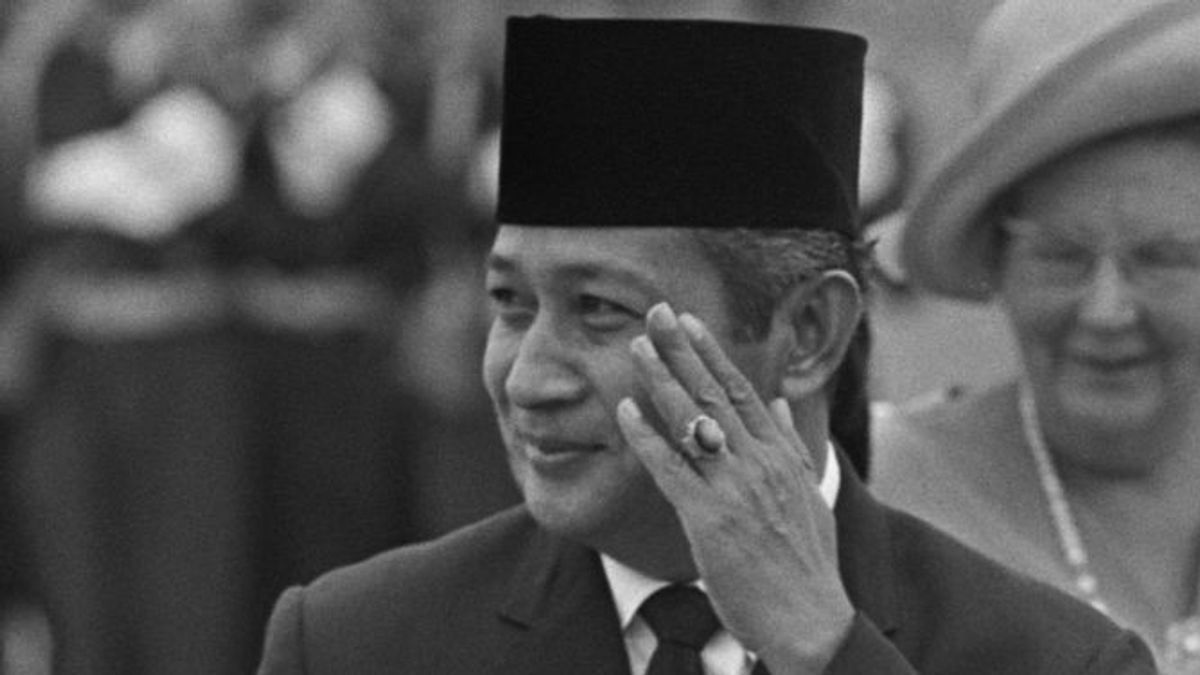
Nasihat Guru Spiritual, Rama Dijat yang Dituruti dan Ditolak Soeharto:  Selamat dan Petaka Orde Baru

(Image VOI id)

Curran’s article raises many questions.  When Keating was dealing with Soeharto he knew the Indonesian leader was a villain. The former general had overseen the slaughter of an estimated 500,000 real or imagined Communists after the 1965 coup and sent thousands of the nation’s best and brightest to an island concentration camp.

The CIA labelled it ‘one of the worst  mass murders of the 20th century, along with the Soviet purges of the 1930s, the Nazi mass murders during the Second World War, and the Maoist bloodbath of the early 1950s.’

Australian scholar Dr Jess Melvin, who exposed the army’s role in organising militias to do the butchery, called it a genocide.

How could an Australian Labor Party leader get so close to Indonesia’s Goebbels? That the two apparently hit it off when neither could speak the other’s language is weird.

One man was a rationalist, hard-wired into Western values, the other an ill-educated street-smart soldier steeped in Javanese mysticism. Soeharto thought it OK to sacrifice half a million of his nation’s citizens to halt his predecessor’s journey to the left and embrace the US which rewarded the shift with goodies galore reinforcing graft.

The timing of Keating’s initiative damaged the result.  By December 1995 when the agreement was signed Soeharto’s authority was waning.  Access to the Internet and fearless journalism from Tempo magazine was rousing dissent. Photocopies of banned Western magazines exposing Indonesia’s woes were openly offered to motorists at intersections.

Keating’s motives were strategically right but morally wrong.  It seems he believed pragmatism crushed standards and no ghastly history showing his counterpart was saturated in gore could drown a determination to have his policy prevail. 

If that’s right so are the cynics who claim there are no principles in politics that aren’t expendable - however deeply embedded in a culture and hardened by time.  As Niccolò Machiavelli wrote, ‘the ends justify the means’.

Last century’s idea that Indonesia might be a threat was ridiculous.  It was founded on Australian ignorance and fear of Asians, exploited by malicious politicians.  Even the most belligerent generals and Muslim extremists dreaming of a Caliphate never had the resources or will to attack Australia, so Soeharto’s assurances were easy to give.

Keating’s work placated the xenophobes, but more significantly the security agreement created a foundation for others to reinforce.  It was all the more remarkable because it ran counter to the non-alignment ‘free and active’ rule usually attributed to first vice president Mohammad Hatta.

Since then it’s been hardened by the 1955 Non-Alignment Movement and sixth president Susilo Bambang Yudhoyono’s tagline of ‘having a million friends and zero enemies.’

No chance now of another agreement with Australia.

First published in Pearls & Irritations 14 October 2012: https://johnmenadue.com/paul-keatings-indonesian-vision-has-been-undone-by-his-successors/

Monday, October 11, 2021

HANDLING COVID THE JAVANESE WAY

 UP, DOWN, IN, OUT, DON'T KNOW - CAN'T TELL


Despite fears of a third wave, the pandemic seems to be waning in Indonesia, once Southeast Asia’s disease epicentre.  Infections are down to a daily average of 1,600, a fraction of the peak reported mid-July.  Deaths hover around 100 a day.

With these summery results lockdowns are ending and kids heading to school. Bali will open to foreigners on 14 October.  UK Immigration has pulled the Republic off its ‘must-quarantine’ red list. Seems like a success story in the world’s fourth most populous country, but there’s a more wintery tale to tell.

The government says there have been more than 4.2 million cases and 142,000 coronavirus-related deaths across the archipelago since the plague landed early last year. 

Why so bad? Sana Jaffrey director of the Institute for Policy Analysis of Conflict in Jakarta blames ‘a mix of denial and dysfunction (which) led to a catastrophic surge of infections.

‘(President Joko) Widodo views the pandemic primarily as a threat to economic stability, rather than a public health crisis … his pandemic response team is dominated by business interests. It is hard to think of a country other than Indonesia where the minister for economic affairs is in charge of fighting an infectious disease.’

The figures above are from Reuters which uses Health Ministry sources. As reported earlier some epidemiologists and NGOs don’t buy the numbers.  A crowd-sourced group of independent health professionals and statisticians calling themselves Lapor (report) COVID-19 are offering figures dramatically different from the government’s data.
 
When officials said the daily infection rate was almost 1,700 new cases, Lapor alleged the reality was closer to 88,000.  On one day the Ministry reported 142 deaths while Lapor – which claims to get info straight from doctors and hospitals bypassing the bureaucracy – said 250 had died.
 
The problems include distrust in government – a legacy of 32-years of one-party authoritarian rule which banned free media – fear that hospitalisation means death, and a flawed testing regime.  

One example is a three-sided tent, big enough for a couple of tables and a few chairs.  It stands at a busy intersection on Jalan Ijen, the most prestigious address in the East Java hilltown of Malang. There’s enough space nearby for hundreds to queue, as they do for Covid checks in Australia.

When P & I called after 3 pm midweek the pop-up clinic had been open for seven hours.  Yet only ten people had swabs stuffed up their nostrils by entrepreneurial staff from an Army hospital.

That info is a conspiracy theorist’s dream.  For the denialists it proves people are unworried because they know the virus is a myth and a Western plot to demonise Asians. 

Read on for a less lurid explanation: The procedure costs Rp 99,000, a third of the fee charged elsewhere and just under ten Aussie bucks.

For that money, you might enjoy a coffee and cake after getting a free test Down Under.  But here in Indonesia, that’s a day’s wage for a truckie or factory hand. However sick they feel, testing’s not an option.

The logic is raw:  Few tests, so no reliable data to build effective policy.

Two people have died in our street during the past three months.  Both were elderly Muslims buried without an autopsy.  Inevitably stories germinated that Covid was the killer, reinforced when the police arrived and a yellow flag was hung at the gateway.

Indonesia has a system of oversight that would horrify Westerners concerned about privacy and freedom. During the 1942-45 Japanese occupation the army set up the Tonarigumi household control and spy structure.

The new Republic kept the regimen once the war was over, renamed Rukun Tetangga (neighbourhood association).  Many duties involving ID cards and family units have been taken over by government, though not jobs like organising funerals and support for the bereaved.

Our RT said all residents would get tested and the street sprayed.  Nothing happened, though the flag is now green.  Another reality check: No tracing, no foundations for public health strategies.

The intense interest in the infection shown by the media in Australia isn’t duplicated in Indonesia where readers and viewers find stats a turnoff – unless they relate to soccer scores.

To counter social media scares TV stations run pre-recorded videos of the President giving assurances.  The Palace rarely has full-on media conferences where journos are free to query.

Regional governments have blitzed streets with posters promoting five routines – hand washing, wearing masks, keeping apart, staying home and exercising.  To add authority they’re topped by images of uniformed provincial governors, police chiefs and army generals.

The photos are supposed to suggest comfort, but the smiles look forced because they know the orders will be widely ignored.  Market crowds are thick, traffic jams routine and in one rough survey two-thirds of people on the street were maskless.

Sirens are more commonly heard, though not all are shrieking ambulances.  Despite pledges to develop an egalitarian society when the Dutch were thrown out last century, officials have retained the arrogance of the former colonialists.

Real or imagined VIPs get a police escort to barge their way through the traffic; angry drivers refuse to pull over disbelieving there’s an emergency, adding to the chaos.

It’s not all depressing.  Widodo wants 2.5 million jabs a day and seems to be getting close. Nearly 146 million have had one needle, mainly with donated Chinese vaccines. Assuming all need two doses, then around 27 per cent of the population of more than a quarter-billion has been covered so far.  The vaccines are free.


So are oxygen refills for patients at home where hundreds are reported to be dying rather than go to hospital.  There’s a government-run voluntary national health scheme but participants have to pay monthly – currently Rp 300,000 ($30) a couple for top cover and visits to some GPs.

Covid has cost plenty - Jakarta is budgeting for an AUD 9.07 billion deficit next year, 4.85 per cent of GDP. Next April new taxes will hit consumer goods.

There are no Job Keeper or Seeker schemes to cushion the unemployed, though the seriously poor are eligible for some relief.  Mosques, churches, corporations and concerned individuals hand out food parcels, often on street corners.  The system is ad-hoc so many miss out.

Since February it’s been compulsory for all citizens to be inoculated, with refusers facing fines and denial of services.  Enforcement will be impractical and unlikely outside formal situations. All mainstream religions have endorsed vaccination. 

The mandate debate that wraps some Australians’ knickers in knots is seldom heard. The aggrieved find it best to keep quiet in a culture that puts community above individualism. Sovereign rights belong to the State.

First published in Pearls & Irritations,  9 October 2021:
https://johnmenadue.com/mishandling-the-covid-19-pandemic-the-javanese-way/