FAITH IN INDONESIA

FAITH IN INDONESIA
The shape of the world a generation from now will be influenced far more by how we communicate the values of our society to others than by military or diplomatic superiority. William Fulbright, 1964

Sunday, May 25, 2014

LETTING THE ART SPEAK THROUGH WAYANG ORANG

Dancing away discrimination 
                               
The dancers’ and musicians’ phones stay silent.  They haven’t rung for about a year since the last big show in the East Java hilltown of Malang.  Unless things change soon it will be time to hang up the ankle bangles.
For wayang orang, the elegant Javanese performance that uses traditional wayang kulit (shadow puppet) themes drawn from the great Hindu classics of the Ramayana and the Mahabharata is being pushed off stage.
The sharp elbows and being exercised by Western-style pop groups, gaudy comedy skits and ear-grating karaoke performances.
The glory days of high Javanese culture outside Yogyakarta seem to have passed.  The sepia invitations and programs are fading despite the plastic wrappers. But even when well preserved the photos of partying VIPs pin dates precisely.  Did people really dress like that last century?  How droll!
All this should lead into a sad tale about Shinta Dewi Kusumawati, whose Bara Pra Tama group performed for more than two decades before national leaders and their guests across the archipelago.
It also showcased Javanese culture at ambassadorial events through Asia, Australia, the United States and Europe – including two months in Spain.
But the jolly 72 year old, who still moves with the grace of a dancer at ease with her body, will have no tears dripping on her albums. 
“That’s all in the past; the high point was the 1990s.  One day we performed four times. But it was wonderful while it lasted,” said the dry-eyed optimist.
“I started the group because I loved indigenous dance and wanted to share it with the world.
“The problem today is funding, and officials not wanting big dance groups to open events. It costs around Rp 40 million (US$ 3,500) for a full performance.  It requires an effort by Government to preserve our culture. 
“Who knows – wayang orang may yet become popular again.”
If it does she’ll be well prepared.  Her house is like a factory with a neat office out front but a cavernous warehouse behind;  Ms Aladdin’s Happy Place.
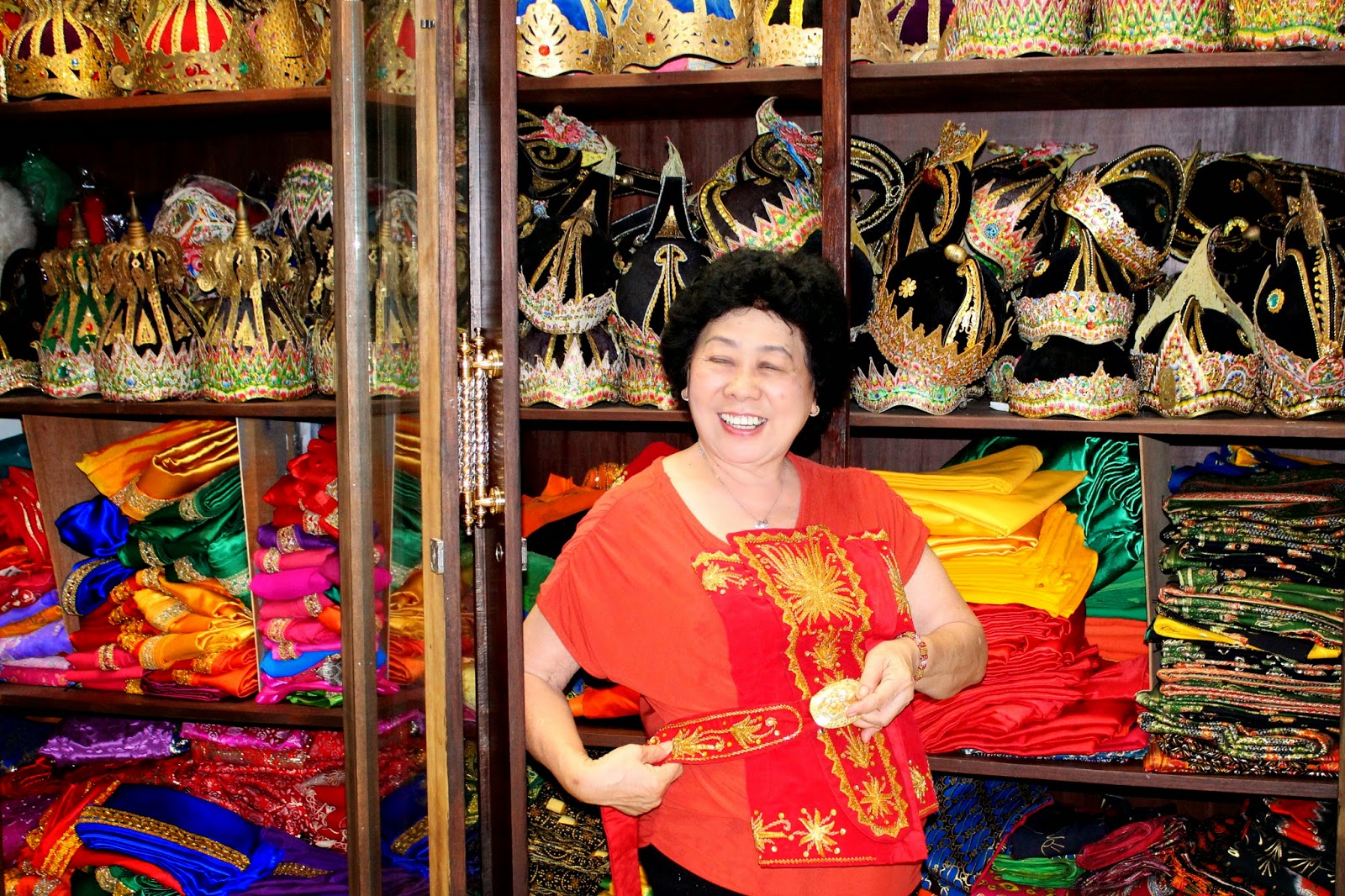

Wardrobes and cupboards jostle with boxes and showcases. Cabinets and drawers squeeze lockers and trunks, all full of an astonishing collection of costumes and accessories.
These aren’t museum pieces, they’re ready to wear, every besequinned batik imaginable, multi-layered jackets, gemstone-studded headdresses, gorgeous skirts, bracelets and beads – all in top condition.
There’s, enough gear to stage an historical TV mini-series and know the characters will look authentic even if the script is suspect.
Need a wavy-blade kris to thrust into a belt or evildoer?  Or a bow and arrow to shoot a hart that morphs into a dying princess, a heartless action? This is your one-stop weapon store.
Every few weeks the costumes lift their skirts and step out of the closet for some anti-mold sunshine therapy. Then they smooth out the wrinkles and jostle their way back into the wardrobes to hang out with their mates.

In Shinta’s front room where the sideboard sags with trophies, are sets of garment goodie-bags.  They’re waiting to be collected for a wedding, the costumes for tari gambyong, the serpentine-armed dancers who greet guests.
Curiously the custodian of all this culture isn’t a kraton-born ethnic Javanese.  Shinta’s original name before she was forced to change by the Soeharto government during one of its many attempts to suppress the Chinese, was Kwee Kiat Siang.
Although she married a Chinese, the late Oei Fee Ling, the couple’s daughter Irene Kartika Widjaya, doesn’t have her parents’ features. She worked as a model and became a principal dancer in Bara Pra Tama.  ‘Kartika’ means a star.
Irene looks so much like a photocopy version of the national heroine that she was regularly featured as a Kartini lookalike in hobbling sarong and kebaya (traditional tight blouse), the exemplar of Javanese womanhood. 


Her Mom said Irene stopped entering Kartini competitions when judges asked her how much she’d pay to win.
“I used to keep out of the way and adopt a low profile when we gave performances because in those days there was still prejudice against the Chinese,” said Shinta.  She stayed busy behind the curtain repairing rips, finding lost props, soothing hurt feelings and then scrutinizing the accounts.
“Some didn’t like the idea of a Chinese being involved in wayang orang, but they accepted it when they saw Irene perform.
“Our family has been here for hundreds of years.  I don’t know where we’re originally from and I don’t even speak Mandarin.
“Although I was trained for ballet I’ve always loved wayang orang.  When I first saw it as a child I was learning ballet.  However I thought at the time that if I have a daughter I hope she’ll want to become a Javanese dancer.”
She did. Irene, 42,(left, in her dancing days) now lives in Jakarta and hung up her crown about six years ago for motherhood and a business career.  She said Shinta who always accompanied the 40-strong group on its overseas performances, was never a pushy Mom, but a woman dedicated to “keeping alive the beautiful cultural inheritance that we all share.”
“There is no difference between the Chinese and Javanese, we are all Indonesians holding hands together,” said Irene.
“I wasn’t aware I was different until I went to university and was labelled because I was Chinese and Catholic.
“We must see the good in each other, not the differences. We are all human – don’t put us in boxes marked ethnicity and religion.”
Said her mother Shinta: “Wayang orang represents the spirit of life.  It’s not nationalistic, but it helps us understand who we are.”

(First published in The Jakarta Post J Plus 25 May 2014)


Friday, May 23, 2014

WHAT CHANCE A STABLE INDONESIAN GOVERNMENT?

The Sorcerer’s Apprentice Doomed   

Jokowi among mates in Malang,  But the scene will be different in Jakarta.
                                 
On 9 July an estimated 187 million Indonesians will have the chance to directly elect their next president.  Current front runner is former Jakarta governor Joko Widodo (Jokowi), pursued by military man Prabowo Subianto. Jokowi has Jusuf Kalla, a former vice president (2004-2009) as running mate in a pairing billed as youth and experience. But as Duncan Graham in East Java argues, this could be a dysfunctional partnership.
…………………….
Drum roll and trumpet blast.  “Ladies and gentlemen, please be upstanding for the next President of the Republic of Indonesia, Haji Doktor Muhammad Jusuf Kalla, exemplary businessman, outstanding political leader and internationally renowned peace-maker, the man who will take this great nation forward to its natural destiny.
“Some of you may have heard he’s the Vice Presidential candidate; technically that’s right. But we all know who’ll be the Big Man around here.” (Applause and laughter.)
Indonesians defer to seniors. Kalla is 72, an age where ambitions have flatlined and a man no longer cares what others think.  Should he still be standing when his term ends in 2019 (life expectancy for Indonesian men is 68) he’ll be more concerned at juggling his great grand children than jostling for sinecures in academia or the UN.
After a career just a heartbeat from the top, the moment has come to stop being an also-ran. For the past five years he’s sat as chairman of the Red Cross in its Jakarta office.
From there he’s watched his former boss Susilo Bambang Yudhoyono (SBY), the man who dumped him in the 2009 election campaign because he was too threatening, let the people’s mandate slip from his grasp and become President Bland.
This is Kalla’s final chance to make his mark, to achieve greatness, to be remembered as a Sulawesi hero who trounced the Javanese. He’s got nothing to lose.
Who’s going to roadblock?  Jokowi, a furniture businessman from a provincial town, briefly the Governor of Jakarta? He’s a candidate with no qualifications for national leadership other than being what the others are not – an unpretentious man of the people who seems to want a better Indonesia, not personal power and limitless wealth.
Wearing a plain shirt, walking to work and eating bakso (meatball soup) on the sidewalk is great media but it’s not statesman stuff. Indonesians expect leaders to strut.
If Jokowi has a philosophy it’s that we should all be nice to one another.  Another mild guy preached that 2,000 years ago and look what happened to him. 
In the chilling documentary The Act of Killing about the 1965 massacre of communists, Kalla promotes violence at a rally of paramilitary thugs called Pancasila Youth: (Pancasila – five principles – is the State ideology).
“The spirit of Pancasila Youth, that some people accuse of being gangsters. Gangsters are people who work outside of the system, not for the government. The word gangster (‘preman’ in Bahasa Indonesia) comes from ‘free men’. This nation needs ‘free men’.
“If everyone worked for the government we’d be a nation of bureaucrats. We’d get nothing done. We need gangsters to get things done. Free, private men, who get things done. We need gangsters, who are willing to take risks in business. Use your muscles! Muscles aren’t for beating up people. Although beating people up is sometimes needed.”
Yet at another time and place he was deservedly applauded for cutting peace deals after prolonged fighting in Aceh and the Moluccas, resolutions that had escaped SBY and his predecessors. There was talk of a Nobel nomination.
Kalla is equally at ease in the departments, the mandarins are his mates. He knows where the skeletons lie, and the living know he knows.
Jokowi may be the little people’s hope for change, but he’s an outsider in Jakarta’s intertwined incestuous, elite and corrupt political establishment.
He has no organised personal powerbase. He doesn’t have a daughter married to a minister or a son who runs a pesantren (Islamic boarding school). His wife has no brothers who are generals or sisters married to megatycoons.
He’s never  communed with Javanese spirits in a mountain cave or featured in a mystic’s prediction. Neither has he ever ordered a battalion to load live ammunition or shaken world leaders’ hands.
Kalla once drove Golkar, former president Soeharto’s political vehicle now rebadged as a democratic people mover. He’s old enough to be 52-year old Jokowi’s Dad and even claims to have persuaded the former Solo (Central Java) mayor to move to the Big Durian and stand as Governor.
When Kalla was manipulating the nation with Soeharto the lanky forester was in Yogyakarta  studying timber.
Kalla won’t need to remind his protégé about the differences; why state the obvious? He’ll let the youngster make speeches and look important when visitors come.  He’ll show him around the traps if he has time, introduce him to a few mates from the old days, point out the toilets, correct his English – that sort of thing.
Unless Jokowi can assert himself from the moment the Koran is raised above his head as he takes the presidential oath, his term is doomed. He’ll be cipherman, not superman, Indonesia’s Jimmy Carter – nice guy, no mongrel.
Kalla won’t be his only problem.  A popular cartoon doing the smartphone rounds shows a baby Jokowi nursed by mother Megawati Soekarnoputri (daughter of Soekarno) a former inept President and the she-who-must-be-obeyed head of the misnamed Indonesian Democratic Party of Struggle (PDIP) that nominated Jokowi.
She’s in the game to keep her founding president Dad’s name alive when this generation, with 67 million first-time voters, has already moved on. Daughter Puan Maharani wanted to be Jokowi’s running mate till someone chanced upon a remnant grain of reality. The party continues to be riven by sinetron (soap opera) plotlines, not magisterial policies to inspire great deeds.
Then there’s Indonesia’s Macbeth bewitched for greatness – even named after a revolutionary martyr hero and son of a famous economist.  At 62 former general Prabowo Subianto, once Soeharto’s son-in-law, still bristles with military authority. Self doubt is not his suit. If he hadn’t been so ruthless and arrogant when in uniform and been discharged from the Army he’d be checking the presidential garage right now to see if its big enough to take both his Mercedes and helicopter.
Jokowi doesn’t need to worry – his bike will fit anywhere.
Prabowo has already mustered a coalition that will control more than 50 per cent of the Parliament, ready to wage political guerrilla war on the former Jakarta governor’s shortcomings, as Tony Abbott did on Julia Gillard.  If Jokowi doesn’t fight back furiously he could get impeached, like fourth president and equally decent man Gus Dur, and retire hurt.
In this bleak scenario the stability of our nearest neighbour, the region’s biggest economy and the world’s most populous Islamic nation could be under serious threat.

(First published in On Line Opinion, 23 May 2014http://www.onlineopinion.com.au/view.asp?article=16335    )

 ##

Sunday, May 18, 2014

KAMPUNG INGGRIS: INDONESIA'S CENTER FOR 'ALLO MISTERS'

Language lite in gritty city


Westerners planning a trip to Pare should pack patience and good humor before they visit the East Java town known as the English kampong.  Duncan Graham reports.
Anyone with white skin, a long nose and taller than the locals is an unprotected species in Pare, once an agricultural center of 18,000 people servicing the vast fertile plains around nearby Kediri.
Now Pare’s prime industry is teaching English, with conversation classes a main feature.  But with whom?  Enter the prey – a strolling foreigner grazing the streetscape. The students salivate – who’ll leap first?
Most know the traditional ‘Allo Misterrrr’ approach is ineffective (particularly towards women) so have refined their behavior.  The pack pounces; encounters are friendly, but wearing and there’s little escape.  Welcome to Kampung Inggris.
“I don’t like the term,” said Mohammed Kalend Osen, the man who started it all almost 37 years ago. (See sidebar.)
“It suggests that everyone in the street speaks English and that’s not true.  I don’t want people disillusioned.  From the time I first started the Basic English Course (BEC) till the year 2000 there was just my school. Now see what’s happened.”
At first glimpse Pare seems a delight.  More than 120 ‘schools’ offering a rijsttafel of courses to suit all learning tastes. 
Across the road from BEC, alongside, behind and beyond, BEC’s rivals shout for business with gaudy banners and risible names.  

London, Oxford and Cambridge get honorable mentions, but the Oscar contenders for the most pretentious have to be the UNESCO Course, Wall Street Academy and the Onthel Islamic Institute, named after an ancient bicycle. Slogan: ‘The onrushing nomad of the English language’.
Close behind are The Valiant and Choice, which offers an imaginative set of programs including ‘cocoon speaking’ and ‘crust grammar’, while Venus gently implies less cerebral  delights. By contrast Melbourne shouts its main attraction – Girl Camp.
At this point let’s take a reality culture check. In Pare ‘camp’ means a single sex dormitory where English is supposed to be used 24 / 7, not a wild Woodstock love-in under canvas.
Most students are in their early 20s wanting to better their English for work or higher study.  They heard about Pare from friends and the Internet, and most are venturing afar for the first time.
“Just heading to study English in East Java for a few weeks, Dad’. Thank God she’s not going to heathen Australia where free sex rules.
Some schools, like BEC, are strictly Islamic, enforcing moral and dress codes, particularly on the women.  Despite this the energy and excitement of thousands of young adults gives Pare a fun feel. You can almost smell the hormones.
Management student Dwi Yandika Putra, 20, and his accountancy mate Muhammad Rifki Alhabib, 21, both from Jakarta though originally from Sumatra, freely admitted that meeting women was a major attraction.

“The girls here are more prepared to open their hearts,” said Rifki.  “It’s easier to get to know them. We can mix with people from all over Indonesia and make new friends.”
Added Dwi: “Pare is so refreshing after the chaos and pollution of Jakarta.  This is the real Indonesia.  The landscape is fantastic.”
Indeed, but it also includes nearby Mount Kelud that exploded last month (Feb) showering the town with a gritty grey sand that makes sidewalks slippery.  Many choose to ride bikes, easily rented at Rp 70,000 (US $6) a month.
Several industries have sprouted to service student needs in Pare.  Facilities include boarding houses, laundries, photocopy kiosks, restaurants and coffee shops – though surprisingly few booksellers.
Pare isn’t a tourist town so has been spared the exploitation virus that infects places like Bali.  Food, transport and accommodation costs are genuine rural rates for inland Java. Students said it was easy to live well for Rp 1.5 million (US $130) a month including tuition fees.
Demand for space to build new schools has boosted land values tenfold, according to Pare Town head, Ahmad Wahyudiono.
“In the holiday season we get up to 10,000 students,” he said. “So many other industries have grown up to serve their needs – our economy has tripled. People now have work who were previously jobless.
“It’s not our job to give permits for schools.”

Fleeing the forest

Muhammad Kalend Osen (right), now 69, grew up in Serbulu, East Kalimantan.  His father was a farmer and the lad worked for a timber mill.
“The Singaporean owner spoke English, and so did my uncle who’d been in Malaysia,” he said.
“I admired them and wanted their skills.  I knew I had to get out of the forest and make something of my life. I also had no religion and I needed faith.”
Aged 27 he moved to Java and became a Muslim. “It was my time of revolution,” he said. “If I’d gone to a Christian area I’d probably now be a Catholic or Protestant.”
He studied English at an Islamic boarding school near Ponorogo, East Java and found the going tough, claiming it took him a year to achieve the results now reached by his students after three months.
He married a teacher from Pare and moved to the little town. A couple of friends sought him ought to help with their studies.
“I thought there might be a business here,” he said.  “My wife inherited land and we started BEC.  Now more than 20,000 have studied with us.  We currently have around 600 students from everywhere in the archipelago – we’ve even had two from Thailand.
“The 15 staff are mostly former students with teaching ability that I’ve selected.
“I understand the criticisms but my methods have been developed through experience.  Yes, I’m authoritarian, I believe in discipline.  I know what works.  The most important thing is to have spirit.
“I use US President John Kennedy’s quote to inspire students: ‘Ask not what your country can do for you, ask what you can do for your country’.
Among Kalend’s techniques is to bus students to Borobudur to meet foreigners. The military style pre-assault briefing includes examining a model of the massive Buddhist temple to determine the best ambush spots. 
“Not at this entrance,” Kalend advises.  “Wait till they’ve finished enjoying with their darlings.”
Teuku S Iskandar, 21, came to BEC last October. He now speaks English with earnest confidence having “got 14 foreigners” on his last visit to Borobudur from 15 approaches.  He’s happy to chat about anything, including religious differences.
“In my homeland of Aceh the teachers weren’t serious,” he said. “They didn’t care whether we learned or not. Once I complained and got a D mark.  In Pare I had to start again with the alphabet.”
“I never went to university,” said Kalend. “I’ve never been to an English speaking country. We tried employing a native speaker once but there were too many cultural differences.
“He was from Scotland and didn’t even understand pluperfects. A teacher has to know.
“No-one from the government has ever been to check what we do.  Even the regent hasn’t visited.”

Comment: Micky Mouse education?


It’s easy to ridicule the Pare model.  Unqualified teachers with no overseas experience, uncertified courses and negligible resources. Uncorrected errors cemented as fact.
BEC, which is the biggest show in town with a splendid musholla and a major building expansion underway, has no language laboratory or library.  Class sizes of 40 students in plain rooms make individual attention impossible.
The sounds of Pare aren’t the clatter of traffic but Islamic pop and the ritual chanting of chirpy but soulless greetings: ‘Good morning Madam, how is your day today? The weather is fine, is it not?’’ Conversation minus cadence makes for sterile communication.
This is teaching language without culture, making English like Esperanto, the constructed tongue that failed through want of human roots.  Absent is an understanding of the ancient and complex language streams that have made English the dominant force in the world. 
Pare pedagogy is English lite, de-caffeinated and mild.  Regulation-choked Western states would close every school and probably launch prosecutions.  Yet despite the flaws and faults something is working that’s hard to dismiss.
Pare’s success indicates failings in the State education system and rejection of the fees charged by more structured private schools like English First. But that’s not all.
A critical mass of self-motivated learners sharing a common goal, driven by a cautious sense of adventure, generates its own energy.  Maybe Indonesian learning styles are organic; they’ve evolved and work best without outside interference. There’s a doctoral thesis lurking here.
Last August the Pare model was transplanted to Karang Indah in South Kalimantan to build tourism and help locals get work overseas.
There’s no independent evaluation. Those who fail to master the language don’t rush to journalists.  Others, like Sovi Ardiansyah, 18, have found the confidence if not the vocabulary.
“Hello Sir, I’m Sovi from Chile,” he announced, darting through traffic at the sight of a freckled face.  South American?  The guy looks unalloyed Indonesian.  
“You know Sir, next to Bali.  We call it Lombok, you say chilli. Ya?”
Well, no, but who cares. Two men from wildly different backgrounds and cultures share a few laughs and bridge gaps. That’s the Pare effect.

(First published in The Jakarta Post 14 May 2014)
##

IMPROVING THE RELATIONSHIP

By the way:
Trust me, I’m from Australia
Thanks to certain unidentified whistleblowers, this column can now reveal details of the top secret negotiations underway between Indonesia and Australia following last year’s spying scandal.
Readers will remember the Australian government greatly offended its northern neighbor by tapping the phones of President Susilo Bambang Yudhoyono and his good lady wife Ibu Kristiani Herawati.
The outraged president demanded a new code of conduct between the nations before formal military cooperation could be reintroduced. Since then senior bureaucrats, etymologists, black-letter lawyers and spin doctors have been seeking the right words to resolve the impasse and soothe hurt feelings. 
Here’s our exclusive – details of Australia’s response - which fell off the back of a becak.
ETHICAL CODE OF CONDUCT (Draft 149a). Without prejudice.
1)      PREAMBLE: Australia will never, ever, cross our hearts, swear on the blood of our convict ancestors, spy again on our dear and most trusted best friends in Indonesia - unless it’s in our national interest, or we are instructed to do so by Washington.
2)      BORDER RESPECT: We pledge to acknowledge and respect the sovereignty and territorial integrity of our great neighbor.  We will never again cross borders without the gracious permission of the Indonesian Government – unless our navigational equipment malfunctions.
3)      NO SURPRISES: We will always notify you of any policy decisions we may or may not make from time-to-time before public release. However we cannot be held responsible for any leaks published by the mongrel media causing you great embarrassment. This we will regret.
4)      DISCLOSURES: Should such leaks occur, we categorically pledge to launch thorough inquires into the source (unless we leaked).  We will condemn the stories as lies perpetrated by unnamed mischief makers, traitors and unpatriotic journalists.  However it must also be understood that we support absolutely the freedom of the press in a robust democracy.
5)      LAW: Should Indonesian slaughtermen kick our cows, or customs arrest our drug mules we will urge our citizens to respect Indonesian rules - even though we think they’re weird. Your laws, not our people.  However we reserve the right to interfere should the Australian electorate get annoyed to the point where our seats in Parliament are threatened.
6)      DISQUIET: Australia will never knowingly use megaphone diplomacy or make inflammatory statements that insult Indonesia and arouse public disquiet – unless these are in our Machiavellian master plan. Which we don’t have.
7)      SEPARATISM: We will not tolerate Australian NGOs grandstanding on separatism in West Papua. No ifs, buts or maybes. We will contrive to be outraged and issue awesome media statements. See Clause 8.
8)       PROVOCATION: Should the Morning Star flag be raised on Australian soil we will monitor the situation closely.  That’s our clear and unequivocal position.  We cannot yet control the Opposition parties, the churches, NGOs and others concerned about alleged human rights abuses. About these we know nothing – unless revealed otherwise by Wikileaks. Clause 7 will then apply.
9)      DONATIONS: We will give you orange lifeboats, patrol boats, Hercules aircraft and other military hardware that’s passed its use-by date. A condition of our generosity is that you do not remove certain specialised electronic equipment that may, or may not, have been installed.
10)  AID: Through the careful placement of our limited aid money, and in close association with Indonesian ticket-clipping authorities, we will fund projects we consider appropriate through the archipelago to the great benefit of Australian contractors. This aid will continue, unless our domestic budget needs demand otherwise. For security reasons such information must remain confidential
11)  DENIAL: We will neither confirm nor deny the existence of this or any other draft document or briefing notes which may or may not have been prepared by rogue contractors, outside operators, over-imaginative journalists, casuals and interns unauthorized by the Australian government and without our knowledge.
12)  COMMUNICATION: A Hot Line will be established to rapidly resolve problems. Phone anytime during Canberra business hours. Otherwise leave a message. Your call is important to us and may be used for training purposes.
13)  PENALTIES: These protocols shall come into force on a date to be agreed but not disclosed.  It may or may not remain in force for an unspecified time.   Duncan Graham 
(First published in The Jakarta Post 18 May 2014)
(


Friday, April 25, 2014

UNESCO WORLD BOOK DAY IN INDONESIA


Book me a future                                          
Today (23 April) is UNESCO World Book Day.  Duncan Graham reports from Yogyakarta on a community initiative to encourage reading,

When university administrator Heny Wardatur Rohmah was pregnant with her first child she went into debt.
Not to buy maternity gear or baby clothes, but books.  “I believed that if I read aloud to my unborn child then she would also develop a love of reading,” Heny said. “I wanted her to be clever.”
She is, most certainly.  Syakiri Divany Wijaya (Diva), now 11, is an exceptional child, known locally as Ratu Buku (the Book Queen).  She could read by age three, is a chess champion and public storyteller with a remarkable handle on English.
Her sister Nayahani Imara Wijaya (Naya), 7, is also smart and equally curious.
Whether the girls could hear their Mom’s voice while in the womb is a matter for medical science to ponder.  What’s not in doubt is the environment in which they’ve been raised. 
The girls’ parents started a free local library in a room at the back of their building materials store in the village of Tegal Manding, about 14 kilometers from Yogyakarta.
It proved so popular that it attracted government support.  NGOs and corporates keen to discharge their community service responsibilities on a worthy cause also got involved by donating books and equipment.
Now the original book room has expanded sideways and upwards to create areas for reading and playing games, principally chess.  Outside is a red tree house where individualistic kids can read in peace and let their imaginations soar.
Hanging from a branch is a sturdy swing for those who can’t sit still while their heads are in a book.
Below is a motorbike-powered van that tours kampongs and villages.  The outfit was donated by a company to the local government for use during the 2010 Mount Merapi eruption, then repainted and fitted out as a mobile library.
This is Mata Aksara (Seeing Letters) and it’s the creation of Diva’s father Nuradi Indra Wiyaya (Adi) and his uncle Badruddin, a man with a talent for inventing and making educational toys and puzzles.
“As a family we’ve always been keen on reading, and we wanted to share our enthusiasm,” said Adi, who studied child psychology at university.
“My father Ki Wahyu Pratista, who used to teach in  a madrasah (Islamic school) wrote a book on philosophy and also helps as a library volunteer.
“Neighbors liked the idea and started coming in to read and borrow. The interest grew and here we are spending much of our time on the project.”
Once a week he drives the motorbike to six villages and asks what sort of books they want.  In one case this has had an astonishing economic impact. (See sidebar)
The 4,000 volume collection is eclectic.  There are giant picture books designed for class reading and given by the US-supported Asia Foundation, news magazines donated by journalists, comics from Japan, an encyclopaedia and a wealth of other material.
There’s even a critical analysis of Karl Marx’s writings by Jesuit Franz Magnis-Suseno. This sits alongside biographies of first President Soekarno, his deputy Mohammad Hatta and shelves full of volumes on other national and international famous names.
“I like reading about these people,” said Diva. “One of my heroes is Marie Curie (the Polish / French physicist and first woman to win a Nobel Prize), and Leonardo da Vinci (the 15th century Italian polymath).
“I also enjoy legends and funny stories, but I don’t like comics because there are too may pictures. However my friends want to hear ghost stories, so that’s what I have to read to them.”
Also in the library is a separate room with two computers linked to the Internet and a TV monitor. Rules prohibit watching anything other than documentaries on DVDs.
Adi said he gets frustrated by official attitudes towards reading. He rejects the idea that Indonesians put money for food before books, pointing out the high uptake of costly cellphones, even among the poor.
When Mata Aksara started to expand Adi’s friends thought he was wasting his time and should concentrate on selling cement and loading lumber.
“Only a minority like books, yet these are the key to education and our future,” he said. “They are so important, yet so ignored.  Too many think libraries are for the elite but we’re showing they’re for everyone.
“Orde Baru (Soeharto’s New Order administration) stopped the development of reading habits through tight censorship and printing restrictions. Now we have to catch up.
“Free libraries do work in Indonesia – we’ve only lost about 50 books, and what does that matter?  If they’re stolen it means they’ re being used. I hope that in the future everyone will be able to have books in their homes.”
Said Diva: “I don’t know what I want to be – it changes every day.  Sometimes a doctor, maybe an archaeologist.” Then she went back to her book.
(Breakout One)
Comic start
Indonesian literature graduate, film maker, blogger, author and self-confessed impulsive book buyer Lutfi Retno Yahyudyanti, 30, came across Mata Aksara through a radio program about books and her book club.  Her day job  is communications manager with an NGO concerned with forestry.
To justify her love of books she quotes a verse from the Koran: ‘Read, in the name of your Lord who created.’
“Some parents prohibit their children from reading anything other than  text books because they think literature will distract from schooling,” she said.
“I tell my radio listeners that the culture of reading has to start early, but not with serious books.
“When I was young I enjoyed comics, even against my parents’ wishes, but I grew out of them.  Now I’ve moved on and read a vast number of topics. I read to learn how the world works.”
(Breakout Two)
Knowledge is profit
The well-paved roads of the Central Java village of Nglebeng Margorejo Tempel are flanked by low stone walls.  Without them the dense salak palms, which already arch across the lane, would surely take over like some mutant science fiction plant. 
The people wouldn’t be able to flee and the vicious thorns would shred their flesh.
Salak, also known as snake fruit because of its scaly brown husk, has long been grown in villages around Yogyakarta.
When the Mata Aksara mobile library first visited Nglebeng several years ago the community asked for books on plant breeding and organic farming.
According to Adi the village has since stopped using artificial fertilizers in favor of organics and now harvests three times a year instead of two.  Growers have also developed a variety called salak madu (honey snake fruit) that sells at a premium.
“All this came about because the people started reading books that gave them information appropriate to their needs,” he said.
##
(First published in The Jakarta Post 23 April 2014)


Saturday, April 19, 2014

EASTER IN EAST JAVA

Obeying the Commandments
Twenty minutes before pray-off the pews were full. Disappointed worshippers in their best heels tottered down the aisles as though a catwalk, hoping the early-birds who’d captured much space might share their good fortune. Few obliged.
The warm-up act featured a sextet in blazers blue – the theme colour for this year’s Good Friday service.  They sang superbly, as did a soaring soprano, a Kate Cambridge dressalike.  On the ceiling images of arrows and stars swirled.  If the congregation hadn’t been so sober and subdued it could have been a nightclub.
Instead it was the Gereja Kristen Indonesia, a major Protestant church in Malang.  The multitudes had come to remember the cruel death of a good man, and be reminded of the ageless lesson: Intolerance begets hate which begets violence which begets war. 
Everyone could participate.  Giant TV screens carried the message and opportunities to note what friends and neighbours were wearing, for a crane camera swooped and soared above the crowd.
This is what it must be like in the Yemen or Afghanistan. The drones circle high like vultures; their lenses focused for signs of AK-47s or improvised explosive devices.  Should a hellfire missile be launched – or should the forgiving joystick god in Langley let the drone Passover?
But here in church the almighty surveillance controller could have spotted only backsliders reading comics instead of Bibles, or fashion faux-pas, like crucifixes that don’t match shoes.
 Islam does public worship better, insisting women wear sajadah, the same white envelope and stay at the back.  The men, who make the rules, can kneel at the front in their smartest sarongs and colourful caps.
Then the readings. The preacher urged his flock to follow the text, a good excuse to power up smartphones and check the Bible app along with Facebook.  Soon we’ll procession an electronic device to the pulpit.  There’s a precedent: Moses brought down the commandments on tablets.
Suddenly a crash and much shouting.  Had terrorists struck?  The police were supposed to be on duty but they were in a huddle far from the church gates, presumably working out who to shake down.  There’d be no shortage of victims; Easter brings out the finest European limos, and many would have full ashtrays or other defects demanding fines.
Fortunately the noisemakers were not modern fanatics bent on persecuting a minority faith, but their counterparts from two millennia past.  The glistening helmets shook as soldiers flogged a brutalised Christ down the aisle to face his temporal judge; a proud Pontius Pilate presciently dressed in a tunic featuring a crown and cross.
The lashed Jesus crashed convincingly on the plywood stage, and was then dragged away. Though not before we witnessed in shock and awe his ripped and ragged clothing, his gore-splashed pain-wracked features - though those who hath eyes to see noticed he was wearing glasses.
Spectacular – but attention was rapidly re-focussed on the altar where the screens flashed scenes of Calvary at sunset and cataclysm worthy of a Russell Crowe movie.  Somewhere must have been the message from the nailed man – to forgive our enemies – though it could have been swamped by the special effects.
The logistics involved in Communion were handled impressively. If the congregation had tried to come to the priest there would have been a traffic jam equalling those outside and we’d have to call back the centurions. 
Trays of tiny white bread cubes were passed among folk whose diet is rice.  Drain cleaner masquerading as wine was served in thumbnail plastic cups to people who live in an alcohol-free culture.
All this dispensing and gathering was done while the orchestra played and choir sang, so passed pleasantly enough. Also passed was the peace, though without eye contact or handshake warmth.
After two hours Jesus had been laid in his cave grave and it was all over for three days. There was a rush to the exits; worshippers woke their Muslim drivers and drove away in a blast of horns, annoyed at the delays, hungry and tired.
We had supped together.  We had experienced the transubstantiation. We’d remembered the awful persecution and death of a man who had tried to change the world through love.  But we returned to the darkness as we had come; strangers all.
##


30 SOMETHING - THE INDONESIAN WOMAN'S DILEMMA


Nosey neighbors and the Indonesian voice  
                       

Dwi Sujanti Nugraheni (Heni) is 38 and not yet married.  So what?  That’s hardly a knock-out issue worthy of an opening line.
Except that Heni, like many Indonesian singles, still lives at home.  She’s not a lesbian.  Her mother asked, concerned that might explain her daughter’s apparent disinterest in men.
And not just her Mom.  The family, neighbors, friends – just about everyone is concerned about Heni’s marital status as the barren 40s approaches.
So what’s a gal gotta do when faced with such outrageous personal intrusions?  Get mad, get even? If you’re Heni you make a film.
“It will be called 30 Something and will focus on my life,” she said.  “It’s going to be funny and a little bitter. The pressures I’m under are common for Indonesian women, particularly in small communities.  I hope it will help me better understand our culture.
“My Mom thinks that if I wed I’ll be safe, but I know that’s no guarantee.  She tells me: ‘I don’t care who – just marry before I die’.
“I appreciate her concern and that of the neighbors.  I don’t want to hurt them.  They’re good people, though like all Indonesians, nosey. I’ve already broken many cultural rules, like coming home late which arouses suspicion.
“You’ll only find me in the malls if the weather’s hot and I need to cool.  I prefer angkringan (eating cheap food and sitting on the sidewalk.)  I can live frugally.  My life is borderless.
“I know what I’m doing. I’m not a prostitute or doing drugs, I’m working as a film maker.  I want to live my life my way. I have many men friends, but marriage is not my priority.”
Instead her prime interest is shooting documentaries and running the now well-established Yogyakarta Documentary Film Festival, turning 13 this December.
What could be finer for a film fanatic than watching, criticising and selecting the nation’s best creative work?  The downside is that the genre has still to find clear focus in the Republic.
“There are many problems, including that documentaries are seen as patriotic and nationalistic government propaganda” she said. “That’s what we had to watch during the Orde Baru era when I grew up.
(The government-sponsored docudrama Pengkhianatan G30S/PKI  (The Treachery of the Communists) was compulsory viewing for school children till 1998 when President Soeharto lost power.)
“The standard of entries is getting better but it’s a slow process. Directors’ styles remain conventional, often imitating overseas trends, so I hold workshops to encourage film makers’ creativity.
“Schools have the ability to show films but that’s not on the curriculum.  My dream is to change that situation – we need to start with the young.
“The other concern is screening.  We don’t have a tradition of art-house movie theaters.  Selection and distribution are dominated by the Cineplex 21 chain, the biggest in the country. We have to pay to get them to show our work.
“Television stations aren’t willing to buy documentaries, arguing that screenings give crew and cast exposures so that should be enough. So far there’s been no interest in crowd funding.
“You can’t make a living making documentaries in this country.  That’s the reality.  I fund my films through working as a researcher and other jobs.  I can make US$ 1000 (RP11.5 million) go a long way.
“I try to get my films shown at festivals overseas where they are given respect.  Then people in Indonesia start to pay attention. I don’t submit them for censorship.”
Heni grew up in Yogya, the daughter of a college administrator.  She started to study political science at the University of Gadjah Mada but found little connection between the theories she was being taught and the life she saw around her, so dropped out.
She’s a self-taught film maker who has won four awards. Her 90-minute film, Denok and Gareng, tells the story of a courageous couple trying their hand at pig farming after years of street living.
Janji Jabrik (Jabrik’s Promise) features a young man struggling with an HIV infection from using dirty needles.  While his friends rapidly perish from AIDS he stoically tries to stay alive for his wife and child. Jabrik has since died.
Pengabar Kematian (The Herald of Death) is about a man who uses a trumpet in a village to announce the death of residents instead of broadcasting the news through the mosque’s loudspeakers.  He does this to give the passing a more personal touch.
Heni found these and other stories while working for a community health clinic in Yogyakarta.  She has also helped deaf people make a film and is now working on a feature about villagers’ beliefs in mountain spirits.
Her skills have been refined through an internship with the non-profit media arts organization Women Make Movies in New York.
 Last year she was one of two Indonesian women given the inaugural John Darling Fellowship (named after the late Bali-based Australian director) to attend a post-graduate course at the Australian National University called Thinking with a Video Camera.  She has also been supported by the German cultural organization the Goethe Institute and attended the Berlinale film festival.
“I’m not into poverty porn,” she said.  “This is my job and I do it seriously. I respect the people I film and their stories.  I want the audience to get closer to the subjects.  I hope my work encourages viewers to be reflective.
”American films tend to be issue-driven, while European cinema is character-driven, a style I follow.  I don’t intrude with commentary – I’m more of a fly-on-the-wall director.
“I love to travel.  I’ve found Europe, and Germany in particular, to be the most accessible for independent documentary makers. I also admire Japanese documentaries because they reveal that nation’s culture
“We Indonesian film makers have got to find our own voice, not imitate others. Documentaries should hold up a mirror to society.  It’s not about nationalism; it’s about understanding who we are, and to make a better society.”

(First published in The Jakarta Post 19 April 2014)
##